In his 94th year and pre-deceased by his parents Paddy and May, brothers Paddy, Con and Eamonn; Mr Ryan passed away peacefully, surrounded by his loving family, while in the care of staff at St. Theresa’s Nursing Home, Cashel.
His passing is most deeply regretted, sadly missed and lovingly remembered by his sorrowing family; loving wife Finola (née Boles, Cahir), sons Des, Kevin and Tony, daughters Caroline and Finola, sisters Tessie (O’Brien) and Breda (Noonan), daughter-in-law Orla, son-in-law Tom, grandchildren Lauren, Aishling, Sophie and their mother Adrienne, Alex, Aaron and their father Luca, Eoin, Fionn, Laura, Amy and Grace, nephews, nieces, sisters-in-law Geraldine, Iris, Maeve and Chris, extended relatives, former colleagues in AIB, neighbours and friends.
For those persons who would wish to attend Requiem Mass for Mr Ryan, but for reasons cannot, same can be viewed streamed live online, HERE.
The extended Ryan and Boles families wish to express their appreciation for your understanding at this difficult time, and have made arrangements for those persons wishing to send messages of condolence, to use the link shown HERE.
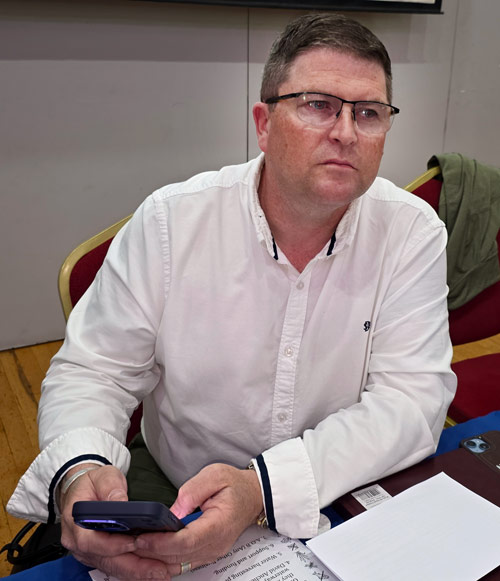
The recent meeting concerning the River Suir, held at Cahir House Hotel in Cahir, County Tipperary, on Wed 26th last, attracted a packed room of anglers, Tidy Towns personnel and environmentalists all united by their concern for the future of the river Suir. The meeting was chaired by Mr Derek Cagney, (National Secretary of the Trout Anglers Federation of Ireland and Chairman of the Cashel, Golden and Tipperary Anglers Association). Despite the strong public attendance and the importance of the issues under discussion, no politicians, elected councillors or other local Thurles representatives were seen to be present.
Meanwhile, independently a formal complaint has now been made once again by myself, directed at the Environmental Protection Agency (EPA) concerning the continuing condition of the River Suir in Thurles town centre and the failure to respond by the known responsible body, namely Tipperary County Council.
The complaint, (EPA reference COM021813), concerns the stretch running from Eircode E41 NX94(Barry’s Bridge) along the full stretch of river running to and including the area Eircode E41 C6K7, (Slievenamon Road River Walk entrance).
Concerns have been raised about this watercourse repeatedly since approximately November 2013. Recent photographs, vidoes and observations indicate that serious problems remain, including:
abnormal, opaque or grey-looking water;
foam or surface scum;
dark material or sludge in the channel;
water suspected of containing domestic wastewater or run-off;
extensive rush and vegetation growth, sucking the oxygen from the shallow water;
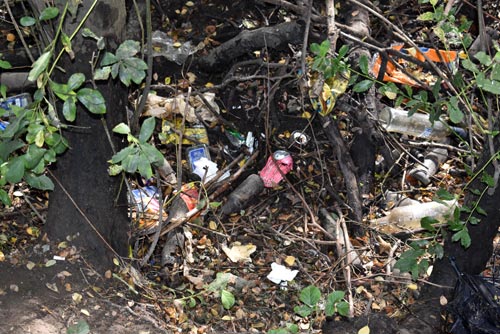
bottles, drinks containers and other litter throughout the riverbed and floating on now stagnant, polluted water.
Loss of the River Suir Fountains at Barry’s Bridge It is deeply regrettable that Tipperary County Council removed the two fountains from the River Suir These fountains were more than decorative features. They enhanced this prominent riverside area, while helping to circulate and aerate the water. Although fountains cannot themselves remedy pollution or replace proper river management, their operation can improve local water movement and dissolved-oxygen levels. At a time when residents are reporting stagnant-looking water, excessive vegetation, algae, sludge and litter, their removal represents the loss of both a valued public amenity and a potentially beneficial source of aeration.
Tipperary County Council should now explain why the fountains were removed, what assessment preceded the decision and whether they will be again restored. Their return should form part of a wider, properly funded programme to investigate pollution, clean the channel and restore this neglected stretch of River,
Photographs alone cannot fully establish the composition or exact source of the water or material contained. That requires a professional inspection, laboratory testing and proper source-tracing. However, the visible conditions are sufficiently abnormal to justify an urgent investigation.
In September 2025, the EPA referred the matter to Tipperary County Council as I requested. The Council subsequently outlined immediate and planned actions, including a proposed catchment-management plan and pilot study, details of which I am not privy. In November 2025, the EPA informed me that it was satisfied, based on the Council’s response, that the Council was taking appropriate steps to fulfil its environmental responsibilities.
Alas however, the continuing conditions during 2026 now raises serious questions about whether those promised measures were ever implemented and whether they produced any measurable environmental improvement.
On 23rd August 2026, the EPA acknowledged my further correspondence. It has again referred the matter to Tipperary County Council and has stated that it will assess what further EPA action may be appropriate after reviewing the Council’s next response. An update has been promised within the next four weeks.
It has been made clear that another referral and exchange of correspondence will not, by themselves, clean this river, identify the source of any discharge or prevent the problem from recurring. The Council’s handling of the matter is itself a central part of this complaint. Independent oversight now requires verification of what is happening on the ground.
Dried-up riverbed in Thurles town centre.
It has been formally requested that a suitably qualified EPA officer conduct an unannounced inspection while the conditions are visible. I am available to meet an officer at the site and identify the affected locations.
The EPA have also been asked to:
inspect and photograph the affected watercourse;
arrange properly documented upstream and downstream sampling;
analyse the water for appropriate chemical, biological and microbiological indicators;
trace relevant drains, pipes, culverts and outfalls;
establish whether any discharge exists and whether it is authorised;
examine Tipperary County Council’s complaint, inspection and enforcement records;
obtain evidence that Tipperary County Council’s promised actions were completed;
specify deadlines for investigation, cleaning and remediation;
consider its statutory supervisory powers if the evidence shows that Tipperary County Council has not performed its environmental duties adequately.
The EPA’s own guidance states that people may complain about a council’s environmental performance where a problem has not been addressed within a reasonable period or properly investigated. It also states that the EPA may issue legal notices or direct a council to take action where its duties have not been performed adequately. Under section 63 of the Environmental Protection Agency Act 1992, as amended, the EPA oversees local authorities’ performance of their environmental-protection functions.
The EPA are being asked to prejudge whether an offence has occurred. A rigorous, evidence-based and independent investigation is being sought. If the EPA decides that an inspection is unnecessary, a reasoned written decision has been asked for, explaining what verified evidence supports that conclusion.
After approximately thirteen years of complaints, plans, promises and political assurances are no longer enough. The public is entitled to a clean watercourse, accountable environmental governance and clear answers about what has entered this section of the River Suir.
From today, August 30th, I will make the substantive correspondence and official responses publicly available, subject to the appropriate protection of personal information. Further photographs and updates will follow.
Ireland’s First-Home Divide: A Six-Figure Salary Is Now Required in Three Irish Counties.
A single first-time buyer now needs to earn more than €100,000 a year to buy a typical home in Dublin, Wicklow or Kildare, according to new research from Chill Insurance. Last year, Dublin was the only county where a six-figure salary was needed.
The estimated salary required is €108,000 in Dublin, €101,250 in Wicklow and €100,238 in Kildare. Yet the current national median salary is only €44,816. Even in Longford, the country’s most affordable county, a single buyer would need to earn €48,375.
The figures assume that buyers have a 10% deposit and can borrow four times their annual income; the usual Central Bank limit. They are estimates and do not include personal debts, household bills or other circumstances.
There is no easy answer to this problem. State schemes can help some people with their deposit or the gap between their mortgage and the purchase price. However, Ireland also needs many more affordable homes, including smaller homes and apartments for people buying alone.
Simply allowing people to borrow more could push prices even higher. Research from the OECD’s Economic Survey suggested in 2025, that the lasting solution is to build more homes by speeding up planning, making serviced land available, lowering construction costs and building more suitable housing near/close to places of employment and public transport.
The real warning is clear: an average single worker can no longer today afford a typical first home in any Irish county. Home ownership is increasingly limited to couples, high earners or people who can get financial help from their families or the Irish State.
Thousands of Vodafone Ireland customers were left without broadband on Saturday after a major service interruption affected users across the country.
The disruption began at approximately 3.16pm yesterday August 29th, with outage-monitoring website Downdetector recording 31,498 reports as the problem escalated. Customers in several counties including Tipperary, Dublin, Cork, Galway, Clare, Limerick, Louth and Cavan, reported losing their internet connections. Some users also experienced poor mobile-data service and Vodafone’s 1907 refusing to answer calls.
The outage prompted a wave of complaints on social media, with many customers searching for information about when their connections would return. Vodafone acknowledged the problem in an online statement, confirming that service interruptions were affecting its broadband network. The company said its technical teams were working to restore connectivity and apologised for the inconvenience caused.
Shortly after 11.15pm, Vodafone announced that broadband service had been restored and connections were returning to affected customers. However, this morning in areas of Tipperary no services were restored, confirmed by their recorded voice over on 1907 contact phone number. The incident has also renewed concerns among some customers in Thurles, Co. Tipperary, who say their broadband frequently fails during periods of heavy rain. While Saturday’s disruption was a nationwide network incident, recurring weather-related outages in one locality could indicate a separate problem involving local lines, cabinets or water entering damaged connections.
However, the service operated by Vodafone in areas of Tipperary are most certainly seen as totally unreliable.
Lyrics and Vocals: The late, great American singer-songwriter of country-folk music, John Edward Prine (1946–2020)
Late John Prine.
With his trademark blend of wit and heartache, John Prine turns an unhappy relationship into a wonderfully funny escape act. Same was featured as a live bonus track on his Grammy-winning 2005 album “Fair & Square”.
Other Side of Town.
Other Side of Town.
Why must you always seem to criticise me. Seems like everything I do just turns out wrong. Why don’t you come on out and despise me, So I could pack my bag and baby I’d be gone.
Remember when you used to call me honey. Well I’d turn around and call you honey too. You might think it’s a joke, but it ain’t funny, To hurt someone who’s so in love with you.
Chorus.
A clown puts his makeup on upside down, So, he wears a smile even when he wears a frown. You might think I’m here when you put me down, But actually I’m on the other side of town.
My body’s in this room with you just catching hell, While my soul is drinking beer down the road a spell. You might think I’m listening to your grocery list, But I’m leaning on the jukebox and I’m about half … way there.
Repeat Chorus.
I’m sittin’ on a chair just behind my ear, Playing dominoes and drinking some ice cold beer. When you get done talking, I’ll come back downstairs, And assume the body of the person you presume who cares.
Repeat Chorus.
I’m across the river on the other side of town. And in my mind I’m going to the dog-racing side of town.
This website uses cookies to improve your experience. We'll assume you're ok with this, but you can opt-out if you wish.AcceptRead More
Privacy & Cookies Policy
Privacy Overview
This website uses cookies to improve your experience while you navigate through the website. Out of these, the cookies that are categorized as necessary are stored on your browser as they are essential for the working of basic functionalities of the website. We also use third-party cookies that help us analyze and understand how you use this website. These cookies will be stored in your browser only with your consent. You also have the option to opt-out of these cookies. But opting out of some of these cookies may affect your browsing experience.
Necessary cookies are absolutely essential for the website to function properly. This category only includes cookies that ensures basic functionalities and security features of the website. These cookies do not store any personal information.
Any cookies that may not be particularly necessary for the website to function and is used specifically to collect user personal data via analytics, ads, other embedded contents are termed as non-necessary cookies. It is mandatory to procure user consent prior to running these cookies on your website.








Recent Comments