When Does Somebody Else’s Pollution Become Our Responsibility?
Since yesterday September 1st 2026, Ireland’s fixed, on-the-spot fine for littering has increased from €150 to €250. This includes rubbish thrown from cars; whether it is a cigarette butt, bottle, food container or takeaway wrapper.
But fines raise a bigger question: At what point does somebody else’s pollution become our responsibility, especially when it enters a local river or waterway?Responsibility begins with the person who discarded the waste. Irish law prohibits causing or permitting polluting matter to enter waterways. Local authorities can investigate pollution, require remedial action and prosecute offenders.
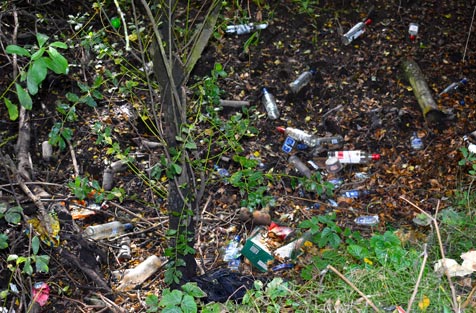
Suir Riverbed Thurles town centre, mainly caused by failure to provide a nearby litter bin.
However, responsibility cannot end with the individual. Many communities like Thurles town, point to too few conveniently located litter bins, or bins that are full or poorly maintained, in town centres, recreational areas and beside popular walking routes. Public-bin provision and maintenance are local-authority services, so councils also have a role in supplying suitable infrastructure where litter is regularly generated.
However, a lack of bins is never an excuse to throw rubbish from a car or throw it in or beside a river. If no bin is available, we must take our waste home. Nevertheless, enforcement works best when it is accompanied by adequate bins, regular collections, public education and convenient recycling facilities. Fining people without addressing obvious gaps in infrastructure tackles only part of the problem.
Once discarded, litter rarely remains where it falls. Rain washes roadside waste into drains, streams and rivers often promoted by Co. Councils. Currents carry it through neighbouring communities and towards lakes and the sea, where it can harm wildlife, obstruct waterways and leave the public paying for its removal. Ordinary residents are not legally responsible for another person’s offence. But once we see pollution threatening a shared waterway, we acquire a civic responsibility; report it, refuse to ignore it and support safe efforts to protect the area.
In the Republic of Ireland, litter, illegal dumping, overflowing public bins and local water pollution can be reported to the relevant city or county council. The EPA also recommends its “See It? Say It!” app, which sends photographs and location details to the appropriate authority.
The person who pollutes should pay. Councils must provide sensible disposal facilities and enforce the law. Communities should not be expected to continually clean up after repeat offenders, but silence allows the damage to travel downstream.
The litter may belong to somebody else, but the river belongs to all of us. Personal responsibility, proper infrastructure and effective enforcement must work together.
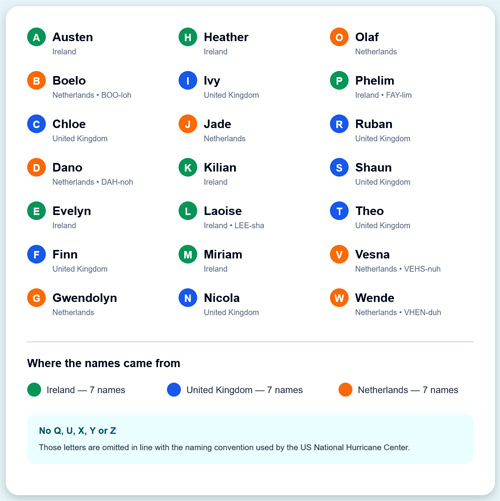
Austen, Boelo and Chloe are first in line to name major storms affecting Ireland, the UK and the Netherlands during the 2026/27 season.
Met Éireann unveiled the list alongside the UK Met Office and Dutch forecasting service KNMI after the public submitted more than 40,000 suggestions. The official list contains 21 names, beginning with Austen and ending with Wende.
Met Éireann confirmed the names on 1st September 2026.
Many of the nominations pay tribute to loved ones, pets and notable figures from meteorological history.
Chloe, the third name on the list, was suggested more than 120 times. One nomination came from the mother of a five-year-old weather enthusiast who is fascinated by forecasts but, according to her family, can “create a storm by herself” when tired.
Finn was proposed for a two-year-old boy described by his family as wild and a force to be reckoned with. Ivy commemorates a nine-month-old Labrador puppy affectionately nicknamed “the absolute destructor”.
Nicola honours a mother who has “weathered many a storm and only come out stronger”, while Theo was inspired by a cat that would hide before thunderstorms, leading its owner to joke that it could predict the weather.
Shaun also appears on the list after winning a public vote held through a partnership between the Met Office and Aardman, the British animation studio behind Shaun the Sheep and Wallace & Gromit. The collaboration is intended to introduce weather preparedness to new audiences through Aardman’s storytelling.
Met Éireann selected several names connected to the history of Irish weather forecasting as it celebrates the 90th anniversary of the establishment of the Irish Meteorological Service.
Austen honours Austen Nagle, its first director, while Evelyn recognises Evelyn Murphy, the first woman to present a weather forecast on RTÉ.
KNMI chose its names from more than 3,000 public suggestions. They include Boelo,pronounced “Boo-loh”—a traditional but now almost extinct name from the eastern Groningen region. The name has been passed through the nominator’s family for generations.
Although the stories behind the names are often warm and personal, meteorologists emphasise that storm naming serves a serious purpose. Giving a potentially dangerous weather system a distinctive name helps the public follow forecasts, understand warnings and prepare for possible disruption.
A storm is named when forecasters believe it could produce medium or high impacts in Ireland, the UK or the Netherlands. Strong winds remain the main consideration, although the potential effects of heavy rain and snow are also assessed.
The three forecasting organisations have named storms jointly since 2015. Each annual list operates from the beginning of September until the following August.
The letters Q, U, X, Y and Z are omitted in keeping with North Atlantic naming conventions.
Pre-deceased by her parents Michael and Mary, sisters Margaret (Lim) and Helen (Mooney); Mrs O’Keeffe passed away peacefully, surrounded by her family, while in the care of Ms Lisa Zimmermann and staff at St. Luke’s Hospital, Kilkenny City Co. Kilkenny.
Her passing is most deeply regretted, sadly missed and lovingly remembered by her sorrowing family; heartbroken husband Barth, sons Flavian and Fiach, daughter Avalon and their partners Lisa, Emma and Andrea, brothers Michael and Arthur, brothers-in-law Eddie, Jimmy, Patsy and Connie, sisters-in-law Maura, Mary and Lily, grandchildren Seosaimh, Patrick, Hannah, Sophie, Ciarán, Allegra, Daisy, Fionn, Molly and Biddy, nephews, nieces, in-laws, extended relatives, neighbours and many friends.
Requiescat in Pace.
Funeral Arrangements.
The earthly remains of Mrs O’Keeffe will repose at O’Connell’s Funeral Home, Killenaule, Thurles, (Eircode E41 HH66), on tomorrow afternoon, Wednesday, September 2nd from 5:00pm until 7:00pm, same evening. Her remains will be received into the Church of St Patrick and St Oliver, Glengoole, Thurles, on Thursday morning to further repose for Requiem Mass at 11:30am, followed by interment, immediately afterwards in adjoining graveyard.
The extended O’Keeffe and O’Brien families wish to express their appreciation for your understanding at this difficult time, and have made arrangements for those persons wishing to send messages of condolence, to use the link shown HERE.
For those persons who would wish to attend Requiem Mass for Mrs O’Keeffe, but for reasons cannot, same can be viewed streamed live online, HERE.
Marie was a wonderful wife, mother, grandmother and work colleague and the heart of her family. She lived a long and wonderful life, surrounded by those she loved and who loved her dearly. Her kindness, love and devotion to her family will live on in the many lives she touched and in the family she so lovingly created. She will be forever missed.
Adults found with a small quantity of controlled drugs for personal use may now be referred to the Health Service Executive instead of being prosecuted under Ireland’s new Health Referral Scheme.
The nationwide pilot scheme took effect on 1 September 2026. It gives An Garda Síochána an alternative response when dealing with an eligible person’s first drug-possession offence.
To qualify, a person must:
Be at least 18 years old.
Have no previous drug-possession conviction or adult caution.
Admit that the drugs were intended for personal use.
Agree to participate in the voluntary referral process.
The person must then contact the HSE and arrange an appointment with a trained SAOR practitioner. The appointment includes screening, discussion of the person’s substance use and support needs, and practical information and advice. Further treatment or specialist support may be recommended where appropriate.
This is therefore not necessarily a compulsory rehabilitation programme. It begins with a screening and brief intervention, followed by additional support when needed.
The Health Research Board explains the intervention. Anyone who declines the referral may instead be prosecuted under existing drugs legislation. Possession of a controlled drug remains a criminal offence under Section 3 of the Misuse of Drugs Act; the scheme does not legalise or decriminalise drug possession.
Garda Commissioner Mr Justin Kelly welcomed the initiative, saying it would allow Garda members to support harm reduction by directing eligible first-time offenders towards health services instead of the criminal justice system. The Government says the scheme is designed to encourage early engagement with support services, reduce drug-related harm and limit the potentially lasting consequences of a first possession offence. It is also intended to allow Garda resources to remain focused on drug dealing, organised crime and exploitation. The Department of Health describes it as a new health-led pathway.
Potential benefits:
It may help people address risky or problematic drug use at an early stage.
It can prevent a first offence from resulting in a conviction that affects employment, education or travel.
It treats some personal drug use as a health matter while retaining penalties for supply and trafficking.
It may reduce unnecessary pressure on Gardaí, prosecutors and the courts.
It can connect people with specialist services they might not otherwise approach.
Potential drawbacks:
Eligibility is limited to first-time offenders, leaving little scope for people whose repeated offending may be connected to addiction.
The decision depends partly on Garda discretion, which may raise concerns about consistency.
There is no single fixed quantity defining personal use; Gardaí assess factors such as the amount and how the drugs are packaged.
The scheme could place additional demand on already stretched health and addiction services.
Because possession remains illegal, critics may regard the initiative as too limited and argue that broader legal reform is needed.
Referral information remains relevant to how any later offence is handled, even though the first incident is diverted from prosecution.
The scheme represents a significant change in Ireland’s response to first-time personal drug possession, but its impact will ultimately depend on consistent implementation, adequate HSE resources and whether participants meaningfully engage with the support offered.
However, questions remain. Could participants be pressured to reveal the source of the drugs, and is the scheme genuinely focused on public health, or partly intended to ease pressure on Ireland’s overcrowded prisons?
Official information describes the scheme as voluntary and focused on screening, advice and support; it does not state that participants must identify a supplier. There is also no published evidence that reducing prison overcrowding is one of its stated objectives.
Mr O’Connor passed away peacefully, surrounded by his loving family, while in the care of staff at University Hospital, Clonmel, South Tipperary.
His passing is most deeply regretted, sadly missed and lovingly remembered by his sorrowing family; loving wife Theresa, son Liam, daughters Vera and Mary, sons-in-law Eoin and Liam, sister Mary (Darmody, Northampton UK), brothers John (London, UK) and Pat (Naas, Kildare), sister-in-law Theresa, cherished grandchildren Cian, Aoibhe, Emma and Holly, nieces, nephews, extended relatives, neighbours and friends.
The extended O’Connor family wish to express their appreciation for your understanding at this difficult time, and have made arrangements for those persons wishing to send messages of condolence, to use the link shown HERE.
Note Please: House Strictly Private.
“The O’Connor family would like to express their sincere gratitude to all those who cared for Seamus throughout his illness and to everyone who has shown such kindness, support and sympathy during this difficult time. Your thoughtfulness is deeply appreciated”.
This website uses cookies to improve your experience. We'll assume you're ok with this, but you can opt-out if you wish.AcceptRead More
Privacy & Cookies Policy
Privacy Overview
This website uses cookies to improve your experience while you navigate through the website. Out of these, the cookies that are categorized as necessary are stored on your browser as they are essential for the working of basic functionalities of the website. We also use third-party cookies that help us analyze and understand how you use this website. These cookies will be stored in your browser only with your consent. You also have the option to opt-out of these cookies. But opting out of some of these cookies may affect your browsing experience.
Necessary cookies are absolutely essential for the website to function properly. This category only includes cookies that ensures basic functionalities and security features of the website. These cookies do not store any personal information.
Any cookies that may not be particularly necessary for the website to function and is used specifically to collect user personal data via analytics, ads, other embedded contents are termed as non-necessary cookies. It is mandatory to procure user consent prior to running these cookies on your website.






Recent Comments