Archives

Victim Of Last Evenings Tragic Traffic Accident Named

The name of the victim of last evening’s tragic accident on the M7 Dublin to Limerick road has been named as Mr Padhraic Moran.

Mr Moran sustained serious head injuries when the car he was driving left the road and crashed through a fence and down an embankment off the southbound carriageway, ending up on waste ground, in a ravine just off the motorway between Birdhill and Castletroy at around 7.40pm on Wednesday.

Mr Moran, who worked in the insurance business, was a consultant broker with one of Ireland’s leading home insurance providers Zurich, and was understood to have been returning to Limerick having attended a meeting in Dublin earlier in the day.

Originally from Ballybunion, Co. Kerry, Mr Moran resided at Mill Road, Limerick and was the brother of popular leading Thurles town clothing retailer Mr Dermot Moran, (Michael Moran Menswear, Friar Street, Thurles).  The deceased was also a cousin of former Kerry All-Star footballer and former Kerry manager Mr Denis “Ogie” Moran.

Road conditions are thought to have played a major role in his death, with reports of unprecedented showers of heavy sleet and hail being experienced by other motorists at this time in the same immediate area.

To Mr Moran’s wife Anne; his brother Dermot and all extended family members go our sincere sympathy on this sad occasion.

Ar dheis Dé go raibh a anam dílis.

Erection Of The Thurles Wesleyan Methodist Chapel

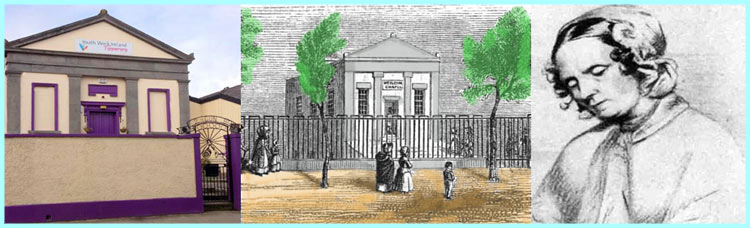
L-R. Pic (1) Wesleyan Methodist chapel today. Pic (2) Initial Drawing of Wesleyan Methodist chapel 1847. Pic (3) Drawing of the Missionary Mrs Asenath Hatch Nicholson, who visited Thurles in 1848.

The Wesleyan-Methodist chapel, built originally 1848, was described back then as being a detached three-bay gable-fronted building, having three-bay two-storey side elevation with lean-to extension to the rear, and with a pitched artificial slate roof with rendered chimney stacks. Lined-and-ruled rendered walls to the front with square-headed niches with limestone sills and moulded render surrounds, ashlar limestone pilasters, and limestone pediment with fascia and acroteria with anthemion motif. Central square-headed replacement timber panelled double doors with render cornice with consoles and limestone steps.

In more recent years its continued use would see it become the home of Thurles FCA [Currently known as the Reserve Defence Force, (RDF)]
and even more recently the newest home to Thurles Youth Centre.

However a report sent to the editor of the Wesleyan-Methodist Magazine[1] records the opening of the Thurles Wesleyan-Methodist chapel; situated as it does today on the west side of Slieve-na-Mon Road, in Thurles, Co. Tipperary. Remember 1848 Thurles was still experiencing the aftermath of three years of the Great Famine of 1845 -1849.

Note: The Wesleyan Methodist Magazine[1] was a monthly magazine published between 1778 and 1969. Founded by John Wesley as the ‘Arminian Magazine’, it was later retitled the Methodist Magazine in 1798 and later again, in 1822, the Wesleyan Methodist Magazine.

A report by Mr Robert Bruce of Roscrea (Tullamore Methodist District) in 1848 reads: “On March 1st a very neat and commodious Wesleyan chapel was opened in Thurles, in the Roscrea Circuit, Ireland by the Rev. Messrs. Croggon and Reilly, who preached very excellent and appropriate sermons, Mr Croggon from Genesis Chapter 28-Verse 17. [And he was afraid, and said, How awesome is this place! this is none other but the house of God, and this is the gate of heaven”] and Mr Reilly from St John Chapter 1 – Verse 29 [The next day John seeth Jesus coming unto him, and saith, Behold the Lamb of God, which taketh away the sin of the world.]“

Mr Bruce reports “The building is 34ft x 25ft and will afford sittings for about 130 persons. There is a very good school-room; there are also apartments for a Master under it. Mr Croggon intends as soon as possible to fix a suitable person here; and in no part of Ireland, so far as scriptural education is concerned is a school more wanted. The building does great credit to the architect, Mr Tinsley, Clonmel and to Mr Leister of Thurles.” [Possibly Thomas or Joshua Leister, Turtulla, Thurles, Millers & Brewers]

Mr Bruce continues, “Through the perseverance and defatigable exertions of the latter, indeed the house has been completed. The cost is £350 of which the sum of £250 has been raised, leaving a debt of only one hundred pounds. It is about thirty years since the Wesleyan Ministers commenced preaching in Thurles, during which time Mr Leister and his excellent wife have been the ardently attached and unwavering friends of Methodism.  With our additional advantages we trust we shall enjoy a larger share of the prospering blessing of Almighty God”.

Asenath Hatch Nicholson
Determined to personally investigate the suffering of the Irish poor during the ‘Great Famine’, self appointed missionary Mrs Asenath (Latter name taken from the Book of Genesis) Hatch Nicholson, was also on an unaccompanied visit to Thurles, Co. Tipperary. An American teacher and arthritic widow of 52 years; (Miss Asenath Hatch had married Norman Nicholson, a widower with three children) who had previously been the proprietor of a vegetarian boarding house and who had championed the causes of abolitionism and temperance arrived here around 1848.   Walking through the countryside on her mission to bring the Bible to the Irish poor, she arrived in Thurles, to distribute copies of the Bible to those who could read, and read the Bible to those who could not.

“The morning was pleasant”, she writes, “and had not my heart been a little sad, it would have been congenial to every feeling of my mind, so naturally fitted for the enjoyment of rich scenery in nature.

She states, “Thurles is an ancient town in the county of Tipperary, somewhat neatly built. It contains a good market-house, fine chapel, college for Catholics, Nunnery, and Charity-school, with a Protestant church, and a Methodist chapel. My reception here was cordial, and the house in quite American taste. My stay was continued a day or two longer than I at first intended; and as Tuesday was market-day, it presented a favourable opportunity of seeing the peasantry, who appeared more cleanly and comfortable than those of many towns in Ireland, though much like Kilkenny.”

Even back then Mrs Nicholson was challenged government on their record of stewardship of relief resources, and their overall attitude toward the poor, for whom she rightly claimed they were fully responsible.

Even then and just like staff employed by modern charities today, Mrs Nicholson made a distinction between the paid relief officers, whom she characterized as bureaucratic, hierarchical and self-serving; and volunteer relief workers, e.g. Quakers, Coast guardsmen and their families and Local Clergy, latter whom she regarded as being compassionate, egalitarian and selfless. Unlike our modern day highly paid charity executive employees, in the early 19th century Mrs Nicholson was scrupulous about her own personal expenses, allowing herself 23 pence a day for food; a diet of bread and cocoa and reduced her stipend to 16 pence (no cocoa) when her resources showed signs of dwindling.

She raged against the diversion of grain being converted from food into alcohol; charging that grain used for distilling could have fed the Irish poor. She stated in her writings, “Reader, ponder this well. Enough grain, converted into a poison for body and soul as would have fed all that starving multitude.”

Methodism had been introduced into Ireland by John Wesley himself.  A body of preachers were attached to travelling circuits, visiting chapels. Of course political correctness was a long way off in the early days of census taking and a number of disabilities were crudely noted revealing a less than sensitive attitude. These census designations were openly identified as, “deaf, dumb, blind, idiot, imbecile and lunatic”.  It was seriously noted that the only groupings showing an increase for example in the 1901 census were, yes, “Lunatics and Methodists”.
One Dead Following Tipperary Multi-Vehicle Collision

Part of the M7 Dublin to Limerick road between Junction 27 Birdhill, Co. Tipperary and Junction 28 Castletroy, Co. Limerick has been closed, after a motorist lost his life in a 12 car pile-up around 8.00pm this evening.

It is understood that the victim, a man aged in his 50’s, suffered head injuries and died after his car left the road; crashing through a fence and ending up on waste ground, in a ravine just off the motorway between Birdhill and Castletroy.

A freak hailstorm is believed to have hit the area at the time of the incident, and may have been the major factor which led to the multi-vehicle collision. It is also understood that there were other injuries sustained by other drivers and their passengers involved, but thankfully in all cases these injuries are not believed to be life threatening.

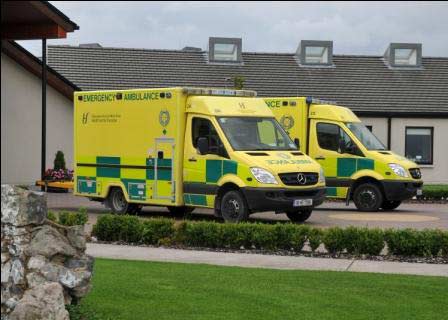
A crew of fire fighters attached to Limerick City & County Fire Service, latter who had been attending a minor collision near Newport Co. Tipperary, were quickly on the scene of the multi-vehicle collisions. Same in turn summoned help from other crews from Newport & Nenagh in Co Tipperary and from Limerick city, with six ambulances from the region being dispatched to the scene.

The southbound traffic lane between Junction 27 Birdhill and Junction 28 remains closed awaiting a Garda forensic collision investigator to conduct a detailed examination of the scene at first light.
Traffic in the area is being turned around by Gardaí and full diversions are in place.

The body of the man pronounced dead at the scene was taken to University Hospital Limerick, where a post mortem will take place.

Ar dheis Dé go raibh a anam dílis.

[Anyone who may have witnessed the accidents are asked to contact Gardaí at Henry Street Garda Station, Limerick, Tel: (061) 212 400.]

Skeleton Of Tipperary Giant To Remain In Trinity College

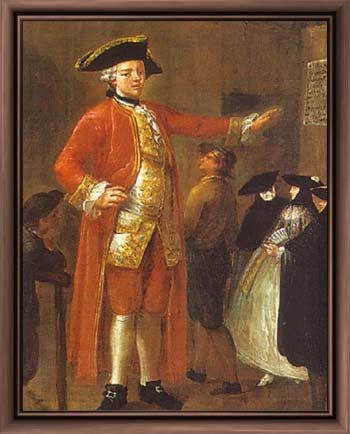
Cornelius Magrath the Silvermines Co. Tipperary giant.

Trinity College Dublin claim that they have no immediate plans to release the skeleton of a giant, born in March 1736, near the Silvermines, Nenagh, Co Tipperary to assist in his burial.

Cornelius Magrath who suffered from gigantism was 7ft 3in tall when he died in 1760. Legend recalls that Trinity students stole his body the day he died and it has been kept at the University ever since.

Of course body snatching was a lucrative business back in the 18th century  and those who were involved were often called “resurrectionists” or “resurrection-men”, who often benefited on the double, stealing personal effects from the corpses sold on for dissection or anatomy lectures in medical schools. Because the only bodies legally available for medical dissection back then were the remains of executed criminals, demand soon outpacing supply.

Such body snatching activity possibly lends itself to the use of the phrase “The Graveyard Shift”.  Graveyards started running out of places to bury people. So coffins were often dug up and bones sent to a “bone-house” allowing for the reuse of grave space. When opening such coffins, it was discovered that a considerable number were found to have scratch marks on the inside lid, confirming that individuals were being burying alive. Based on this evidence it was agreed that a piece of string be tied to the wrist of certain corpses; to be lead through the coffin and up through the ground before being tied to a bell. An individual would sit out in the graveyard all night (the “graveyard shift”) to listen for bell; sounds, hence someone could be “saved by the bell” or was considered to be a “dead ringer.”

The Magrath skeleton today is viewed only by those doing research and continues to inspire scholarship through teaching a great many students, scientists, professors and experts studying his disease.

While it is claimed that Tipperary locals are calling on Cornelius’s skeleton to be released for burial; certainly Thurles.Info has heard nothing about it and Trinity College have released a statement also confirming it also had not been approached by any Tipperary individuals who are requesting his burial. The University in the past admits putting Cornelius’s skeleton on public display, but there are no plans for such similar displays into the future; leaving Cornelius to be only visited by medical students or associated groups involved in research or other educational activities.

Looks like our Dublin Media were stuck for front page sensationalism and national debate again.

You can read all about the Tipperary Giant Cornelius Magrath simply by clicking HERE

Man Charged With Murder Of Pensioner Paddy Lyons

Mr Ross Outram, aged 26, with an address at Ferryland, Waterford Road, Clonmel, Co. Tipperary, has been charged with the murder of elderly pensioner and farmer Mr Paddy Lyons; latter found savagely beaten to death in his remote rural farmhouse last Saturday.

Wearing dark trousers, blue and white trainers and a navy jumper, the accused Mr Outram was brought before Dungarvan district court this morning, having been charged with the murder last night. Mr Outram had previously been arrested on Monday afternoon in Clonmel and detained under Section 4 of the Criminal Justice Act.

He was later questioned during Monday evening and into Tuesday, at Dungarvan garda station, in relation to the death of the 90 year old pensioner.  Detective Sergeant Shay Keevans told Dungarvan district court that he had charged Mr Outram at the Garda station at 11.55pm on Tuesday night.

Judge Finn granted the accused legal aid, while remanding him in custody to appear before Dungarvan district in seven days, on Wednesday, March 8th next.

No application was made for bail since, being on a murder charge, bail application can only be dealt with by the High Court and not at District Court level.