|
|
“It’s just one man’s opinion, but it’s my opinion and I reserve the right, above all others, to hold that opinion.”
The movement to ‘Repeal the Eighth Amendment’ is certainly gathering momentum, and various categories of unborn babies are facing an increasing prospect of being legally aborted within Ireland. The law already allows the abortion of the children of suicidal mothers (subject to certification by three professionals that the case comes within the parameters of the Protection of Life in Pregnancy Act 2013), and the danger of abortion is extended by the same Act to children of mothers whose lives are in danger from the pregnancy in the opinion of two professionals in ordinary cases, or just one in emergency cases.
 Ms Justice Mary Laffoy Chairperson of the 100-member convention taxed with considering issues including the Eighth Amendment. The protagonists of the ‘Repeal’ campaign aim to further extend legal abortion in Ireland to other tragic cases, for example, unborn children suffering from a fatal foetal anomaly, anencephaly, various chromosomal or genetic anomalies, and to children conceived through rape or incest. Other ‘Repealers’, depending on the extent of their liberalism, would extend a right of abortion to the mothers of any or all children regarded by their mothers as flawed, unhealthy, unwanted or inconvenient.
It is argued by the protagonists of the ‘Repeal the Eighth’ that this repeal will free the legislators from the restrictions of the Eighth Amendment and enable them to enact laws to cater for these needy cases. But the question remains ‘will it’?
Where do lawmakers get their authority to enact laws anyway? Most people and most democratic constitutions would say that the power of the legislature to make laws comes to them from the people. But are there limits to the powers the people may grant to the legislature? The theory of parliamentary supremacy (or “legal positivism”) would hold that there is no limitation on the laws Parliament may enact. As Sir Leslie Stephen explained in this theory in his book ‘The Science of Ethics’: “If a legislature decided that all blue-eyed babies should be murdered, the preservation of blue-eyed babies would be illegal”.
But differently from many other constitutions, the Irish Constitution in Article 6 says that “All powers of government, legislative, executive and judicial, derive, under God, from the people…”. These words “under God” were deliberately added to ensure that the Irish constitution would not be guilty of the absurdity to which the theory of absolute parliamentary supremacy leads. The Dáil is not omnipotent, but is subject to the law of God.
The awkward fact for atheists, agnostics, the lapsed, and those in the Dáil who haven’t read article 6 of the Irish Constitution, is that those who did write it and the majority who enacted it in 1937, mostly believed in God, and gave the Dáil no power to enact laws which are contrary to the law of God. When God said “Thou shalt not kill”, the consequence of Article 6 is that no TD, no Seanadóir, no Judge, no Doctor shall kill or authorise the killing of any innocent unborn child.
So, surely before they repeal the eighth Amendment (or Article 40, s.3, 3° which it inserted into the Constitution), abortion advocates need to surely repeal or amend Article 6, and also perhaps paganise or at least de-Christianise that Preamble to Bunreacht na hÉireann whose first words are “In the Name of the Most Holy Trinity, from Whom is all authority…”.
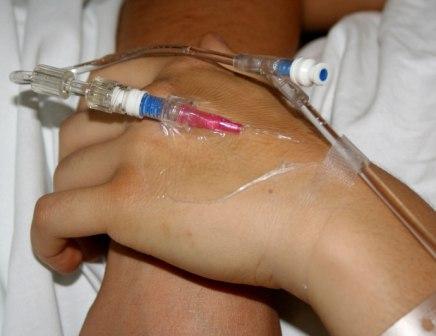 The Executive Committee of the Irish Nurses and Midwives Organisation (INMO) have agreed to ballot its members on proposals tabled during negotiations at the Workplace Relations Commission (WRC) this morning. This agreement now defers the proposed by nursing staff to take industrial action planned for Tuesday next.
While the dispute had centred around genuine staff shortages and incentives in recruiting and retaining nurses, the INMO Executive Committee are now expected to recommend that members accept these latest proposals, which are expected to cost in the region of some €180m per annum.
This dispute had been clamouring in relation to taking action for months, with members of the INMO voting 90% in favour of industrial action since before Christmas 2016. The organisation will now put in place immediate arrangements for a ballot to take place, with a view to having same completed no later than the end of March 2017 next.
With regards to outstanding outcomes on issues which still require debate on both sides; further dialogue just may result in mutual and acceptable outcomes for both members and their union representatives.
 It is with great sadness we learned of the death today, Saturday 4th March 2017, of Mr Phil Bourke, Fishmoyne, Borrisoleigh, Thurles, Co. Tipperary.
Mr Bourke passed away peacefully while in the care of the staff at South Tipperary General Hospital, Clonmel.
His passing is most deeply regretted by his loving wife Peg; his family Annette, Catherine, Richard, Eamonn and Michael; grandchildren; brother Michael; sister Kitty O’Halloran; daughters-in-law; sisters-in-law; brothers-in-law; nephews; nieces; extended relatives and many friends.
Funeral Arrangements
The earthly remains of Mr Bourke will repose at Kennedy’s Funeral Home, Borrisoleigh, on tomorrow Sunday, March 5th, from 5.00pm, with removal at 7.30pm to St. Mary’s Church, Drom, Templemore, Co Tipperary.
Requiem Mass will be held on Monday March 6th at 11.30am, followed by interment immediately afterwards in St Brigid’s Cemetery, Borrisoleigh, Thurles, Co Tipperary.
Ar dheis Dé go raibh a anam dílis.
Our politicians and councillors will be all over our radio’s and other media channels come Monday morning next, each hailing the onset of ‘High Speed Broadband’ which is to be rolled out to over 3,250 additional homes across Co. Tipperary shortly.
Each elected representative will be claiming that their two & a half pence worth of verbal contribution to the need for Rural Broadband has had major effect on the ‘powers that be’. Each will rejoice on the fact that they have persuaded same powers to relent, thus ensuring that we rural Hillbillies are truly equal before the law and will soon have full access to all internet Porn Sites, as enjoyed by urban Dublin dwellers for the past number of years.
Yesterday following some sort of press release, those sitting in Eir Board Rooms with their Sales & Marketing executives, were possibly sharing ‘high fives’ and rubbing their hands with delight, following welcoming announcements by community leaders, who incorrectly have been duped into stupidly believing that this announcement by Eir, has the potential to create new businesses in Co. Tipperary.

For Eir to claim that that they will now be rolling out a 1 gigabyte service to 3,250 new homes and businesses in the Premier County during 2017 is far-fetched and the stuff of fantasy, to say the least. Has anyone spotted an Eir van installing fibre optic cable between the towns, for example, of Thurles, Nenagh and Clonmel; extending to the rural outbacks of Cloneen, Golden, Gottenbridge or Ballyporeen?
Can you imagine a 1 gigabyte of service being pumped down the 40 year old copper cables, connecting Upperhurch to the rest of the world? No, Eir’s rollouts are coming to large populated towns like Thurles, Clonmel, Nenagh, Tipperary etc., where consumers already enjoy 360 megabit download speeds, with most people more than happy with just 120 megabites speeds.
Eir‘s purpose in these claims is to get their hands on already existing Virgin Media & Sky business.
No, alas, there will be no huge benefits accruing to rural businesses, and rural dwellers will not be considering setting up new commercial industry any time soon, from their humble hamlets, brought about by improved ‘High Speed Broadband’ coverage.
You doubt my statement? View the following sites HERE and HERE and ‘Select your County’. Then reading between the lines, make up your own mind.
Central Statistics Office (CSO) Live Register Figures, recently published for the month of February 2017, and when compared to the figures for the previous month January 2017; show an overall slight decrease in those seeking Social Welfare benefits.
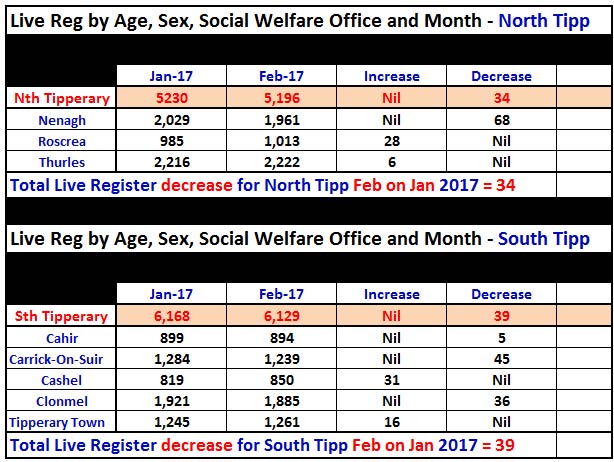
Overall 73 persons left the live register in Co Tipperary in February 2017; 34 in North Tipperary and 39 in South Tipperary, when compared with the previous month of January 2017.
North of the County, in the towns of Roscrea and Thurles, the live register shows an increase of 34 persons, while in the town of Nenagh figures are decreased by 68.
South of the County, Cashel and Tipperary Town figures have increased by 47, while Carrick-On-Suir, Cahir and Clonmel decreased by a total of 86 persons.
Meanwhile the 1432 jobs promised and highlighted by former Tipperary Minister Alan Kelly, (700 Nth Tipp & 692 Sth Tipp) in mid to late 2015 and prior to the last General Election held on 26th February 2016; have as yet still not materialised.
|
Support Us Help keep Thurles.info online by donating below. Thank you.
Total Donated 2026: €300.00
Thank You!
Daily Thurles Mass Livestream
|



Recent Comments