According to local radio, Mr Michael Lowry TD has rejected suggestions that the Garda Training College in Templemore is now under threat.
Mr Lowry says he secured a commitment during negotiations on the Programme for Government that Templemore would remain the primary national Garda training centre. He also says a recent review endorsed maximising Templemore’s capacity and prioritising investment there and also at an outreach facility in Tallaght. The Government previously denied making a deal with Mr Michael Lowry, however Mr Lowry nevertheless now says he secured a commitment on Templemore, during government-formation negotiations.
Templemore clearly remains Ireland’s principalGarda college and is receiving further investment. However, the wording “primary” does not mean “exclusive”.
The published Programme for Government commits to considering a second Garda training college and allowing trainees to complete parts of their training elsewhere. It does not guarantee that every existing course will remain in Templemore, Co. Tipperary. Mr Lowry’s stronger assurance appears to arise from government-formation negotiations, however no published agreement, letter or memorandum setting out its precise terms can be located.
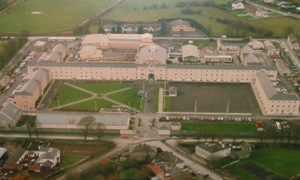
Garda Training College, Templemore, Co. Tipperary.
The Training Review A Garda Training Review Group examined how to increase training capacity, including: ► maximising Templemore’s throughput; ► establishing a second college; ► using other institutions or locations; ► providing outreach training.
Mr Lowry says the review protects Templemore’s status but concluded that developing Dromard would require unjustifiable investment. However, the complete final report, Dromard assessment and comparative costings do not appear to have been published. Until they are released, those conclusions remain Mr Lowry’s account of the review rather than independently verifiable findings.
Dromard Farm Dromard Farm at Clonmore is approximately six kilometres from Templemore and comprises about 256 acres: 160 acres of grazing land and 96 acres of woodland, together with a uninhabited period house and sheds. The OPW purchased it in 2006, at the Department of Justice’s request, for a proposed Garda Centre of Excellence. Planned uses included public-order, firearms, detective, surveillance, dog, mounted and water-unit training, together with off-road motorcycle, four-wheel-drive and other driver training. It is therefore reasonable to say that Dromard was bought partly for advanced Garda driver training. It was not purchased solely as a high-speed pursuit track. A tactical training building was constructed in 2008, while part of the woodland was used for off-road vehicle and motorcycle exercises. The notion of introducing a larger Centre of Excellence was abandoned following Ireland’s financial crisis.
What Did It Cost? The strongest contemporaneous records give Dromard’s purchase price as €4.3 million. Some recent political statements, by Mr Alan Kelly TD, use a figure of €5.5 million, but no public breakdown supporting that amount can we locate. It possibly could include fees, taxes or subsequent expenditure, but the OPW should now clarify this. Until then, €4.3 million is the best-supported purchase price. At approximately €16,800 per acre, Dromard’s €4.3 million purchase price was below reported national and regional farmland averages during the 2006 property boom. It cannot therefore be described as a clear market overpayment on the available figures. However, the property contained substantial woodland and an uninhabitable house, and the State may have purchased a much larger and more expensive estate than Garda requirements justified. The later failure to develop or fully use it turned a potentially market-priced acquisition into questionable value for the taxpayer.
Then came the Rent Controversy Between 2009 and 2013, Garda College administration rented Dromard land to local farmers, even though the OPW was its legal owner. The OPW could find no documented agreement authorising the Garda College to take over the letting. An internal audit initially identified €124,903 in rent. Instead of being paid to the OPW, the money had been lodged into the Garda College Restaurant Account. The final verified amount was €131,260.80. An Garda Síochána then repaid that money to the OPW on July 6th 2017. This same €131,260.80 was repaid to the OPW from the “Garda Vote”, latter An Garda Síochána’s taxpayer-funded annual budget. This meant that public money intended for Garda services was used to replace rent that had previously been placed in the Garda College Restaurant Account.” The Public Accounts Committee report found a serious failure to monitor and control State property and finances, but no public outrage was observed.
Was It A Cover-Up? There is strong evidence that the wider Templemore financial problems were kept from effective scrutiny for years. The Public Accounts Committee found that: ► financial problems had been identified as early as 2006; ► recommendations from earlier reports were not implemented; ► senior management had numerous opportunities to address the problems; ► internal auditors did not receive adequate support or cooperation; ► disclosure to oversight bodies was unacceptably delayed; ► a significant number of senior personnel knew about the irregularities.
Mr John Barrett, then Garda Executive Director of Human Resources, alleged that senior figures tried to prevent the issues from “breaking cover”. Evidence also emerged of communications suggesting auditors should be kept “at bay”. It is therefore reasonable in ordinary language to describe the wider affair as prolonged institutional concealment or obstruction of oversight. However, no court finding located establishes that named individuals entered into a criminal conspiracy specifically to conceal or steal the Dromard rent. Therefore it is reasonable to conclude that there is strong evidence of prolonged institutional concealment and avoidance of proper oversight concerning the wider Templemore finances. Whether this constituted a criminal cover-up of the Dromard rent specifically has not been established in a court of law. GSOC completed a six-year criminal investigation into the wider financial irregularities and sent a file to the Director of Public Prosecutions in 2023. No reliable public confirmation of a prosecution concerning the Dromard rent can be located.
Questions Still Requiring Answers Before Dromard is sold, the Government and OPW should now publish:
The final Garda Training Review report.
The complete Dromard technical and cost assessment.
Its present valuation, use and rental income.
An explanation of the €4.3 million and €5.5 million figures.
Any formal decision authorising its disposal.
The comparison between investing in Dromard, Templemore, Tallaght or a second college.
Templemore is not facing closure, but political assurances are not a substitute for published evidence. Given Dromard’s history, the public deserves complete transparency before a valuable State training asset is disposed of.
In County Tipperary, 112 adults accessed emergency accommodation during July 2026, seven fewer than in June of this year. However, the published figures do not provide a separate County Tipperary breakdown for children, meaning the county’s full homelessness total cannot be established from the monthly report.
A total of 17,527 people, including 11,868 adults and a record 5,659 children, were living in emergency accommodation in Ireland during July 2026, according to the Department of Housing’s latest report. The total increased by 45 from 17,482 in June. The correct June breakdown was 11,862 adults and 5,620 children, meaning the adult population rose by six and the number of children by 39.
Adults aged between 25 and 44 remained the largest adult age group, accounting for 6,138 people, or 51.7% of all adults in emergency accommodation. Simon Communities of Ireland said the overall population had increased by 1,469 people, or 9.1%, during the previous 12 months. Executive director Ms Ber Grogan called on political leaders to show homelessness the same urgency demonstrated by the Dáil’s recall to address rising fuel prices. Ms Grogan said stronger homelessness-prevention measures, increased delivery of social and affordable homes, and clearer routes from emergency accommodation into permanent housing were urgently needed.
The Salvation Army also warned that returning to school creates immense pressure for families living in emergency accommodation. Mr Anthony Byrne, service manager at Houben House family hub, said children can experience anxiety when asked where they live and may feel excluded because they cannot invite friends home for play dates, parties or sleepovers.
The July total was only 21 below the record of 17,548 recorded in April 2026. These monthly statistics cover people using designated emergency accommodation and should not be interpreted as a complete count of everyone experiencing homelessness.
Pre-deceased by her parents Tomás and Ellie and brothers Eugene, Tom and Denis; Ms Roseingrave, sadly, passed away peacefully, while in the care of staff at University Hospital Cork.
Her passing is most deeply regretted, sadly missed and lovingly remembered by her sorrowing family; loving partner Michael, heartbroken daughter Natasha, son-in-law Dermot, beloved grandsons Christopher and Dan, sisters Máire, Siobhán and Paula, brothers-in-law, sisters-in-law, nieces, nephews, extended relatives, neighbours and a wide circle of friends.
Requiescat in Pace.
Funeral Arrangements.
The earthly remains of Ms Roseingrave will repose at Kennedy’s Funeral Home, Dublin Road, Thurles (Eircode E41 XY47) on tomorrow afternoon, Saturday August 29th, from 5:00pm until 7:00pm, same eveming. Her funeral cortège will be received into the Church of the Holy Cross, Dundrum, Dublin 14. (Eircode D14 K820) to further repose for Requiem Mass on Monday morning, August 31st, at 10:30am, followed by committal prayers in the Victorian Chapel, Mount Jerome cemetery, Harold’s Cross, Dublin(Eircode D6W HY98) at 12:15pm.
For those persons who would wish to attend Requiem Mass for Ms Roseingrave, but for reasons cannot, same can be viewed streamed live online, HERE.
The extended Roseingrave family wish to express their appreciation for your understanding at this difficult time, and have made arrangements for those persons wishing to send messages of condolence, to use the link shown HERE.
The passing of Ms Jordan is most deeply regretted, sadly missed and lovingly remembered by her sorrowing family; loving daughters Shauna and Kaya, partner Gordon, parents Noel and Aileen, Kaya’s Dad Paul, nephews, nieces, cousins, extended relatives, neighbours and a wide circle of friends.
Requiescat in Pace.
Funeral Arrangements.
The earthly remains of Ms Jordan will repose at Ardeen Nursing Home, Garryvicleheen, Thurles, (Eircode E41 CY91) on Sunday afternoon, August 30th, from 5:00pm until 7:00pm same evening. Her funeral cortège will be received into the nearby Church of St Joseph and St Brigid, Bohernanave, Thurles on Monday morning, August 31st, at 10:30am for Funeral Mass at 11:00am, followed by a service of cremation in Shannon Crematorium Illaunmanagh, Shannon, Co. Clare, (Eircode V14 PV30) at 3:00pm.
For those persons who would wish to attend Requiem Mass for Ms Jordan, but for reasons cannot, same can be viewed streamed live online, HERE. For those persons who would wish to attend the service of cremation but for reasons cannot, same can be viewed streamed live online,HERE. [Using Password NJT3]
The extended Jordan family wish to express their appreciation for your understanding at this difficult time, and have made arrangements for those persons wishing to send messages of condolence, to use the link shown HERE.
Lyrics and Vocals: American singer, songwriter, actress, philanthropist, and business woman, the late, great Ms Dolly Rebecca Parton Dean(née Parton), [1946–2026].
The late Ms Dolly Parton.
A song for all you dog lovers everywhere; the late Dolly Parton’s “Cracker Jack” is a tender tribute to the scruffy stray she once befriended as a child and remembered as her loyal playmate and best friend. Recorded in 1973 but unreleased until the 2007 reissue of “Jolene”, this bittersweet country story celebrates the unconditional love of a cherished pet and the memories that endure after they are gone.
Cracker Jack.
Cracker Jack.
Once I had a little dog, I called him Cracker Jack. He had a spot around one eye that looked just like a patch. His legs were way too long and he was awkward as could be. He wasn’t much to look at but he looked alright to me. I found him by the river bank just wandering about. He was cold and hungry and his ribs were sticking out. I snapped my fingers, whistled, when he came, I picked him up. I was just a kid and Cracker Jack was just a pup. I took him home and fed him ’til he couldn’t eat no more. I took him to my room and put a blanket on the floor. After that beside my bed is where he’d always sleep. Each night in my prayers I’d pray the lord his soul to keep.
Chorus.
Cracker Jack, The best friend that I ever had was Cracker Jack, But he was more than that, A playmate, a companion, He was love and understanding, That was Cracker Jack. The best friend that I ever had was Cracker Jack, But he was more than that, Everything a kid could want I had in Cracker Jack.
Cracker Jack would run to meet me after school each day. He’d jump and wag his tail and look at me as if to say, “I love you and I’ve missed you and I’m glad you’re home again”. I knew just how he felt ’cause me and Cracker Jack was friends. Through the woods and fields we would often roam about, And when we got in trouble we would help each other out. I could run almost as fast as Cracker Jack could run, We had a lot in common and we had a lot of fun. He was always with me when I was growing up. We shared each other’s good times and we shared each other’s love. He only lives in memories now but often I think back, To the days of childhood, the days of Cracker Jack.
This website uses cookies to improve your experience. We'll assume you're ok with this, but you can opt-out if you wish.AcceptRead More
Privacy & Cookies Policy
Privacy Overview
This website uses cookies to improve your experience while you navigate through the website. Out of these, the cookies that are categorized as necessary are stored on your browser as they are essential for the working of basic functionalities of the website. We also use third-party cookies that help us analyze and understand how you use this website. These cookies will be stored in your browser only with your consent. You also have the option to opt-out of these cookies. But opting out of some of these cookies may affect your browsing experience.
Necessary cookies are absolutely essential for the website to function properly. This category only includes cookies that ensures basic functionalities and security features of the website. These cookies do not store any personal information.
Any cookies that may not be particularly necessary for the website to function and is used specifically to collect user personal data via analytics, ads, other embedded contents are termed as non-necessary cookies. It is mandatory to procure user consent prior to running these cookies on your website.







Recent Comments