Sinn Féin’s Housing Record: Opposition, Alternatives and the Charge of NIMBYism, (“Not In My Backyard”).
Ireland’s housing crisis has produced no shortage of political outrage. Sinn Féin has been among the loudest voices condemning missed targets, unaffordable rents and the chronic shortage of homes. But a party that presents itself as the answer to the housing emergency must be judged not only by what it promises nationally, but by what its representatives do when actual developments are proposed locally. That is why Mrs Mary Lou McDonald’s latest planning appeal matters.
The Sinn Féin president and Dublin Central TD has joined local party councillor Seamus McGratten in appealing permission for a 249-bed student-accommodation development on the former Matt’s of Cabra pub site, at Fassaugh Avenue in Dublin 7. An Coimisiún Pleanála’s official record confirms the appeal, which was lodged in June 2026. A decision is due by October 6.
Mrs McDonald argues that the land should instead be used for social and affordable housing. She has raised concerns about height, overlooking, traffic, parking, drainage, road safety and pressure on local services. Any one of those concerns may sound reasonable when considered in isolation. Almost every substantial urban development creates some local inconvenience or planning trade-off. The problem is that Ireland can no longer pretend those trade-offs do not exist. We cannot demand tens of thousands of additional homes and student beds while insisting that every development must create no traffic, cast no shadow, inconvenience no neighbour, alter no streetscape and place no pressure on existing services. That is not a housing policy. It is a formula for building almost nothing.
The Cabra scheme is particularly revealing because this is not the first time Mrs McDonald has opposed a major residential proposal on the same site. An earlier application sought permission for 117 build-to-rent apartments. That proposal also faced opposition from the Sinn Féin leader. The political message is difficult to ignore: apartments were unsuitable, and now student accommodation is unsuitable too. Social and affordable housing is presented as the preferred alternative, but no equivalent 249-unit public-housing project is currently being delivered on the site.
It is always easier to endorse the ideal development that does not yet exist than to accept the imperfect one that is ready to proceed. Mrs McDonald’s suggestion that student accommodation should instead be built at Grangegorman, illustrates the familiar politics of displacement: housing is necessary, but “somewhere else.” would be better. Every constituency has a “somewhere else.” Taken together, those arguments are one reason Ireland finds itself trapped in endless cycles of objections, appeals, redesigns and delays.
Dedicated student accommodation is also not unrelated to the wider housing crisis. Students who cannot secure purpose-built rooms compete for houses and apartments in the private rental market. Blocking student beds does not eliminate demand; it pushes that demand back into neighbourhoods already struggling with high rents and limited supply.
The Cabra controversy would be less damaging for Sinn Féin if it were an isolated case. It is not. Sinn Féin representatives have opposed, appealed, challenged or voted against numerous housing-related developments. Fine Gael has claimed that the party objected to, voted against or attempted to hinder 11,687 homes in Dublin between 2018 and 2023, later increasing its claimed total to more than 12,000. Those figures come from a political opponent and should not be accepted uncritically. The totals combine formal objections with council votes, rezoning disputes, legal actions and opposition to particular development or land-transfer models.
A detailed Journal FactCheck found that an earlier claim that Sinn Féin had objected to approximately 6,000 homes was misleading because many of the cases concerned affordability, public-land disposal or tenure rather than straightforward opposition to construction. That qualification is important,but it is not a complete defence. Sinn Féin frequently says it supports building on a site but opposes the proposed mix of private, affordable and social homes. It says public land should remain public and that developments should contain more genuinely affordable housing. Those are legitimate ideological positions. However, rejecting developments because they do not conform to Sinn Féin’s preferred model still has consequences. A home delayed by a dispute over tenure remains a home unavailable to a family. A project voted down because it includes private housing does not shelter anyone while politicians debate the perfect ownership structure.
Some cases involved more direct opposition. At Kilbride Lodge in Bray, two Sinn Féin councillors voted against 18 social-housing apartments. In Knocklyon, two party councillors opposed 27 social homes proposed on football pitches, although three other Sinn Féin councillors supported the development. At Fosterstown North in Swords, Sinn Féin councillors backed legal action concerning a 278-home scheme, citing density, height and school-capacity concerns.
Oscar Traynor Road, O’Devaney Gardens, Ballymastone, Killinarden and Kilcarbery, here Sinn Féin also opposed development arrangements involving hundreds of homes. The party’s position was generally that the public land involved should deliver more social and affordable housing rather than being developed under private or mixed-tenure models.
Yet this exposes the central contradiction in Sinn Féin’s approach. The party wants to be judged on the housing system it imagines, while dismissing criticism of the developments its representatives actually oppose. It promises dramatic increases in supply, but too often treats individual projects as optional whenever the location, height, tenure or design becomes politically uncomfortable. In the 2024 general-election campaign, Sinn Féin promised 300,000 homes over five years, including 125,000 social, affordable-purchase and affordable-rental homes. Such ambition requires difficult choices. It requires accepting apartments, density, construction disruption, mixed-tenure developments and buildings taller than many existing neighbours would prefer. It requires political leaders to tell communities that additional housing cannot always be built without changing their surroundings.
The real test of a housing party is not whether it supports housing in theory. Every party supports housing in theory. The test is whether it supports enough real developments, in real communities, to match its promises. Sinn Féin is entitled to challenge poor planning and demand better affordability. But when its representatives repeatedly oppose concrete proposals, while insisting that a different development, would be preferable, scepticism is justified.
Ireland does not need another party that promises abundance nationally and practises obstruction locally. Until Sinn Féin reconciles those two positions, its housing rhetoric will continue to look less like a credible delivery plan and more like political opportunism; blame the Government for every shortage, promise a perfect alternative, and object when construction reaches your own doorstep.
For years, the people of Thurles have heard announcements, assurances and political claims about the Inner Relief Road and the long-promised Outer Ring Road. Yet despite all the publicity and political celebration, Thurles still has no completed Inner relief road, no Outer Ring Road and no binding construction timetable that the public can honestly rely upon.
Mr Michael Lowry TD and Mr Ryan O’Meara TD, who both support the present government, must now accept political responsibility for the continuing lack of measurable progress. Meetings, press releases and statements welcoming developments are not substitutes for an approved budget, completed design, signed construction contract and machinery working on site.
Tipperary County Council describes the Inner Relief Road as approximately 1.1 kilometres of new road linking the N62 at Slievenamon Road with Mill Road. The scheme includes a new bridge over the River Suir, several junctions and associated flood-relief works. However, the council’s May 2026 management report still stated that Department of Transport approval was required before the project could proceed to detailed design and construction.
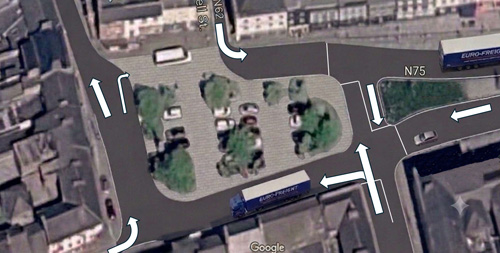
One of our many readers has submitted the suggestion shown above, which they believe could help ease the daily traffic bottleneck in Liberty Square, Thurles. This problem is likely to become even more severe when schools reopen in late August and early September. Any suggestions from other readers?
Inner Relief Road: The public was informed that the Inner Relief Road may be “ready for construction” in 2027. That wording does not provide a guaranteed completion date. If approvals, design work, procurement and funding continue to slip, there is a genuine danger that construction will not commence before 2030.
Outer Ring Road/Thurles Bypass: The situation surrounding the Outer Ring Road is even more concerning. Mr Michael Lowry has said that the Thurles bypass will advance through design and planning and that he will insist it is “ready for construction in 2030.” That is not a promise that the road will be built or opened by 2030. The scheme remains at a very early development stage, despite the need for a bypass having been recognised as necessary, some 40 years ago or more.
If the shorter and more advanced Inner Relief Road cannot be brought promptly to construction, how can the public have confidence that the much larger and longer Outer Ring Road will be construction-ready by 2030?The Thurles electorate are not fools.
There must also be accountability for the loss of the historic Great Famine “Double Ditch” at Mill Road. Local heritage campaigners described and proved it to be a famine-era pathway dating from approximately 1846, constructed as relief work for impoverished and starving people and later used as a right of way and Mass path. Concerns were raised publicly from 2020 onward, that the proposed Inner Relief Road would seriously damage or destroy this locally significant landscape feature. The tragedy now is that part of Thurles’s tangible Famine heritage appears to have been sacrificed for a road that, years later, has still not been delivered. Whatever disagreement may exist about its formal archaeological status, the failure to preserve, commemorate or meaningfully incorporate the “Double Ditch” into the project represents a serious loss to Thurles town’s historical memory.
Meanwhile, HGVs will continue entering Thurles every day. Even after a bypass is eventually constructed, some heavy vehicles will still need to enter the town to supply supermarkets, shops, hotels, restaurants, construction sites and other local businesses. These essential deliveries cannot simply be prohibited.
However, there is an important difference between HGVs that must enter Thurles to supply local businesses and heavy through-traffic that has no business being in the town centre. In the absence of proper alternative routes, both types of traffic continue to use the same narrow medieval streets and junctions.
The council’s own transport planning identifies the effect of through-traffic on Thurles and recognises the need for relief and bypass infrastructure. The Local Transport Plan presents the Inner Relief Road and a town bypass as important elements of the future transport network.
Regrettably, local elected representatives and county councillors have failed to grasp—or act upon—the urgency of this critical issue.
No redesign of Liberty Square can really solve the underlying problem. Wider footpaths, altered parking arrangements, crossings and junction changes may improve the visual appearance and pedestrian environment, but they cannot create a proper alternative route for strategic traffic.
Without the Inner Relief Road and Outer Ring Road, attempts to improve traffic movement in Liberty Square, risk becoming little more than a rearrangement of the same congestion.
Mr Michael Lowry TD and Mr Ryan O’Meara TD must now jointly secure and publish:
►Final Department approval for the Inner Relief Road; ► A fully funded programme for detailed design and construction; ► Firm construction commencement and estimated completion dates; ► Immediate progression of the Outer Ring Road through its formal planning and approval stages; ► An interim HGV-management plan separating essential local deliveries from avoidable through-traffic; ► A permanent memorial or heritage interpretation scheme acknowledging the Great Famine “Double Ditch” and the people whose suffering and labour it represented.
Thurles has already lost an irreplaceable piece of its Famine-era heritage. It must not now be left with neither the historic “Double Ditch” nor the road whose development was used to justify its loss. A plaque of some description must now be constructed recognising its once construction and recent destruction.
Thurles does not need more political celebration of mere preliminary steps, which is all our local politicians have had to offer their electorate over the past 40 years. It needs approvals, funding, contracts, construction and most of all accountability.
Ireland may be about to create an entirely new residential construction market, but the opportunity is being misunderstood.
In April, the Irish Government announced proposed planning exemptions that would allow a detached auxiliary dwelling of between 32 m² and 45 m² to be built behind an existing home and connected to the main house’s services. The detailed conditions have not yet been finalised, and the regulations still require environmental assessment and Oireachtas approval.
That distinction matters. This is not simply permission to place a larger garden room beside the patio. It is a proposal to create a new home without the conventional planning process.
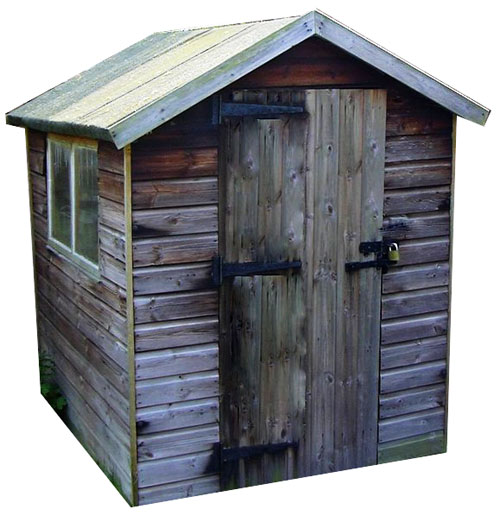
Homenot a shed!
And a home is not a shed with better finishes. The Government has explicitly stated that all relevant Building Regulations, Building Control requirements and fire-safety rules will continue to apply. Removing planning permission does not remove the obligation to design, construct and certify a safe, energy-efficient dwelling.
That is where the real market disruption begins. Ireland already has a capable garden-room sector supplying offices, gyms, studios and leisure spaces. Many of those companies deliver attractive buildings quickly and efficiently. But a structure intended for occasional use is fundamentally different from a dwelling occupied every day and night. A compliant home must address structure, insulation, ventilation, airtightness, energy performance, drainage, fire safety, radon protection, access and long-term durability. Depending on the final regulatory route, it may also require professional design input, a commencement notice, inspection documentation, energy assessment and completion certification. These obligations are not administrative extras. They are the product.
The commercial risk is obvious. Homeowners may compare two buildings that appear almost identical online: one offered as an inexpensive “garden pod” and another priced as a fully designed and certified dwelling. The cheaper option may win at the kitchen table because the most important differences are hidden inside the floor, walls, roof, ventilation system and compliance file. Those differences may only become visible years later — during a sale, an insurance claim, a mortgage application or an investigation following a fire or structural failure.
That creates four urgent challenges for the industry. ► First, design must become repeatable. The strongest providers will develop standardised systems that can be engineered, energy-modelled and documented once, then adapted responsibly for each site. ► Second, buyers need meaningful protection. A marketing promise or company guarantee is not the same as independent certification, professional indemnity cover and a credible structural warranty. ► Third, contractors need a clear delivery process. Responsibility for design, assigned roles, inspections, testing and handover documentation must be established before work begins — not assembled retrospectively when a customer asks for proof. ► Fourth, the public needs better information. “Planning exempt” must never be allowed to become shorthand for “unregulated.”
There is also confusion around tax. Revenue currently allows up to €14,000 of qualifying Rent-a-Room income to be exempt from Income Tax, PRSI and USC. However, current guidance says a detached self-contained unit does not qualify. The Government has only committed to considering how auxiliary dwellings might interact with the relief. The opportunity remains substantial. Families need flexible accommodation. Adult children need routes to independence. Older homeowners need options. Ireland needs additional housing capacity.
But the winners will not be the businesses that manufacture the cheapest box. They will be the contractors and partners that can deliver a genuine home: designed correctly, built safely, tested properly, certified transparently and supported long after handover. That is the standard serious builders should establish before the first advertising campaign begins.
In this market, compliance will not slow the sale. Compliance will be the sale.
Aspiring screen performers and anyone curious about life on a television set are being invited to apply as extras for the second season of a major historical drama filming in County Wicklow.
The Amazon Prime production, currently operating under the codename “Bluetooth,” has been described as an epic “swords and shields” saga. Its first season has already been filmed and is expected to premiere early next year, while production on the second instalment is due to run from August until November 2026.
Casting organisers hope to recruit thousands of people from across Ireland for a wide variety of scenes. No previous acting experience is required, and applications are welcomed from people of different ages, appearances, ethnicities, religions and cultural backgrounds.
The team is also interested in applicants with distinctive skills or experience, including musicians, athletes, tradespeople, animal handlers and speakers of different languages. However, the organisers have stressed that this is not an exhaustive list and that everyone who meets the basic eligibility requirements is encouraged to attend.
Following an earlier casting session in Newtownmountkennedy, the remaining open calls will be held at the Camden Court Hotel, Camden Street Lower, Dublin 2, on Monday, 13th July and Tuesday, 14th July, from 10am until 5pm each day.
No appointment is necessary, and applicants only need to attend one session. The process is expected to take approximately 20 minutes and will involve completing an application form and having a photograph taken. The opportunity is open to adults and young people aged 16 years or over. Applicants must be living in Ireland on a full-time basis and must have a valid PPS number and permission to work in the country.
Parents or guardians interested in applying on behalf of children under 16 can request a separate application form by emailing extras@btproductions.ie.
Successful applicants could be offered paid work during the production period, although some people may be contacted at short notice to attend filming or costume fittings.
For anyone interested in history, film, television or acting, or simply looking for an unusual experience, the chance to meet new people and earn some extra money, the open casting call offers an opportunity to become part of a large-scale historical production filmed against some of Ireland’s most striking scenery.
Pre-deceased by Joe Tolton, Sidney Sussex, and daughter Jackie Tolton; Mrs Sussex passed away peacefully at Fenor Hill Nursing Home, Urlingford, Co. Kilkenny.
Her passing is most deeply regretted, sadly missed and lovingly remembered by her sorrowing family; loving sons Steve and Andy, stepsons Paul and Graham, daughters-in-law Kim, Julie, Rachael, Louise and Joanne, grandchildren Karley, Michael, Danny, Shannon, Caitlin, Bradley, Patsy and Abbie, great-grandson Felix, extended relatives, kind neighbours and friends.
The extended Sussex family wish to express their appreciation for your understanding at this difficult time, and have made arrangements for those persons wishing to send messages of condolence, to use the link shown HERE.
This website uses cookies to improve your experience. We'll assume you're ok with this, but you can opt-out if you wish.AcceptRead More
Privacy & Cookies Policy
Privacy Overview
This website uses cookies to improve your experience while you navigate through the website. Out of these, the cookies that are categorized as necessary are stored on your browser as they are essential for the working of basic functionalities of the website. We also use third-party cookies that help us analyze and understand how you use this website. These cookies will be stored in your browser only with your consent. You also have the option to opt-out of these cookies. But opting out of some of these cookies may affect your browsing experience.
Necessary cookies are absolutely essential for the website to function properly. This category only includes cookies that ensures basic functionalities and security features of the website. These cookies do not store any personal information.
Any cookies that may not be particularly necessary for the website to function and is used specifically to collect user personal data via analytics, ads, other embedded contents are termed as non-necessary cookies. It is mandatory to procure user consent prior to running these cookies on your website.








Recent Comments