|
|
 It was with great sadness that we learned of the death yesterday, Tuesday 17th April 2018, of Mr Thomas Meagher, Fertiana, Thurles, Co. Tipperary, and formerly Ballingarry (SR), Co. Tipperary.
Mr Meagher passed away peacefully, while in the care of Padre Pio Nursing Home, Holycross, Thurles.
His passing is most deeply regretted by his loving wife Eleanor; son Tom; daughter Elaine; grandchildren Matthew, Sarah and Sullivan; his sisters and brothers; Maura, Pat, Vera, Kit and Ollie; sisters-in-law Peggy, Mary and Jan; brothers-in-law John and Tony; nieces; nephews; extended relatives; neighbours and friends.
Funeral Arrangements
The earthly remains of Mr Meagher will lie in repose at his residence on tomorrow evening, Thursday from 3.00pm to 8.00pm.
Removal will take place on Friday morning at 11.00am, for Funeral Mass in Holycross Abbey, Thurles at 11.30am, followed by interment immediately afterwards in the adjoining cemetery.
Go ndéana Dia trócaire ar a anam dílis.
Independent.ie report today that confidential education details, given to a senior infants class on paper intended for use as a colouring project, has now become the subject of an investigation at a Co. Tipperary primary school.
It is understood that part of this confidential education report, which concerned a special needs boy, was handed to five and six-year-old senior infant students, in the form of A4 sheets for use in a drawing project.
A detailed assessment of the 10-year-old boy’s educational needs were clearly legible on the reverse side of an A4 sheet, detailing how this older special needs boy; latter experiencing emotional and special education issues, should be managed. It is believed that pages from this report may were accidentally gotten mixed up with blank A4 pages, intended for use in the classroom.
The issue came to light when the primary students were permitted to take their colouring project home, and an older sibling of one of these children became curious about the messaging on the reverse side of the A4 project page.
Realising the significance of this written material; this older student then brought it to the attention a parent, who became dismayed and shocked by the information contained thereon; which included the boy’s name and his date of birth.
 It was with great sadness that we learned of the death yesterday, Tuesday 17th April 2018, of Mrs Eileen Stapleton (née Crawford), Clonmel Road, Cashel, Tipperary and formerly of Littleton, Thurles, Co. Tipperary.
Mrs Stapleton passed away peacefully at her home surrounded by her family.
Her passing is most deeply regretted by her loving husband John; daughters Ruth and Rachel; sons John and Mark; son-in-law J. D.; daughters-in-law Kiara and Maurica; grandchildren David, Sarah, Rebecca, Caela, Ava, Conor and Crawford; brothers John, Pat and Gerard; sisters Ann, Bridie and Mary; brothers-in-law; sisters-in-law; nephews; nieces; extended relatives; neighbours and many friends.
Funeral Arrangements
The earthly remains of Mrs Stapleton will lie in repose at Devitt’s Funeral Parlour, The Green, Cashel, tomorrow evening, Thursday, from 5.00pm to 7.30pm.
Removal will take place on Friday morning to St. John the Baptist Church, Cashel, for Requiem Mass at 12.00 noon, followed by interment immediately afterwards in Cormac’s Cemetery.
Note please: Family flowers only. Donations in lieu, if desired, to South Tipperary Hospice. House private.
Go ndéana Dia trócaire ar a h-anam dílis.
Brief Beauty
© Author & Poet Tom Ryan.
Be beautiful for the moment,
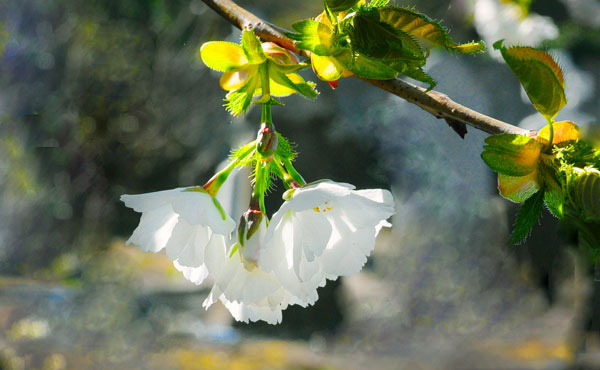
Like the cherry blossom flower.
Enchanting, undaunted,
For a brief and lovely hour.
And, as pink blossom petals fall
In the wind of a summer’s day,
Oh, be graceful for the moment,
Come what may, come what may.
End
Tom Ryan, “Iona”, Rahealty, Thurles, Co. Tipperary.
Work is well under way in relation to the clearing of the site for the new Thurles car park, situated on the ‘Money Side’, south of Liberty Square here in the town.
This development has involved a great deal of unseen, yet necessary planning and preparatory work, prior to its commencement; as Templemore/Thurles Municipal Engineer Mr Michael Tierney explained today.
All new development areas currently; even areas requiring just site clearance for a car park, must take into account fully those residing and using the area. And I am not just talking about humans, I this case I am also talking about wild life inhabitants who rightly use this area, and whose needs and well-being must also be also fairly considered. So, let’s take the case of the Thurles Daubenton’s Bat for example.
Note: Bats as we know, in general, are small, furry, intelligent animals often referred to as being like ‘Mice with Wings’. Indeed, almost one quarter of all land mammals’ resident here in Ireland are bats. Despite the often-used idiom, “Blind as a Bat”, indeed the contrary is true, as bats are far from being blind, having excellent vision and seeing perfectly well, while also truly taking possession of the night through their capability and use of sonar. Flying at high speeds bats listen using echolocation (biological sonar) and can locate insects faster than any of our much loved feathered friends; making their their appearance at dusk, when our insect activity is to be viewed in maximum throng. [And no girls, bats do not get tangled up in your long hair.]
We are aware that some seven different types of bats have been identified as residing here in our Emerald Isle. They are:- (A) The Lesser Horseshoe; (B) Pipistrelle (Latter the small common bat); (C) The not so common Natterer; (D) The Long Eared Bat; (E) The rare Whiskered Bat; (F) Ireland’s largest bats known as Leisler’s; and finally (G) Water bats called Daubenton’s, latter first described by the German naturalist and zoologist, Heinrich Kuhl, back in 1817, who named them in honour of the French naturalist Louis-Jean-Marie Daubenton.
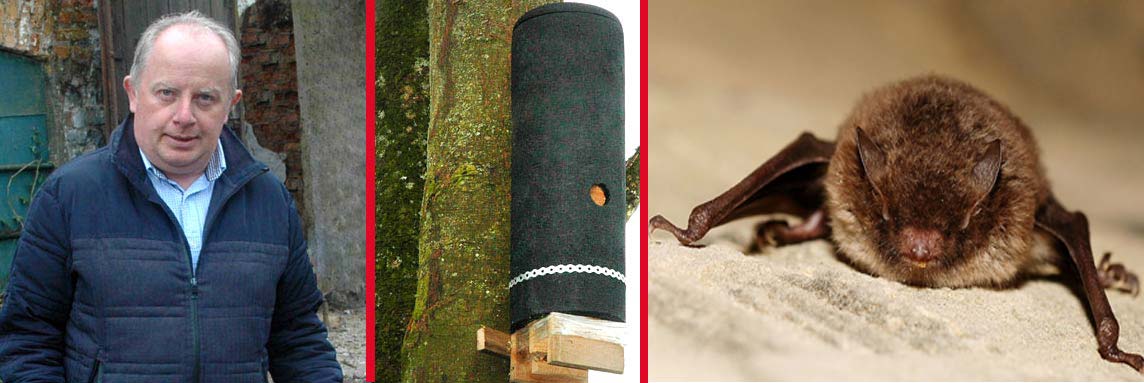 Pictured Left-Right: (1) Templemore/Thurles Municipal Engineer Mr Michael Tierney: (2) A Large Hibernation Colony Bat Box; (3) A Daubenton’s Bat. The Daubenton’s Bat (Myotis daubentonii. Irish-Ialtóg uisce.)
The Daubenton’s bat is a Eurasian bat with short ears and is thankfully considered to be increasing their population growth in many areas. More often called the ‘water bat’, this species is easily recognised at dusk, flying just a few centimetres above the surface of our River Suir, latter which runs parallel slightly to the east of this new car park amenity. This species of bat can be spotted skimming above the surface in search of midges, caddisflies, moths, beetles, daddy long-legs, mayflies, earwigs, and spiders, and may even scoop prey from the very surface of the water. While other bats feed over and around water; none hold the same close association with water as do Daubenton’s, which can even swim, should it accidentally end up in the water.
While none of these bats have been identified as currently residing in the new car park’s immediate vicinity, new Hibernation Colony Bat Boxes have been installed just in case, since the area is part of their rich hunting ground. Bats never settle individually, preferring to live in colonies, so these boxes, high in the trees, now allow for large numbers of bats to congregate together, in a dry, safe place and are ideal for use as bat nurseries for their young.
Bats hibernate in the wintertime. This is necessary since there are not many insects available to eat during our Irish winters. When they hibernate, their heartbeat slows down, while their body temperature is also lowered. This helps them to save their energy and survive a cold winter.
Yes, we as humans remain the minds and the stewards of our everyday living world, and to avoid a catastrophic loss of biodiversity, we must fully realise that our own ultimate future, as living human beings, also depends upon our greater understanding of the natural environment and where necessary we must allocate and learn to share ecological real estate.
|
Support Us Help keep Thurles.info online by donating below. Thank you.
Total Donated 2026: €300.00
Thank You!
Daily Thurles Mass Livestream
|



Recent Comments