Large numbers of music fans from across Tipperary are preparing to make the journey to Stradbally this weekend as Electric Picnic returns with a packed programme of headline performances.
The sold-out festival takes place at Stradbally Hall, Co. Laois, from Friday, August 28th, to Sunday, August 30th, with around 80,000 people expected to attend. Organisers have now released the Main Stage timetable, allowing Tipp festival goers to plan their weekend.
Electric Picnic MAIN STAGE Times:- Friday’sMain Stage programme will see JADE open the Main Stage action at 6:00pm, followed by Zara Larsson at 7:30pm and Sombr at 9:00pm. Lewis Capaldi will bring the opening night to a close with a headline set beginning at 10:45pm.
Lewis Capaldi – Someone You Loved.
Saturday’s Main Stage programme includes Role Model at 5:30pm, The Mary Wallopers at 7:15pm and CMAT at 9:00pm. Gorillaz will headline from 11:05pm until 12:35am.
A full day of Sunday Main Stageentertainment begins with the RTÉ Céilí Mór at 1:00pm. James Marriott, Van Morrison, The Saw Doctors, Djo and Amble will follow before Fontaines D.C. close the festival with a 10:30pm headline performance.
With Stradbally located just over the county boundary, a sizeable Tipperary contingent is expected to be among the crowds arriving for one of Ireland’s biggest weekends of live music.
The schedule and festival dates shown above are confirmed by the official Electric Picnic website and the published Main Stage timetable.
The Stench of Neglect: River Suir in Thurles Suffocates in Waste.
A Waterway Left to Fester: Apparent Pollution, Institutional Neglect and an Inexcusable Failure to Act.
The early images in the video immediately below are visually consistent with sewage-contaminated water, inadequately treated wastewater, detergent-bearing grey-water, or another organic effluent. The foam could indicate surfactants, while the grey colour and sludge may indicate suspended solids and decomposing organic matter. It does not resemble clean surface-water run-off.
However, a photograph alone cannot conclusively identify the slowly flowing substance in a river now almost static. Proper investigation should include samples from the suspected discharge point and locations upstream and downstream. Relevant analyses include dissolved oxygen, BOD, COD, ammonia, orthophosphate, suspended solids, E. coli, conductivity and surfactants. EPA material confirms that BOD, dissolved oxygen, ammonia, nitrate and phosphorus are central indicators of organic contamination, and that pollution-incident sampling should cover downstream, discharge-point and upstream locations.EPA sampling procedure
This slide-show above, however, presents a disgusting and deeply alarming picture; grey, foaming liquid and foul-looking sludge accumulating in what should be a living watercourse. Its exact composition must now be determined by laboratory testing, but its visible condition is wholly incompatible with the clean, healthy river environment the public is entitled to expect.
This river is neither a sewer nor a dumping ground. If analysis confirms an unlawful discharge, its source must be stopped, the damage remediated and every available enforcement power used.
Continued neglect after documented notification would be indefensible, a betrayal of the waterway, its wildlife and the community these authorities and representatives are supposed to serve.
Reminder
We can confirm that the above public meeting will take place, as stated above.
Thirteen years of warnings As stated in a recent post on Thurles.Info, the deterioration of the River Suir cannot credibly be described as “sudden” or “unforeseeable”. For more than a decade, residents, anglers and environmental campaigners have raised concerns about pollution, excessive vegetation, restricted flow, sediment, litter and neglect. These concerns were documented in “River Suir Crisis—Thirteen Years of Warnings, But Still No Coordinated Action”.
Now, 13 yearslater; the Minister of State Mr Kevin “Boxer” Moran recently visited sections of the Suir in Thurles and Holycross following representations from Independent TD Michael Lowry. It was stated that the Office of Public Works would support an application by Tipperary County Council under the enhanced Minor Flood Mitigation Works Scheme. However, I can confirm from recent discussions with varying responsible bodies, that they are not aware of any recent communication. Support for an application is welcome, but it is not a restoration programme. The public has not been shown the precise work proposed, the scientific evidence supporting it, the environmental assessments required, the anticipated cost and timetable or the body responsible for delivery and monitoring.
Political videos, visits and announcements by politicians and councillors cannot substitute for accountable work. Councillor Micheál Lowry, Deputy Michael Lowry and every other representative addressing the issue must be judged by measurable results. The same standard must apply to Tipperary County Council officials. [ Which begs the question; “Where were all the other local elected councillors when a recent promotional video, capturedby Mr Lowry TD, was uploaded unto social media.” ]
The missing ingredient for the River Suir is not more talk, it is delivery.We need clear answers:
► What works will be carried out? ► When will they begin? ► Who is responsible for delivery? ► Has the funding application now been submitted? ► What section of the river will be prioritised first? ► How will pollution and damaging discharges be reduced? ► How will progress be measured and reported publicly?
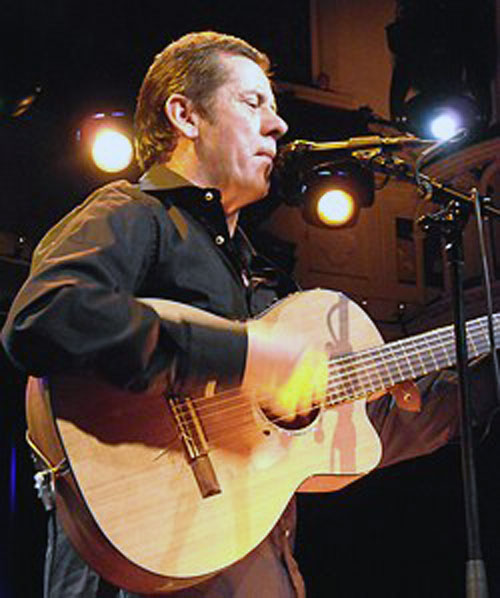
Lyrics and Vocals: Irish born (Co. Kildare) folk singer-songwriter Kevin Barry Moore better known professionally as Luka Bloom, (younger brother of folk singer Christy Moore).
Luka Bloom.
Written in 2003 as the Iraq War loomed, Luka Bloom’s song offers a quiet but resolute response to the fear and division of its time. Speaking from the perspective of an ordinary Irish citizen, it rejects the rush toward conflict and affirms our shared desire to live together in peace. More than two decades later, its simple message has lost none of its urgency or humanity.
I am not at war with anyone. I am not at war with anyone. Go away war planes, You bring fear and shame, I am not at war with anyone. I give my love to Iraq and to Syria. I give my love to Israel and to Palestine. We could live as one between the sea and sun. I am not at war with anyone. I don’t need to be friends with everyone, But I’d like to live in peace with everyone. This rush to war was wrong, I just sing my song, I am not at war with anyone. I risked my life to cross the Mediterranean. I’d love to go back home and live in peace again. But now I hope I’ll find the heart of humankind, ‘Cause I am not at war with anyone. I am not at war with anyone.
Lieutenant Henry Richard Power of Littleton, Pocklington and the Royal Flying Corps.
Irish athletics is presently enjoying one of the most remarkable periods in its history. At the European Athletics Championships in Birmingham this August, Ireland secured four individual medals: gold for Mark English in the 800 metres and Kate O’Connor in the heptathlon, silver for Rhasidat Adeleke in the 200 metres, and bronze for Andrew Coscoran in the 5,000 metres. Their achievements offer a timely reason to remember an earlier Irish sporting talent: Henry Richard Power of Ballydavid House, a gifted high jumper and all-round athlete whose promising career was cut short by the First World War.
In the churchyard of St Mary’s at Littleton, County Tipperary, an intricately carved Celtic cross preserves the memory of the Power family of Ballydavid House. Among the names associated with that memorial is Lieutenant Henry Richard Power, athlete, university student, infantry officer and Royal Flying Corps observer, whose life ended during an aerial battle over the North Sea in August 1917. His story links a vanished Irish country house with an old Yorkshire school, the playing fields of Dublin University and the dangerous skies of the First World War.
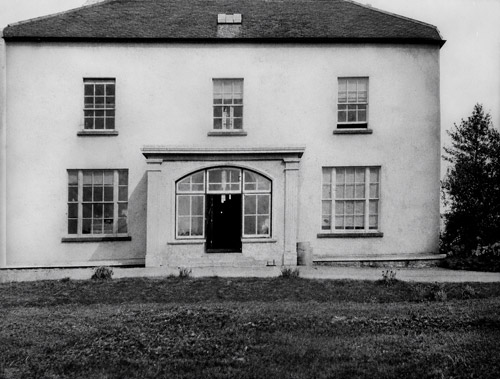
Former Ballydavid House Littleton, Thurles, since demolished in 1963.
The Power family of Ballydavid House Henry belonged to a prominent local family long associated with Ballydavid House, Littleton which stood near the crossroads village of Littleton, approximately five miles east of Thurles. The house occupied an elevated position and was approached through an avenue planted alternately with green and copper beech trees. Henry’s father, James Michael Power, was baptised at Moycarkey, County Tipperary, on February 4th 1861. His mother, Maria Louise Houghton, was baptised in the Hanover Square district of London on April 11th 1867. Although James was Roman Catholic and Maria belonged to the Church of Ireland, they married in Paddington, London, on February 4th, 1888. They had two sons: James Houghton Power, born around 1888, and Henry Richard Power, born at 21 Lower Mount Street, Dublin, on August 1st 1893.
The religious composition of the household was recorded clearly in the 1901 Irish census. At Ballydavid were: James Michael Power, aged 40, head of the household and Roman Catholic (RC); Maria Louise Power, aged 34, his wife and a member of the Church of Ireland (C of I); James Houghton Power, aged 12, their elder son and a member of the Church of Ireland; Henry Richard Power, aged seven, their younger son and also a member of the Church of Ireland.
The family’s position in the Littleton community rested not only upon ownership of Ballydavid House, but upon a longer tradition of employment, farming and participation in local affairs. The house and its tree-lined avenue formed an imposing presence in the village landscape.
The brothers at Pocklington. Both Power brothers were sent to Pocklington School in the East Riding of Yorkshire. Founded in 1514, Pocklington was already a school of considerable age and reputation, when Henry entered it in May 1908. School records place him there until December 21st 1911. The 1911 census found the 17-year-old Henry boarding at the school, although his birth year was entered as 1894 rather than 1893. Henry soon distinguished himself as an athlete. He was selected for the school’s Gymnastics VIII and developed particular ability in the high jump. The Michaelmas 1911 issue of the Pocklington School Magazine reported enthusiastically upon his performance at the Thurles sports: “H. R. Power, a student of Pocklington School, Yorkshire, has recently performed a great feat by clearing 5ft. 8in. in a running jump at the Thurles Sports in Co. Tipperary.”
The magazine described the young Irishman as “a grand and determined jumper” who appeared capable of reaching the highest level. It also praised him as an accomplished all-round gymnast, especially proficient in strength exercises. During the preceding school term, he had cleared five feet six inches in the high jump and finished second in the school gymnastics competition. The writer predicted that Power might attend Durham University and establish himself in university athletics. “Durham” was almost certainly an error for “Dublin” University, for Henry subsequently entered Trinity College in Dublin.
Athlete and student at Trinity College. At Trinity College, Henry continued to excel in sport. He represented Dublin University in intervarsity competition and won the high jump. His athletic ability was not confined to a single event; he also placed second in the shot put and competed in several other disciplines. In June 1914 he finished second in the high jump at the Irish Amateur Athletic Association championships at Ballsbridge. Contemporary reports regarded him as one of Ireland’s most promising jumpers. A later obituary recalled that at his final university sports he cleared five feet nine and a half inches. For an amateur athlete of the period, competing without modern equipment or specialised training methods, it was an impressive achievement.
Henry also served in the Dublin University Officers’ Training Corps. The experience prepared him for the very different life that began when Europe descended into war.
From the Royal Irish Rifles to the Flying Corps In October 1915 Henry received appointment as a second lieutenant on probation in the 3rd Reserve Battalion of the Royal Irish Rifles. His rank was subsequently confirmed in September 1916. Accounts of his infantry service differ over whether he served with the 13th or 14th Battalion, but contemporary newspaper reports indicate that he saw active service during the Battle of the Somme in 1916. The experience would have brought him into one of the most destructive campaigns of the war. In January 1917 he transferred to the Royal Flying Corps. He trained as an observer, a demanding role that combined aerial reconnaissance, navigation, photography and the operation of a Lewis machine gun. Henry initially served with No.18 Squadron before joining No. 48 Squadron. The latter had an important place in aviation history: it was the first operational squadron equipped with the Bristol F.2 Fighter.
Although commonly known as the Bristol Fighter, the F.2B was a two-seat aircraft. Its pilot operated a forward-firing gun, while the observer occupied the rear cockpit with a flexible Lewis gun. Effective cooperation between the two men was essential. The observer had to watch the sky constantly, communicate with the pilot and defend the aircraft against attacks from behind.
The Gotha Raids. By 1917 Germany had begun using Gotha heavy bombers to attack targets in Britain. These raids represented a disturbing new development in warfare. Civilians far from the trenches could now be reached by formations of large aircraft crossing the North Sea. On August 22nd 1917, German Gothas carried out a raid against the Kent coast. As the bombers turned homeward, British aircraft based in France and Belgium rose to intercept them. Ten Sopwith Camels of No. 4 Squadron, Royal Naval Air Service, went after German fighters protecting the raiders. Other aircraft from No. 3 Squadron searched for the bombers, while No. 66 Squadron dispatched six Sopwith Pups. Six Bristol Fighters of No. 48 Squadron also took to the air.
Henry Power flew as observer in Bristol Fighter A7219, piloted by John Herbert Towne Letts. Thirty miles out from Nieuport The Bristol Fighters encountered the returning Gothas approximately thirty miles off Nieuport and at an altitude of about 15,500 feet. Letts brought A7219 within roughly 200 yards of the enemy formation and opened fire. He made repeated attacks while Henry worked the Lewis gun from the observer’s cockpit. The British crews were operating far out over the sea, at great height and against heavily armed bombers capable of returning concentrated fire. During the running engagement Henry was struck by an enemy bullet. As he collapsed, the barrel of his Lewis gun swung forward and struck Letts on the head. Despite suffering an injury and concussion, Letts retained control of the Bristol Fighter. He fired a green signal flare to indicate that he was breaking off and returning to base. The other British pilots apparently interpreted the flare as an instruction for the whole formation to withdraw. Letts succeeded in nursing the damaged aircraft back to its aerodrome. Nothing, however, could be done for his observer. Henry Richard Power was dead when they landed. He was just 24 years old.
Burial at Zuydcoote Henry was buried in Zuydcoote Military Cemetery in northern France, in Plot I, Row A, Grave 7. The cemetery lies near the Belgian frontier and contains many men who died at casualty-clearing stations established in the Dunkirk area. Henry’s grave records his service with the Royal Flying Corps and his connection with the Royal Irish Rifles. A notice published on 5 October 1917 described him as the younger son of the late James Power and Mrs Power of Ballydavid House. It recalled his education at Pocklington, his studies at Trinity College and his reputation as one of Ireland’s most promising athletes. It also recorded that he had performed “very good service” after transferring to the Flying Corps.
His father had died at Ballydavid on January 21st 1912. His elder brother, Second Lieutenant James Houghton Power, served with the Royal Field Artillery during the war and survived the fighting, but died at Ballydavid on February 10th 1919, aged only 30 years. (Note: Shaving cream and a straight edge were used to highlight faded lettering on Celtic cross headstone.) Maria Louise Power had therefore lost her husband and both of her sons within a seven year period.
Remembered in Ireland, England and France. Henry Richard Power is commemorated in numerous places associated with his family, education and military service. At Littleton, his name appears on the First World War memorial inside St Mary’s Church. He is also remembered on the Power family’s magnificent Celtic cross in the adjoining churchyard. At Pocklington School, “H. R. Power” was inscribed upon the dark-oak war memorial unveiled in July 1921. The memorial, decorated with carved soldiers, the white rose of Yorkshire and elements of the school arms, honoured former pupils who had died in the war. Henry is also included in the school’s Roll of Honour preserved in All Saints’ Church, Pocklington. His name appears in Trinity College Dublin’s war records and in Ireland’s Memorial Records 1914–1918. He is recorded in the Royal Irish Rifles Roll of Honour, preserved in the Irish Regiments Chapel at Westminster Cathedral. As a casualty of the early air war, Henry is commemorated at the Museum of Army Flying at Middle Wallop and in the Royal Flying Corps and Royal Air Force Book of Remembrance in St Clement Danes Church, London. In France, his name forms part of the Ring of Remembrance at Notre-Dame-de-Lorette. The great elliptical memorial bears the names of almost 580,000 men of many nationalities who died in northern France during the First World War, presented alphabetically and without distinction of rank, religion or nationality.
The passing of Ballydavid. Ballydavid House remained in the Power family’s possession until 1940. After the death of Maria Louise Power, responsibility for the property passed to her sister Anne Houghton, who had devoted much of her life to the Stewart Institution in Cork. Following Anne’s death in 1950, the house entered a period of decline. It changed ownership several times and was eventually judged unsafe. In 1963 Ballydavid House was demolished. Much of its masonry was reportedly used as rubble filling during construction of a new wing at St Patrick’s College, Thurles, between 1963 and 1965. (The once nearby apple orchard is Littleton new Cemetery today.) The house stood approximately where Littleton’s Roman Catholic Church (Church of Our Lady & St Kevin) now stands. Some of the old beech trees from its avenue still survive.
A young life between two worlds. Henry Richard Power’s story belongs equally to Ireland and Yorkshire. He was born in Dublin and raised at a Tipperary country house, yet important years of his youth were spent at Pocklington School. He became known not for soldiering but for athletics: a determined high jumper and gymnast whom his school believed capable of reaching the summit of Irish and university sport. War carried him from the playing field to the Somme and then into the still-new world of military aviation. On 22 August 1917, thirty miles out over the sea, his life ended in the rear cockpit of a Bristol Fighter while pursuing the bombers that had attacked England. His grave at Zuydcoote, his name on the memorials of Pocklington and Trinity College, and the carved Celtic cross at Littleton connect the scattered places of his short life.
While Ballydavid House itself is gone. Henry’s name remains.
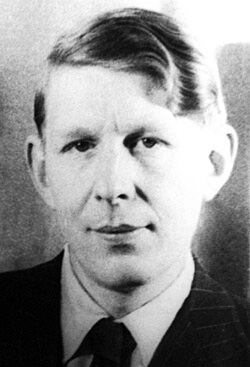
Funeral Blues by the late British-American poet W.H. Auden (1907 – 1973).
W. H. Auden’s“Funeral Blues”, (Also known as “Stop all the clocks,” a reference to its first line), is a powerful poem that captures the overwhelming grief of losing a loved one. It first appearing in a 1936 play W. H. Auden and Christopher Isherwood called “The Ascent of F6”. The poem was later substantially rewritten and published in its familiar form in 1938.
Late W. H. Auden(1907 – 1973)
Through commanding language, stark imagery, and a movement from everyday surroundings to the wider universe, Auden portrays a speaker whose loss feels so immense that time, nature, and society itself should come to an immediate halt. The poem ultimately explores how bereavement can transform a once-meaningful world into one that seems almost empty and without hope.
Funeral Blues (Read here by award winning English character actor Simon Callow.)
Stop all the clocks, cut off the telephone, Prevent the dog from barking with a juicy bone, Silence the pianos and with muffled drum Bring out the coffin, let the mourners come.
Let aeroplanes circle moaning overhead Scribbling on the sky the message ‘He is Dead’. Put crepe bows round the white necks of the public doves, Let the traffic policemen wear black cotton gloves.
He was my North, my South, my East and West, My working week and my Sunday rest, My noon, my midnight, my talk, my song; I thought that love would last forever: I was wrong.
The stars are not wanted now; put out every one, Pack up the moon and dismantle the sun, Pour away the ocean and sweep up the wood; For nothing now can ever come to any good.
This website uses cookies to improve your experience. We'll assume you're ok with this, but you can opt-out if you wish.AcceptRead More
Privacy & Cookies Policy
Privacy Overview
This website uses cookies to improve your experience while you navigate through the website. Out of these, the cookies that are categorized as necessary are stored on your browser as they are essential for the working of basic functionalities of the website. We also use third-party cookies that help us analyze and understand how you use this website. These cookies will be stored in your browser only with your consent. You also have the option to opt-out of these cookies. But opting out of some of these cookies may affect your browsing experience.
Necessary cookies are absolutely essential for the website to function properly. This category only includes cookies that ensures basic functionalities and security features of the website. These cookies do not store any personal information.
Any cookies that may not be particularly necessary for the website to function and is used specifically to collect user personal data via analytics, ads, other embedded contents are termed as non-necessary cookies. It is mandatory to procure user consent prior to running these cookies on your website.





Recent Comments