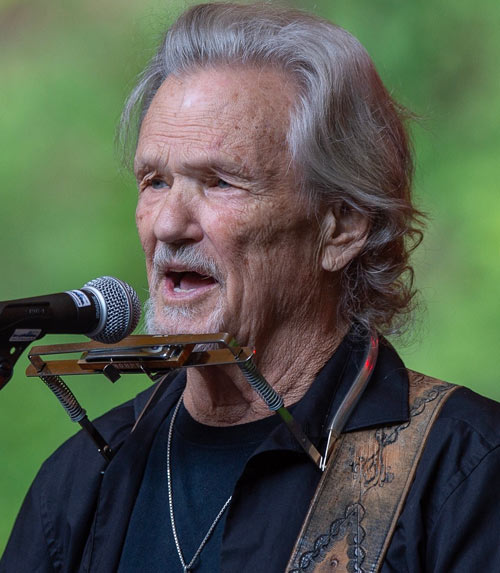
Lyrics and Vocals: American singer, Song writer, Musician and Actor the late Kris Kristofferson. (1936–2024).
The Late Kris Kristofferson.
Kris Kristofferson’s gospel-leaning country classic ‘Why Me ?’ feels less like a performance and more like a plainspoken prayer. Released as a single in March 1973 from the album “Jesus Was a Capricorn“, it became the biggest solo hit of his career, topping Billboard’s Hot Country Songs in July 1973. Kristofferson later linked it to a moment at a church service when the preacher asked, ‘Is anybody feeling lost?’, and his hand went up. So, with that honesty at the heart of it, here’s ‘Why Me ?’.
‘Why Me ?’
Why me Lord, what have I ever done, To deserve even one, Of the pleasures I’ve known. Tell me Lord, what did I ever do, That was worth loving You, Or the kindness You’ve shown. Lord, help me Jesus, I’ve wasted it, So help me Jesus, I know what I am, But now that I know that I’ve needed You, So Help me Jesus, my soul’s in Your hand. Try me Lord, if You think there’s a way, I can try to repay, All I’ve taken from You. Maybe Lord, I can show someone else, What I’ve been through myself, On my way back to You. Lord, help me Jesus, I’ve wasted it, So help me Jesus, I know what I am. But now that I know that I’ve needed You, So help me Jesus, my soul’s in Your hand. Lord, help me Jesus, I’ve wasted it, So help me Jesus, I know what I am. But now that I know that I’ve needed You, So help me Jesus, my soul’s in Your hand. Jesus, my soul’s in Your hand.
Tarmac, Trolleys, Plastic Bags and Trampled Trees.
Double Ditch Obliterated, Then Abandoned.
Please first see the video immediately hereunder before preparing yourself to weep.
Now may I suggest you quickly grab a box of tissues.
Once upon a time, there was a place in rural Thurles, Co. Tipperary that had the cheek to be historic. They called it “The Double Ditch”; a raised path built through wet ground, faced with limestone, and rooted in the grim practicality of the once Great Famine, (1846-1849), to keep people working, to keep families alive, to keep feet dry enough to move. Yes, same was a civic scar, but an honest one, and a rare thing to be found in modern Ireland; a piece of lived history, a public walkway you could still walk on.
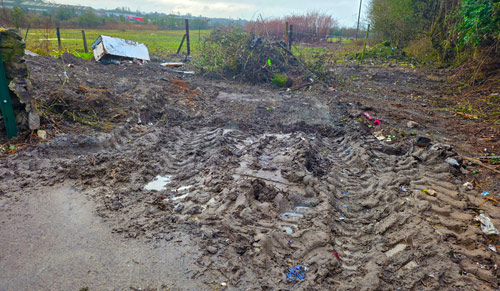
A recent abandoned attempt at cleaning the area.
Naturally, this could not be tolerated. So it became “connected”, “improved”, “enhanced”, “brought forward”, (whatever soothing verb local councillors, the local Municipal District Administrator and her officials would prefer), until all of it were “totally and wantonly obliterated”, its ancient hedgerows removed and the route flattened under heavy machinery, without so much as the courtesy of admitting what was being lost to the residents of our struggling town. Then, after much denial of its existence, with a straight face that would even shame a Victorian undertaker, it reappeared in planning language as being a “paved, pedestrian, walking route along a historical walking path”, despite being described by local councillors and politicians as not paved at all, before being levelled and left with only a temporary skin of tarmacadam.
And now we arrive at the masterpiece of their planning – “The Aftercare”.
Because nothing says “community amenity” like building a walkway and then abandoning it to rot, as if maintenance were an optional lifestyle choice, like decaf or seatbelts. The grand vision, a safe walking route on Mill Road, Thurles, tied into wider footpath plans, presented as “overdue” and “necessary”. The execution, however, appears to have followed the classic local-government model; do the ceremony; pour the tarmac; maximise the photocredit, then disappear vanishing into the mist.
So the area has now again begun its return to nature, that sacred Irish policy position otherwise known as “leaving it in a hape”. First came the willow saplings, same thrusting up through the tarmac like a botanical middle finger to uninterested municipal district officials, while rooting themselves into every crack that sheer neglect has kindly widened for them. Then arrived the briars and brambles, years of Autumn’s leaves, nettles and rank grass, all working in quiet co-operation like they’ve been awarded the contract. Soon enough, the walkway becomes less of a public route and more of a living demonstration of what happens when you build infrastructure with no real future plan to mind it, other than personal glorification.
And the litter, ah, the litter; not the dainty odd sweet-wrapper sort. No, this is the full rural-civic anthology, large plastic bags flapping like distressed flags; tyres slumped in the verge; broken wire fencing sagging like exhausted excuses. The occasional supermarket trolleys, thoughtfully dumped to ensure nobody confuses the place for cared-for land. If you’re lucky, a washing machine or two, because why wouldn’t you add white goods to a heritage corridor?
But the true flourish, the one that should make even the most hardened press-release writer blush, is how the site has been used as a stage for virtue, and then as a bin for its consequences.
In spring 2025, the area beside ‘Dun Muileann‘ on Mill Road, Thurles, became part of the One Hundred Million Trees planting push, funded locally by Allied Irish Banks’ Thurles branch, with students and the odd idle volunteer turning up to plant a dense mini-forest, using the Miyawaki Method; the whole point being fast-growing biodiversity and a carbon sink. The public reporting around it speaks of over two thousand native saplings planted at the site, a serious effort, and no small gesture of community buy-in.
And then, in the sort of anticlimax Ireland has successfully perfected; those young trees are left in a space now allowed to slide into total disorder, where over the past number of months horses are permitted to trample through the plantings that were meant to be protected long enough to establish themselves. A “green space”, promised and photographed, now reduced to a patch of scruff and horse manure, where the only thing thriving is the evidence of nobody being responsible.
That’s the moral of it, really, the fetish for the new, paired with the total inability to mind what’s then built.
Because it takes a special kind of civic arrogance to first flatten a famine-era landmark that once, literally, put bread into mouths, and then to shrug at the basic upkeep required to stop the replacement from becoming an overgrown dumping lane.
We are told, endlessly, about “heritage”, “biodiversity”, “active travel”, “community”. The words are always there; the maintenance however rarely is.
And so the Double Ditch, the real one, survives mostly as an idea: something that mattered, that was walkable, that carried memory in its stones. What’s left on the ground is the modern tribute: tarmac, blocked drains, weeds, rubbish, bent fencing, and the quiet certainty that nobody, supposedly in authority, will be held to account for any of it.
On behalf of myself, I offer my sincere apologies to Thurles Branch of AIB; (Sponsors), to MrRichard Mulcahy (Co-founder of the 100MT Project initiative) and to all those students who enthusiastically and eagerly took part in last April’s planting. Hopefully some of the trampled saplings will continue to survive, after all horse dung is a nutrient-rich organic fertilizer and soil conditioner.
Lyrics and Vocals: Irish singer, songwriter and entertainer of the country and Irish genre Johnny McEvoy.
Johnny McEvoy.
The song hereunder “You Seldom Come to See Me Anymore” sees Johnny McEvoy at his best: warm, gentle, and heartbreakingly direct, where a few simple lines say what a whole argument never could. It was even one of the nearest he came to breaking the UK charts, helped along by strong record sales in the North of Ireland. So if you know it, sing it, and if you don’t, you’ll certainly feel it.
You Seldom Come See Me Any More.
You Seldom Come See Me Any More.
What’s your hurry, can’t you stay and pass an hour away? And we’ll sit and dream awhile by candlelight. For when the long day’s over, that’s the time I fear the most, When I hear your footsteps fade into the night. You’re restless, tell me why there’s a teardrop in your eye, And I’ve seen it there a hundred times before. And I know you’re going to leave me and it always breaks my heart, For you seldom come to see me any more. I well recall that day when my ship it sailed away, To a far off distant land across the sea, Where a cruel war was raging, where time was standing still, And blind hatred was the order of the day. You’re restless, tell me why there’s a teardrop in your eye, And I’ve seen it there a hundred times before, And I know you’re going to leave me and it always breaks my heart, For you seldom come to see me any more. Now I know it can’t be fair for a soldier’s wife to hear, How he helped to keep his country proud and free, And no bronze nor fancy ribbons can ever heal the pain, When he comes back half the man he used to be. You’re restless, tell me why there’s a teardrop in your eye, And I’ve seen it there a hundred times before, And I know you’re going to leave me and it always breaks my heart, For you seldom come to see me any more. You seldom come to see me any more.
St Patrick’s Day parade committees across Ireland are warning that escalating insurance costs and reduced availability of public liability cover are placing community celebrations under severe strain, raising the risk of cancellations, scaled-back routes and last-minute uncertainty for towns and villages.
Hereunder, Video of the Thurles, Co. Tipperary, St Patrick’s Day Parade Held 2025.
Volunteer-led committees say public liability insurance has become a barrier to participation, not just a safety requirement, with higher premiums, stricter conditions and growing administrative demands landing on groups that rely entirely on fundraising and unpaid work.
Public liability insurance, covering injury to spectators and participants, as well as third-party property damage, has become increasingly difficult to secure for volunteer-led events, with committees reporting that quotes are higher, conditions are tighter and the administrative burden has grown significantly.
Recent media reporting has highlighted the scale of the challenge, with one Wicklow parade committee facing insurance estimates in the €5,000–€10,000 range (with €6,500 cited), a cost that can exceed the entire fundraising capacity of smaller communities.
At the same time, local-authority event permissions typically require proof of insurance in advance, often at high indemnity limits and with specific policy wording, adding pressure to secure cover early and at a price communities can afford.
A spokesperson associated with the Thurles town St Patrick’s Day Parade Committee, has stated that;- “Insurance has always been a problem and ever since Covid it has doubled. This is a volunteer-run event. We’re proud of the work that goes into making it safe and welcoming, but the cost and complexity of insurance is now the single biggest threat to Irish parades. Without a workable solution, communities will lose events that bring people together and support local businesses. We’re told to produce more and more documentation and pay for more and more controls, which we do, but the quotes still rise and the uncertainty remains. At some point, towns are simply being priced out of their own national day. St Patrick’s Day shouldn’t become a luxury product available only to the biggest centres. If we don’t act, we’ll sleepwalk into a future where local parades quietly disappear, and once they’re gone, they’re hard to bring back.”
Committees stress that risk management standards have risen sharply in recent years. Organisers are now expected to produce robust event management plans, crowd control measures, stewarding and traffic management arrangements, important steps for safety, but often costly to implement.
National claims data shows improvements in the wider public-liability landscape, with the Injuries Resolution Board reporting a 40% reduction in public-liability claim volumes, between 2019 and 2023. Parade organisers are asking that progress be reflected in affordability and availability for well-managed community events.
Calls for action. Community parade organising committees are urging:
A dedicated community events insurance support mechanism, aligned with documented safety standards and transparent pricing.
Clear engagement from Government, insurers and local authorities to protect the viability of community parades, not just flagship events.
A simplified national template for parade risk management and event documentation to reduce administrative burden and improve consistency.
Engagement with insurers, brokers and Government to increase capacity for community events and prevent avoidable cancellations.
St Patrick’s Day belongs to every community and participants are asking for the implementation of practical measures, so that smaller towns and villages can continue to celebrate safely without being priced out of total existence.
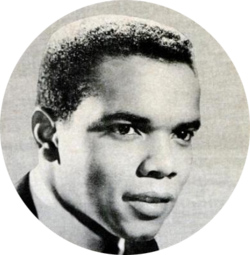
Lyrics and Vocals: American singer and songwriter, the late John Lester Nash Jr.(1940-2020).
Johnny Nash.
Released in 1972, “I Can See Clearly Now” is the bright, reggae-laced, pop-soul single that became Johnny Nash’s signature recording; written and produced by Nash, it pairs an easy, sun-after-storm groove, with a simple message of resilience, moving from setback and confusion to renewed confidence and perspective.
I Can See Clearly Now.
I Can See Clearly Now.
I can see clearly now, the rain is gone. I can see all obstacles in my way. Gone are the dark clouds that had me blind, It’s gonna be a bright (bright), bright (bright), Sun-shiny day. It’s gonna be a bright (bright), bright (bright), Sun-shiny day. I think I can make it now, the pain is gone. All of the bad feelings have disappeared. Here is the rainbow I’ve been prayin’ for, It’s gonna be a bright (bright), bright (bright), Sun-shiny day. Look all around, there’s nothin’ but blue skies. Look straight ahead, nothin’ but blue skies. I can see clearly now, the rain is gone, I can see all obstacles in my way. Gone are the dark clouds that had me blind. It’s gonna be a bright (bright), bright (bright), Sun-shiny day. It’s gonna be a bright (bright), bright (bright), Sun-shiny day. Gonna be a bright (bright), bright (bright), Sun-shiny day. Oh, what a bright (bright), bright (bright), Sun-shiny day…
This website uses cookies to improve your experience. We'll assume you're ok with this, but you can opt-out if you wish.AcceptRead More
Privacy & Cookies Policy
Privacy Overview
This website uses cookies to improve your experience while you navigate through the website. Out of these, the cookies that are categorized as necessary are stored on your browser as they are essential for the working of basic functionalities of the website. We also use third-party cookies that help us analyze and understand how you use this website. These cookies will be stored in your browser only with your consent. You also have the option to opt-out of these cookies. But opting out of some of these cookies may affect your browsing experience.
Necessary cookies are absolutely essential for the website to function properly. This category only includes cookies that ensures basic functionalities and security features of the website. These cookies do not store any personal information.
Any cookies that may not be particularly necessary for the website to function and is used specifically to collect user personal data via analytics, ads, other embedded contents are termed as non-necessary cookies. It is mandatory to procure user consent prior to running these cookies on your website.







Recent Comments