A series of upbeat tourism announcements and investment-led press releases in County Tipperary are landing against a stark national backdrop, after Eurostat reported that Ireland was one of only two EU member states to record a fall in tourist accommodation nights in 2025.
Eurostat’s early estimates show EU tourism nights hit a record 3.08 billion in 2025, up 2% year-on-year, while Ireland recorded a -2% decline (with Romania the only other country in negative territory).
Irish coverage of the figures has put the Republic’s total at 41.3 million tourist bed nights in 2025 (-1.8%), describing it as the weakest performance in the EU. The same reports note that the peak summer quarter (Q3 2025) fell 4.1%, with hotel nights down 8.4% and camping nights down 27%, while “holiday and other short-stay accommodation” rose 15.4%.
Of course, local press releases paint a different story: “growth”, “season extension”, “boost tourism”.
Despite the national decline, Tipperary tourism communications over the past year have repeatedly highlighted expansion, regeneration and new visitor offerings:-
Dromineer, Lough Derg (Nenagh MD): Tipperary County Council press material describes a €1.2m watersports facility as a “best-in-class” outdoor tourism hub intended to enhance the visitor experience and support year-round activity. Roscrea (Grant’s Hotel): A Council press release on a feasibility study lists explicit objectives to “boost tourism activity” and increase footfall and dwell time in the town centre, alongside employment and night-time economy goals. Carrick-on-Suir: A Council announcement confirms award of a €2.9m Phase 2 contract under the regeneration plan, presented as part of a wider town-centre renewal drive. Thurles: Sadly the only tourism-tagged local event promotion (Feb 2025), shows a Council/MD posting highlighting for St Patrick’s Day Parade, Thurles (2025), categorised under Tourism, which pushes footfall activity in the town centre (music, attractions, participation).
Thurles it is time to wake up.
Countywide “Roadmap” messaging: The Tipperary Tourism Roadmap 2025–2030 sets out targets around economic growth, season extension and giving visitors reasons to stay longer, and was publicly launched in late November last year.
Fáilte Ireland funding (Midlands / JTF): A national press release announced €5.5m for 17 regenerative tourism projects, bringing the scheme’s announced tourism funding to almost €60m, reinforcing the wider policy message of building new and improved visitor experiences.
The core contradiction: publicity versus performance. The tension is not that Tipperary’s projects are unwelcome, it is that headline-grabbing announcements about “growth” and “visitor experience” risk sounds hollow when the national data shows Ireland moving against the EU trend.
A key question now is whether local strategies are being matched with measurable outcomes, bed capacity, occupancy, shoulder-season activity, and value-for-money delivery, or whether Tipperary is simply publishing plans, while the wider system continues to lose ground.
We will be speaking about solutions in the coming days, so do stay tuned. Update Thurles Tourism Debate: Part IV.
Concerns over Tipperary’s ability to sustain and grow tourism have intensified following a recent council presentation on tourism performance and marketing activity, a meeting where councillors again highlighted the county’s deepening shortage of visitor accommodation.
While elected members warned that a lack of “bed nights” is now actively preventing the county from hosting events, retaining tour groups and converting day-trippers into overnight stays, local stakeholders say the discussion risks becoming yet another exercise in acknowledging the obviouswithout confronting who is accountable for years of drift and under-delivery.
Thurles social media continuously sells “local life” as if it were a tourism product and that is completely failing us. Thurles tourism messaging is too often confused about its real job.
A visitor does not fly to Ireland for a post from Thurles Tourist Office wishing them a “Happy Christmas”; “Happy New Year”; Inviting Nail Bar Appointments; Selling Clothing; Local Book Launches and other generic services that exist to be found in every backward town and village in Ireland. Yes, local businesses matter, but when social tourism channels read like a community noticeboard, it dillutes the towns strongest selling points and waste the fleeting attention created by international coverage.
Right now, too much content promotes what exists here locally, rather than what a visitor would travel from North America, France & UK for. That is why tour coaches stop and then quickly go or totally avoid Thurles altogether. That is why day-trippers don’t become overnight stays and that is why international attention risks becoming little more than a headline.
What Thurles Must & Should Do Immediately.
Use the Lonely Planet moment, and immediately deliver Thurles Lions Club Signposting so Thurles stops being overlooked.
Tipperary has a rare opportunity in the fact that the county has been recognised in Lonely Planet’s Best in Travel 2026list, (a global “top 25” selection). Tourism Ireland says Tipperary is described as “best for hiking, history and fine food”, exactly the kind of international positioning counties spend years trying to win. But that attention must now be converted into overnight stays, and that requires practical, on-the-ground delivery, particularly for towns like Thurles. So here is the uncomfortable truth; ‘Likes’ on Facebook are not bed nights. If our digital content does notanswer the visitor’s basic questions, they stay on the motorway.
Thurles Lions Club have shown our town of Thurles the lead by securing €29,600 in LEADER funding for a Thurles Heritage Trail, including signage at strategic points around the town with QR codes linking visitors to digital storytelling. Thurles has been crying out for this kind of hands-on, visitor-ready infrastructure for years. It should be treated as an emergency priority, not reduced to a cosy talking-point trotted out once a month for newspaper coverage, with scarcely a single progressive tourism voice in the room.
If Tipperary County Council is serious, this is precisely what it should be funding, promoting and delivering, with councillors and officials finally partnering with those who actually understand the tourism industry.
Currently if visitors attempt to visit the Thurles Tourism Site – Oops! That page can’t be found.
We will be speaking more about failures and solutions in the coming days, so do stay tuned. SeeThurles Tourism Debate: Part III.
Ford has issued an urgent safety warning to 2,865 Irish owners of its Kuga plug-in hybrid (PHEV), advising that a high-voltage battery defect could, in certain circumstances, lead to battery thermal venting and potentially a vehicle fire, with a risk of injury.
Kuga Plug-In Hybrid
The renewed warning follows an earlier safety notice issued in March 2025 affecting the same vehicles, when owners were instructed not to charge the battery due to the risk of a short circuit while driving. Ford later stated that a software update, rolled out in July 2025, would detect anomalies and prevent any fire risk.
However, owners who previously received, and in many cases installed, that update have now been sent a fresh warning letter instructing them to follow the latest guidance regardless of whether the earlier action was completed.
What owners are being told to do now Until a permanent remedy is available, Ford is advising affected customers to:
Limit charging to a maximum of 80% and do not exceed this limit.
Use only the default “Auto EV” mode, and avoid Deep Mud and Snow modes until further notice.
Ford has said it does not yet have a fix, but anticipates a remedy by mid-year, and that customers will be contacted and instructed to arrange a dealer visit once the remedy is ready.
Vehicles affected. Ford said the vehicles impacted were manufactured before 28th November 2023, and that unsold affected vehicles have been placed on hold.
Background and customer impact. The Kuga crossover has been one of Ford’s strongest sellers in Ireland, with 3,124 registrations over the past three years, and more than 95% of those sales being plug-in hybrids. Last year, some owners affected by the initial defect began legal actions against the car maker, with one Circuit Court claim alleging the vehicle was effectively worthless while repayments continued under a personal contract plan. Asked why battery packs are not being replaced and whether compensation would be considered for owners facing difficulties selling affected vehicles, Ford said it would “define the right remedy for this issue”, adding: “We apologise for any inconvenience this may cause to our customers… We remain committed to providing our customers with safe and high-quality vehicles, addressing potential issues and responding quickly.”
Customer guidance: Affected owners are advised to follow the instructions in Ford’s letter and contact Ford’s customer contact centre or their dealer for further assistance.
Most significant reform of Irish asylum laws in the history of the Irish State.
The government has given approval to publish the International Protection Bill 2026, legislation that will lead to the “most significant reform of Irish asylum laws in the history of the State” in line with the EU Migration and Asylum Pact.
The Bill will put in place a new EU framework to manage migration and asylum for the long-term and will ensure Ireland’s policy aligns with other EU countries. The overall objective of the Bill is to provide a fair, sustainable and efficient asylum procedure that is consistent with how asylum laws operate across the EU.
The Bill introduces faster processing of asylum claims with a much more efficient decision-making system. Faster processing will mean that applicants spend less time in IPAS accommodation, and it will significantly reduce the cost of the asylum system to the State. Faster decision-making will also mean that successful applicants will be granted international protection sooner, and those whose applications are refused can be returned to their country of origin sooner.
The International Protection Bill 2026 will replace the International Protection Act 2015.
In July 2025, the Department launched the first phase of pilot pact implementation programme. The first phase aimed to test the ability to process cases end-to-end within the time frame of the future Border Procedure. This requires a first and second-instance decision, with a return order where appropriate, delivered within 12 weeks, and a return effected within a further 12 weeks. During this first phase, the implementation team also mirrored some elements of the screening process as well as parts of the future border procedure that are permitted under current legislation.
Phase one was conducted from July 1st to October 7th 2025 and included applicants from three designated safe countries of origin, Georgia, India and Brazil.
During the initial three months, pilot applicants were successfully processed within the 12 week timeline permitted for first and second instance decisions under the Border Procedure. On average, cases took less than 60 days from application to final decision being issued.
This represents a significant shift from the current median processing times in the IPO and IPAT, and therefore a significant reduction in costs for accommodation and other supports.
On October 8th 2025 the second phase of the transition pilot was launched with the addition of the remaining 12 designated safe countries of origin. Early this year future phases of the pilot will be implemented, in advance of the Pact coming into effect in June 2026.
The government and the Attorney General are developing provisions for inclusion in the Bill to give effect to the proposals, approved by Government on November 26th 2025, that adults who are beneficiaries of international protection will not be entitled to seek family reunification for a period of three years following their grant of international protection.
They must also demonstrate that they are financially self-sufficient. This will be assessed by reference to appropriate income thresholds to be prescribed by the Minister. They will also have to show financial self-sufficiency and not be in receipt of certain social welfare payments or owe money relating to International Protection Accommodation Services (IPAS) payments.
The Government proposes to bring forward amendments at Committee Stage to address Material Reception Conditions, Restrictions of Movement, Detention, Special Reception Needs and Labour Market Access, as required by the EU Reception Conditions Directive. Other matters to be dealt with by amendments to the Bill during the legislative process include legal counselling, legal advice and legal aid, and matters relating to data sharing.
The Bill will now be presented to the Houses of the Oireachtas and follow the standard parliamentary process over the coming months with a view to enactment in the Spring session, so that it can become operational as required by EU law by June 12th 2026.
The pre-legislative scrutiny report on the General Scheme, including 92 recommendations, was published on December 1st. Some recommendations have been given effect in the published Bill, and others will be considered as the Bill proceeds through the legislative process.
“The first, the gentle Shure (Suir) that making way By sweet Clonmell (Clonmel), adornes (adorns) rich Waterford; …” (Excerpt from poem by Edmund Spenser’s ‘Irish rivers’.)
♦ Note: It should be noted that in 2026 Cahir Castle has since been fully restored and has now become a major tourist attraction in Cahir, Co. Tipperary. However this was not the case in 1912 when McCraith published her book.
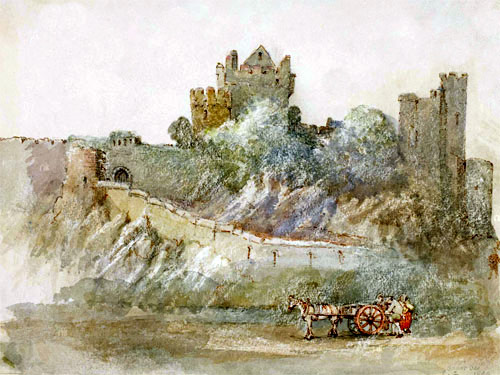
Cahir Castle as depicted by the artist James Stark Fleming (1834-1922).
The Suir – From Its Source To The Sea.
Cahir Castle rises on an island in the Suir, and commands the bridge in the middle of the town. This old ivy-clad Butler stronghold is probably the best example of late feudal architecture in Ireland. It was built in the fifteenth, or early in the sixteenth, century, and has remained in the family of its builders ever since.
The Butlers ceased to live in their castle about a hundred and fifty years ago. It has not been inhabited since a company of infantry was quartered there in the days of the late Earl of Glengall (he it was who gave the site for the present barracks, about a mile outside the town, formerly used for Cavalry, and now used for Field Artillery). For over a century the Castle has undergone no structural alteration, but remains an eloquent witness of the life led long ago in Ireland by a Lord of the Pale.
Centuries before the Butlers built the present Castle; centuries before even Conor O’Brien, Lord of Thomond, founded his castle there in 1142, the rock in the Suir upon which it stands was regarded as a natural point of vantage, to be defended by a “dun,” or fort. Its very name in Irish, Cathair-Duine-Iascaigh, (Irish – “the stone stronghold of the fish-abounding fort), is a word-history.
An old Irish MS♦., the Book of Lecan, records the destruction of this fort of Cathair Curreagh in the third century.
♦ Note: “MS” is the standard abbreviation for “Manuscript” (from Latin manu scriptus, “written by hand”)
This is the outline of the romantic story. A relative of Curreagh Lifé was killed by Finn MacRadamain, chief of the district surrounding Cathair, the modern Cahir. In revenge, Curreagh Lifé murdered Finn’s mistress, Badamair, who had her dwelling on the Cathair-Duine-Iascaigh, whence she supplied Finn with food and clothing, no doubt of her own catching and weaving. After murdering her, Curreagh plundered the fort, and escaped away beyond the river Bannow towards Waterford. Finn pursued him. After many days he got sight of Curreagh in the distance. Thereupon Finn pronounced an incantation over his spear, and hurled it at Curreagh, who was in the midst of a group of friends. Nevertheless, the spear found its way truly to Curreagh’s heart and killed him.
The Brehon Laws refer to this fort of Cathair, and Geoffrey Keating states that, among many other royal residences, Brian Boru fortified and used this fort of Cathair also.
When the Anglo-Normans came first to Ireland, Knockgraffon, and not Cahir, was the principal place in the Barony, which passed, about 1215, to one of Henry II’s knights, Philip of Worcester. From him it passed to his nephew, William, whose great-granddaughter brought it to the de Berminghams by her marriage with Milo de Bermingham. In 1332 the Barony reverted to the Crown on William de Bermingham’s attainder. But the English King was little bettered by Cahir. As has been said already, Bryan O’Brien and his Irish had by 1332 overrun and re-conquered Tipperary.
However, in 1325 the King granted the Barony to James, Earl of Ormonde, and to Elizabeth, his wife. James Cildare, the natural son of this Earl, by Catherine Fitzgerald, daughter of the Earl of Desmond, has generally been recognised as the founder of the Cahir branch of the Butlers. Since he, or his successor, quartered the de Bermingham arms with his, there was probably also a prudent alliance with the previous owners.
The new Lords of Cahir held an equivocal position. They occupied the borderland between the two great warring houses of Butler (Ormonde) and Fitzgerald (Kildare). Butlers by descent, Fitzgeralds by marriage and interest, they contrived throughout the Barons’ War, and the fiercest struggles of the sixteenth century, to retain their estates amid the ruin of their confederates. Perhaps the position of their Castle helped them, for an old record says:
“In the mydst of ye ryver Suyre lyeth an Ilaund, ye same a natural rock, and upon yt a Castle, which, although yt may not be built with any greate arte, yet is ye seite such by nature that yt may be said to be inexpugnable.”
Cahir Castle has changed little during the centuries. Today it closely resembles its appearance in 1599, as pictured in the Pacata Hibernia ♦.
♦ Note: Pacata Hibernia (Latin for “Pacified Ireland”) is a significant 17th-century historical work by Sir Thomas Stafford detailing the Elizabethan Wars in Ireland, particularly the campaign in Munster under Sir George Carew, offering a contemporary, soldier’s perspective with valuable maps and plans of Irish towns and fortifications. First published in 1633, it serves as a primary source for understanding the final, bloody stages of Gaelic Irish resistance against English rule, culminating in the Flight of the Earls and the Plantation of Ulster.
Instead of at once attacking O’Neill in the North, those of the Irish Council who had estates to lose in the South persuaded Essex to lead his army into Munster. Having been defeated near Maryborough, Essex marched to Kilkenny, thence to Clonmel, and so on to Cahir.
Reynolds, secretary to the Earl of Essex, describes Cahir as “the only famous Castle of Ireland which was thought impregnable; it is the bulwark for Munster, and a safe retreat for all the agents of Spain and Rome.” The Butlers of Cahir were staunch for Hugh O’Neill. Cahir Castle, therefore, Essex attacked.
Encouraged by Hugh O’Neill’s victories, and expecting reinforcements from Mitchelstown, those “heathens,” as the English writer courteously termed the garrison, refused to surrender. Thereupon Essex put his cannon into position, and began a vigorous siege. Despite wide breaches in their walls the garrison held out bravely for ten days, until they found that their expected reinforcements had been cut off. Despairing, the garrison attempted to make a sortie and to vacate the Castle under cover of darkness. It was a desperate endeavour, and was discovered by the besiegers. Eighty of the garrison were slaughtered, and the English took the Castle.
Essex re-garrisoned Cahir with English troops, left his wounded there, and went on to Clonmel. It was his first success, and his last, in Ireland.
In spite of this armed resistance, the Lord of Cahir managed to keep his Castle and lands from confiscation. This was through the influence of the head of the Butlers, Thomas, Earl of Ormonde, called “the Queen’s Black Husband” from his colouring and his Sovereign’s marked preference.
During the Cromwellian Wars and, later, during the Revolution, the luck of the Butlers of Cahir held. The Baron of Cahir was a minor during the wars of 1641–50, his guardian being George Mathew, a half-brother of the Earl of Ormonde. In 1647, previous to the coming to Ireland of Cromwell in person, Lord Inchiquin, ‘Murrough of the Burnings‘, (Murrough O’Brien, 1st Earl of Inchiquin♦), who was then fighting on the side of the Parliamentarians, invested Cahir Castle. The siege was one of hours only. The Castle was promptly handed over to Inchiquin, and a flimsy story put about to shelter Mathew’s cowardice; or was it his prudence?
♦ Note: The slaughter of the garrison at Cashel and the subsequent devastation of Catholic-held Munster earned Inchiquin the Irish nickname, Murchadh na Dóiteáin or “Murrough of the Burnings”.
Cromwell himself appeared before Cahir Castle on February 24th, 1650, and again George Mathew surrendered without a shot having been fired. One of the conditions of surrender was that: “The Governor may enjoy his estate, which he has as his jointure, and the wardship of the heir of Cahir”.
Although the Butler estates were surveyed by Petty♦during the Commonwealth for that object, they were not actually allotted to soldiers or adventurers; and at the Restoration, in 1662, Ormonde had little difficulty in reinstating his kinsman, “the heir of Cahir.”
♦ Note: Sir William Petty (1623–1687), an English scientist, physician, and political economist who was a key figure in the Cromwellian land confiscations in Ireland. He was responsible for overseeing the famous Down Survey of Ireland in the 1650s, which was the first detailed, large-scale land survey in the world.
The Butler luck, or prudence, held also during the Revolution. Thomas, seventh Baron Cahir, fought for James II on the bloody and disastrous field of Aughrim♦, and was outlawed in 1691. But, two years later, his outlawry was reversed and his estates restored. Being known as strong Catholics, with Jacobite leanings, the Lords of Cahir lived abroad during the eighteenth century.
♦ Note: Aughrim, County Galway. The battle was one of the bloodiest ever fought in Britain and Ireland; 7,000 people were killed.
By the death of Pierce, eleventh Baron, in 1788, the old Butler line became extinct. But a claimant appeared in the person of Richard Butler of Glengall, who derived his descent from Sir Theobald Butler, Baron of Cahir, in the time of Elizabeth. Richard Butler was married to a niece of Lord Chancellor Clare, and, as legal difficulties were thus smoothed over, he succeeded as twelfth Baron Cahir. He was afterwards created first Earl of Glengall. His son, the second Earl, died in 1858 without a male heir. The Barony of Cahir fell into abeyance again, and the Earldom became extinct.
The present representative of the Butlers of Cahir is the last Earl of Glengall’s daughter, Lady Margaret Charteris, to whom belongs the beautiful park through which the Suir runs for over two miles, together with many acres of surrounding mountain and valley.
Cahir Castle is in excellent preservation. It still serves for flower shows and other gatherings. The Butlers migrated, first, to Cahir House, a Georgian mansion, overlooking the Market Square on one side, and the lovely demesne upon the other, and, later, to the Lodge, on the opposite bank of the Suir.
Cahir Park.
The beautiful green banks of the River Suir are nowhere more attractive than in Cahir Park. To appreciate the place properly, you really have to see it for yourself.
Fortunately, the park is open to pedestrians. Private carriages and anglers can also enter, but only with permits, which (at the time of writing) were available from the Estate Offices in Castle Street.
It’s hard to say when Cahir Park looks its best: on a hot summer’s day, when cattle stand knee-deep in the broad, clear river and the trees and pastures are at their richest “living green”; or in late autumn, when the scarlet coats of huntsmen and the dappled white, black and tan of the foxhounds come and go through groves of golden oaks and coppices, with yellow bracken underfoot and laurels still keeping their summer colour.
In places the riverbanks become almost steep, and a graceful bridge spans the Suir at Kilcommon. From there you can reach a picturesque thatched cottage, built as a tea-house♦, and once a favourite rendezvous-is reached.
♦ Note: “Picturesque thatched cottage, built as a tea-house” refers to the ‘Swiss Cottage’ and again, is today 2026 also fully restored and a major tourists attraction. END
This website uses cookies to improve your experience. We'll assume you're ok with this, but you can opt-out if you wish.AcceptRead More
Privacy & Cookies Policy
Privacy Overview
This website uses cookies to improve your experience while you navigate through the website. Out of these, the cookies that are categorized as necessary are stored on your browser as they are essential for the working of basic functionalities of the website. We also use third-party cookies that help us analyze and understand how you use this website. These cookies will be stored in your browser only with your consent. You also have the option to opt-out of these cookies. But opting out of some of these cookies may affect your browsing experience.
Necessary cookies are absolutely essential for the website to function properly. This category only includes cookies that ensures basic functionalities and security features of the website. These cookies do not store any personal information.
Any cookies that may not be particularly necessary for the website to function and is used specifically to collect user personal data via analytics, ads, other embedded contents are termed as non-necessary cookies. It is mandatory to procure user consent prior to running these cookies on your website.







Recent Comments