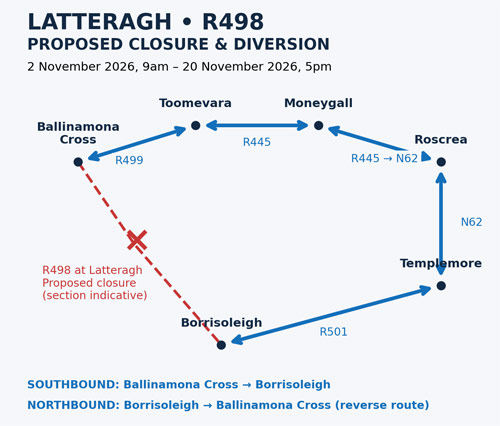
Tipperary County Council proposes to close the R498 at the Latteragh realignment works, affecting motorists travelling between Nenagh and Thurles.
When Would The Road Close? From 9:00am on Monday, 2nd November 2026, until 5:00pm on Friday, 20th November 2026, to facilitate construction of the realignment project.
Southbound Diversion Traffic will divert at Ballinamona Cross, following: R499 to Toomevara → R445 towards Moneygall → N62 via Roscrea and Templemore → R501 to Borrisoleigh.
Northbound Diversion Traffic will divert in Borrisoleigh village, following the same route in reverse. Diversions will be fully signposted.
Allow Extra Time The diversion could bring additional traffic and delays around Borrisoleigh, particularly during school drop-off and collection times. Parents, teachers, commuters and other road users should allow extra journey time and follow the diversion signs.
Motorists travelling through County Tipperary in early October should plan ahead for two proposed overnight closures on the M8 motorway to facilitate road resurfacing.
Tipperary County Council’s proposal affects the section between Junction 6 at Horse and Jockey and Junction 7 at Cashel North, with each direction scheduled to close on a different night.
The southbound closure is planned from 9:00pm on October 5th until 5:00am on October 6th, 2026. Traffic will be diverted through Horse and Jockey and along the R639 before rejoining the motorway at Junction 7, Cashel North.
The northbound closure is planned from 9:00pm on October 6th until 5:00am on October 7th, 2026. Drivers will leave at Junction 7 and follow the R639 towards Horse and Jockey, rejoining the M8 at Junction 6. Both proposed closures are scheduled to last some eight hours.
Anyone travelling during these hours should allow extra journey time, follow diversion signs and check for updated traffic notices before setting off.
A man, understood to be in his 60s has died following a collision involving a van and three cars at Cooper’s Lot on the R688 in Cashel, Co Tipperary, at approximately 5:40pm yesterday afternoon Monday, 14th September.
The man, who was driving one of the cars, was pronounced dead at the scene. A post-mortem examination is due to take place at University Hospital Waterford.
The van driver, a man in his 40s, suffered serious injuries and was taken to Tipperary University Hospital in Clonmel. No other injuries were reported.
The road was reported closed this morning for a forensic examination, with local diversions in place.
Gardaí are appealing for witnesses and dash-cam footage from anyone travelling in the Cooper’s Lot area between 5:00pm and 6:00pm on Monday.
This fatal Cashel collision, yesterday, brings to 8 the number of people killed on Tipperary roads so far this year.
Anyone with information is asked to contact Cahir Garda Station on Tel: 052 7445630, the Garda Confidential Line Tel: 1800 666 111, or indeed any Garda station.
New safety regulations for e-scooters will take effect on Friday next, September 4th 2026.
Under the regulations, anyone using an e-scooter in a public place must:
Wear a helmet.
Wear high-visibility clothing.
Continue to comply with the existing minimum age of 16.
Follow existing rules governing speed, equipment, passengers and where e-scooters may be used.
The measures follow a rise in serious injuries involving e-scooters, particularly head injuries among children. Gardaí will be able to identify breaches of the protective-equipment rules through roadside enforcement.
A €100 fixed-charge fine for offences including riding without a helmet is expected to be introduced separately in the coming weeks. It is therefore important not to describe that fine as taking effect on September 4th next.
The Government also plans to raise the minimum riding age from 16 years to 18 years. That change is not yet in force because it must first complete the European Union’s Technical Regulation Information System process. The process can take up to 12 weeks, with implementation expected before the end of 2026.
Charges associated with seized e-scooters are also due to increase in early October. Further proposals under consideration to possibly include insurance, licensing and registration requirements.
Two reports present contrasting pictures of Irish tourism in 2026.
Fáilte Ireland’s business sentiment survey reveals falling turnover and widespread concern among operators, while official Central Statistics Office figures show growth in foreign visitors and expenditure. The reports are not necessarily contradictory. They measure different aspects of tourism and suggest that national growth is not reaching every business, sector or region equally.
First report: Tourism operators report declining turnover Fáilte Ireland surveyed 643 tourism businesses about trading conditions in the year to May. Only 24% reported increased revenue compared with 2025, while 25 per cent recorded no change and 51 per cent experienced a decrease. B&Bs, activity providers, pubs and bars were among the weakest-performing sectors. Businesses along the Wild Atlantic Way also reported particularly difficult conditions.
Dublin performed more strongly. In the capital, 38% of businesses reported increased revenue and the same proportion recorded a decline. Nationally, however, 43% expected revenue to fall during the remainder of 2026, compared with 29% anticipating growth. Approximately three-quarters of operators said the Middle East conflict had affected their businesses. Among those reporting an impact, 74% cited higher energy costs, 55% experienced other cost increases and 53% were affected by disruption associated with April’s fuel protests. Half reported increased cancellations, while 45% said bookings had declined. Hotels also observed that longer leisure stays were becoming less common.
Businesses are responding cautiously. Some 55% were seeking cost reductions, one-third planned to absorb increased expenses and another third intended to target domestic holidaymakers. That strategy may prove challenging because many operators believe Irish consumers have less disposable income. Fáilte Ireland stressed that the findings represent operators’ opinions rather than verified financial results. Sentiment may have been influenced by strong expectations following 2025, persistent cost pressures and a succession of negative international developments.
Hidden Heartlands and the Tipperary position. Ireland’s Hidden Heartlands broadly reflected the national difficulties. In that region, 20% of respondents reported increased revenue, 30 per cent recorded no change and 50 % experienced a decline. Looking ahead, 28% of Hidden Heartlands businesses expected revenue to increase during the remainder of 2026, while 26% anticipated no change and 46% expected a decrease. This result was slightly better than the Wild Atlantic Way, where 56% reported falling revenue to date and 48% expected a decline during the remainder of the year. Nevertheless, the Hidden Heartlands figures indicate considerable pressure on inland and rural tourism businesses.
These regional findings cannot be treated as figures for Tipperary or Thurles. Parts of Tipperary, particularly around Lough Derg, are promoted through Ireland’s Hidden Heartlands, but other parts belong to Ireland’s Ancient East. Fáilte Ireland’s consumer tourism site identifies Thurles specifically as part of Ireland’s Ancient East. Neither region’s results provide a reliable stand-alone measurement of tourism performance in the town.
The survey contains no county or town-level breakdown. It therefore shows the wider environment in which Tipperary businesses are operating, rather than proving that local turnover followed the regional pattern.
Second report: Foreign visitors and expenditure increase
The CSO recorded 676,300 completed foreign-resident visits in July 2026. This was 5% above July 2025 and 3% higher than in July 2024. Approximately 3.9 million foreign visits were completed between January and July; 13% more than during the equivalent period of 2025, although only 0.4 per cent above 2024. Visitors spent 5.2 million nights in Ireland during July, an annual increase of 2%. Average stays nevertheless declined from 7.9 to 7.6 nights. This shortening of visits may help explain why some accommodation, hospitality and activity businesses did not experience growth matching the increase in arrivals.
Great Britain and Continental Europe each supplied 32% of visitors, while North America accounted for 30%. Half travelled for holidays and leisure, 29% visited friends or relatives and 11% came for business. Foreign visitors spent an estimated €681 million, excluding fares, 9% more than in July 2025. North Americans contributed €300 million, or 44% of the total, demonstrating the market’s disproportionate economic importance.
All CSO figures are national and do not identify how many visitors travelled to Tipperary or Thurles, or how much they spent there.
Growth is real but uneven. Higher visitor numbers and national expenditure do not guarantee increased revenue for every operator. Spending may be concentrated in Dublin, hotels and major attractions, while smaller rural businesses receive a limited share. Some 33% of July visitors stayed with family or in their own property, further restricting benefits for commercial accommodation. Shorter stays and rising energy, fuel, payroll and supply costs can also weaken margins despite increasing visitor expenditure.
The combined evidence therefore points to uneven growth; Ireland is attracting more foreign visitors, but regional operators remain under pressure. For Tipperary and Thurles, the national and regional findings provide important context, but more detailed local data would be required to establish their actual tourism performance. However, Thurles Tourist Office’s promotion of local nail bars, coffee shops and clothing stores as a means of attracting international visitors must be regarded as out of touch with the realities of attracting foreign tourism.
This website uses cookies to improve your experience. We'll assume you're ok with this, but you can opt-out if you wish.AcceptRead More
Privacy & Cookies Policy
Privacy Overview
This website uses cookies to improve your experience while you navigate through the website. Out of these, the cookies that are categorized as necessary are stored on your browser as they are essential for the working of basic functionalities of the website. We also use third-party cookies that help us analyze and understand how you use this website. These cookies will be stored in your browser only with your consent. You also have the option to opt-out of these cookies. But opting out of some of these cookies may affect your browsing experience.
Necessary cookies are absolutely essential for the website to function properly. This category only includes cookies that ensures basic functionalities and security features of the website. These cookies do not store any personal information.
Any cookies that may not be particularly necessary for the website to function and is used specifically to collect user personal data via analytics, ads, other embedded contents are termed as non-necessary cookies. It is mandatory to procure user consent prior to running these cookies on your website.






Recent Comments