There are many great engineering feats across the world. The Pyramids. The Great Wall of China. The Hoover Dam. And now, proudly joining that list… The Invisible Night-Time Car-Destroying Humps of Liberty Square, Thurles car park.
Yes, nestled in the thriving town of Thurles; a place known for its culture, history, and increasingly, its ability to test a car’s suspension beyond factory specifications; two magnificent road humps have been installed in the new car park situated south of Liberty Square. Not just any humps. Extremely high humps.The kind that don’t slow traffic; they redefine it.
Picture the scene. It’s dark. You’re driving home. All is calm. Then suddenly, BANG. Yes you’ve just discovered one of Thurles’ newest attractions; “Guess Where the Hump Is.” No reflective paint. No triangular hazard markings. No “hazard teeth.” Not even a polite hint. Just raw, unfiltered suspense. In fact, the lack of proper road markings is not even new to the area, concerns have previously been raised that road markings around Liberty Square are confusing and unsafe. But why stop at confusing when you can go full invisible ambush?
Vehicle Undercarriage Adjustment Programme, (V.U.A.P.). Locals report that cars are now receiving what engineers are calling: “Unscheduled structural realignment.” Others might call it: “The exhaust is now optional.” Between these humps and existing road issues, Thurles is quietly becoming Ireland’s leading centre for :- Suspension stress testing; Shock absorber retirement schemes, and spontaneous undercarriage redesign. And if you think that’s dramatic consider this: Tipperary has already seen over €50,000 paid out in compensation for pothole-related vehicle damage in recent years.
So clearly, the strategy is evolving; If potholes don’t finish the job, the humps will. While Thurles boldly pioneers the construction of Everest-sized speed ramps, meanwhile, the Potholes Live On. Oh, the potholes are heritage sites now. Protected. Preserved. Possibly getting listed. Residents have long complained about roads in poor condition, with some routes described as “full of potholes” and “very poor” , and even “deplorable” in broader Tipperary reports.
But filling them? Ah no, sure that would be reckless. Why eliminate a pothole when you can simply install a hump nearby and let drivers experience both?
It’s about balance. Engineering Brilliance (Or Something Like It), so let’s admire the process:-
Build two extremely aggressive road humps ✔️
Forget the hazard markings ✔️
Leave them practically invisible at night ✔️
Place them where unsuspecting drivers will absolutely hit them ✔️
This is not a mistake. This is performance art. A bold statement on modern infrastructure. A physical metaphor for life in Thurles: “You won’t see the problem… until it hits you.”
Final Thought:- Add a scoreboard; Give out prizes for best airborne moment, and rebrand the car park as: “Liberty Square Adventure Zone”.
Over 5,000 Speeding Offences Detected as Gardaí warn of ongoing road safety risks.
An Garda Síochána has described road safety compliance during the recent St Patrick’s bank holiday enforcement period as deeply disappointing, with more than 200 motorists arrested on suspicion of driving under the influence of alcohol or drugs over the past seven days.
In Tipperary, within the past 7 days at least several arrests linked to drink- and drug-driving enforcement were reported during the St Patrick’s bank holiday period, including a drink-driving arrest in Cahir, a serious drink-driving incident in Cashel, and a suspected drug-driving arrest in South Tipperary.
Speaking on RTÉ Radio’s Morning Ireland, Superintendent Mr Liam Geraghty of the Garda Press Office said the provisional figures showed a troubling level of dangerous behaviour on Irish roads, despite widespread public discussion about road deaths, road safety, and increased Garda enforcement over the holiday period.
Superintendent Geraghty said the level of offending was especially concerning given the visibility of the Garda road safety campaign and the additional checkpoints put in place during the St Patrick’s operation.
Gardaí also expect that more than 5,000 drivers will have been detected speeding during the same seven-day period. According to Superintendent Geraghty, this represents a significant rise on the 2025 average of approximately 500 speeding detections per day, with the bank holiday weekend seeing daily detections exceed 700.
He highlighted one particularly serious example in which a vehicle was detected travelling at 112 km/h in a 50 km/h zone on the R183 in Monaghan, describing it as motorway speed on a small urban road in a built-up area.
Superintendent Geraghty said it was a major concern that, despite advance notice of increased checkpoints and enforcement activity, such high numbers of road users continued to take the risk of speeding or driving under the influence, placing themselves, their passengers, and other road users in danger.
He further noted that six people had died on Irish roads since the Garda road safety operation was launched the previous Wednesday at the Road Safety Conference in Killarney.
Referring to public attitudes, Superintendent Geraghty said there appeared to be a disconnect between what people say about road safety and how some behave in practice. He pointed to RSA survey findings indicating that 12 per cent of Irish motorists admit to driving under the influence of alcohol, while more than 25 per cent believe driving a short distance after drinking is acceptable.
Superintendent Geraghty also defended current Garda road policing resources, stating that 647 personnel are now assigned full-time to roads policing duties. He said this is the largest specialist area within An Garda Síochána and is supported by uniformed and plainclothes members across the organisation.
He added, however, that enforcement alone cannot eliminate dangerous driving, noting that even if every Garda member were deployed on the roads, there would still be many stretches without visible Garda presence. He said personal responsibility remains essential and urged all drivers to act safely for their own sake and for the safety of all road users.
Gardaí are appealing for witnesses after a male pedestrian was seriously injured in a road traffic incident in Cashel, Co. Tipperary.
The collision happened shortly after 11.00pm on the Clonmel Road (R692) on Sunday night. The injured man, who is in his 20s, was taken to Cork University Hospital, where he is receiving treatment for serious injuries. No other injuries were reported.
A technical examination of the scene was carried out by Garda Forensic Collision Investigators, and the roadway has since reopened to traffic.
Investigating gardaí are particularly anxious to speak with three motorists who travelled along the route and passed the pedestrian before the collision occurred.
Any road users who were travelling on the Clonmel Road in Cashel between 10.30pm and 11.00pm, and who may have camera footage, including dash-cam recordings, are asked to make it available to gardaí.
Anyone with information is asked to contact Cahir Garda Station on Tel: 052 744 5630, the Garda Confidential Line on Tel: 1800 666 111, or indeed any Garda Station.
Fresh figures showing compensation paid to motorists for pothole damage underline the continuing burden poor road conditions are placing on drivers across county Tipperary.
Tipperary County Council has paid out €50,105 in compensation for pothole-related vehicle damage since 2023. While this is below the very highest totals seen elsewhere in our emerald isle, it still places Tipperary among the more significant local authority payouts and points to a persistent problem on our counties roads.
These figures must be seen in the wider national context. Local authorities paid approximately €1.3 million in compensation to motorists over the past three years for pothole-related damage. That is a serious cost to the public purse, but it is also a direct cost to families, workers and business owners, latter who rely on safe and passable roads every day.
What is particularly concerning in Co. Tipperary is that the claims issue does not appear to be isolated or short-term. Council management reports have shown an ongoing stream of pothole claims during 2024 and 2025, reinforcing the view that this is a recurring roads maintenance issue, rather than a once-off spike.
There is also concern that some motorists feel they were deliberately ignored or did not receive adequate responses, after raising road damage issues. That only adds to public frustration. When people take the time to report hazardous road conditions or seek redress for damage caused, they are entitled to clear communication, fair treatment and timely follow-up.
It is important to state that councils are not automatically liable for every pothole-related incident. In general, compensation arises where there is evidence of negligence or where repairs or interventions may have been carried out to an insufficient standard. However, that makes it all the more important that repairs are durable, properly inspected and carried out before defects worsen and place more motorists at risk.
The real issue here is not only compensation after the fact. The real issue is prevention. Tipperary needs a stronger and more proactive road maintenance programme, faster response times to reported defects, better quality control on repairs, and greater transparency for the public on how complaints and claims are handled.
Real Costs of getting behind the wheel of a vehicle here in Ireland. Irish motorists continue to face an escalating financial burden, with basic motoring-related taxes and charges estimated to generate some €6.2 billion annually for the State. From high fuel costs driven by excise duty, carbon tax, VAT and additional levies, to Vehicle Registration Tax and annual motor tax, drivers are contributing at every stage of car ownership and use. On top of these standard charges, motorists must also absorb insurance levies, tolls, NCT fees, parking charges and a growing range of fines and penalties for road traffic and parking offences, all of which add to the overall cost of getting behind the wheel. Yes, and I haven’t mentioned property tax which is partially associated in housing same vehicle. While electric vehicle owners currently benefit from reduced rates in some areas, concern is mounting that further measures, including a proposed weight-based tax on heavier vehicles such as SUVs, could place even more pressure on drivers in the years ahead. Motorists should therefore not be left paying the price for road failures that could and should have been addressed months earlier.
Motorists are calling on Tipperary County Council to:
prioritise lasting repairs on known problem routes,the streets of Thurles town being one neglected area
improve response systems for motorists reporting potholes and road damage,
ensure all complainants receive timely acknowledgement and follow-up,
publish clearer local data on pothole complaints, repairs and claims outcomes.
People across Tipperary deserve safer roads, better accountability, and a council response that is effective, transparent and fair.
A significant roads funding package for 2026, announced in February 2026, has been outlined for Tipperary, covering both regional/local roads and national roads.
Regional & Local Roads (Tipperary County Council): €49,379,670. The largest share of the allocation is directed toward the day-to-day upkeep and long-term resilience of the county’s regional and local network.
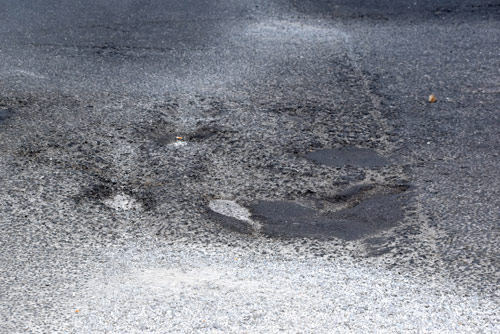
Over last weekend, you’d be forgiven for thinking Thurles, Co. Tipperary, had been abandoned, judging by the state of our streets. Once again we’re driving on loose gravel, while yesterday’s potholes are “repaired” with cold tarmac tipped straight into puddles, as if water were a suitable foundation.
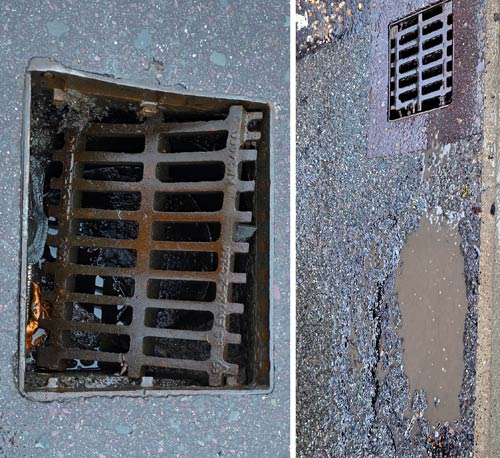
Worse than that, a drain cover was left open since last Thursday, near to the junction at Bowe’s corner; the grate cover having been dislodged in direct line with vehicle wheels. (See picture featured hereunder.)
Pic 1 Left: Grate cover dislodged. Pic 2 Right: On Barry’s Bridge, once again, a sinking surface, as 18 wheelers bounce over a raised pedestrian platform. Pictures: G.Willoughby.
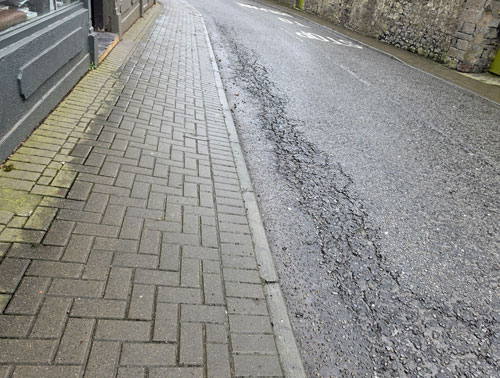
Parnell Street, Thurles beginning to sink and unravel with footpath now at a distinct sloaping angle. Picture: G. Willoughby.
“Protection & Renewal”: €36,234,670. Within the regional and local roads budget, €36,234,670 is assigned to Protection & Renewal. This funding supports a wide range of works and programmes, including:
restoration, improvement, and maintenance works
discretionary schemes
bridges and structures
drainage projects
road safety measures
climate adaptation works
community involvement initiatives (and other related supports)
National Roads (Tipperary): €8,360,343.
In addition, €8,360,343 has been allocated for national roads within Tipperary, supporting key routes that play a major role in commuting, freight, and regional connectivity.
A Combined Local Package of Approximately €57.7m. Taken together, the figures referenced locally bring the overall roads investment package for Tipperary to around €57.7 million for 2026.
National Context: Over €1.5bn for Roads in 2026. For broader context, the Department of Transport has stated that more than €1.5 billion was provided nationally in 2026 for national roads and regional/local roads, placing the Tipperary allocation within a substantial nationwide investment programme.
This website uses cookies to improve your experience. We'll assume you're ok with this, but you can opt-out if you wish.AcceptRead More
Privacy & Cookies Policy
Privacy Overview
This website uses cookies to improve your experience while you navigate through the website. Out of these, the cookies that are categorized as necessary are stored on your browser as they are essential for the working of basic functionalities of the website. We also use third-party cookies that help us analyze and understand how you use this website. These cookies will be stored in your browser only with your consent. You also have the option to opt-out of these cookies. But opting out of some of these cookies may affect your browsing experience.
Necessary cookies are absolutely essential for the website to function properly. This category only includes cookies that ensures basic functionalities and security features of the website. These cookies do not store any personal information.
Any cookies that may not be particularly necessary for the website to function and is used specifically to collect user personal data via analytics, ads, other embedded contents are termed as non-necessary cookies. It is mandatory to procure user consent prior to running these cookies on your website.







Recent Comments