Fines for a total of 16 road safety offences have doubled today.
Implementation of Action 30 of Road Safety Strategy.
Stronger deterrent to those who choose to break our lifesaving rules of the road.
World Health Organisation, estimate 5% reduction in average speed could result in a 30% reduction in fatal collisions.
Fines for speeding, will increase from €80 to €160, while fines for mobile phone use; the non-wearing of seat belts; and failing to ensure that a child is properly restrained within a motor vehicle, will rise from €60 to €120, and all with effect from midnight last night.
Fines for a learner permit holder driving a vehicle unaccompanied by a fully qualified licence bearing person will now increase from €80 to €160. Novice and learner drivers who fail to display ‘L’ or ‘N’ plates, or tabard vests in the case of motorcyclists, will see their fines also doubled to €120.
Three new fixed-charge notices will also come into force in early 2023, same relating to the misuse of a disabled parking permit (Fine €200), illegally parking in an electric charging bay (Fine €80) and breaching a heavy goods vehicle (HGV) ban and entering a specified public road without a valid permit (Fine €200).
These new measure comes into effect as the death toll on Irish roads this year has already risen to 122, an increase of 11 deaths, when compared to the same period last year.
However, motorists believe that this doubling of road offence fines has more to do with raising Irish revenue, rather than reducing deaths on our roads.
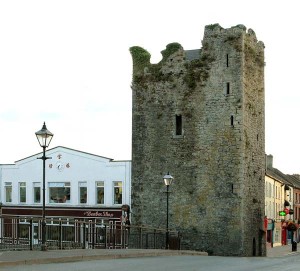
Traffic was brought to a halt at about 12:00 noon today, here in Thurles, when a female pedestrian, came into contact with a moving vehicle in the area of Barry’s Bridge and Barry’s Castle.
The lady pedestrian is understood to possibly have lost her balance, leaving a nearby pavement, before colliding with a slow moving vehicle, latter exiting from Barry’s Bridge unto Emmett Street in the town.
It was raining heavily at the time of the accident, as confirmed by extensive flooding on nearby Kickham Street, for the second time in just 10 days.
Despite backed up heavy traffic, and the narrow streetscape, Gardai and an Ambulance crew managed to effectively reach the scene.
The female pedestrian managed to walk to the ambulance aided by crew and from her posture appeared to be suffering from shock and possibly slight head injuries.
Major rail works, currently being undertaken, are expected to bring disruption to train journeys this coming Halloween Bank Holiday weekend.
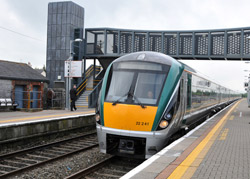
Due to a series of track and signalling works taking place, Iarnród Éireann have warned customers that a revised timetable will come into effect this October Halloween Bank Holiday weekend, and those expecting to travel, using the service, are being advised to book in advance.
These major works will be taking place, affecting Cork, Kerry and Limerick services, from Saturday afternoon to Monday morning.
The line between Portarlington and Thurles will be closed from 14:30 on Saturday.
All services between Dublin and Cork, Kerry and Limerick will be part-replaced by bus transfers, thus resulting in this revised schedule.
Note: Services between Cork and Dublin (Heuston) will operate on a revised schedule, with bus transfers between Thurles and Kildare set to operate in both directions.
People are being asked to please check time schedules before making essential journeyswith full details to be shown online atwww.irishrail.ie.
Direct services between Limerick and Dublin (Heuston) are cancelled. Journeys between Limerick and Dublin Heuston, involving a change at Limerick Junction, will have bus transfers between Thurles and Kildare, in both directions.
Direct services between Tralee and Dublin (Heuston) will operate as follows:
Saturday: 17:05, Heuston Station, Dublin to Tralee will operate between Mallow and Tralee only.
Sunday: 08:30Heuston Station, Dublin to Tralee will operate with bus transfers between Thurles and Kildare. Commuter services between Portlaoise and Dublin Heuston will involve bus transfers between Portlaoise and Portarlington in both directions.
Irish Rail apologise to their customers, in anticipation of any inconvenience brought about by these essential repairs and updates.
You can’t trust sewage or drainage pipes….They’re full of crap.
You would think that following the major flooding of our Thurles streets, last Sundays night; which saw 73.2mm to 125mm [3 to 5 ins] of sewage, permeated with surface water, flooding business premises and other dwellings, that those who raised our property taxes by 10% each year for the next two years, would have cleaned out our blocked drains.
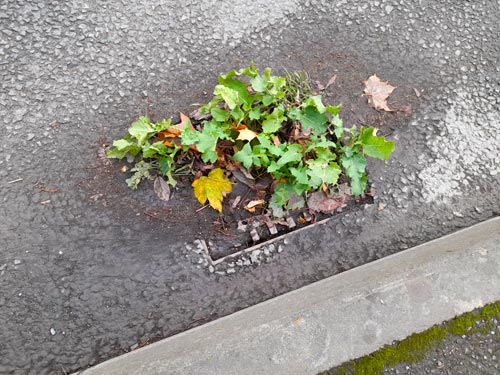
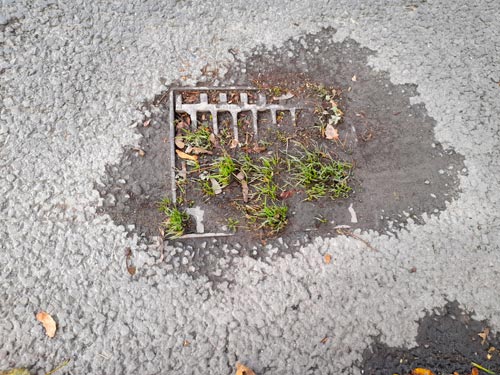
No, five days later, total failure, I regret to report; as pictured by our drone this morning within the 50 kilometre [30mph] speed limit area, between O’Carroll’s (Top Oil) Service Station and Thurles Lidl Supermarket, on the N62, Slievenamon Road in the town.
N62 Slievenamon Road, Thurles, Co. Tipperary, October 21st 2022. [Pic. G. Willoughby]
The N62 road is a national secondary road linking the M6 motorway east of Athlone, Co. Westmeath with the M7 motorway south of Roscrea and junction 6 of the M8 motorway close to the Horse and Jockey in Co. Tipperary.
The N62 is well travelled daily by local councillors; Municipal District senior officials and staff. Because of heavy traffic, our “eye in the sky” was only able to hover over, and photograph just two of some 5 identified blocked drains, all within a 500 meter stretch of this secondary road.
Clue to locating blocked drains. Since, hopefully, you are driving within the 50 kilometre [30mph] speed limit laid down in this area, recently prone to flooding, it is easy to locate the blocked drains.
N62 Slievenamon Road, Thurles, Co. Tipperary, October 21st 2022. [Pic. G. Willoughby]
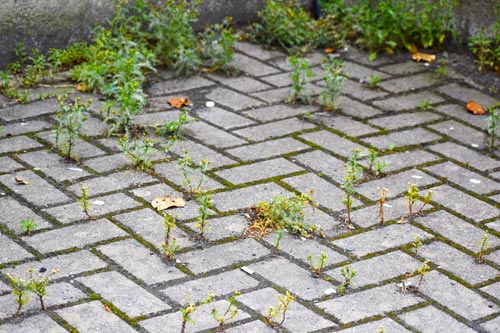
First check for tall Grass; various sprouting Brassicas; (latter genera of plants relatives of the cabbage and mustard family), Dandelines, frost tolerant Common Groundsel and germinating Wheat seed. Same growth can be located growing, like tiny islands, on tarmacadamed road surfaces, usually located close to kerbs; growing from what appear to be at first potholes.
Here also is yet another clue; Thurles potholes (which we are aware number 3,978, following a more recent count by the Central Statistics Office) are for some unknown reason, usually round, disk shaped, or hoop-shaped on our Tipperary roads. Blocked drains on the other hand, for some strange reason and for the most part are quadrate or rectangular in shape.
Same are used everywhere else in Ireland, except Thurles town, to drain away excess rain and ground water from impervious surfaces, such as paved or tarmacked streets, car parks, parking lots, footpaths, side-walks, and roofs of buildings. But then Thurles is big into promoting biodiversity, as can be seen by the state of our polluted river Suir, our pavements and our local graveyards.
Section of current Thurles pavement. [Pic. G. Willoughby]
Once identified, one wonders should Thurles Municipal District Council contact Irish Water; or the Office of Public Works; or maybe Iascach Intíre Éireann (Inland Fisheries Ireland)? Maybe there is some other government department that Thurles Local Councillors can blame befort shifting responsibility.
A must read for Thurles residents and their businesses.
QUESTION: Were Thurles Councillors & Officials duped yet again at their Monday meeting with Irish Water officials?
Poorly treated sewage continues to harm the quality of our rivers, lakes and coastal waters, says EPA.
Just half (51%) of Ireland’s sewage was treated to the European Union standards set to protect our environment, well below the EU average of 90%.
Works to eliminate raw sewage flowing into seas and rivers from 32 towns and villages have commenced or are due to start by 2024.
Irish Water has no clear plan to improve treatment at 27 priority areas where waste water discharges are impacting on rivers, lakes and coastal waters.
The EPA report on Urban Waste Water Treatment in 2021, [Found HERE]and released today, shows that investment in waste water infrastructure is delivering improvements to priority areas identified by the EPA, but treatment at many areas is still not as good as it needs to be.
Emmett Street running parallel with River Suir.
“Irish Water does not have clear plansin place to deal with one-third of the priority areas where waste water is adversely impacting the environment and has not allocated resources in its investment plan to complete improvements at these areas” ~ says EPA
Irish Water must provide for all improvements needed at these areas in its next investment plan, which covers the period 2025-2029.
Launching the report today, Dr Tom Ryan, EPA Director said: “This report shows that targeting investment at the priority areas identified by the EPA is delivering improvements in water quality, and the elimination of raw sewage discharges from Cobh and Castletownbere in Cork are good examples of progress. However, it will take a high level of sustained investment over the next two decades to bring all treatment systems across the country up to the required standard to protect the environment and public health”. Dr. Ryan added: “Irish Water has failed to produce action plans to improve treatment at one-third of the priority areas identified by EPA where waste water is harming our rivers, lakes and coastal waters. It is essential that Irish Water provides clear, site specific action plans and time frames to improve treatment in these areas, and it needs to allocate the necessary resources in its next investment cycle to implement and complete them and to resolve the associated environmental harms”.
Ireland’s largest treatment plant at Ringsend in Dublin is overloaded and fails to consistently treat sewage to the required standards. A major upgrade of the plant began in 2018 and is due to be completed in 2025. Construction work to provide treatment for the 32 areas discharging raw sewage listed in the report is either ongoing or due to start in the next two years. It is essential that Irish Water delivers these projects as soon as possible.
Mr Noel Byrne, EPA Programme Manager said: “Sixteen years after the final deadline to comply, half of Ireland’s sewage is still not treated to the standards set to protect the environment. It is particularly concerning to see some towns such as Ballymote in Sligo failing in 2021, despite having the necessary treatment infrastructure and meeting the standards in 2020. This highlights the need for improved vigilance and oversight by Irish Water to make sure treatment infrastructure is always operated at its optimum”.
The report also highlights that Irish Water needs to improve its information on the condition and performance of sewers to inform and plan upgrade works necessary to mitigate environmental risks from sewer overflows.
The report is now available on the EPA websiteHERE.
This website uses cookies to improve your experience. We'll assume you're ok with this, but you can opt-out if you wish.AcceptRead More
Privacy & Cookies Policy
Privacy Overview
This website uses cookies to improve your experience while you navigate through the website. Out of these, the cookies that are categorized as necessary are stored on your browser as they are essential for the working of basic functionalities of the website. We also use third-party cookies that help us analyze and understand how you use this website. These cookies will be stored in your browser only with your consent. You also have the option to opt-out of these cookies. But opting out of some of these cookies may affect your browsing experience.
Necessary cookies are absolutely essential for the website to function properly. This category only includes cookies that ensures basic functionalities and security features of the website. These cookies do not store any personal information.
Any cookies that may not be particularly necessary for the website to function and is used specifically to collect user personal data via analytics, ads, other embedded contents are termed as non-necessary cookies. It is mandatory to procure user consent prior to running these cookies on your website.







Recent Comments