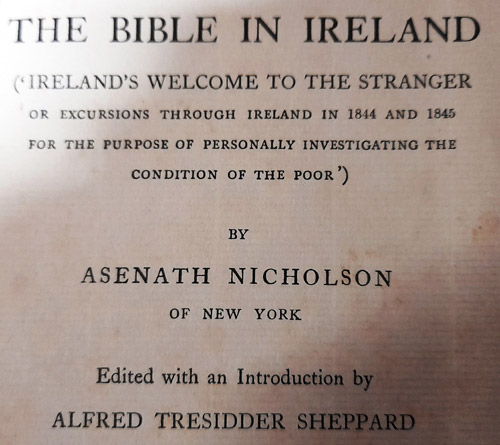
In a rare book, [edited with an introduction by Alfred Tresidder Sheppard, (London 1871-1947)], entitled “The Bible in Ireland”(Ireland’s welcome to the stranger or excursions through Ireland in 1844 and 1845 for the purpose of personally investigating the conditions of the poor), written by Asenath Nicholson; we learn of her visit to Thurles, Co. Tipperary and other nearby villages, including Gortnahoe, Urlingford, Cashel and Holycross.
Asenath Nicholson writes: “The celebrated estate of Kilcooley, (Gortnahoe, Thurles, Co. Tipperary) has descended by hereditary title, from the days of Cromwell, till it is now lodged in the hands of one who shares largely in the affections of all his tenants, especially the poor.
The wall surrounding his domain is said to be 3 miles in extent, including a park containing upwards of 300 deer and a wild spot for rabbits. A church and an ancient ivory covered Abbey, of the most venerable appearance, adorn part of it. But the pleasure of walking over those delightful fields is enhanced by the knowledge that his tenants are made so happy by his kindness. To every widow he gives a pension of £12 a year and to every person injuring himself in his employment, the same sum yearly, as long as the injury lasts.
His mother was all kindness, and her dying injunction to him was ‘to be good to the poor’. His house has been burnt*, leaving nothing but the spacious wings uninjured. An elegant library was lost.”
Note on ‘Burnt’ *. A huge accidental fire partly destroyed the property, causing it having to be reconstructed in the 1840s, during which the family occupied the old abbey. The interior today mostly dates from after that fire.
His mother, whom he ardently loved, was buried on the premises and his grief at her death was such that he left the domain for 12-months. He supports a dispensary for the poor, who resort to it twice a week, and receives medicine from a physician who is paid some £60 a year for his attendance. I was introduced to the family of this physician, to see his daughter, who had been a resident in New York some 6 years, and hoped soon to return thither to her husband and child, still living there. As I was seated a little son of 2 years old, and born in America stood near me. I asked his name. Yankee Doodle, ma’am was the prompt reply. This unexpected answer brought my country, with every national, as well as social feeling, to mind, and I classed the sweet boy in my arms. Let not the reader laugh; he may yet be a stranger in a foreign land. This name the child gave himself, and insists upon retaining it. O! those dear little children! I hear their sweet voices still: ‘God bless ye, lady, welcome to our country,’ can never be forgotten.
While in this family, I attended the Protestant church on Mr Barker’s domain* and heard the curate read his prayers to a handful of parishioners, mostly youths and children. By the assistants of a rich uncle of his wife’s, he can ride to church in a splendid carriage, which makes him tower quite above his little flock. His salary is £75 per annum.”
[Note on ‘Mr Barker’s domain’ *. Prior to 1770 the Barkers may not have spent much time at Kilcooley and when they were present, they lived in the old abbey, which had been modified to serve as a private residence. Without any direct heir provided by the last Sir William Barker in 1818, and following his death, his estate was inherited by his nephew, Chambre Brabazon Ponsonby, on condition he adopted the surname, ‘Barker.’ He in turn passed away in 1834 and the Kilcooley estate then passed to his eldest son, William Ponsonby-Barker of whom Asenath Nicholson speaks. Latter William referred, was himself an ardent Evangelical Christian and in the years prior to his death in 1877, he would habitually follow the example set by King David (c.1005–965 BCE), and Abishag, latter a native of the town of Shunem north of Mt. Gilboa in ancient Palestine, (See 1 Kings 1:1-4), originally brought to King David’s bed to “lie in his bosom”, chastely, to keep him warm as he neared death according to the Old Testament. As stated, the ageing William Ponsonby-Barker would also take a young woman to bed with him, as a human hot water bottle. It is said that be choose from among the housemaids, who were lined up following evening prayers. The story has been repeated down through the years, possibly repeated because on one occasion, the maid whom he selected, offended his sense of smell, so in the darkness he sprinkled her liberally from a bottle containing what he believed contained perfumed water. The following morning it was discovered that the bottle actually contained ink.]
Asenath NicholsonContinues: “Thurles, an ancient town in the County of Tipperary contains a good market house, fine chapel, college for Catholics, nunnery and charity school, with a Protestant church and Methodist chapel. I took a ride of 3 miles to visit Holy Cross, (Thurles, Co. Tipperary). On our way we passed a splendid estate, now owned by a gentleman who came into possession suddenly by the death of the former owner from whom he acted as agent. Last Christmas they had been walking over the premises in company; on their return the owner met with a fall and was carried home to die in a few hours. It was found he had willed his great estate to his agent. Holy Cross was the most vulnerable curiosity I had yet seen in all Ireland. We ascended the winding steps and looked forth upon the surrounding country, and the view told well for the taste of O’Brien, who reared this vast pile in 1076. (Today there are few remains of the original 12th/13th century church; only the north arcade of the nave and parts of the south aisle date from this time.) The fort containing the chapel is built in the form of a cross. The architecture, the ornamental work, and the roofs of all the rooms, displayed skill and taste. We visited the apartments for the monks; the kitchen where their vegetable food was prepared, and the place where repose so many of their dead. Pieces of skulls and leg bones lay among the dust, which had lately been shoveled up and as I gathered a handful and gave them to an old woman, who acted as my guide, she said, ‘This cannot be helped. I pick ‘em up and hide ‘em, when I see ‘em, and that’s all can be done; people will bury here, and it’s been buried over for years, because you see ma’am, it’s the place of saints. People are brought many miles to be put here the priest from all parts have been buried here, and here is the place to wake them,’ showing a place where the coffin or rather body was placed in a fixture of curiously wrought stone. The altars, though defaced, were not demolished; the basins cut out of the stone for the holy water were still entire; and though many a deformity had been made by breaking off pieces as sacred relics, enough remains to show the traveller what was the grandeur of the Romish Church in Ireland’s early history.
I stayed in Thurles with a Catholic family, and the husband endeavoured to induce me to become one church; but zeal was tempered with the greatest kindness.”
“Let the passer-by inscribe my epitaph upon this stone, ‘FANATIC’, what then? It shall only be a memento that one, in a foreign land, lived and pitied Ireland and did what she could to seek out its condition.”
Introducing Mrs AsenathHatch-Nicholson.
Mrs Asenath[pronounced A-se-nath]Hatch-Nicholson walked through Thurles, Co. Tipperary and indeed the greater Irish countryside, between the years 1844 and 1848, singing hymns, reading the Bible; while distributing Bibles and religious printed tracts, to the few who could read.
She was 52 years old, at the time of her arrival in Ireland, before commencing to walk the highways and byways of nearly every county in Ireland.
She took to the Irish roads wearing Indian rubber boots; a polka coat; underneath which she carried two filled bags of Bibles; same attached to her waist by a stout cord. The Bibles had been supplied by the Hibernian Bible Society, (founded in Dublin, Ireland in 1806; their aim to encourage a wider circulation of the Bible in Ireland). `
She is also recorded as wearing a large bonnet; a black bearskin muff; silver rimmed spectacles and carried an umbrella. A number of doctors had generously offered to remove a large wart from her face, of which she recorded, with some indignation, that same was possibly the reason that people were inclined to stare at her.
The poet W.B. Yeats would later refer to her, stating, “one of its missionaries who travelled Ireland has written her life, has described meeting in peasant cottages where everybody engaged in religious discussion, has said that she was everywhere opposed and slandered by the powerful and wealthy, because she was on the side of the poor”.
Asenath Hatch Nicholson (1792 – 1855). Above drawing attributed to Anna Maria Howitt.
In a rare book, [edited with an introduction by Alfred Tresidder Sheppard, (London 1871-1947)], entitled “The Bible in Ireland”(Ireland’s welcome to the stranger or excursions through Ireland in 1844 and 1845 for the purpose of personally investigating the conditions of the poor), written by Asenath Nicholson; we learn of her visit to Thurles, Co. Tipperary and other nearby villages, including Gortnahoe, Urlingford and Holycross.
Born the daughter of Michael and Martha Hatch in Chelsea, latter a village in the White River Valley of eastern Vermont, New England, United States; Asenath Hatch(February 24th, 1792 – May 15, 1855), grew up to became a teacher, a reforming journalist, a social observer and philanthropist, and a committed practising vegan.
Regarding the latter, her family had become interested in a diet recommended by Rev. Sylvester Graham, latter an American Presbyterian Minister and a dietary reformer, known for his emphasis on vegetarianism. At the age of 39, Asenath married her husband Norman Nicholson (Merchant c.1790–1841); latter a widower (c.1790–1841), with three children, in 1831, before moving with him, to live in New York. In the 1840s she ran boarding houses at No.118 Williams Street, New York and at No. 21 Beekman Street, Saratoga Springs, New York and at Wall Street, which offered a strict vegetarian menu and she would go on to publish what is regarded as the first Sylvester Graham Recipes, entitled “NATURE’S OWN BOOK: VEGETABLE DIET. FACTS AND EXPERIMENTS OF MANY YEARS PRACTISE.“
Asenath Nicholson’s diet advocated that; “good bread, pure water, ripe fruit and vegetables are my meat and drink exclusively.” Her published book did use some recipes containing dairy products, but for the most part advocated against their use.
Her family belonged to the Protestant Congregational Church (Protestant churches in the Calvinist tradition), where she was Christened with the name ‘Asenath‘, latter the biblical name of an Egyptian , [daughter of Poti-pherah, priest of the ancient Egyptian Town of On], whom the Pharaoh gave to Joseph son of Jacob, to be his wife; as a gift for his interpreting of the Pharaoh’s dream, [ See Genesis 41:45, 50 and Genesis 46:20. ], and after naming him ‘Zaphenath-Paneah’ possibly Egyptian meaning, “the revealer of secrets”.
Asenath’s Arrival In Ireland
It was in the cold attics and underground cellars, portrayed in the 2002 American epic historical drama film, “Gangs of New York“, (Five Points, area of Manhattan), that Asenath Nicholson first became acquainted with the extreme poverty of the Irish peasantry, and it was there that she identified that they were indeed a suffering people.
Following her husband’s possible separation and eventual death; in May 1844, Asenath left New York for Ireland, aboard the passenger packet vessel ‘Brooklyn‘ to begin for the next 15 months, her journey around the country, visiting almost every county. During her travels she rebuked people regarding their hygiene habits and their use and abuse of alcohol, tobacco, tea and coffee, which she argued was capable of giving its users “delirium tremens“, latter a severe mental or nervous system change.
Her parents in America had instilled in Asenath, from an early age, that idleness was both a sin and disgraceful. As she travelled, she noted that many people lacked employment, and relied almost entirely on their crop of ‘Lumper’ variety potatoes, to avoid starvation. In relation to employment Asenath Nicholson saw employment conditions in Ireland different to the then insensitive Sir Charles Edward Trevelyan*, (latter head of the British civil service), who regarded the Irish people as being lazy.
* In a letter to an Irish peer, the same Sir Charles Trevelyan wrote; “the judgement of God sent the calamity (i.e. the Great Famine), to teach the Irish a lesson”.
Asenath Nicholson identified and denounced many of the existing Protestant Irish landlords, for failing to grant employment to their tenants; then necessary in an effort to stave off hunger and extreme poverty being experienced by the latter. She declared that her own did not have a place for her and were it only that the Catholics took her in, she would have been without shelter. As a teacher, she visited Protestanted schools to learn that they are not being thought to read maps, since the children are conceived as being from the “lower orders”. Asking the same question, when visiting a Presentation Sisters Roman Catholic school, she learned that, though they are children of the poor, they are taught everything, as the nuns “do not know what God will expect of their assembled pupils”.
Regarding the Potato; she noted that on visiting the village of Roundstone in Co. Galway, a man described the potatoes to her as being; “The greatest curse that ever was sent on Ireland; and I never sit down, see, use, or eat one, but I wish every divil of ’em was out of the island.The blackguard of a Raleigh, (Refers to Sir Walter Raleigh 1552 – 1618), who brought ’em here, entailed a curse upon the labourer that has broke his heart. Because the landholder sees we can live and work hard on ’em, he grinds us down in our wages, and then despises us because we are ignorant and ragged.” Asenath would record, “This is a pithy truth, one which I had never seen in so vivid a light as now”.
Asenath noted seeing a woman with her daughters carding and knitting, which gave rise to her following comment; “This was an unusual sight for seldom had I seen, in Ireland, a whole family employed among the peasantry. Ages of poverty have taken everything out of their hands, but preparing and eating the potato, and then sit listlessly on a stool, to lie in their straw or saunter upon the street, because no one hires them”. She became loud in praise of the few resident landlords, who provided employment for their tenants and derided those who had abandoned the poverty stricken.
With her strong interest in the need for employment, there is little doubt that Asenath Hatch Nicholson would have left the Thurles area, before first visiting the work sites established by the Thurles/Rahealty Famine food committee, including the Great Famine Double Ditch; same sadly, recently, deliberately and knowingly, destroyed by Tipperary County Council, aided and abetted by self-serving local councillors, Thurles Municipal District officials and the town’s two resident politicians, namely J. Cahill & M. Lowry.
Asenath became enraged that grain was being diverted from food into alcohol. She was furious that grain was being used for distilling, which could feed the Irish pauper. It has often been charged that the government had allowed food to be exported while the inhabitants, remaining in Ireland, were left to starve. Nicholson looked at this issue of diverted food sources from another angle; charging that grain used for distilling alcohol could have fed the Irish poor. In 1847, with grain prices high, the consumption of legal spirits fell only about 25%, from approximately 8,000,000 gallons to about 6,000,000 gallons, and it took 30,000 tons of grain to distil 6,000,000 gallons of eighty proof spirits, which could have provided more than 300,000,000 servings of grain-based cereal. Irish Catholic priest and teetotalist reformer, Rev. Fr. Theobald Mathew, latter born in Thomastown, near Golden, County Tipperary, had earlier complained to the aforenamed Sir Charles Trevelyan, and also to judges in Thurles District Court, latter whom issued liquor licences, that “Pestiferous Erections”(make-shift public houses) were being erected at some relief work sites, including in the area of Upperchurch, Thurles, Co. Tipperary. [Same would account for the large number of pubs that once existed between Thurles and Kilcommon, Co. Tipperary]. In at least one case, a publican who was a member of a local relief committee, had recommended men get work, only on condition that they spent part of their wages on alcohol.
As soon as Asenath Nicholson arrived in Dublin on 7th December 1846, she wrote to the readers of the New York Tribune, [founded and published by Horace Greeley (1811-1872)] and another American Congregationalist minister; abolitionist, emancipator and former lawyer, Rev. Joshua Leavitt (1794-1873), in which she described conditions in Dublin city, and asking for assistance for the Irish poor. Asenath did not have the means to finance relief efforts herself and despaired that she had to witness a famine, without the necessary means to relieve the hungry. A letter duly arrived from Horace Greeley with money from his newspaper’s readers, which she regarded as something of a sign indicating divine intervention. Other friends also sent food, clothing and money to be distributed by her or to be sent by her to other trusted friends for similar distribution.
During July 1847 New Yorkers sent Asenath Nicholson five barrels of Indian corn aboard the United States frigate “Macedonia”. Using the funding she had acquired, she walked through areas of Dublin each morning, often distributing slices of bread from a large basket. She went on to open her own soup kitchen in The Liberties, in Dublin; an area she had selected because of its recognised extreme poverty.
Note: As early as 1789, the Republic of Vermont, the town where Asenath was born, had forbade the sale of slaves. Not herself being of the Quaker faith; it was not surprising that she befriended Quakers, who opposed slavery. In the autumn of 1848, like so many others, believing the Great Famine was over, Asenath Nicholson left Dublin for London. She was seen off to the boat, probably by her great friend the abolitionist Quaker and printer Richard Davis Webb one of the founder members of the Hibernian Antislavery Association. Webb, a friend of the Young Irelander member Thomas Davis and sympathetic to Irish nationalism; was one of the few Irish delegates who attended at the 1840 Anti-Slavery Convention in London, which also included Daniel O’Connell, (The Liberator).
The St. Patrick’s Day Parade committee are delighted to announce that this years (2023) the parade will return to the streets of Thurles on Friday, March 17th, after a three year absence caused by the Covid-19 virus pandemic.
The parade event will starts at 2:30pm in the town centre, with the theme this year being “The Past, Present & Future”, leaving the interpretation presented by each of the entrants or organisations wide open e.g. same may reflect a club or other organisations progress, viewed either through its past, its present, its future or all three such stages of its growth and progress, presented in a creative format combined.
Note: If you would like to contact the committee in relation to entries or sponsorships, please call their chairperson on Tel. No: 0851974620 or email hello@thurlestouristoffice.ie.
Prizes
1st Prize for Overall Winner — €1,000 plus Thurles St. Patrick’s Day Parade Trophy. 2nd Prize for Best Large Entry — €500 and a Trophy. 3rd Prize for Best Band Entry — €250 and a trophy. 4th Prize for Best School Entry — €250 and a trophy.
There will also be 12 Prizes and 600 medals, plus vouchers and trophies for further entries.
Two of societies golden rules remain as good today, as they have been in the past.
“What rules are they“, I hear you say.
*A person can check out the cleanliness of a hotel, by the state of its toilets. * A person can check out a communities pride in its self, by the state of its local cemetery.
State of St. Patrick’s Cemetery Loughtagalla, Moyne Road, Thurles, Co. Tipperary. Pic: G. Willoughby.
While individual family graves in St. Patrick’s Cemetery Loughtagalla, Moyne Road Thurles are kept in pristine condition, maintenance under the control of Thurles Municipal District Council, leaves a lot to be desired.
[See image above of the area upon which people are being asked to walk in an effort to reach nearby family graves.]
It is also worthy of note that St. Patrick’s Cemetery, situated at Loughtagalla, Moyne Road, Thurles, is one of the very few graveyards in Tipperary which does not list those interred there on the internet, other than one very brief mention on the charity website Commonwealth War Graves Commission.
With people across the world anxious to trace their family histories, surely a website identifying graves in St. Patrick’s would greatly benefit in attracting tourists to an area where Tipperary Co. Council has deliberately and with great success, totally destroyed the town’s past existence.
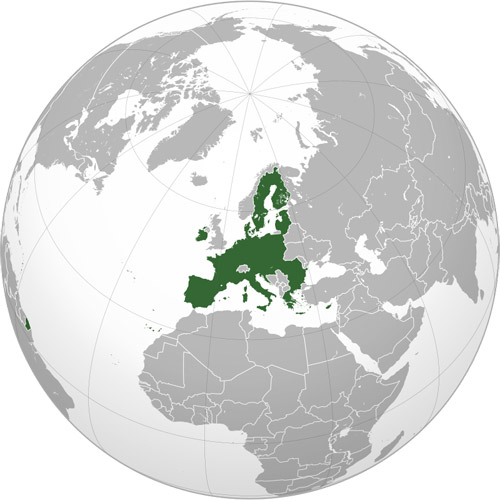
Minister for Tourism, Culture, Arts, Gaeltacht, Sport and Media Catherine Martin has welcomed the European Commission’s adoption of Ireland’s Territorial “Just Transition Plan” .
The adoption of the “Just Transition Plan” confirms significant Ireland/EU funding to support the Midlands region, as Ireland moves away from fossil fuels. The tourism element of the “Just Transition Plan” includes allocations of €38 million under Regenerative Tourism business supports and €30 million for a Tourism Trails Network.
Eight midland counties are expected to benefit from the allocation.
The eight counties expected to receive funding include Co. Tipperary, Co. Laois, Co. Westmeath, Co. Offaly, Co. Longford, Co. Roscommon, Co. Galway and Co. Kildare; all targeted areas that were previously heavily dependent on peat production.
CEO of Fáilte Ireland Mr Paul Kelly said: “This investment reinforces the value of tourism to the economic well-being and development of a destination. I want to pay tribute to the team at Fáilte Ireland for their tireless work over a number of months on developing our successful submission to the EU. The allocation to Fáilte Ireland is recognition of our expertise as the National Tourism Development Authority to deliver projects of scale that will create jobs, empower businesses and build stronger communities leaving a lasting legacy of transformative change that will enhance the appeal of the Midlands as a tourist destination for generations to come. It is an unprecedented investment in tourism, and one that is going to have a tangible economic impact in the towns and communities of Ireland’s Hidden Heartlands and Ireland’s Ancient East Fáilte Ireland is looking forward to working collaboratively with local tourism businesses and communities, the East and Midlands Regional Assembly (EMRA), Bord na Mona, Local Authorities, and our strategic partners including Waterways Ireland, National Parks and Wildlife Service and Coillte, to deliver this transformational project of scale.”
This EU “Just Transition Fund” in Ireland has 3 priority areas for investment:
Generating employment through diversification of the local economy.
Restoration of degraded peatlands and regeneration of industrial heritage assets.
This website uses cookies to improve your experience. We'll assume you're ok with this, but you can opt-out if you wish.AcceptRead More
Privacy & Cookies Policy
Privacy Overview
This website uses cookies to improve your experience while you navigate through the website. Out of these, the cookies that are categorized as necessary are stored on your browser as they are essential for the working of basic functionalities of the website. We also use third-party cookies that help us analyze and understand how you use this website. These cookies will be stored in your browser only with your consent. You also have the option to opt-out of these cookies. But opting out of some of these cookies may affect your browsing experience.
Necessary cookies are absolutely essential for the website to function properly. This category only includes cookies that ensures basic functionalities and security features of the website. These cookies do not store any personal information.
Any cookies that may not be particularly necessary for the website to function and is used specifically to collect user personal data via analytics, ads, other embedded contents are termed as non-necessary cookies. It is mandatory to procure user consent prior to running these cookies on your website.







Recent Comments