Community Spirit to Shine at Thurles St Patrick’s Day Parade.
Thurles is preparing for a vibrant celebration of community, culture and colour, as final arrangements continue for the town’s 2026 St Patrick’s Day Parade.
The event will take place on Tuesday, March 17th, with participants gathering on Abbey Road before making their way into Liberty Square at 2.30pm. Ahead of this years parade, traditional music will begin in Liberty Square from 1.30pm, helping to set the tone for what organisers hope will be a festive and well-supported afternoon.
This year’s celebrations will also place a strong emphasis on inclusion. A sensory area is being provided for those with additional needs, while Ukrainian groups have been invited to take part and share their culture as part of the day’s programme.
Organisers have spent recent weeks working to raise the funds needed to stage the event, with church gate collections taking place across neighbouring parishes. Having already collected in Holycross/Ballycahill last weekend, volunteers are now turning their attention to Thurles. The overall cost of the parade is expected to come in at between €8,000 and €9,000.
A number of awards will be presented on the day, with plaques, medals and prizes across categories including Best Performance/Art/Education, Best Dressed Window, Best Small Entry, Best Traditional Window, Best Sports, Judges’ Special Award, Best Individual Entry, Best Walking Group and Best Large Entry. A vase sponsored by Supermac’s will be awarded to the Best Large Entry, while the overall winner will receive a trophy sponsored by Michael’s Jewellers. The current prize fund stands at between €1,800 and €2,000.
The theme for this year’s parade is simple: “Wear Green”. Organisers are encouraging everyone attending to embrace the occasion in style and help fill the town with colour on the national day. They are also appealing for additional stewards to assist with the running of the event. Anyone interested in helping can contact Mobile Tel. No: 087 977 4725.
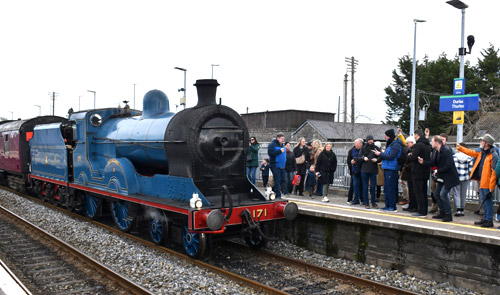
The No. 171 “Slieve Gullion” Steams into Thurles at 11:57am This Morning, Marking Another Milestone for Irish Main Line Steam.
Great Northern Railway (Ireland) S Class 4-4-0 No. 171 “Slieve Gullion”, arrived into Thurles Railway Station at 11:57am this morning, drawing a warm welcome as the Railway Preservation Society of Ireland’s (RPSI) flagship steam locomotive continues its return to regular main line operation.
Today’s working forms part of the RPSI’s “An Sáirséal” Steam & Diesel Special operating between Dublin Connolly and Limerick, with No. 171 hauling the train from Dublin Connolly to Thurles, before an 071 Class diesel takes over for the onward run to Limerick.
Built by Beyer, Peacock & Co. in Manchester in 1913, No. 171 is one of the celebrated GNR(I) S Class express passenger locomotives, named after a mountain in the south of County Armagh, Northern Irelandand, is synonymous with the golden age of Irish main line steam.
Following an extensive overhaul and a long period out of traffic, No. 171 returned to steam in July 2024, officially launched back into service at Whitehead in September of that year, and later resumed main line, revenue-earning passenger work in November 2025, its first such duties since 2002.
An RPSI spokesperson said the Thurles arrival is “another proud moment for everyone who contributed to bringing ‘Slieve Gullion’ back; proof that Irish main line steam remains very much alive, and still capable of turning heads wherever it goes.”
A North Tipperary councillor has warned that Tipperary County Council must “come out strongly” with regard to its position on the proposed Shannon-to-Dublin water transfer scheme, as the multi-billion euro project moves through the planning process.
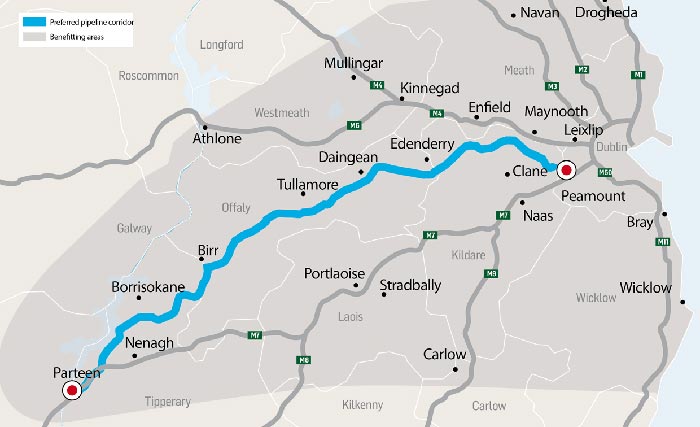
Uisce Éireann states the abstraction would be a maximum of 2% of the long-term average flow at Parteen Basin. The volume most commonly cited in public reporting is roughly 330–350 million litres per day(depending on the source and whether a rounded “up to” figure is used).
Cost estimates are varied. Uisce Éireann has referenced a preliminary indicative range in the €4.58bn–€5.96bn bracket, while other reporting has noted higher “worst-case” risk scenarios discussed in official correspondence.
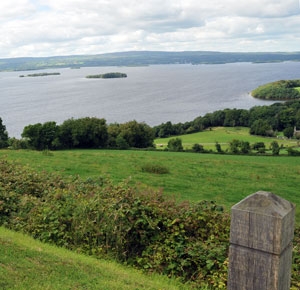
“A legacy of a beautiful lake that’s destroyed” Speaking on local radio, Councillor Bugler said she fears the council will not oppose the project strongly enough when it finalises its submission. She said she raised her concerns directly with council Chief Executive Ms Sinéad Carr, warning against any temptation to prioritise potential local “community benefit” funding over environmental impact. She has urged the council not to “sell us out” and said she was worried about damage to Lough Derg for future generations.
Uisce Éireann has said it is proposing a “bespoke Community Benefit Scheme” linked to communities hosting construction and permanent infrastructure.
Criticism after Killaloe meeting. The councillor also criticised Uisce Éireann’s public engagement after a recent information meeting in Killaloe, saying she was dissatisfied with the answers provided on how the project would operate during low-flow or drought periods. In particular, she questioned how a 2% abstraction figure based on long-term averages would translate during dry spells and whether abstraction would be reduced or suspended, and what that would mean for the reliability of supply to Dublin and the wider region.
Proposed Tipperary – Dublin Pipeline.
“What turns this from local frustration into national hypocrisy is the scale of spending Ireland is willing to contemplate elsewhere. The Irish Government has backed the Water Supply Project for the Eastern and Midlands region, intended to bring a new long-term water source from the Shannon system towards the greater leaking Dublin area“. See Link Here
Ms Bugler further claimed that some representatives displayed limited familiarity with local water and wastewater infrastructure, including the source of supply for towns Ballina and Newport from the Mulcair River, and raised concerns about treatment levels at Ballina’s wastewater facility. These are allegations made by the councillor in media reports; Uisce Éireann has not, in the published material cited here, issued a point-by-point response to those specific claims.
Council submission in preparation. Meanwhile, Tipperary County Council is preparing its formal submission to the planning authority. Separate coverage has reported that consultants have been appointed to assist the council in drafting its response. With the application now before An Coimisiún Pleanála, we learn that stakeholders and members of the public can also make submissions as part of the statutory process, ahead of a decision on whether the project proceeds and, if so, under what conditions.
The Vee in the running for national “Best Drives” award, and here’s how to back Tipperary.
One of Ireland’s most dramatic road trips is in the spotlight this week, with The Vee shortlisted in the Best Drives series, run by The Journal in association with Allianz Insurance. The series celebrates standout scenic routes around the country, and the overall winner will be rewarded with a dedicated video feature shared across The Journal’s platforms.
Why ‘The Vee’ is turning heads: The nomination describes ‘The Vee’, (VIEW HERE ), as “one of the most visually stunning drives in Ireland”, and it’s easy to see why. Named for its famous V-shaped bend, the route climbs into the Knockmealdown Mountains and opens up sweeping views over valleys and patchwork farmland below On clear days, you’re treated to big skies and big horizons, with views stretching towards the Galtee Mountains, home to Galtymore (917.9m), widely noted as the highest inland mountain in the country. And then there’s the height of the pass itself: The Vee rises to around 610 metres (2,000 feet) above sea level, adding that unmistakable “mountain road” feel, especially as the road curls past the lake and viewpoint.
The suggested starting route: The drive can be started from either Clonmel or Cahir, continuing through Clogheen, up and over The Vee, and onwards towards Lismore. It’s a route that manages to feel like a proper road trip without demanding an entire day, ideal if you want a scenic spin with a few memorable stops built in.
Don’t miss Bay Lough: A highlight mentioned in the nomination is Bay Lough, latter a quiet, upland lake close to the high point of the pass. It’s a natural “pull in, step out, and take it all in” moment, whether you’re after photos, fresh air, or a calm pause mid-drive. The nomination also suggests taking to the water, including kayaking, as part of the experience, underlining the sense that this is more than a nice view from a car window; it’s an outdoorsy corner of the county worth lingering in.
A route on the Tipperary–Waterford line: The Vee sits right on the border, straddling Tipperary and Waterford, a gateway drive that shows off the best of both sides of the mountains, with wide open panoramas and that signature V-shaped turn that gives the route its name.
How to vote: Tipperary County Council has urged people to “support Tipperary with your vote” as the poll goes live. To take part, look up The Journal’s “Allianz Best Drives” poll HERE and please do cast your vote for The Vee. (As we go to press now running in second place).
Tip: As always on upland routes, take it handy on bends, expect changing conditions, and pull in safely when stopping for photos, the views will still be there when you arrive.
A Roof to Save, A Night to Remember – Major New Fundraiser To Be Unveiled Soon.
Something Big Is Coming: Major New Fundraiser for Cathedral of the Assumption, Thurles – Set for Early May.
Almost every family in the Thurles area has at least one thread that leads back to Thurles Cathedral. It might be the memory of a baptism carried in a shawl and whispered prayers. It might be First Communion photographs taken on the steps, Confirmation day nerves, or the steady comfort of familiar hymns sung from the choir. For others, it is the bright lift of a wedding morning and, sooner or later for us all, the quiet dignity of farewells; funerals, anniversaries, candles lit for names we still speak.
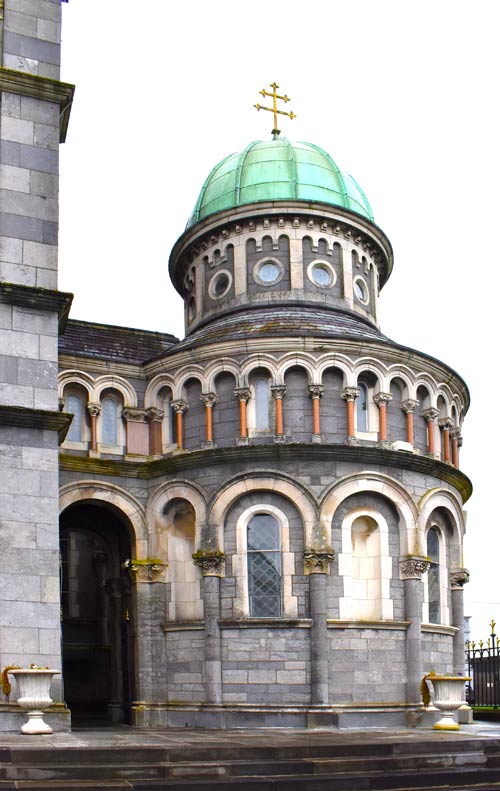
Thurles Cathedral Baptistery.
Thurles Cathedral isn’t just a landmark you pass on the way through Thurles town; no it is a place where lives are marked, where time is measured in sacred moments, and where the community’s joys and sorrows have been gathered and held for generations.
And then there’s the detail that catches you almost immediately as you approach from the street. To the right, slightly apart, like a gentle prologue before the main story, stands a circular building, modest in scale yet rich in meaning.
That round building is the baptistery; its separation from Thurles Cathedral is no accident, and it is one of the things that makes Thurles so quietly distinctive. In Ireland, baptisteries are typically absorbed into the body of the church. Here in Thurles, it stands free, echoing the great continental tradition, where baptism, the beginning of the Christian journey, was given its own threshold-space; a place of welcome, entry, and promise, before you pass into the larger embrace of the Cathedral itself.
Stand for a moment, let the little round baptistery hold your gaze, and watch how stone and light conspire to make something quietly, heart-stoppingly beautiful.
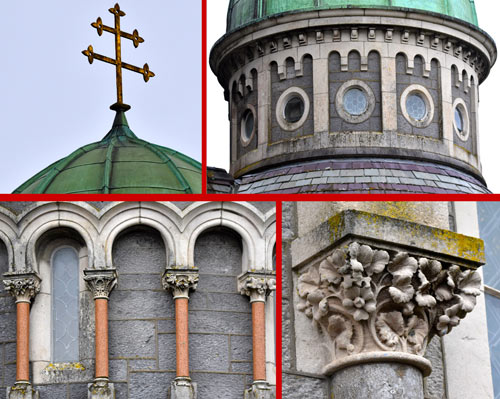
Built in locally quarried limestone, the baptistery shares the Cathedral’s grounded, elemental strength; stone that feels native to its own landscape. Yet it totally refuses that tiresome, boring, and tedious lack of variety that results so often in dull routine. String courses and carved details break the grey with crisp definition, and in places lighter stone is introduced to lift the eye and relieve the broad limestone planes.
Then comes the architecture’s music; the repetition of arches. Below, a long, slender rhythm of limestone, pillars support lower arcade. Above, the upper arcade rests on a colonnade of stunted pillars in polished red Aberdeen granite, a sudden richness, a warmth of colour that feels almost like a flourish, as if the building has discovered ornament and decided to rejoice in it. Higher still, an upper wall, smaller in circumference than the lower, becomes more intricate, same richly decorated and pierced by twelve circular openings that read like little moons of daylight.
And naturally, the gaze rises again, to the dome, a crowning that seems to gather the whole circular form into a single upward gesture. At its summit sits the archiepiscopal cross with two arms, the sign that this Cathedral belongs to an archbishopric; not only a parish church, but a mother church with a wider symbolic reach.
All of which brings us to the urgent present. Beauty like this depends on something deeply unromantic but absolutely essential, a sound roof. And right now, Thurles is seeking to re-roof the building and a major conservation step and fundraising is underway to make that possible. It is the sort of work that doesn’t make headlines the way a new project might, yet it is the work that decides whether what we love will endure; keeping out water, preventing slow damage, protecting artistry and memory alike.
In a way, it is fitting that the baptistery greets you first. A baptistery is about beginnings. And this moment is another beginning, too; the community’s chance to put its shoulder under the task, to protect what has protected so many of our milestones, and to ensure that the Cathedral remains not just admired, but kept.
A Gentle Call To Action. If this place has ever held even one moment of your life; a prayer, a photograph, a hymn, a vow, a farewell, consider doing one small thing to help it hold those moments for the next family, and indeed the next.
A donation, a fundraiser, a share with someone who has moved away, but still carries Thurles in their heart, it all matters. Roofs are saved the way communities are built: not by one grand gesture, but by many hands doing what they can, when they can.
A major new fundraising event to support the re-roofing of the Cathedral of the Assumption, Thurles will be unveiled soon, with an early May 2026 date now in the diary. Watch this space and be ready to help keep a roof over the place that has held so many of our life’s moments. Because some buildings are more than stone. They are memory made visible, and now, quite literally, the future of this one is “In Our Hands“.
This website uses cookies to improve your experience. We'll assume you're ok with this, but you can opt-out if you wish.AcceptRead More
Privacy & Cookies Policy
Privacy Overview
This website uses cookies to improve your experience while you navigate through the website. Out of these, the cookies that are categorized as necessary are stored on your browser as they are essential for the working of basic functionalities of the website. We also use third-party cookies that help us analyze and understand how you use this website. These cookies will be stored in your browser only with your consent. You also have the option to opt-out of these cookies. But opting out of some of these cookies may affect your browsing experience.
Necessary cookies are absolutely essential for the website to function properly. This category only includes cookies that ensures basic functionalities and security features of the website. These cookies do not store any personal information.
Any cookies that may not be particularly necessary for the website to function and is used specifically to collect user personal data via analytics, ads, other embedded contents are termed as non-necessary cookies. It is mandatory to procure user consent prior to running these cookies on your website.






Recent Comments