|
|
I never really believed that the late Princess Diana would ever accept an invitation to visit Thurles, but ‘nothing ventured ‘ for Thurles, can often result in ‘nothing gained.‘
Over 4 million British tourists had visited the Republic of Ireland in 2006. Tourism in Thurles was then practically non existent, with those responsible for marketing North Tipperary, only pushing their products west of the Shannon, in an attempt to justify earlier politically influenced public finances spent in funding in counties Limerick, Clare and Galway, while ignoring projects in the environs of Thurles, a practise they appear to still continue, as part of their marketing strategy today.
To cut a long story short, the following ‘Letter of Invitation‘ was penned and sent to Kensington Palace. I was encourage in this venture by the recently deceased Mr Ned Ryan, Upperchurch, and also by friend and lifetime museum patron, the late Mr Matty Ryan, both of whom had close associations with the late Princess Margaret, Countess of Snowdon, and younger sister of Queen Elizabeth II.
Our communicated invitation read as follows:-
Kensington Palace,
London W8 4PU
Date :- 22/ 7/ 1997.
Your Highness, Diana, Princess Of Wales,
On behalf of the people of Thurles, the members of our committee and myself, I would like to extend an invitation to Your Highness, to visit the home of your ancestors here in County Tipperary, Ireland.
As you maybe aware, your ascendancy were protectors and rulers of Thurles until 1841 and it is the intention of this committee to erect a stone testimonial,to commemorate your progenitor, Lady Elizabeth Butler, Viscountess Thurles, (1587-1673).
It is now the fervent desire of this committee, that You Highness would greatly honour us by unveiling this stone inscription.
We are very much aware of your many personal and public commitments, both at home and abroad, and fully comprehend that significant preparations would need to be put in position between, both Her Majestie’s Government and the Government of the Irish Republic, before such a visit could take place.
If, however, Your Highness were to signal her willingness and availability to accept this invitation, immediate preparations could be entered into, which would conform with your busy agenda.
It is our heartfelt wish that Your Highness will find time, in her busy calendar of events, to accept this invitation sometime in the near future.
I remain,
Yours most sincerely,
St. Mary’s Famine Memorial Church, Thurles, Co. Tipperary.
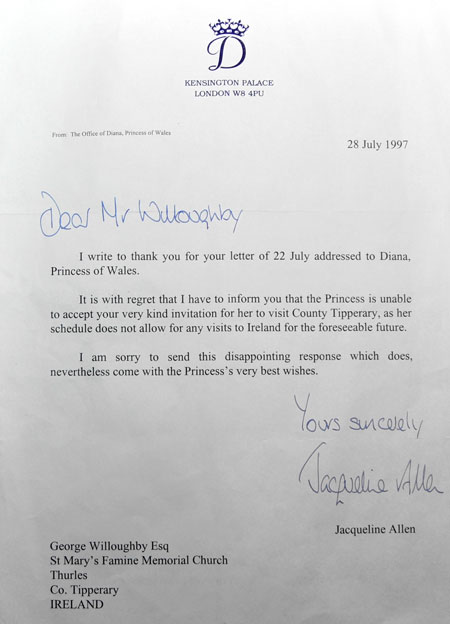 The reply from Kensington Palace We were aware that, politically, it was not possibly the best time in our nations history to send such an invitation. Then Fianna Fail Minister for Foreign Affairs, and later disgraced T.D., Mr Ray Burke, had days before, just welcomed the decision taken by the Orange Order, with regard to certain of their Annual Marches, which gave space for all feuding factions in the North, to consider how the whole marching issue could be handled on the basis of respect for the rights of all, both the Orange Order and the wider community alike.
The now deceased, but then Northern Ireland Secretary Mow Mowlam had hinted that substantive negotiations, seeking a genuinely new political dispensation, based on equality, parity of esteem, respect for human rights and the principle of consent, were about to begin that September in Northern Ireland. Sinn Féin were being encouraged to take their place at the Conference Table, to represent the views of those who supported them. Fair and reasonable assurances had been spelled out with regards to what was expected by both British and Irish negotiators, before Sinn Féin would be allowed take part in these upcoming negotiations.
That same July 1997, the Democratic Unionist party leader Ian Paisley would vote against the Anglo-Irish plan for guerrilla disarmament, storming out of the voting session in Stormont Castle, near Belfast, while stating his party was out of the peace talks for good, while Mowlam confirmed that Sinn Fein would now sit at the negotiating table, when peace talks would resume in September of the same year.
Princess Diana’s reply to our invitation arrived six days later in a letter from Kensington Palace and as expected her reply, pictured here, disappointingly spelt out her sincere regret. We now share this letter with you, our readers, for the very first time. (Click on Letter Image to enlarge.)
A little over just 4 weeks later, on the 31st of August 1997, Diana, Princess of Wales, was fatally injured as a result of a car collision in the Pont de l’Alma road tunnel in Paris, France. Her companion, Dodi Fayed, and the driver of the Mercedes-Benz W140, Henri Paul, were pronounced dead at the scene of the accident. Fayed’s bodyguard, Trevor Rees-Jones, was the only survivor. Although earlier the media pinned the blame on the paparazzi, the crash was ultimately found to be caused by the reckless actions of the chauffeur, who was the head of security at the Ritz and had earlier goaded the paparazzi waiting outside the hotel.
An eighteen-month French judicial investigation concluded in 1999, that the crash was caused by Henri Paul, who lost control of the car at high speed, while under the influence of alcohol, which may have been made worse by the simultaneous presence of an antidepressant and traces of a tranquilizer in his body.
On hearing the news, Thurles ladies began to arrive with bouquets of flowers to the door of St Mary’s Church here in Thurles, in an unprecedented show of sympathy and solidarity.
July 31st each year I often think, what an ambassador this world has truly lost and what if the Princess had decided to visit her ancestral home of Thurles, instead of visiting France, on that fateful day in 2007.
But then each person’s road, while on this earth, is so often paved with numerous ‘what if ‘s.’
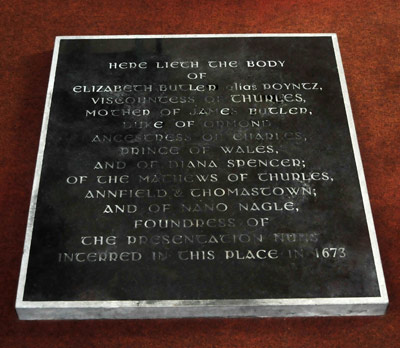 St Mary's Church, Thurles, burial place of Elizabeth Butler (alias Poyntz) progenitor of the present Heirs to the British Crown. According to reports, by our top Tipperary Radio station ‘Tipp FM,’ today, we learn that Her Majesty Queen Elizabeth II of England will visit Cashel and Coolmore Stud near Fethard, Thurles, Co. Tipperary, during her forthcoming historic visit to Ireland in May.
Deputy Tom Hayes has announced that a trip to South Tipperary will be included on Queen Elizabeth II’s itinerary, when she visits as speculation still surrounds this two-day state visit, beginning Tuesday, May 17th, though this date has yet to be fully officially confirmed. Confirmation of her visit to South Tipperary, however, was given to Deputy Hayes by Taoiseach Enda Kenny.
“The Queen’s visit will be a huge boost for the County“, Deputy Hayes stated on Tuesday evening. He said he had made strong representations for the Queen to come to South Tipperary and he was very happy with the commitment that Taoiseach Enda Kenny had given him.
Her Majesty Queen Elizabeth’s visit will be the first to the Irish Republic by a reigning British monarch since her grandfather George V visited Ireland in 1911.
Meanwhile, back at the ranch here in Thurles, Political leaders, Tourism Marketing Groups, County Councillors, Urban District Councillors and those with paid responsible for promoting Thurles, have once again failed their public in promoting Thurles and North Tipperary.
Fifteen miles up the road from Cashel, lies the town of Thurles, the ancestral home of Her Majesty Queen Elizabeth II. Yet, as far as I am aware, no invitation or representation has been made to indicate, nay insure, that Her Majesty visits Thurles her home town, during this her first visit to Ireland.
It would now appear that there are more public representatives in North Tipperary requiring ‘motions of censure’ than Mr Michael Lowry TD.
In the days when Urban District Councillors received no pay, just expenses, made real decisions regarding our community and were not associated with individuals who write identifiable misspelled anonymous poison pen letters to the local press, we had governance. Amongst their many progressive decisions made was the raising of a plaque to commemorate Elizabeth Butler, progenitor of the present Heirs to the British Crown, which they erected at St Mary’s Church in Thurles.
In those unpaid days, these Councillors knew the value of visitors from across the water.
Now, in possibly a waisted attempt to educate our present overpaid Councillors, allow me to demonstrate the unharnessed value of English Tourism to our town, through statistics shown hereunder, supported by the Irish Central Statistics Office (CSO).
Estimated Number of Overseas Visitors to Ireland 2000-2007 (‘000’s.)
Visitors to Ireland – Year:—-2000.– 2001.– 2002.–2003.–2004.—2005.–2006.—2007.
Great Britain:——————-—-3,559.—3,462.—3,579.—3,719.—3,681.—3,822.–4,060.—4,032.
Other Europe:——————–—1,453.—1,357.—1,392.—1,497.—1,600.—1,917.–2,281.—2,590.
USA and Canada:—————--1,043.——912.—–849.—–904.——977.——953.—1,055.—1,073.
Other Areas:—————————256.—–260.——245.—–249.——317.—– 285.——314.——317.
Total Overseas Visitors:——-6,310.—5,990.—6,065.–6,369.– 6,574.—6,977.—7,709.—8,012.
Failure to study these figures and act, gives licence and credence to “Ireland : A Rough Guide: distributed by the Penguin book Group, to publish the following untruths:- “Having seen the Rock of Cashel, most people head out of Tipperary for the West, and frankly this isn’t a bad idea – the north of the county has little to distract you.” “You’re unlikely to be immediately enticed by a first sight of counties Tipperary and Waterford, much of whose countryside could well vie for the title of Ireland’s dullest.”
I am at pains to point out, of course that this information contained is “Ireland : A Rough Guide,” is always to found under the armpit of every American tourist who visits our Fair Green Isle. Perhaps our Public Representatives and Marketing Groups, presently over funded, while charged with the responsibility of promoting our public and business interests locally, would like to use this website, to explain to our Hoteliers, Nightclubs, Bed and Breakfasts, other Local Businesses, and, I nearly forgot, our numerous unemployed people, why they have failed to take advantage of this golden business opportunity, afforded us. Indeed I suspect that the wonderful American poet Robert Lee Frost in writing ‘The Road Not Taken‘ had just read this aforementioned ‘Comic Travel book.’ Quote:
“Two roads diverged in a yellow wood, And sorry I could not travel both,
And be one traveler, long I stood, And looked down one as far as I could,
To where it bent in the undergrowth;( ‘Undergrowth possibly refers to Thurles ‘) Then took the other, as just as fair,
And having perhaps the better claim, Because it was grassy and wanted wear.”
Remember, our valued 1,000 plus readers who visit this website each day, could see your future silence, as an admission of failure and worthlessness, so do explain the reasons for your lack of any progressive action please. See your chance to explain as a perfect opportunity for further self seeking publicity, which we can afford you and which you seek ever so diligently, through local press reports.
We, just like the present Fine Gael party, stand for H.O.T – Honesty, Openness,Transparency, so let’s publicly debate these issues very soon.
“We know you all, and will awhile uphold the unyoked humour of your idleness,” (With apologies to William Shakespeare‘s Henry IV, Part 1)
 The Source Arts Centre The arts here in Co Tipperary are set for a major financial boost following the announcement of nearly €400,000 in funding from the Arts Council.
The Arts Council has confirmed it will invest in five Tipperary organisations around the county, based on their already proven track record to date.
The organisations to benefit are as follows:-
Source Arts Centre Thurles, who will benefit to the tune of €65,000.
North Tipperary County Council Arts Office,who will receive €105,000.
Clonmel Junction festival, in South Tipperary, who will receive €118,750.
South Tipperary County Council arts office, to receive €69,358.
Tipperary Excel Heritage Company, who will benefit to the tune €37,500.
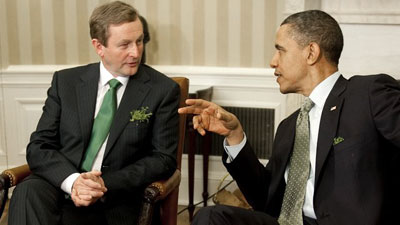 US President Barack Obama accepts invitation from An Taoiseach Enda Kenny Its official, US President Barack Obama has accepted an invitation from An Taoiseach Enda Kenny, to visit Moneygall, latter situated on the borders of Offaly and Tipperary, here in Ireland, this coming May.
Speaking at the end of a meeting in the Oval Office with Taoiseach Enda Kenny, President Obama said he is looking forward to visiting Ireland. The President stated ‘I want to say today, that I intend to come to Ireland in May, but the date of the visit has yet to be finalised.’
He said he is ‘excited ‘ about visiting all the famous sites, but also to visit the place his great, great, great, great, great, grandfather hails from, in Moneygall. Taoiseach Enda Kenny stated the visit was a vote of confidence in the Irish people, at a time of great fiscal difficulty.
The Taoiseach assured the US President of a rapturous welcome, and said jokingly that if he wanted a round of golf he would be happy to join him.
President Obama joked back, that he had heard Mr Kenny was a good golfer, so he himself would have to practice.
On a more serious front, the US president and the Taoiseach also discussed how Ireland will bounce back from economic turmoil. Mr Obama confirmed the willingness of the United States to continue to co-operate with and give practical assistance wherever and whenever possible. “There is just an incredible bond between our two countries,” the president said from the Oval Office.” And that’s one that we want to reaffirm here today.”
Taoiseach Enda Kenny was in the White House meeting Mr Obama today for the traditional St Patrick’s Day presentation of shamrock.
Last night, Mr Kenny addressed around 1,000 guests at the annual gala dinner of the American Ireland Fund. The American Ireland Fund is aiming to raise $100m for Irish charities by the end of 2013.
Enda Kenny’s also had meetings with Vice President Joe Biden and US Treasury Secretary Timothy Geithner.
Click for UPDATE
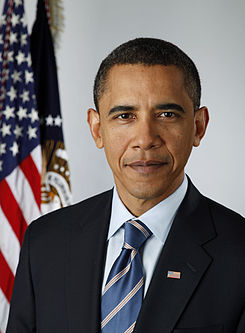 Barack Obama, 44th President of the United States USA’s 31st Irish President Barack Obama and Queen Elizabeth II are likely to visit Ireland in late May or early June of 2011.
In the case of President Obama his visit is likely to coincide with other European engagements. “The end of May is likely,” said an official, familiar with discussions regarding Mr Obama’s forthcoming trip to Europe. Records unearthed by the Church of Ireland’s Rev. Canon Stephen Neill show beyond doubt that Mr Obama’s ancestors, on his mother’s side lived, worked, married and had children in the Moneygall area, situated on the border separating counties Tipperary and Offaly. It is expected that the president will wish to visit his ancestral home during this visit.
Mr Obama and his wife, US first lady Michelle Obama, will visit Britain on a state visit at the invitation of Queen Elizabeth II, from May 24th to 26th. He will travel on to Deauville, France, for the G8 Summit on May 26th to 27th. Discussions within the US administration are now focused on whether Mr Obama should visit Ireland before London or after Deauville and the White House hope it is before the UK, visit according to US officials.
Neither the White House, the Irish Embassy in Washington nor indeed the US embassy in Dublin would confirm officially that a visit is likely in late May. Discussions about the trip appear not to have, so far, involved the Irish government, with the speculation that the US are waiting for Irish politics to be fully clarified over the coming week.
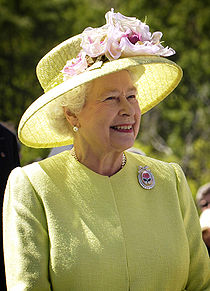 Her Majesty Queen Elizabeth II The annual St Patrick’s Day pilgrimage to Washington will be one of the first acts of our new Taoiseach Enda Kenny and if the May expected visit materialises, a visit is likely to be announced at the White House during the St Patrick’s Day reception.
Democratic congressman Richard Neal, the former head of the Friends of Ireland in the House of Representatives, stated that a visit to Ireland would have obvious implications for Mr Obama’s re-election campaign.
Planning in relation to both visits is somewhat complicated by the fact that Irish President Mary McAleese has already issued an invitation to Her Majesty Queen Elizabeth, to visit Ireland, probably also in late May or June.
Regarding Her Majesty Queen Elizabeth’s II visit, there may be a reluctance on the part of the Irish government to take on two such important visits so close together, however these logistics are something that both governments will be anxious to negotiate.
Queen Elizabeth II, although she has never visited Thurles, has strong ancestral connections with the town and is a direct descendant of Viscount and Lady Thurles through their eldest son, the Duke of Ormond. The Duke’s daughter, Elizabeth, married Philip Stanhope, 2nd Earl Chesterfield, and their daughter Elizabeth Stanhope married John Lyon, 4th Earl Strathmore. Six generations later in direct line was the 14th Earl Strathmore whose daughter, Elizabeth Bowes-Lyon married the future King George VI; and these are the grandparents of Prince Charles. Thurles is therefore expected to be included as a stop off point in any proposed future visit.
Many of Queen Elizabeth’s ancestors are buried at St. Mary’s Church here in Thurles, including Lady Elizabeth Butler,(Elizabeth Poyntz, Acton, 1673.) from whom she inherited her christian name. Sophie Helen Rhys-Jones, wife of Prince Edward attended a funeral on behalf of the British Royal Family in November last, here in Upperchurch, Thurles, Co Tipperary.
|
Support Us Help keep Thurles.info online by donating below. Thank you.
Total Donated 2026: €300.00
Thank You!
Daily Thurles Mass Livestream
|



Recent Comments