|
|
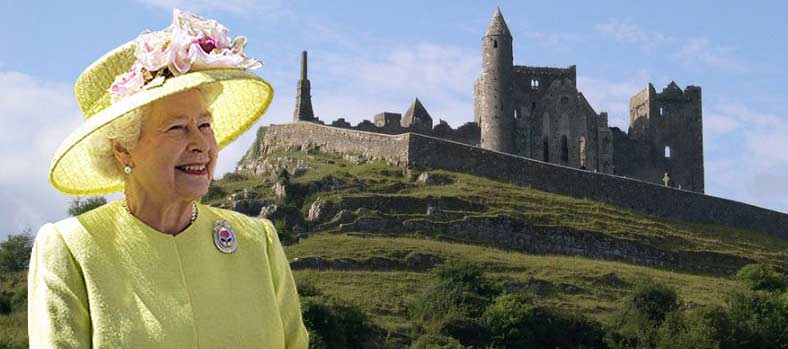 Queen Elizabeth - Welcome To Your Home County Her Majesty Queen Elizabeth II is due to visit Cashel and Fethard in Co.Tipperary on Friday morning next, with a large force of Gardaí and security personnel to be drafted in.
In Cashel, where the Queen will visit the historical “Rock,” (In Irish: Carraig Phádraig) traffic flow restrictions on the M8 are being put in place, beginning from next Monday until next Friday inc, with both carriageways reduced to just one lane. Vehicles will be required, in specified areas, to reduce their speed below 100kmph. Some restrictions in Cashel town will also commence in advance of this visits, fully agreed following local consultation with business and residents in key areas.
With effect from next Thursday evening, access to Cashel will be from Junction 9 of the M8 only, with all other exits effectively closed. Vehicle Information Signs will be put in place on the northbound lane at Junction 10, (Cahir south of Cashel) and at the 2km Junction for Cashel, with motorists warned to make careful note.
A cordon will be placed around Cashel, sealing off the town, between 6.00pm next Thursday and 12.00noon the following day, and only those with valid passes, e.g. local residents and business owners, allowed through a 7km outer cordon around the town.
Police cordons will also be placed around Fethard and Killenaule, as and from Thursday evening, continuing until noon on Friday, although gardai state that business will be permitted to continue as normal, for the most part.
Gardaí have warned the public to allow ample extra time for necessary journeys and to use public transport if at all possible, but point out that some bus timetables may be subject to disruption for short periods of time.
On Friday afternoon the Queen will continue on her visit to Co.Cork, and will not be visiting Thurles, her Ancestral Home, mainly due to the inability of Bord Failte, Politicians, County and Local Councillors and other marketing groups, charged with the Development of Thurles as a Tourist attraction, and who failed to forward an invitation within a proper and appropriate time frame.
Over the coming days we here in Thurles will be showing you, what the Queen missed by not including Thurles in her itinerary.
Meanwhile Your Majesty, “Fáilte roimh do chontae dúchais do Co.Thiobraid Árann.” (Translated “Welcome to your home county, Co.Tipperary.”)
The “Ryan’s Daughter” restaurant, managed by Garry and Geraldine Roche, is a well known and popular haunt of Cashel and Tipperary locals. The restaurant is also particularly well known to long distance travellers, who take a well deserved break, away from the busy, fast M8 motorway, on their journeys between Dublin and Cork.
Situated under the shadow of the Rock of Cashel, on the entrance to the historic Town of Cashel, (Well, that is if you are travelling from the Thurles side.) the chatter from patrons at this delightful little oasis today, was totally focused on the visit by Her Majesty Queen Elizabeth II, on Friday week.
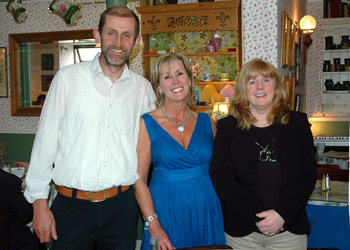 N.Dennehy (Camera), G.Roche (Ryan's Daughter) and H.McInerney (Producer 'Nationwide.') This morning, as I sat amongst the patrons at “Ryan’s Daughter,” enjoying a coffee and a hot scone, the excited chatter was pleasantly interrupted by an unexpected visit from RTÉ Television. Well known producer and reporter Helen McInerney and camera man Neilus Dennehy, were first to appear, much to the obvious delight of those present. They were soon joined by other much loved RTÉ personnel, who arrived in the forms of Mary Kennedy and Michael Ryan, all filming for RTÉ’s popular ‘Nationwide‘ programme.
Locals and visiting tourists, regardless, were pictured or interviewed, between mouthfuls of bacon and cabbage, salad sandwiches and tempting cream cakes.
Note, those wishing to view captured footage of this mornings visit to Cashel by RTÉ, should tune into the “Nationwide” programme, which will go out on air on Monday next at 7.00pm.
Meanwhile, in Cashel town, blossoming flowerbeds are already in place, road repairs are nearing completion and traffic signpost maintenance is fully complete. Everywhere men in yellow reflective jackets are to be observed with yard brushes, rakes and shovels, all totally focused on insuring that all things in the “Cashel of the Kings” will be “Ship Shape and Bristol Fashion,” well ahead of the eagerly awaited ‘Royal Visit.’
For those representing left wing republican politics, and who plan to protest at Her Majesty’s visit to Cashel, be warned, your presence will not be observed with any welcome by Cashel locals and will be damaging to the cause, well that’s if the conversations I overheard this morning are anything to go by.
The ears of Ireland’s Gaelic Athletic Association (GAA) leaders must have burned. Praise was being heaped on them, for recognising that the queen’s visit to Croke Park, in Dublin, is intended as a moment of reconciliation with the GAA over Bloody Sunday, which saw 13 spectators and one player, latter Tipperary footballer Michael Hogan, shot dead. Praise was also being heaped on the GAA, for spearheading the building of a bridge between the British establishment and an organisation that was founded to roll back English influence in Ireland. Some remarked that the queen’s visit will be as significant as the GAA’s 2001 decision to remove the ban on members of the British military and the Northern Ireland security forces from playing Gaelic games.
Locals I spoke to on the streets, later in the day, were 100% unanimous, Queen Elizabeth is welcome to visit Cashel or any other part of Co Tipperary, at anytime. As one commentator put it, “What’s all the fuss, sure Queen Elizabeth is a native of Thurles, Co Tipperary anyway, if anyone cared to check.”
Tipperary is often referred to as the“Premier County,” a description once attributed by Young Irelander Thomas Davis, editor of The Nation newspaper in the 1840’s, and it was he who also stated that “Where Tipperary leads, Ireland follows.”
When US President Barack Hussein Obama visits Moneygall, on the Tipperary / Offaly border, towards the end of May next, there is no doubt that he will receive the warmest and friendliest of Irish welcomes, for which this country is renowned for bestowing on it’s visitors.
Towns all over Ireland are feeling the ‘teeth ‘ of our mainly self inflicted financial recession. During a recent visit to Monegall, we noticed, what appeared to be just one of Irelands many ‘ghost estates’ or half finished housing estate projects, blighting the village landscape. However, thanks to this strong minded local community, through research, enterprise and drive, the leader of the most powerful country in the world is coming to visit their tiny village.
This village and surrounding areas must now surely prosper, working together as they have, displaying kinship and teamwork, this community have assured themselves a proper place in Irish American lore, and highlighted a destination to which many Americans and Irish Americans will wish to visit in the coming years.
Documents show that Barack Obama’s ancestors, like John Fitzgerald “Jack” Kennedy‘s great grandfather Patrick Kennedy, from Dunganstown, Co Wexford and Ronald Wilson Reagan‘s great grandfather, Michael O’Reagan, from Ballyporeen, CoTipperary, sailed from Ireland to America in search of a dream, leaving behind them a then ‘God Forsaken ‘ island called Ireland. All left Ireland around the time of the ‘Great Famine,’ 1845-1849, as did of course later (1873) John P. Holland, inventor of the modern submarine, the ‘Fenian Ram’, in 1881 and “Father of the U.S. Submarine Service,” and earlier (1760’s) Commodore John Barry, credited as “The Father of the American Navy,” by his contemporaries.
America has been a friend to the Irish and Irish immigrantion has greatly benefited America’s progress as a nation. History will continues to identify and catalogues the lineage of great and influencial world leaders, such as US President Barack Obama, brought about through often forced Irish immigration.
Barack Obama Ancestry
President Barack Obama’s lineage is easily catalogued:-
Joseph Kearney (c.1794-1861) and Phoebe Donovan (c.1800-1876), – Falmouth Kearney (c.1830-1878) and Charlotte Holloway (c.1834-1877), – Jacob William Dunham (1863-1936) and Mary Ann Kearney (1869-1936), – Ralph Waldo Emerson Dunham Sr. (1894-1970) and Ruth Lucille Armour (1900-1926), – Stanley Armour Dunham (1918-1992) and Madelyn Lee Payne (1922-2008),- Barack Hussein Obama Sr. (1936-1982) and Stanley Ann Dunham (1942-1995)- US President Barack Obama.
Leaving his spouse and off springs here in Ireland, Joseph Kearney travelled to America to claim land. It is not documented how he got to England, however, one means of cheap travel at this time was by consenting to travel, as ballast, on an empty British coal boat. Human ballast at this time saved those transporting coal into Ireland by open sea barge, the cost of paying men to shovel sand into these empty barges, to stop them riding high in the water on their return trips to England.
History does record that he reached the port of Liverpool where he boarded the ‘Caroline Read,’ and eventually arrived in New York City on 25th of April 1849. His eldest son Falmouth Carney (Kearney) was soon to followed this 3,000-mile Atlantic voyage. The passenger list for the ship 903 ton ‘Marmion,’ which entered the port of New York on March 20th in 1850, includes a 19-year-old labourer named Falmouth Carney whose destination was Ohio.
………..ID……………NAME ………………. AGE…GENDER …FROM……..PORT……….. TO DEST……. SHIP………ARRIVED……
…….304353……Falmouth Carney……….19………M……..Ireland….Liverpool…………OHIO…….Marmion……03-20-1850…..
Later records reveal this ship ‘Marmion,’ Captained by F. W. Jordan, with 1,300 tons of coal on board, under a strong south easterly wind and in heavy seas, foundered off Cape Flattery, on November 8th. 1879. The ship was abandoned, and the crew boarded the ‘Tam O’Shanter,’ which had been standing by, and all were taken to San Francisco.
Falmouth was followed by Phoebe Kearney and her children, William and Mary, some 17 months later, entering New York again on the ‘Clarissa Courier,’ on August 28th 1851.
Two years after his arrived in America, Falmouth Kearney married Charlotte Holloway, with possibly his uncle, one William Kearney, serving as Justice of the Peace. American Census records in 1860 show that Falmouth, a farmhand, his wife Charlotte and several children are living in Deerfield, Ohio. Later, according to the census of 1870 show this same family are listed as a farmers with an address in Tipton County, Indiana.
As already shown, both Falmouth and Charlotte both died, one year apart and were survived by their five daughters and possibly three sons.
US President Barack Obama is the great-great grandson of Falmouth Kearney’s youngest daughter, Mary Ann.
Irish Americans everywhere examine your achievements and raise your heads with pride, follow the call “Yes We Can.”
Our thanks to Ollie Hayes and his bar staff, who assisted us greatly on our recent visit.
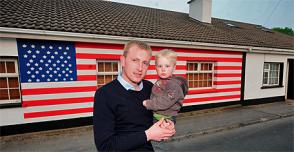 J. Austin and son Matthew. Photo courtesy of Irish Independent Newspapers US President Barack Obama is due to visit his ancestral home in Moneygall, situated on the Tipperary-Offaly border, on Monday May 23rd next, however his visit may be the subject of change, to Sunday 22nd, depending on his busy Irish schedule.
I visited Moneygall village yesterday, to find the locals residents as busy as bees in a hive, armed with ladders, paint brushes, shovels and power-washers, all engaged in a total revamp of their small hamlet. All locals are intent on ensuring that no stone will be left unturned and all will be ‘Ship Shape and Bristol fashion,’ for when the intense glare of the global media is brought to focus on ‘Obama Land.’
One Tipperary family, are most certainly pulling out all the welcome stops for this highly anticipated homecoming and State visit, with local Jason Austin and his family having painted their home, in the village, with the Stars and Stripes and the Irish Tricolour.
A continuous stream of tourists and day trippers have already begun to seek out Moneygall. Locals tell of a group of lawyers who arrived visiting from Chicago recently, all boasting connections with President Obama. The CIA and security personnel are currently undertaking their necessary preparatory work and visitors from overseas are beginning to show a distinct tourism interest and appear eager to associate themselves with Obama’s true ancestral Irish roots.
Almost daily now visitors from all over Ireland, are veering from intended destinations anxious to take a peep. When filming in the town recently, we ran into well known photographer Paddy Phipps, who had travelled from Co Longford and the equally well known Fionán O’Driscoll, member and PRO of the Waterford Male Voice Choir, who had travelled from Waterford.
United States Ambassador to Ireland and Chairman Emeritus of the Pittsburgh Steelers football team Mr Dan Rooney has also gifted the village some Pittsburgh Steelers memorabilia for the occassion.
Moneygall village presently offers a rare opportunity to watch a small, yet lively community, passionately engaged in their preparations for when the worlds spotlight focuses brightly on their community and historical connection. So if you have a chance to visit Moneygall in the weeks ahead, do so and observe at first hand contented people, attired in paint splattered overalls, all playing their part in ‘Welcome Home Mr President’ preparations, and demonstrating what is needed to take us out of our financial recession.
Regrettably, nationally, republican and other members of the far-left fringe of ‘career protesters,’ namely Republican Sinn Féin, the new kids on the block Éirígí and People before Profit, latter organisations with all the problems and no solutions, will be attempting to attract attention for themselves by protesting at all our up and coming high profile visits by heads of State. Hopefully all press cameras will remain pointed in the opposite direction. I believe it was John Steinbeck sums it up when he said, “It is the nature of a man as he grows older, to protest against change, particularly changes for the better. A dying people tolerates the present, rejects the future, and finds its satisfactions in past greatness and half remembered glory”
Watch out for our short video on Moneygall, to be uploaded soon on this site.
Ireland has been lucky, nay totally blessed, by its last two choices for the post of ‘President of Ireland.’
It was Mary Robinson who broke the mould into which British-Irish relations had settled so bitterly and deeply, when, as the first Irish head of State, she visited her British counterpart, way back in May 1993. She was to break possibly an even more significant pattern some weeks later during that year, when, on a visit to Belfast, she shook hands with then Sinn Féin leader Gerry Adams, who now has moved South and been elected to Dail Eireann.
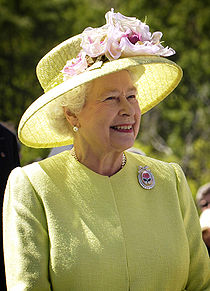 Her Majesty Queen Elizabeth II Our current President Mary McAleese, thankfully, continued along this barely worn pathway, first walked by Mary Robinson, to continue this contact with Buckingham Palace, developing this new friendly personal relationship, as part of her stated agenda to “build bridges between the two islands and among the communities of Ireland.”
The ‘Trojan’ work of these two great leaders appears to have gone unnoticed however by our North Tipperary’s elected ‘Heads of State’ and other ‘Dignitaries’ charged with the development and tourism marketing of the of our town and county.
Thurles Town, Queen Elizabeth’s ancestral home, thus far, has not been included in the Queen’s up and coming May itinerary, despite the fact that the Rock of Cashel some 15 odd miles down the road, which has little comparative historical associations, is now assured inclusion.
Thurles business people and our increasing numbers of unemployed, please, please, please click here and then weep. This is the type of ‘Gombeenism ‘ what has made our town, county and country the present laughing stock of the world. But lets blame no one except ourselves, we voted them into office and continue to pay these ‘comedians ‘ their salaries and pensions.
However, of course, Cashel Town Council sent out their ‘Invitation’ in early March, unlike Thurles who are presently ‘spell checking ‘ their letter. Still we live in hope and should Her Majesty be flown in by helicopter, the giant craters, referred to affectionately by locals as ‘pot holes,’ and now increasingly evident in Liberty Square, should go reasonably unnoticed.
There appear to be no ‘Comedians ‘ sitting on Cashel town council, rather instead, members like Deputy Mayor Maribel Wood, who feel they owe some responsibility to the views expressed by local business people, by the unemployed and by their electorate. They recognise the need to attract a little of the massive spotlight that such a visit to their town will receive, as the worlds press gathers to observe our behavour. Now, with the eyes of the world firmly following this beam of light, they can be assured that some future customers will get a look at their well laid out market stall. It is their hope that this visit will now stand them in good stead in the quickly emerging dark years ahead, looming increasingly large on all our horizons. Thurles can now only hope to once again “eat of the crumbs which fall from the masters table,” in relation to future tourism traffic.
Queen Elizabeth II has announced that she is to visit Croke Park and Cork when she comes to Ireland next month.
Yesterday evening, a joint statement was issued by Áras an Uachtaráin and Buckingham Palace, outlining details of her four-day visit, which will begin on Tuesday 17 May. The programme will include a formal welcome from President Mary McAleese, a ceremony at the Garden of Remembrance, a courtesy call on Taoiseach Enda Kenny and a State dinner in Dublin Castle.
There will also be events at Trinity College Dublin, the National War Memorial Gardens in Islandbridge, the Guinness Storehouse and Croke Park. The Queen and her husband Prince Philip will also visit the Irish National Stud in Kildare, as well as the Rock of Cashel and Cork.
According to the statement, the itinerary is ‘a wide-ranging and exciting celebration of the close ties between our two countries. This is a historic visit that also celebrates our close modern partnership.’
One of the symbolic highlights of the Queen’s visit will be a tour of Croke Park, where in November 1920 British troops shot dead 14 people including Michael Hogan, Tipperary GAA Gaelic footballer and one-time Captain of the Tipperary team. Michael Hogan was a member of the Irish Volunteers and was born in the Grangemockler area of Co. Tipperary. These killings were in retaliation for the killing earlier of 13 people and the wounding of 6 others by the IRA. Four of the British casualties were military intelligence officers and another four were known members of the Secret Service. The assassinations were planned by Michael Collins then head of the secretive Irish Republican Brotherhood and IRA Chief of Intelligence.
For the majority of Irish people now living, this war is long over and while we remember our fallen heroes like Collins, with gratitude, thankfully Her Majesty the Queen will sit and watch an exhibition of hurling and football, played by schoolchildren at our valued GAA Headquarters. A Croke Park spokesman said the GAA was confident that the Croke Park visit ‘will be welcomed by those who play, administer and support our games, at home and abroad.’
Thank God some of us have moved upwards and onwards.
For security reasons, no particular days and times have been assigned to the events to be attended by the Queen and these will be now announced closer to her visit.
Tell me this, is it true that Thurles is twinned with the English town of Bollington or am I hallucinating again?
|
Support Us Help keep Thurles.info online by donating below. Thank you.
Total Donated 2026: €300.00
Thank You!
Daily Thurles Mass Livestream
|



Recent Comments