The controversy around Ireland’s scheduled football fixtures against Israel in 2026 is real, serious and understandable. People are entitled to strong political and moral views. They are entitled to protest, to criticise governments, to question sporting bodies, and to demand consistency from international organisations. But there is still an important principle worth defending: where possible, politics and sport should be kept separate.
That does not mean sport exists in a fantasy world, untouched by history or suffering. It plainly does not. Ireland knows that better than most.
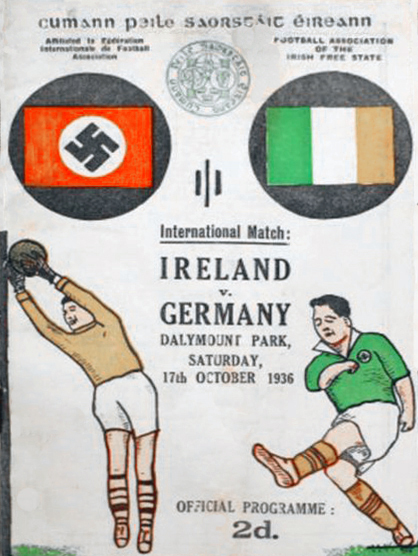
In October 1936, Ireland played Germany at Dalymount Park, at a time when Hitler’s regime was already in power. The German team gave the Nazi salute before the match. Looking back now, the images are deeply uncomfortable. Yet the match itself has also survived in Irish football memory as a sporting occasion, with Ireland winning 5–2, and the players on the pitch did what players are supposed to do; – they played football.
That example does not excuse the politics of the time. It does not make the symbolism harmless. But it does show the danger of making every football match a referendum on world affairs. Once we insist that teams may only play countries whose governments we approve of, sport becomes impossible to organise fairly. The rule will always be applied unevenly. Some states will be punished, others ignored. Some causes will become fashionable, others forgotten.
The recent Ireland match against Qatar also shows why consistency matters. Qatar has faced years of serious criticism over the treatment of migrant workers, especially around the 2022 World Cup. Amnesty International and Human Rights Watch have reported abuses including exploitation, unpaid wages, unsafe conditions and cases amounting to forced labour, even while acknowledging that some labour reforms have been introduced. Yet Ireland still played Qatar in Dublin in May 2026. That does not mean those concerns were unimportant. It means that, in practice, international football has continued to operate even when the opposing state has a deeply controversial human-rights record. If sport is to become a tool of political exclusion, the rule must be clear, consistent and applied equally; not selectively according to which controversy is most prominent at a given moment.
The players themselves are then placed in an impossible position. They are selected to represent their country in football, not to solve foreign policy. Asking them to carry the burden of international diplomacy is unfair. A footballer may have personal views, moral doubts, or sympathy with victims of conflict. But when a national team is drawn in an official competition, the decision to play should not be dumped on the shoulders of the players alone.
The same applies to supporters. Fans can protest. Fans can refuse to attend. Fans can display conscience. But the existence of protest does not automatically mean the fixture itself should be cancelled. A democratic society should be capable of allowing both: the match and the protest; the sporting contest and the political opinion.
There is also a practical issue. International sport depends on agreed rules. If Ireland refuses to fulfil a fixture, the consequences may not fall on the government whose actions are being criticised. They may fall on Irish players, Irish supporters, the FAI, and Ireland’s future standing in competition. That may satisfy a political demand in the short term, but it may do little to change the conflict itself.
None of this means sport should be morally blind. There are extreme cases where exclusion may be justified, particularly where international sporting bodies agree a clear, consistent and rules-based position. But that decision should be made transparently by the governing bodies responsible for the competition, not improvised country by country, match by match, under public pressure.
The lesson from Dalymount in 1936 is not that politics does not matter. It is that sport often becomes a stage onto which politics intrudes. The challenge is to prevent that stage from being completely consumed by it. Ireland can condemn injustice. Ireland can speak strongly in international forums. Irish citizens can protest, campaign and argue, but the national team should not automatically become a substitute foreign ministry.
Football cannot fix war. It cannot settle borders. It cannot undo suffering. What it can do, at its best, is preserve a small space where people compete under rules rather than slogans.
That space is worth protecting, not because politics is unimportant, but because sport matters too.
Limerick produced a ruthless attacking display at the TUS Gaelic Grounds, sweeping Tipperary aside on a 5-27 to 0-25 scoreline to secure their place in the Munster senior hurling final against Cork on Leeside on June 7.
A crowd of 29,069 paid into the Ennis Road venue, where John Kiely’s side once again underlined the strength of their round-robin form on home soil. It was Limerick’s third Championship win in succession and it sends them into an eighth consecutive Munster decider, extending their remarkable run of provincial final appearances since 2019.
The tone was set almost immediately. Aaron Gillane struck the opening goal inside the first 15 seconds, finding space straight from the throw-in before driving a low finish to the net. From there, Limerick rarely looked in danger of being reeled in.
Aidan O’Connor added Limerick’s second goal in unusual fashion when his low delivery from a 65 travelled all the way through a crowded goalmouth and ended up in the net. With Gillane also claiming another green flag later in the contest, and O’Connor finishing with a brace of his own, the Limerick full-forward line carried a constant threat.
Kiely had restored Cian Lynch to the starting team after his influential showing against Waterford, while Mike Casey was also handed a start. Shane O’Brien and Barry Nash were named among the substitutes, but Limerick’s reshuffle did little to interrupt their rhythm.
All six starting forwards were on target before half-time, with Gearóid Hegarty, Tom Morrissey, Cathal O’Neill, Lynch, Gillane and O’Connor all contributing as the home side built a commanding platform. Casey also chipped in from defence as Limerick moved 2-6 (12pts) to 0-4 ahead during the opening half.
Tipperary, despite having surrendered their All-Ireland crown eight days earlier, did offer resistance before the break. Stefan Tobin impressed with his movement and accuracy, while Darragh McCarthy, Noel McGrath, Jake Morris and Eoghan Connolly helped Liam Cahill’s side stay within range.
A run of Tipperary scores briefly brought life to the travelling support, with Tobin proving a willing outlet and McCarthy reliable from placed balls. Connolly landed a long-range effort late in the half, but Diarmaid Byrnes responded with a free of his own to leave Limerick 2-12 (18pts) to 0-14 in front at the interval.
The second half, however, belonged almost entirely to the Treaty. Limerick tightened their grip around the middle third and began to punish every gap in the Tipperary defence.
Byrnes dispatched a penalty after Kyle Hayes was fouled by Connolly, a moment that also resulted in a black card for the Tipperary player. During that spell, O’Connor struck again before Gillane completed his double, turning a competitive-looking contest into a heavy defeat for the Premier County.
Late points from Tobin, Connolly and substitute Paddy McCormack added to Tipperary’s total, but they did little to alter the complexion of the afternoon. The result leaves Tipperary fifth in the Munster table, below Waterford on scoring difference, while their wait for a Championship win over Limerick continues.
For Limerick, this was a statement performance: five goals, a 17 point winning margin, and another Munster final date secured.
Brian Lohan’s men took control before half-time, opening up a huge lead through scores from Ian Galvin and Sean Rynne, before Galvin struck the game’s only goal just after the restart to leave Tipp reeling.
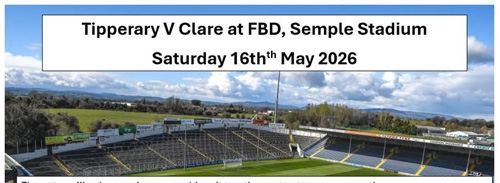
Clare delivered a massive statement in the Munster SHC last night with a commanding 1-25, (28pts) to 0-17 (17 pts) victory over Tipperary at Semple Stadium.
Things went from bad to worse for the All-Ireland champions when Willie Connors was sent off, and Clare ruthlessly stretched their advantage with points from Tony Kelly, Peter Duggan and Diarmuid Stritch.
The defeat leaves Tipperary staring at a shock championship exit, with their hopes now depending on Waterford getting a result against Limerick today.
Please avoid the Nenagh → Latteragh(R498) → Borrisoleigh route due to extensive roadworks and Stop/Go traffic management systems. Here significant delays are expected.
As Ireland prepares to face Israel in football in the months ahead, emotions and protests sadly are likely to surround the matches. In times like these, it is important to remember that behind modern politics are also human stories; stories of courage, survival and ordinary people who chose humanity over hatred.
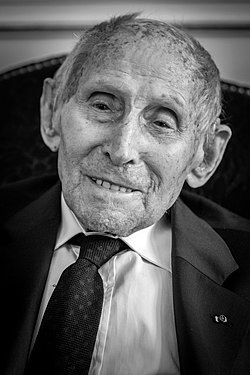
Mr Georges Loinger.
One such story is that of Mr Georges Loinger, a remarkable Jewish member of the French Resistance who saved hundreds of children from the Holocaust during the Second World War. His life reminds us that compassion and bravery can exist even in humanity’s darkest moments.
Born in Strasbourg in 1910, Mr Loinger grew up in a Jewish family and became an outstanding athlete. During the Nazi occupation of France, he used not weapons, but intelligence, sport and daring imagination to rescue Jewish children from deportation and almost certain death.
One of his most extraordinary methods involved football and ball games near the Swiss border. Loinger trained frightened children to run fast and fearlessly. Then, close to the frontier, he would throw a football or ball across the border and encourage the children to chase after it. By the time guards realised what was happening, the children had already crossed into neutral Switzerland and escaped Nazi persecution.
As the war intensified and German troops tightened border security, Loinger developed other creative escape plans. Sometimes children were disguised as mourners attending funerals near cemeteries beside the Swiss frontier. Hidden routes, ladders and false papers became tools of survival. Through these dangerous missions, Loinger personally helped rescue at least 350 Jewish children.
Loinger himself had earlier escaped from a German prisoner-of-war camp. Because he had blond hair and blue eyes, Nazi guards did not realise he was Jewish. After escaping, he joined the Jewish aid organisation OSE, which worked secretly with the French Resistance to protect children whose parents had been murdered or deported to concentration camps.
Those who knew him said he carried himself with calm confidence rather than fear. He later explained that sport helped him appear natural and composed at checkpoints, something that often saved lives. His courage earned him some of France’s highest honours, including the Legion of Honour and the Resistance Medal.
When Ireland and Israel meet on the football field, demonstrations and political disagreements may dominate news headlines. Yet stories like Georges Loinger’s show another side of history; one where the game of football itself became an instrument of rescue, hope and survival for vulnerable children fleeing real genocide.
Mr Loinger died in 2018 at the age of 108, but his legacy continues to inspire people across the world. In remembering him, we remember not Irish politics, but humanity.
This website uses cookies to improve your experience. We'll assume you're ok with this, but you can opt-out if you wish.AcceptRead More
Privacy & Cookies Policy
Privacy Overview
This website uses cookies to improve your experience while you navigate through the website. Out of these, the cookies that are categorized as necessary are stored on your browser as they are essential for the working of basic functionalities of the website. We also use third-party cookies that help us analyze and understand how you use this website. These cookies will be stored in your browser only with your consent. You also have the option to opt-out of these cookies. But opting out of some of these cookies may affect your browsing experience.
Necessary cookies are absolutely essential for the website to function properly. This category only includes cookies that ensures basic functionalities and security features of the website. These cookies do not store any personal information.
Any cookies that may not be particularly necessary for the website to function and is used specifically to collect user personal data via analytics, ads, other embedded contents are termed as non-necessary cookies. It is mandatory to procure user consent prior to running these cookies on your website.



Recent Comments