This August, the fairways of Thurles Golf Club will become the setting for something far greater than a round of golf.
From Tuesday, 18th August to Friday, 21st August 2026, golfers from across County Tipperary and the Archdiocese of Cashel and Emly are invited to gather in friendship, rivalry and common purpose for the Thurles Lions Club Golf Classic 2026.
At the heart of the event stands one of Thurles’s most treasured landmarks: the magnificent Cathedral of the Assumption.
Construction of the Cathedral began in 1865, and it was consecrated in 1879. For almost a century and a half, its towers, domes and sacred spaces have watched over generations; marking baptisms, weddings, funerals, feast days and countless moments in the life of the community. Now, as the Cathedral approaches its 150th anniversary in 2029, its roof requires major replacement. The wider fundraising campaign is working to secure the future of this much-loved building, described by Thurles Parish as more than stone and mortar, but a place of faith, memory and community that must be preserved for generations still to come.
Thurles Lions Club has committed to raising €50,000 over four years in support of that mission, and the upcoming Golf Classic is one of the central events in that effort.
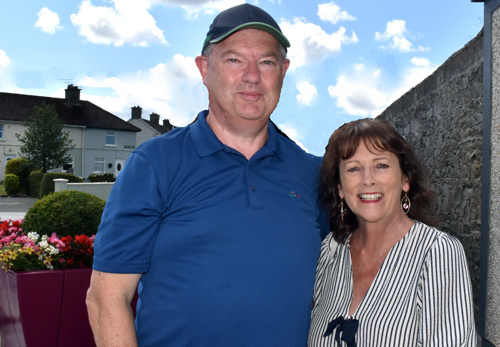
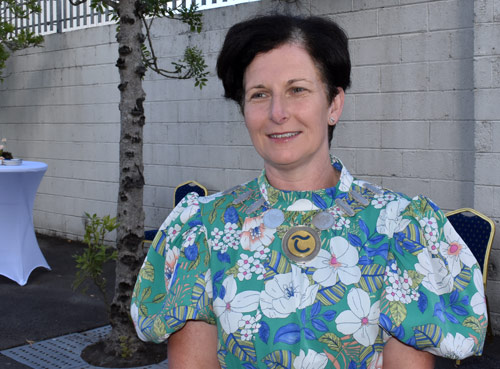
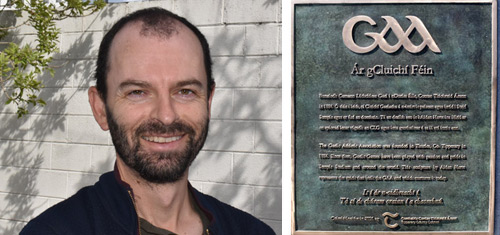
The People To Chat To:- L-R: Lions Club member Mr William McDonagh and Lions Club President Ms Mary Slattery.
A golf competition with parish pride at stake. Teams of three players are invited to enter, with every team competing for the Thurles Lions Club Golf Classic Trophy and a share of an overall prize fund of approximately €2,000.
But this is no ordinary golf classic. Parish teams will also have the opportunity to compete for two special perpetual trophies: The Tipperary Parishes Trophy, sponsored by Thurles Lions Club. The Cashel and Emly Trophy, sponsored by Archbishop Kieran O’Reilly.
To represent a parish, each member of the team must either live in that parish or have grown up there. A parish may enter as many teams as it wishes. The two best team results from each parish will be combined to determine its overall score—opening the door to friendly rivalry, local bragging rights and, perhaps, a little parish history.
► Who will carry the honour of their community? ►Who will hold their nerve over the closing holes? ► Which parish will return home with the trophy?
Event Details:
Date:18th – 21st August 2026. Venue: Thurles Golf Club. Teams: Teams of three. Cost: €210 per team, including green fees and a meal. Prizes: Approximately €2,000 in prizesplus Trophies.
Thurles Golf Club provides a fitting stage for the occasion: a mature parkland course known for its peaceful surroundings, welcoming atmosphere and strong playing conditions.
Note:Payment may be made when the team checks in at Thurles Golf Club on the day of play.
Businesses, organisations and individuals can also support the event through tee-box sponsorship for €100. Parish teams are encouraged to seek local sponsorship and bring their wider communities into the campaign.
This is an opportunity to play for your parish—but also to play for heritage, remembrance and the generations who will one day walk through the Cathedral doors.
Four summer days. Three players per team. One great community cause. Great golf. Great cause. Great community. Support. Play. Make a difference.
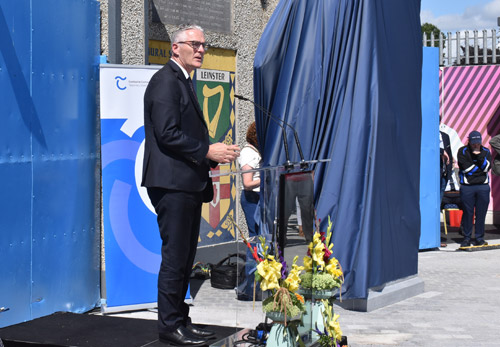
GAA President Jarlath Burns has pledged to do everything within his power to help secure a brighter future for Semple Stadium, during the remainder of his term in office.
The Armagh native made the commitment at the unveiling of the new “Ár gCluichí Féin” statue at the historic Thurles venue yesterday.
With Semple Stadium having fallen behind many of the country’s more modern grounds, the need for significant investment and redevelopment is now widely recognised. Addressing those in attendance, Mr Burns spoke passionately about the responsibility facing the GAA and its leadership over the coming decade. He said the stadium must receive the funding required to ensure future generations can continue to take pride in one of the Association’s most iconic venues. Mr Burns pledged that, during his remaining months as Uachtarán Chumann Lúthchleas Gael, he would work to honour Semple Stadium and help restore it to the standard envisioned by pioneering figures such as Tom Semple.
His powerful five-minute address left a lasting impression on the audience. Speaking without notes, his exceptional command of the Irish language, natural eloquence and strength as a public speaker, held those present in awe.
His remarks were a fitting and memorable tribute to Semple Stadium’s remarkable past, as well as a strong statement of intent regarding its future.
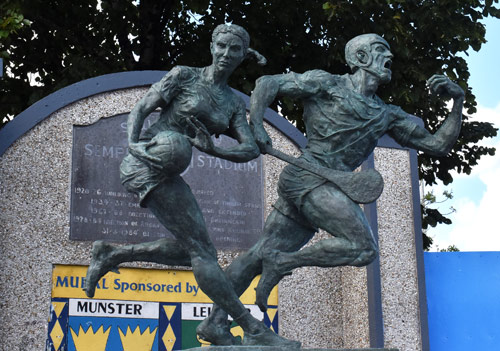
A monumental bronze sculpture by Kilkenny artist Mr Aidan Harte was unveiled outside FBD Semple Stadium in Thurles today, celebrating the town’s unique place in the history of Gaelic Games.
Standing more than three metres tall, Ár gCluichí Féin, (meaning Our Own Games), depicts a male and female player in motion, representing the energy, skill and shared traditions of hurling, camogie and Gaelic football.
Ár gCluichí Féin. Pic: G. Willoughby.
The inclusion of the female figure is particularly significant, making the work the first major GAA statue to portray a female player.
The sculpture honours Thurles as the birthplace of the Gaelic Athletic Association, which was founded at Hayes’ Hotel in the town in 1884. The Ladies Gaelic Football Association was also established at the same location 90 years later, in 1974. GAA President Mr Jarlath Burns attended the unveiling alongside young representatives of the Primary Games and leading Tipperary players, including senior hurling captain Mr Ronan Maher, vice-captain Mr Jake Morris and senior camogie captain Ms Caoimhe McCarthy.
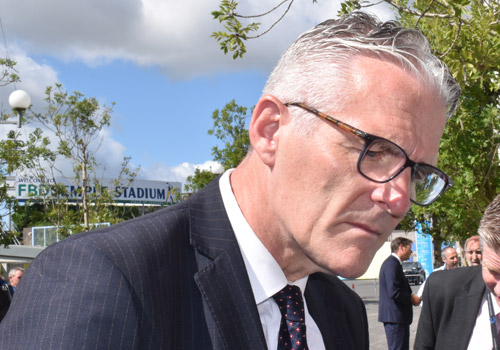
GAA President Mr Jarlath Burns. Pic: G. Willoughby.
Commissioned by Tipperary County Council in partnership with Tipperary GAA and FBD Semple Stadium, the artwork forms part of a wider place making programme for the area. The investment also includes tourism, active-travel, road, cycling and public-realm improvements around the stadium and truly is a must view.
Mr Harte began his career in the arts at Kilkenny-based animation studio Cartoon Saloon, working alongside its founders Tom Moore and Paul Young. He later studied sculpture in Florence and has created several prominent works, including the widely discussed Púca sculpture commissioned for County Clare.
Now permanently positioned beside one of Ireland’s most celebrated sporting grounds, Ár gCluichí Féin provides a striking tribute to the generations of women and men who have played, supported and sustained Ireland’s native games.
Present Chairperson (Cathaoirleach) of Tipperary County Council, Labour CouncillorMs Fiona Bonfield summed up the occasion in her introductory opening speech stating: “It is wonderful to see such a large attendance here today. Unlike most occasions held in Semple Stadium, there is no debate this morning about team selections, controversial refereeing decisions, or whether the ball went over the bar. For once, we are all gathered in complete agreement to celebrate something truly special. It is a great pleasure to be here today for the unveiling of this remarkable artwork—a piece that celebrates a place of profound importance in Ireland’s sporting, cultural and social history: Thurles, the birthplace of the Gaelic Athletic Association. In a week when we have witnessed at first hand the importance of our national games to our people, and collectively celebrated a historic game last Sunday, (Mayo v Kerry) we have, as a nation, felt a tremendous sense of pride in that journey.
Today, we gather not only to welcome a new artistic creation, but also to honour a story—a story that began here in Thurles in 1884, when a small group of visionaries came together with the ambitious idea of preserving, promoting and strengthening Ireland’s indigenous games and cultural traditions. From that meeting emerged an organisation that would grow beyond anything its founders could ever have imagined. What would those founders think if they could see the GAA today? For more than 140 years, the GAA has helped to shape communities across Ireland and throughout the world. It has nurtured generations of players, volunteers, supporters and families. It has provided places where people belong, where friendships are forged, where leadership is developed and where local pride flourishes.”
Chairperson (Cathaoirleach) of Tipperary County Council Labour CouncillorMs Fiona Bonfield. Pic: G. Willoughby.
“At the heart of that story is Thurles. This town occupies a unique place in our national consciousness. It is where the foundations were laid for a movement that would become one of the largest amateur sporting organisations in the world. It is fitting, therefore, that this artwork should stand here in Thurles as a permanent reminder of that legacy, and of the vision, determination and community spirit that inspired the founders of the Association. Public art has a special role in our communities. It allows us to connect with our shared history, celebrate our identity and tell our stories in a way that resonates across generations. Great artwork, however, endures. It captures the imagination, sparks conversations and leaves a lasting impression. This artwork does precisely that. It honours the past while speaking to the future. It reminds young people of the extraordinary heritage they inherit and encourages them to become the next generation of players, volunteers, artists, leaders and custodians of community life. As we unveil this artwork, we celebrate far more than a historical event. We celebrate creativity. We celebrate artistic mastery. We celebrate community. We celebrate volunteer-ism. We celebrate identity. Above all, we celebrate a town whose name will forever be linked with one of the most influential organisations in Irish life.” continued Ms Bonfield.
While welcoming the many dignitaries and team players in attendance today; Ms Bonfield further stated, “Fittingly, here in Thurles, at the Field of Legends, we celebrate a passion that can unite neighbours, families and entire counties”.
Our Games Began Here — and Today, They Come Home
“Ár gCluichí Féin” artist Mr Aidan Harte. Pic: G. Willoughby.
Speaking after the sculpture was revealed, Ár gCluichí Féin artist Mr Aidan Harte described the satisfaction of finally seeing the completed work installed on its plinth. The artist spent much of the previous year modelling the figures in clay at his Kildare studio, before the piece was transferred to a foundry and cast in bronze.
Mr Harte stated, “My father will be the first to tell you that I am Ireland’s worst sportsman. I peaked as a corner-forward at the age of nine. But sculpting this pair of giants was my version of senior hurling. Thank you to Ms Melanie Scott of Tipperary Arts Office for awarding me this commission amid strong competition, and for supporting me throughout its year-long creation.
Thank you to Mr Vincent O’Shea for his good advice, and the occasional kick up the arse when I needed it. Thanks also to sculptors Mr Alan Clarke, Ms Liz O’Kane and Mr Hywel Pratley for their second opinions on anatomy and composition, and to Mr Kieran Riley for his engineering advice on constructing a work of this scale. The Foundry did far more than cast the sculpture; they were co-creators. My thanks to Mr David O’Brien, Jessica, Sandra, Ahmed and Brian for transforming the clay created in my studio into bronze.
The raw materials for the plinth came from Manor Stone, while Thomas Duffy and the County Council team constructed it, along with the elegant space in which the sculpture now stands. Completing everything on time required close coordination between Thurles District Council and Semple Stadium, led by Ms Deirdre Dunne and Mr David Morgan.
Finally, thank you to the people of Thurles for allowing my champions to become part of the Semple Stadium’s story. Our games began here. They thrived here. Today, they come home.
Down in County Clare, my first public sculpture, The Púca, stands in the birthplace of Michael Cusack, founder of the GAA, with FBD Semple Stadium one of the great arenas of Gaelic games, and it is an honour to take part in its continuing story. I hope this sculpture reminds everyone who sees it of how powerful we can be when people unite around the things they love. The two figures do not depict any particular players, because Gaelic games belong to all of us. Thank you to everyone who helped bring this work to life: my wife, Bronagh, who put up with the muddy floors; my neighbour Stuart, who loaned me his football boots; and my models, Natalia Hornet, Noémie Birard, Michael Harte and Pierce Harte. I created the sculpture on top of a steel armature, built by my father Billy, back in the 1970s. Billy himself hurled on these hallowed grounds for Kilkenny.
Thank you all for coming out and sharing this special occasion”, concluded Mr Harte.
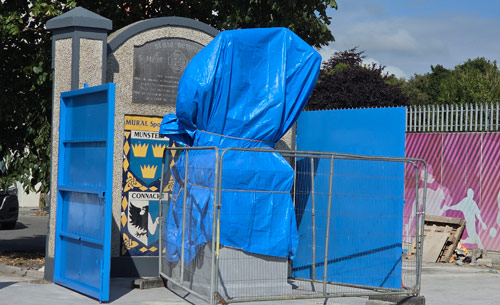
A striking new bronze artwork planned and in place at the entrance to FBD Semple Stadium in Thurles; celebrating Tipperary’s unique place in the history of Gaelic games.
The permanent public artwork was commissioned by Tipperary County Council in partnership with Tipperary GAA and the management of FBD Semple Stadium. It is installed near the stadium entrance, and expected to create a new landmark for supporters, visitors and the wider Thurles community.
Set to be unveiled; artwork celebrating Thurles as birthplace of the GAA. Pic: G. Willoughby.
Rather than honouring one individual player or official, we understand the sculpture is intended to represent Gaelic games more broadly. The original commission sought a bronze design featuring male and female sporting figures, reflecting the traditions of hurling, camogie, Gaelic football and ladies’ football.
The location is particularly significant. The Gaelic Athletic Association was founded in Hayes’ Hotel, Thurles, on November 1st 1884, while the Ladies Gaelic Football Association was also established in the town in 1974. The artwork will therefore recognise Thurles not only as one of Ireland’s great sporting towns, but as the birthplace of organisations that have shaped Irish community life for generations.
Semple Stadium itself has played a central role in that history. It is the home of Tipperary hurling and football and one of the country’s most famous GAA venues. The stadium was named after Mr Tom Semple in 1971 and hosted the historic 1984 All-Ireland Hurling Final, during the GAA’s centenary celebrations.
Full public details of the completed sculpture, including the selected artist and the formal unveiling arrangements, have not yet been clearly published on the council’s official project page.
When unveiled, the new bronze tribute should provide a lasting reminder of Thurles’ proud contribution to Ireland’s national games.
Club Chairperson Mr Enda Bourke (Secretary) Reports:-
Thurles Special Olympics Basketball Club 2025/26 season concluded with final competitions at the Presentation Sports Hall on Wednesday June 10th. Medals were presented to the athletes; concluding another successful campaign and the Chairman thanked the athletes for their dedication to training during the year and all the families and carers who support the athletes every week, along with a great group of volunteers.
On Tuesday 16th, Thurles Golf Club hosted our Club, with the Golf Club Professional, Mr Raymond Ryan giving the athletes a clinic on ball striking and putting. Afterwards, the athletes and their families were treated to refreshments in the Clubhouse, courtesy of Thurles Golf Club.
A big thank you to all who supported Thurles Special Olympics Basketball Club during the past year and we look forward to next season, which will commence at the end of September 2026.
Finally, we remember with sadness the family of Ms Mary Long, a long-time member of our Club, who passed away recently. May Mary rest in peace.
This website uses cookies to improve your experience. We'll assume you're ok with this, but you can opt-out if you wish.AcceptRead More
Privacy & Cookies Policy
Privacy Overview
This website uses cookies to improve your experience while you navigate through the website. Out of these, the cookies that are categorized as necessary are stored on your browser as they are essential for the working of basic functionalities of the website. We also use third-party cookies that help us analyze and understand how you use this website. These cookies will be stored in your browser only with your consent. You also have the option to opt-out of these cookies. But opting out of some of these cookies may affect your browsing experience.
Necessary cookies are absolutely essential for the website to function properly. This category only includes cookies that ensures basic functionalities and security features of the website. These cookies do not store any personal information.
Any cookies that may not be particularly necessary for the website to function and is used specifically to collect user personal data via analytics, ads, other embedded contents are termed as non-necessary cookies. It is mandatory to procure user consent prior to running these cookies on your website.




Recent Comments