|
|
A capacity crowd of parents, students and teachers were held spellbound by a very realistic enactment of the founding meeting of 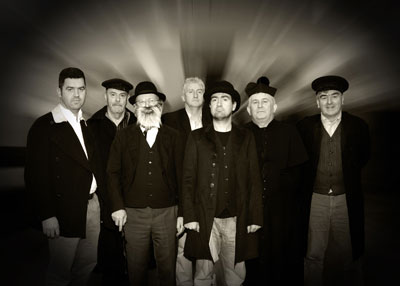 the G.A.A. by a group of Thurles actors in Tipperary Institute on Wednesday last. the G.A.A. by a group of Thurles actors in Tipperary Institute on Wednesday last.
Organised by Tipperary Education Support Centre in Thurles, the enactment was brought to life with a script devised by author and historian Tom Noone from contemporary records of the event, and played by members of Thurles Drama Group.
The actors, in genuine period costume supplied by St. Mary’s Famine Museum, decided on a most original concept, by having all the cast enter the auditorium through the audience and then taking their places among the audience, just as they would have done at an actual meeting.
The narrator gave the reasons for the meeting and invited Michael Cusack to open proceedings. What followed kept everyone’s interest at a high level as various points in favour of the proposed association were made, clarification sought on a number of issues, elections held and acknowledgements made of the sterling work done by Cusack and the new President of the fledgling organisation, Tipperary man Maurice Davin. The meeting concluded with the reading of Archbishop Thomas William Croke’s charter for the association.
The cast pictured above comprised Donal Taylor, Tom Noone, Flan Quigney, Martin Fitzgerald, David McElgunn, Liam Ryan and Jimmy Duggan.
Among the capacity audience were Most Rev. Dr. Clifford, Archbishop of Cashel & Emly, Nicky Brennan, immediate past president of the G.A.A., Barry O’Brien, Tipperary Co. Board chairman, Tim Floyd, Tipperary county secretary, and a large number of the Tipperary hurling panel.
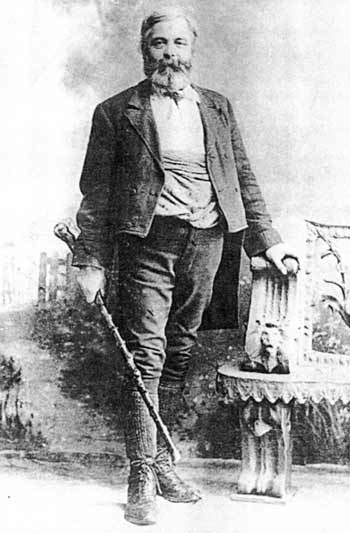 Michael Cusack 1847- 1906 founder of the Gaelic Athletic Association Among the many functions being held country-wide to mark the 125th anniversary of the Gaelic Athletic Association, is a novel idea arranged by a number of teachers in the Co. Tipperary Education Centre here in Thurles.
All of the primary schools in town were invited to submit projects to mark this special occasion, and the response from the students has been magnificent.
The results of their endeavours are on show in Tipperary Institute, and include videos conceived and produced by the students themselves, along with drawings, displays, pictures and essays.
All the work will be recognised on Wednesday 4th November in the Institute at a function to be attended by a number of dignitaries, including members of the Tipperary Senior hurling panel.
Now this is where the novel idea comes into being.
A number of local actors will stage a re-enactment of the very first meeting of the Gaelic Athletic Association, held in Miss Hayes’ Hotel, Main Street, Thurles, on November 1st 1884, with a specially commissioned script based on contemporary accounts of the meeting.
It is hoped to have a link with the Michael Cusack Centre in Clare during the presentation.
This event promises to be an historical and educational evening.
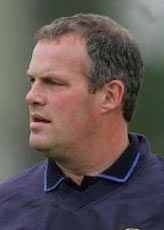 Ken Hogan Tipperary Former Tipperary senior hurling manager Ken Hogan, who won five Munster titles and two All-Ireland crowns during his playing career as goalkeeper with the Premier County, has been handed a two-year term in charge of the county’s U-21 hurlers.
Ken won two under-14 ‘B’ championship medals in 1976 and 1977 and an under-21 ‘B’ medal in 1983. He was a member of the Tipperary senior inter-county team from 1987 until 1993, winning two North Tipperary senior hurling championship medals and captaining his side to the title in 1989.
Ken will be assisted in his new post by Tommy Dunne, TJ Connolly and William Maher.
Ken Hogan, from the Lorrha-Dorrha club, stepped into management when his playing days ended, serving as a selector alongside former Tipp senior boss Fr. Tom Fogarty in the 1990s.
Hogan was elevated to the top position for two seasons in his own right when he succeeded Michael Doyle as team boss in 2003.
An ambitious planning application is expected to be lodged later this week in respect of a new entertainment development project near Thurles Co.Tipperary.
Businessman Richard Quirke has plans to build a massive entertainment facility which will include a five-star hotel, entertainment centre seating 15,000 people, casino, new racecourse for horses and a new greyhound track .
The horse racing course is designed to be similar to the Dundalk, Co Louth track, which successfully opened two years ago and received a grant of €10.2 million from Horse Racing Ireland (HRI).
The Dundalk track which is understood to have cost over €20 million is an all-weather, floodlit track and is viewed as a very sound financial venture.
It is understood this new proposed development will be on an existing 800-acre site close to the village of Two Mile Borris, at Noard House approximately five miles from Thurles town.
The chances of this project becoming a reality may end up being totally dependent on the results of a current review of policy regarding casino gambling in Ireland by the present Government whose decision is expected to be revealed towards the end of 2009 or early 2010. It is believed that now with the advent of Online Casino’s the government may change previous views held in relation to such matters.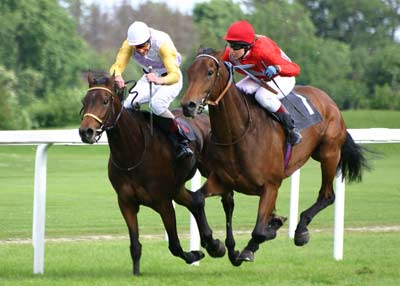
Slot-machine tycoon Richard Quirke, a former garda, who boosted his fortune from his gaming arcade,”Dr Quirkey’s Good Time Emporium”, trading as Dublin Pool & Juke Box Company Limited, at 55-56, Upper O’ Connell Street, Dublin 1, is well-known in gaming industry circles. He was previously the owner of the Carlton Cinema site in the centre of Dublin, latter which he sold for an estimated €30 million. The accounts for his Dublin pool and juke box firm lists property worth more than €6m and income for himself and his wife Ann just under €3m. His son Wesley has been dating the former Miss World Rosanna Davison for approximately two years.
Horse Racing Ireland (HRI) officials would make no comment on this matter today at Thurles track, but sources close state that the HRI have had ambitions for a number of years regarding a new racing track in the Munster area.
The 2007 National Development Plan allowed for the provision of €70m to go toward helping finance new racecourses, however, in today’s very different economic situation, both the Government and the HRI have both called a halt to capital development funding.
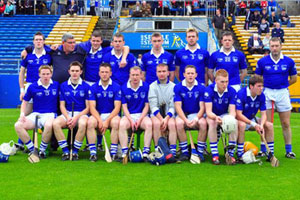 Thurles Sarsfields - Pic courtesy John O'Loughlin Thurles Sarsfields netted their 30th Tipperary SHC title with a comprehensive 0-14 to 0-5 win over Drom & Inch before an attendance of almost 10,000 spectators at Semple Stadium.
Thurles Sarsfields blazed a trail in the opening quarter as two points each from Johnny Enright and Pa Bourke along with an Alan Kennedy score saw them race into a 0-5 to 0-0 lead by the 11th minute.
The Sars were hugely dominant in the opening stages as Drom & Inch struggled to make an impression eventually opening their account in the 13th minute thanks to Johnny Ryan.
The Sars kept up their momentum by scoring three of the next five points to hold a well deserved 0-9 to 0-3 at half-time.
Drom and Inch constantly struggled for possession throughout and Pa Bourke continued to be deadly accurate from open play while Enright and substitute ‘Redser’ O’Grady also made their presence felt.
Sarsfields showed a great hunger throughout play and although Drom and Inch closed the gap to six points with five minutes remaining they were unable to find the necessary scores required.
Final Score: Thurles Sarsfields 0-14 Drom And Inch 0-5
Sarsfield Captain Johnny Enright accepted the Dan Breen Cup from Tipperary GAA Chairman Barry O’Brien, and full-back Padraic Maher was rightly confirmed as the Man-of-the-Match.
Thurles will now face Cork champions Newtownshandrum in the Munster Club SHC quarter-final on November 1.
Thurles Sarsfields Team: P McCormack; M Cahill, P Maher, K O’Gorman; B O’Dwyer, L Cahill, S Lillis; A Kennedy (0-2), M Gleeson; P Bourke (0-4, 0-2f), S Ryan, D Maher; R Ruth (0-1), L Corbett, J Enright (0-5, 0-1f).
Subs Involved: D Kennedy for Ryan (16 mins), R O’Grady (0-2) for Ruth (47), J Lawlor for L Cahill (60), D O’Dwyer for A Kennedy (62), M Collins for O’Gorman (63).
Drom & Inch Team: D Young; Martin Butler; E Costello, M Costello; D Kennedy, P Stapleton, Michael Butler; J Woodlock, S Butler; E Woodlock, S Callanan (0-2, 0-1f), J Kennedy (0-1); D Butler, M Long, Johnny Ryan (0-2, 0-1f).
Subs Involved: E Buckley for Stapleton (27 mins), D Ryan for Long (31), M Ryan for E Woodlock (44), D Collins for D Ryan (53), James Ryan for J Woodlock (65).
|
Support Us Help keep Thurles.info online by donating below. Thank you.
Total Donated 2026: €300.00
Thank You!
Daily Thurles Mass Livestream
|



Recent Comments