The Easter Supermarket Aisle is really a ‘Confession’ of what we Value.
Not taste. Not ingredients. Not children’s health. What we value and what we reward, is packaging that wins the argument in the moment.
Enter into any Irish supermarket in the weeks before Easter and you’ll find it, that dazzling wall of foil, cartoon faces and glossy packaging, positioned strategically at child height. Now walk a child past that wall of Easter eggs and watch what happens. They don’t scan ingredients. They scan cartoon characters, colour and sparkle. Their attention is being bought through design and the bill is handed to parents at the till.
That’s why the palm oil conversation matters. Not because palm oil is a cartoon villain, but because it’s often part of a bigger formula: cheaper fats, big sweetness, high profit margin, huge volume. And, when you attach that formula to a licence kids already love, you get a product that sells itself and most importantly for the retailer, sells fast.
Palm Oil Conversation Matters.
A Tesco listing for a Tesco Peppa Pig Easter product includes “Vegetable Fats (Palm, Shea…)”. Read that again; the most child-attractive packaging can be paired with ingredients designed to protect a price point, not a growing body. Now here’s the part that will annoy people. Supermarkets will say, “We simply stock what customers buy.”
Yes True, but incomplete. Retailers shape what customers buy. They choose what gets eye-level space, what gets aisle-end promotion, what gets “2 for €X”. They decide what looks like the normal choice. If the loudest, sweetest, most character-heavy egg is placed where every family must pass, then “choice” becomes a bit of theatre. A kid asks. A parent caves. The system works exactly as is so designed.
And don’t pretend we don’t know the long game. Health guidance remains consistent: keep saturated fat lower overall and don’t let it quietly dominate the diet. We also know that diets built around ultra-processed treats don’t damage a child in one day, they train preferences and routines over years.
The tragedy is that Irish makers who are trying to do it better are often invisible to children.
That’s a strong ethical and ingredient choice. But on a crowded Easter shelf, a subtle box can’t compete with the instant dopamine or feel-good hit of a character egg.
So here’s my fair, defensible ask: Supermarkets: Stop hiding Irish quality behind adult-looking packaging and premium-price assumptions. Give local makers seasonal visibility where families actually shop. Supermarkets aren’t trying to harm children. They are, however, designed to maximise sales per metre of shelf space. Character products sell fast, drive “pester power”, and deliver predictable seasonal turnover. Artisan chocolate can be slower-moving, pricier, and less visually “grabby” for small hands. Irish chocolatiers: You don’t need to slap a cartoon face on everything, but you do need to meet kids where they are. Easter is visual. Make “better ingredients” look fun. The uncomfortable truth is that the better chocolate product often loses the packaging battle. Here’s where Easter gets unfair. Many artisan brands package beautifully for adults; elegant boxes, subtle colours, premium cues, but kids don’t buy with adult eyes. Parents:Don’t let the aisle decide for you. Flip the box. Read the fat list. Buy the fun, but buy it with open eyes. Look for palm oil/palm kernel oil on the label (it will be named).
Easter should be a treat. It shouldn’t be a marketing lesson where children learn that the brightest box is automatically the best choice.
If we really want better food culture, we have to reward it, not just applaud it.
Reducing the voting age to 16 is often sold as a simple, modern reform, to bring young people into the ‘democratic tent’ earlier, to boost turnout, and strengthen civic culture. In practice, it is neither simple nor risk-free. If voting is the most consequential act of civic membership, then lowering the threshold should only happen where the benefits are clear, durable and supported by institutional scaffolding to make sure it work. Right now, there are strong reasons not to entertain it.
First is principle and coherence: Eighteen is widely understood as the point at which the State recognises full adult status. Voting sits alongside other “full membership” rights and responsibilities, and it matters that this package is intelligible. Lowering the voting age, while leaving most other adult thresholds intact, either creates a new inconsistency, or invites pressure to “tidy up” the rest of the law to match. Either way, it is not a neat reform; it changes the logic of adulthood in public policy.
Second. The lived reality of 16-year-olds is structural dependence. Many teenagers are financially dependent, living under parental authority, and constrained by school and household expectations. That does not mean they cannot form political views. It does mean their ability to cast an independent vote can be narrower than it is for adults. In some cases, the risk is that a ballot becomes a proxy for household influence, not a genuinely autonomous civic voice.
Third. The modern information environment makes younger cohorts more vulnerable to manipulation. Politics is increasingly shaped by micro-targeting, influencer pipelines and rapid misinformation loops. Expanding the electorate to include minors increases the premium on strong media-literacy and civic preparation. Even advocates of votes at 16 regularly acknowledge that early, structured political education is essential. The problem is that civic education is uneven and often contested, so the reform risks outpacing the safeguards.
Fourth concern: Schools become an unavoidable political battleground. If 16-year-olds are voters, schools are the most efficient point of contact. Teachers and principals would face intensified pressure to “balance” content; parents would worry about politics being smuggled into classrooms; campaign groups would seek access through “non-partisan” resources. International discussions of votes at 16 frequently stress education as a prerequisite, but that is exactly where the most polarising arguments land.
Fifth. There are serious administrative and safeguarding complications around registration. An electoral register must be usable and transparent, but the Irish State also has a duty to protect under 18s’ personal data. Where 16–17s have been enfranchised, special arrangements have been needed to manage this tension. It is not a reason never to do it, but it is a reason not to treat the change as cost-free or merely symbolic.
Sixth. The political and constitutional “bandwidth” argument matters, especially in Ireland. Changing the national voting age is not a routine legislative tweak; it carries constitutional implications and would demand major political energy. In a country with multiple urgent reform priorities; housing, health capacity, infrastructure, cost-of-living etc., there is a fair question; “Is this the best use of this scarce reform capital?”
And Finally. The promised benefits are not guaranteed. Events that feel unusually important, visible, and emotionally charged, can see strong youth participation, but that does not automatically translate into higher turnout in ordinary elections or lasting engagement. Research from countries that have lowered the age are encouraging findings in some contexts, mixed results in others, and a recurring theme that outcomes depend heavily on preparation and political environment. In other words, the evidence is conditional not a clear mandate.
None of this denies that young people deserve a stronger voice. It argues that lowering the voting age is a blunt tool with real downsides. If the aim is youth influence and civic strength, there are lower-risk steps; better civic education and media-literacy; easier registration at 18; structured youth assemblies with real consultation power; even pilots at local level where issues are closer to daily life. Before redefining who gets a vote, we should fix the foundations that make democratic participation meaningful in the first place.
St Patrick’s Day parade committees across Ireland are warning that escalating insurance costs and reduced availability of public liability cover are placing community celebrations under severe strain, raising the risk of cancellations, scaled-back routes and last-minute uncertainty for towns and villages.
Hereunder, Video of the Thurles, Co. Tipperary, St Patrick’s Day Parade Held 2025.
Volunteer-led committees say public liability insurance has become a barrier to participation, not just a safety requirement, with higher premiums, stricter conditions and growing administrative demands landing on groups that rely entirely on fundraising and unpaid work.
Public liability insurance, covering injury to spectators and participants, as well as third-party property damage, has become increasingly difficult to secure for volunteer-led events, with committees reporting that quotes are higher, conditions are tighter and the administrative burden has grown significantly.
Recent media reporting has highlighted the scale of the challenge, with one Wicklow parade committee facing insurance estimates in the €5,000–€10,000 range (with €6,500 cited), a cost that can exceed the entire fundraising capacity of smaller communities.
At the same time, local-authority event permissions typically require proof of insurance in advance, often at high indemnity limits and with specific policy wording, adding pressure to secure cover early and at a price communities can afford.
A spokesperson associated with the Thurles town St Patrick’s Day Parade Committee, has stated that;- “Insurance has always been a problem and ever since Covid it has doubled. This is a volunteer-run event. We’re proud of the work that goes into making it safe and welcoming, but the cost and complexity of insurance is now the single biggest threat to Irish parades. Without a workable solution, communities will lose events that bring people together and support local businesses. We’re told to produce more and more documentation and pay for more and more controls, which we do, but the quotes still rise and the uncertainty remains. At some point, towns are simply being priced out of their own national day. St Patrick’s Day shouldn’t become a luxury product available only to the biggest centres. If we don’t act, we’ll sleepwalk into a future where local parades quietly disappear, and once they’re gone, they’re hard to bring back.”
Committees stress that risk management standards have risen sharply in recent years. Organisers are now expected to produce robust event management plans, crowd control measures, stewarding and traffic management arrangements, important steps for safety, but often costly to implement.
National claims data shows improvements in the wider public-liability landscape, with the Injuries Resolution Board reporting a 40% reduction in public-liability claim volumes, between 2019 and 2023. Parade organisers are asking that progress be reflected in affordability and availability for well-managed community events.
Calls for action. Community parade organising committees are urging:
A dedicated community events insurance support mechanism, aligned with documented safety standards and transparent pricing.
Clear engagement from Government, insurers and local authorities to protect the viability of community parades, not just flagship events.
A simplified national template for parade risk management and event documentation to reduce administrative burden and improve consistency.
Engagement with insurers, brokers and Government to increase capacity for community events and prevent avoidable cancellations.
St Patrick’s Day belongs to every community and participants are asking for the implementation of practical measures, so that smaller towns and villages can continue to celebrate safely without being priced out of total existence.
While the Suir silts up and sewage claims persist, Tipperary’s “solutions” look like optics-first spending, paid for by the public, twice over.
The Flooding “Solutions” Scam: Councils Let Rivers Choke, Then Sell Us Flood Barriers.
We’re being asked to accept flooding as inevitable. Each time the water rises, we’re told it’s “unprecedented”, that there’s nothing to be done, and that the only answer is another costly flood barrier, another engineered scheme, another grand capital project.
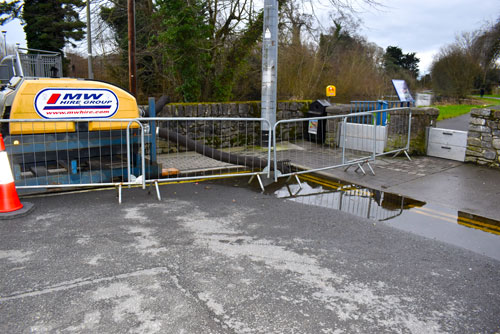
Although flood barriers are in place here and pumps are operating on Emmet Street, Thurles, flooding continues as water is rising through wastewater drains on the street surface, before being pumped again into the swollen river. In these circumstances, surface barriers offer little or no protection. Pic: G. Willoughby.
But for many towns, the more uncomfortable truth is this: a significant part of the problem is neglect, plain, predictable, year-after-year neglect, and it sits squarely with local authorities and the agencies they work alongside.
When river channels and outfalls are allowed to silt up, narrow, and clog, the river loses capacity. Water backs up sooner. “Manageable” rain becomes road flooding, business disruption, and damaged homes. That is not an act of God, it’s an act of governance.
Maintenance isn’t glamorous, so it gets skipped. Routine river maintenance is boring. It doesn’t lend itself to ribbon-cutting. It requires surveys, schedules, repeat work, and public reporting. And that’s exactly why it’s so often pushed down the list. Instead, we get the shiny alternative; manufactured flood barriers, the visible, photogenic, capital-heavy answer. They may have a place in specific settings, but far too often they’re treated as a substitute for basic poor river stewardship. Even professional bodies that caution against dredging as a universal fix still accept the basics: increasing channel conveyance can help reduce levels in smaller, more frequent floods. The key is that it must be targeted and properly managed, because indiscriminate dredging can speed flows and shift risk downstream. So nobody credible is demanding a reckless “dig everything” policy. What people are demanding is far more reasonable:
Why are we spending vast sums on barriers when the river’s basic capacity is being allowed to deteriorate in the first place?
Thurles: Tarmac by the river, while sewage flowed in plain view. Nowhere is the contradiction more glaring than in Thurles, Co. Tipperary.
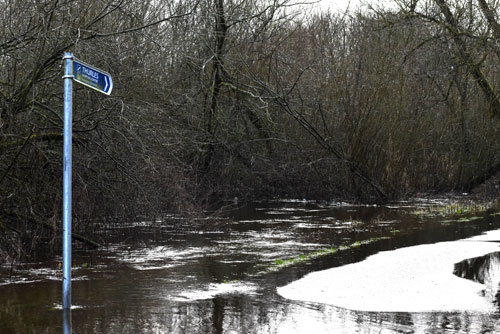
Flooded new Thurles tarmac pathway, while a tangle of willow trees and low, leaning branches stretch across the water, effectively blocking and constricting its flow. Pic: G. Willoughby.
In April 2022, a public district meeting heard claims that “raw sewage” was flowing into the River Suir along the extended Riverwalk area. The report quoted a councillor saying he had pictures and describing it as disgusting.
Read that again carefully: The issue wasn’t hidden away in a remote field. The allegation was that sewage was entering the river along the very walkway being promoted as an amenity. Then, in March 2024, a Thurles-based TD publicly questioned Uisce Éireann about discharges of raw sewage into the River Suir, in Thurles, and in September 2025, further local reporting again described sewage and pollution concerns in the town centre stretch. So let’s stop pretending this is a mere “perception issue”. If a town is paving and polishing riverside paths while the public is seeing (and smelling) pollution in the water, that’s not regeneration. That’s cosmetic spending beside a neglected system.
You also raise an accusation many locals will recognise: that some works were pushed through to use up available funding, especially after another walkway plan failed to materialise. I can’t independently prove the motive — but the pattern is familiar: when capital money appears, councils can scramble to spend it quickly on visible works, while harder, messier problems (pollution sources, maintenance regimes, enforcement) are left to drag on.
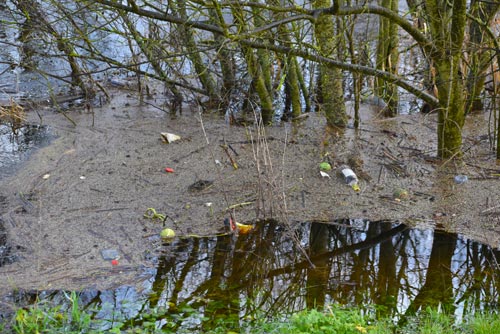
Stationary filth and litter in abundance as Thurles Municipal District provides river-side seating, without even one litter bin being placed in the vicinity. Pic: G. Willoughby.
Funding announcements don’t equal progress: In November 2025, a funding allocation of €447,300 for an extension of the Thurles River Suir walkway was publicly announced under the ‘Outdoor Recreation Infrastructure Scheme‘, including a planned looped walk.
Here’s the question that should be asked at every launch and photo-call: What is the point of extending a riverside amenity if the river itself is being allowed to degrade, and if flooding repeatedly makes sections unusable anyway? Local reporting at the time of that funding announcement explicitly linked renewed frustration to ongoing flooding and calls for proper maintenance of the river.
Who should be held responsible? Start with the council: This is where the gloves come off. Tipperary County Council cannot keep presenting flooding as a surprise while communities can see, year after year, the tell-tale signs of avoidable risk: silting, blocked channels, overgrowth, neglected outfalls, and the creeping sense that nobody is minding the basics.
And when the response defaults to barriers and big-ticket projects, rather than a published maintenance programme, people are right to feel played. Yes, extreme weather is real. But neglect is real too. And neglect is optional.
What Thurles (and every town) should demand now: If councils want to be taken seriously, the minimum standard should be:–
A published annual maintenance schedule for key watercourses: inspections, targeted desilting, vegetation management, debris clearance, and outfall/culvert checks, with dates and locations.
Before-and-after surveys at known pinch-points showing what capacity was restored and what risk was reduced.
A public pollution action list: identify suspect outfalls, state ownership/responsibility, publish remedial timelines (with named leads across council and Uisce Éireann).
A rule of priorities: no more “path-first, river-later” optics. If the water is compromised, fix the water first.
Independent oversight and reporting, including engagement with the Environmental Protection Agency and catchment structures like LAWPRO, which has recently hosted public discussions where concerns about the Suir around Thurles were raised.
And one final point: agencies such as the Office of Public Works can fund schemes and design defences, but if local maintenance and accountability are missing, we will keep paying twice: first in flood damage, then again in erecting flood barriers.
In the words of Forrest Gump, “Stupid is as stupid does”, meaning a person’s intelligence is defined by their actions and behaviour, rather than their appearance, reputation, or perceived abilities.
Again Three Questions: (1) Why have Rates in Tipperary increased by 5%? (2) Why are we forced, yes forced, to pay property tax on houses we worked hard to purchase, from already taxed incomes? (3) Why do we continue to elect and pay local councillors who make absolutely no contribution in dealing with the problems existing in our respective areas, while officials really make the decisions.
See link to PDF declaration HEREshowing salaries and expences over a 3 month period (12 weeks), of between €10,300.00 and €15,500 each.[Note: €15,500÷ 12 =€1 291.66 in costings per week, while double jobbing, per Tipperary Co. Council].
If we’re serious about flooding, stop buying flood barriers as being the first answer. Start with the river itself. Start with proper maintenance. Start with the truth.
Ireland’s Daily Drug Docket: Punish the Profiteers, Treat the Addicted.
Hard on Supply, Human on Use: Time for Common Sense in Irish Drug Policy.
Spend any time around a District Court and you quickly get the sense of a system carrying a weight it was never designed to hold. Day after day, more people find themselves before the courts on drug-related charges; possession, small-scale supply, probation breaches linked to use, and the petty crimes that trail behind addiction, like a shadow.
The scale is not anecdotal. In 2023, the courts made 21,907 orders in relation to drug offences in the District Court alone, involving 15,858 defendants. The wider crime picture is hardly reassuring either: the CSO recorded 16,119 incidents of controlled drug offences in 2024, and noted that the decline that year included falls in both possession for sale/supply and personal use incidents. Even if the trend line moves up or down in a given year, the reality in communities is constant: drugs are an everyday presence, and the courts are one of the last public services left standing at the point of crisis.
Against that backdrop, it infuriates decent people to see what looks like “soft” sentencing for dealers, especially when the damage is so visible. Families are burying loved ones. The Health Research Board recorded 343 drug poisoning deaths in 2022, a grim number behind which sit real kitchens, real bedrooms, real unanswered phones.
So why, people ask, does someone caught dealing sometimes receive a shorter sentence because they have no previous convictions and plead guilty early?
The first uncomfortable answer is that sentencing in Ireland is not a simple “one crime, one fixed penalty” system. Judges set a sentence based on the seriousness of the offence, then adjust it for aggravating and mitigating factors. Two of the most common mitigating factors are (a) no previous convictions, and (b) an early guilty plea.
The logic of the guilty plea is not mysterious, even if it sticks in the throat. A timely plea saves court time, shortens lists, avoids a contested trial, and often spares witnesses the ordeal of giving evidence. Citizens Information says plainly that you can generally expect a reduced sentence for pleading guilty, because it saves time and can be seen as remorse. The Director of Public Prosecutions’ own guidelines also recognise that a guilty plea is a factor to be taken into account in the mitigation of a sentence.
A clean record is treated as relevant because courts look not only backwards at wrongdoing, but forwards to the likelihood of rehabilitation and reoffending. It doesn’t mean “good character” cancels out harm. It means the system is trying, sometimes clumsily, to calibrate punishment to a person as well as to an act.
None of this means the law is blind to serious trafficking. Ireland’s Misuse of Drugs Act has a specific high-value supply offence, the well-known €13,000 threshold, aimed at commercial dealing and importing. Citizens Information summarises the core idea: for importing drugs at that level, there is a very severe sentencing framework, with limited scope to depart where the court finds exceptional circumstances. In other words, at the top end, the law’s intent is deterrence and long sentences. If the public perception is that dealers “walk free”, the more likely explanation is that many of the cases clogging lower courts are not kingpins, but street-level, low-level, or messy hybrid cases where addiction and dealing overlap, and where the headline seriousness is assessed differently.
But the deeper question is not really about discounts for pleas. It is about who we choose to blame. In the public conversation, users are often spoken about as if they are simply reckless, selfish adults who should carry full moral responsibility for every ripple of harm that follows. Yet, as anyone who has watched addiction up close knows, dependence is not a lifestyle accessory. It is frequently bound up with trauma, mental ill-health, homelessness, coercion, and despair. That reality is precisely why the Citizens’ Assembly on Drugs Use recommended that the State introduce a comprehensive health-led response to possession of drugs for personal use, responding primarily as a public health issue rather than a criminal justice issue, even while possession remains illegal.
This matters because criminalising users can make the problem worse. A conviction narrows employment, housing, and education options. Shame drives people away from services. Fear keeps people silent when they should be calling for help. Meanwhile, organised supply adapts, recruits, and replaces. If we’re honest, the criminal courts are often being asked to do the work of health, housing and social care, at the wrong end of the pipeline.
That doesn’t mean turning a blind eye to crime. It means recognising different roles in the drug economy and responding accordingly. A person in addiction who possesses a small amount is not the same as the person profiting from others’ dependence. The law already distinguishes, but our rhetoric often doesn’t.
There are also practical models that point in a better direction. The Drug Treatment Court in Dublin is explicitly designed as a supervised treatment and rehabilitation programme for offenders with problem drug use, as an alternative to custody in suitable non-violent cases. It is not soft. It is structured. It requires engagement, monitoring, and consequences for non-compliance. But it is at least an admission of reality: that for some offenders, reducing harm and reoffending means treating addiction rather than simply warehousing it.
So where does that leave the public anger, the very real anger, at dealers and the devastation around them? We should direct it with precision. The profiteers, the organisers, the coercers, the groomers of teenagers, the ones who intimidate communities and treat addiction as a business model, they deserve the full force of law and sustained policing pressure. The legislation exists to impose very serious sentences in the higher-end cases, and it should be applied firmly where the evidence supports it.
But if we keep pouring users through the courts as if punishment alone will cure dependency, we will continue to fill lists, fill cells, and fill graveyards, while congratulating ourselves on being “tough”. A country can be hard on the trade and humane to the addicted at the same time. In fact, if we want fewer victims, it is the only approach that makes any sense.
This website uses cookies to improve your experience. We'll assume you're ok with this, but you can opt-out if you wish.AcceptRead More
Privacy & Cookies Policy
Privacy Overview
This website uses cookies to improve your experience while you navigate through the website. Out of these, the cookies that are categorized as necessary are stored on your browser as they are essential for the working of basic functionalities of the website. We also use third-party cookies that help us analyze and understand how you use this website. These cookies will be stored in your browser only with your consent. You also have the option to opt-out of these cookies. But opting out of some of these cookies may affect your browsing experience.
Necessary cookies are absolutely essential for the website to function properly. This category only includes cookies that ensures basic functionalities and security features of the website. These cookies do not store any personal information.
Any cookies that may not be particularly necessary for the website to function and is used specifically to collect user personal data via analytics, ads, other embedded contents are termed as non-necessary cookies. It is mandatory to procure user consent prior to running these cookies on your website.









Recent Comments