A Local Authority Waters Programme (LAWPRO) representative has informed Nenagh Municipal District councillors, last week, of a major decline in the water quality of Tipperary’s rivers and streams.
Ms Catherine Seale-Duggan the newly appointed Community Water Officer with LAWPRO has warned that the quality of watercourses in Co. Tipperary has dropped substantially and worryingly over the past 10 years.
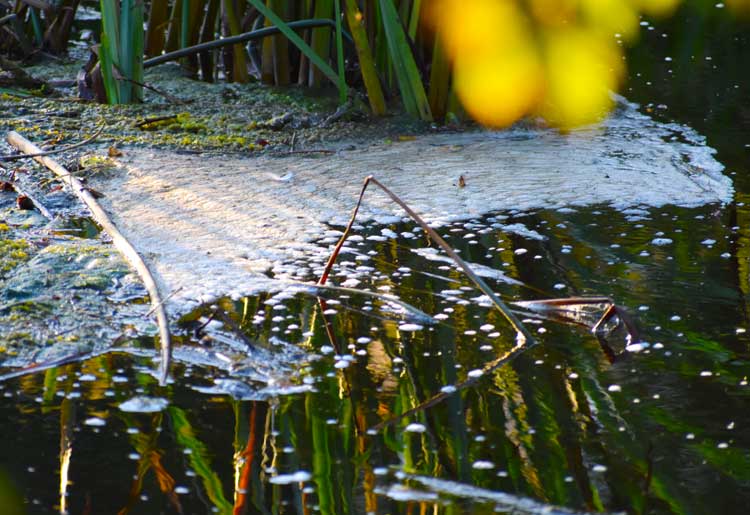
State of River Suir just 100 meters from Barry’s bridge in Thurles Town centre. Pic: G. Willoughby, 2019.
Ms Seale-Duggan confirmed that only 1/3 of rivers in Tipperary were in the category of “Good and High Status”, whereas ten years previously almost 2/3 of the counties rivers fell into that same stated category. She stated that the Nenagh River (Irish: An Ghaothach) which rises in the Silvermine Mountains in Co.Tipperary, and flows east of Nenagh into Lough Derg, north of Dromineer village, falls into the “Moderate Status” category.
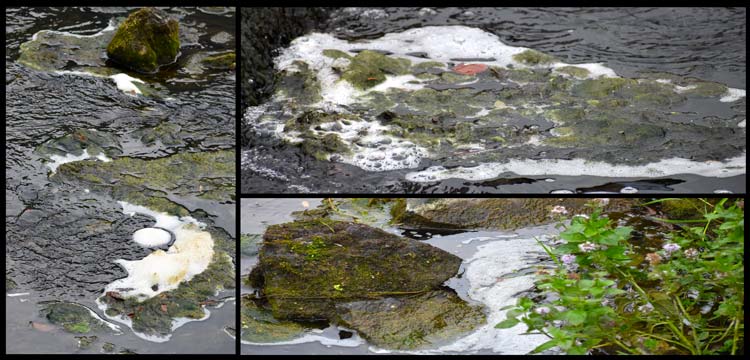
River Suir at Barry’s Bridge, Thurles town centre. Pic: G. Willoughby, 2021.
“What we are aiming for in the case of every river and stream,is the Good and High Status”, Ms Seale-Duggan stated, “We are targeting those areas where the water quality is adversely impacted, and agriculture is part of that concern and focus. Inspectors will visit farms and look at opportunities to stop pollutants getting into rivers and streams”.
This work will now be heavily subsidised through a €60 million project and advisers from Dairy Co-ops will be engaging directly with farmers. Alas, the farming community will continue in the mindset of “I have rights” and no indigenous mindset showing that “I have obligations” in serving present and future generations, not to mention the health of the very planet itself. Water European Innovation Partnership (EIP) is also working to reduce the loss of nutrients in farms and to prevent nutrients from these same areas, gaining access to watercourses and polluting them. According to ICBF data, accurate up to June 1, 2023 the county with the second-largest dairy herd is Co. Tipperary with 194,018 cows, which is an increase of 59,259 head, since 2013. (Largest is Co. Cork). There is a difference of 69,544 head of cattle, between Co. Tipperary and Co Kilkenny, latter in third place on ICBP’s list.
We hope that Ms Catherine Seale-Duggan, the newly appointed Community Water Officer with LAWPRO, has better success with Municipal District officials than we had.
Yesterday, January 22nd 2024, the road sweeper unit made several passes up and down on Kickham Street, east of Thurles Town centre, Co. Tipperary. Their purpose for the crew’s occupancy, was not to collect litter or debris relating to ‘Storm Isha’, but rather to suck up loose gravel, generated by the cold tarmacadam that had been brought into play, to fill giant craters just 14 days before.
Street sweeper unit gathering gravel on Kickham St. Thurles. Pic: G. Willoughby. Mid-morning January 22nd 2024.
Thankfully, the cold spell experienced over the past two weeks had held this tarmac together, now that the rainy season has arrived, as we have experienced since Saturday last; unprecedented heavy traffic and heavy rain has, as expected, loosened the cold tarmacadam, resulting in the road surface becoming one long gravel driveway. (See image hereunder).
Gravel on Kickham Street, Thurles, before the Road Sweeper Unit arrived; brought to my attention by stones striking the toughened glass on my front window, latter broken by flying surface gravel, sometime previously. Pic: G. Willoughby. Early Morning of January 22nd 2024.
Yesterday’s road sweeping exercise resulted in a two man operation. One driving the sweeper unit, while another employee attempted to keep pace, slightly to the fore, using a leaf blower to drive loose gravel from pavements; slung their by the wheels of vehicles and aimed at unsuspecting pedestrians.
Mr Joe MacGrath (Chief Executive Tipperary Co. Council), was busy yesterday, rubbing shoulders and having his picture taken with Fianna Fáil’s Minister Mr Darragh O’Brien and Tipperary Fianna Fáil TD Mr Jackie Cahill (Thurles); all 3 individuals attempting to boost both their images and personal expenses, while officially opening a children’s playground in Newport, Co. Tipperary, which by the way, cost almost €3 million to deliver. They were then later joined in their promotional picture by Mr Michael Lowry TD. (Thurles), who climbed in on the act, at Woodview Close, Nenagh, where Mr Darragh O’Brien officially cut the ‘Munster GAA blue ribbon’, suitably chosen, to open 10 social homes.
Meanwhile, back on Kickham Street, in forgotten Thurles, Co. Tipperary, within 4 hours after the sweeper had sucked up much of the loose gravel and departed, the last remnants of the streets cold tarmacked surface broke loose, leaving behind massive crates. (See image hereunder).
Kickham Street, Thurles yesterday afternoon, after the road sweeper unit had returned to base. Pic: G. Willoughby. Afternoon of January 22nd 2024.
We ask the question again and again, “For what are Thurles residents paying property tax ?” We get absolutely nothing in return, except silence or arrogance from officialdom, same disposed to exaggerate their own worth or self importance; often dished out in an overbearing manner”.
Time has now come to name the Tipperary Municipal District officials responsible.
Ms Sharon Scully (Thurles District Administrator), together with Mr Joe MacGrath (Chief Executive of Tipperary Co. Council) and Mr Marcus O’ Connor, (latter Director of Services Roads and Transportation, Active Travel, Health and Safety) have all been notified. [We have been made aware that Mr Joe MacGrath will be away from his office until Friday next, January 26th, with limited access to his emails. To this end a communication has been forwarded to his secretary Ms Evelyn Harty, since this matter now requires urgent attention.]
Tipperary is marginally below the national average level of affluence, according to the 2022 Pobal HP Deprivation (Poverty) Index.
The Index, which is Ireland’s primary social gradient tool, found a nationwide improvement in measures such as employment and population growth, with levels largely returning to those observed in 2006, however persistent disadvantage remains for many communities.
Since the 2016 general election, County Tipperary has been a parliamentary 5 seater constituency that has elected to Dáil Éireann, 5 TDs, (Teachtaí Dála). In August last, 2023, an Electoral Commission, because of population increase, has recommended that Tipperary revert to a 2 x 3 seater constituency (6 TD’S), representing North and South Tipperary, in the next general election; same expected to take place at the latest in 2025, if not sooner.
Those 5 TD’S elected in the previous 2020 General Election, together with their vote counts are shown in the table hereunder.
The Pobal HP Deprivation Index uses data from Census 2022, analysing ten measures of an area’s levels of disadvantage. These include educational attainment, employment status and the numbers living in individual households. Almost 19,000 small areas, including 640 in Tipperary, (50-200 households) were indexed, leading to the development of a detailed map of the relative affluence and disadvantage.
Ms Anna Shakespeare(CEO of Pobal) has recently stated “The 2022 Pobal HP Deprivation Index is created to inform national policy and ensure that resources can be properly directed to where they are most needed. There has been an overall improvement for the majority of communities in Ireland, however we must also recognise that this is not being experienced equally. At Pobal, we are committed to working on behalf of government to support communities to combat disadvantage. This tool helps to create an understanding of the challenge of disadvantage and where it is prevalent, which is an important step towards achieving social inclusion for all.”
The 2022 Pobal HP Deprivation Index, is available on Pobal Maps HERE, (latter a free online Geographical Information System map viewer), which outlines the deprivation score for various geographic units such as county, constituency, electoral division or small area. Percentage data for the area is provided under a range of categories such as unemployment, educational attainment, and population change. The data can also be extracted for further analysis, through the geoprofiling viewer and compared between the 2022 Index Census and the three previous editions.
The two questions which now must be asked are:-
Why has Tipperary, with 5 Teachtaí Dála, been allowed to fall behind on the Pobal HP Deprivation Index?
Should the Tipperary electorate now change their choice of candidates, when it comes to voting in the 2025 General election?
Vocals: American singer and songwriter, the late John Denver(1943 – 1997). Lyrics: American folk singer-songwriter, the late Edward Potts McCurdy(1919 – 2000).
Last Night I Had The Strangest Dream.
Last night I had the strangest dream, I never dreamed before. I dreamed the world had all agreed, To put an end to war. I dreamed I saw a mighty room, And the room was filled with men, And the paper they were signing said, They’d never fight again, And when the paper was all signed, And a million copies made, They all joined hands and bowed their heads, And grateful prayers were prayed, And the people in the streets below, Were dancing round and round, And guns and swords and uniforms, Were scattered on the ground.
(Sing it with me) Last night, I had the strangest dream, I’d never dreamed before. I dreamed the world had all agreed, To put an end to war.
(Sing it again) Last night I had the strangest dream, I’d ever dreamed before. I dreamed the world had all agreed, To put an end to war. I dreamed the world had all agreed, To put an end to war.
Change to age requirements opens role to 35 to 50 year olds for first time.
The Minister for Justice, Helen McEntee TD, has welcomed the new recruitment campaign for An Garda Síochána, which opens for applications today and closes on Thursday 8 February.
Noting that recruitment into An Garda Síochána has accelerated following the forced closure of the Garda College to intakes, due to Covid-19, the Minister said: “I am very pleased to see Garda recruits once again regularly entering training at Templemore, and this competition will ensure there is a continuous pipeline of new trainees. As a government we allocated the highest ever budget of €2.3 billion to An Garda Síochána for 2024. That included funding for between 800 and 1,000 new Gardaí, and I hope, and indeed expect, that there will be a strong response to this campaign. I encourage anyone who believes they can make a positive contribution as a Garda to consider putting their name forward. Policing is a career in which no two days will be the same – it can be exciting, rewarding and undoubtedly challenging, but it offers a great opportunity to have a positive impact in the community and to be a part of a modern, inclusive police service that has the respect and trust of the Irish public.”
The last Garda recruitment campaign which closed in April 2023, received approximately 5,000 applications.
Both the Government and Garda Commissioner have said they are committed to reflecting the increasing diversity in Irish Society by ensuring that all communities see themselves reflected in An Garda Síochána. The Garda Commissioner has also put a strong focus on equality, diversity and inclusion and encourages applications from people of all backgrounds to join An Garda Síochána through this campaign.
Noting recent changes made to the eligibility requirements and increased training allowance, Minister McEntee added: “We have significantly increased the training allowance for trainee Gardaí, to €305 per week. Given that, and the decision to increase the maximum age of recruitment from 35 to 50, I believe we are opening up policing as a career option to a new cohort of people who will bring a range of different life and career experiences to the table. Across 2023 we have seen recruitment into An Garda Síochána gain real momentum. And with unprecedented funding recently allocated for equipment and wellbeing initiatives, and recent increases in frontline supervisors, I believe those who join will be supported as they take on what I know can be a challenging job. Our Gardaí do vital work every day investigating crime, supporting victims and maintaining the security of the state. Given that my top priority is building stronger, safer communities, I want to express my gratitude to them for their outstanding dedication and commitment and I hope this competition will lead to many more joining their ranks.”
Prospective candidates can visit publicjobs.ie for more information on how to apply.
Closing Date for the competition is Thursday 8th February 2024.
This website uses cookies to improve your experience. We'll assume you're ok with this, but you can opt-out if you wish.AcceptRead More
Privacy & Cookies Policy
Privacy Overview
This website uses cookies to improve your experience while you navigate through the website. Out of these, the cookies that are categorized as necessary are stored on your browser as they are essential for the working of basic functionalities of the website. We also use third-party cookies that help us analyze and understand how you use this website. These cookies will be stored in your browser only with your consent. You also have the option to opt-out of these cookies. But opting out of some of these cookies may affect your browsing experience.
Necessary cookies are absolutely essential for the website to function properly. This category only includes cookies that ensures basic functionalities and security features of the website. These cookies do not store any personal information.
Any cookies that may not be particularly necessary for the website to function and is used specifically to collect user personal data via analytics, ads, other embedded contents are termed as non-necessary cookies. It is mandatory to procure user consent prior to running these cookies on your website.








Recent Comments