Mr Martin Mansergh, former Irish Minister of State and key Irish peace process adviser, sadly dies aged 78 years.
Martin George Southcote Mansergh, former Minister of State, historian, and one of the most influential advisers in the Northern Ireland peace process, has died at the age of 78 years, while on a trip to the Sahara with fellow retired parliamentarians.
M.Mansergh, R.I.P.
Born in Surrey, England, in December 1946, Mr Mansergh was the son of historian and Oxford academic Nicholas Mansergh, a renowned authority on Anglo-Irish relations, and Diana Mary Mansergh. He was educated at The King’s School, Canterbury, before going on to study at Christ Church, Oxford, where he obtained a doctorate in history. His academic background and deep interest in Irish and European affairs shaped both his intellectual outlook and his later political career.
Although English-born, Mr Mansergh made Ireland his home and dedicated his professional life to Irish public service. His historical awareness, combined with a sharp political mind, made him a trusted adviser to Fianna Fáil Taoisigh Charles Haughey, Albert Reynolds, and Bertie Ahern. He was regarded as a central figure in the complex and often secret efforts to open dialogue with Sinn Féin from the late 1980s, laying the groundwork for the negotiations that led to the Good Friday Agreement in 1998.
Elected to Seanad Éireann in 2002, he served until 2007, when he was elected TD for Tipperary South. In government, he was appointed Minister of State with responsibility for the Office of Public Works. While his parliamentary career was significant, it was his quiet, steadfast role in shaping government policy on Northern Ireland and his contribution to peace that most defined his public legacy.
Tributes following his death have described him as a man of integrity, intellect, and generosity. His early negotiations on behalf of successive Taoisigh, his resilience during years of painstaking dialogue, and his commitment to reconciliation earned him the respect of political leaders across divides. “Few on the Irish side were more crucial to the Peace Process,” one tribute reflected, “whether through his role as an intermediary or in crafting a new political and intellectual framework for peace.”
He is recalled as being a key figure in establishing contacts and building trust in the years leading to the Good Friday Agreement. His contribution, alongside that of Mr John Hume, senior government officials, and Sinn Féin representatives, was pivotal in transforming the political Irish landscape.
Away from politics, Mr Mansergh was known as a historian and writer, contributing to Irish and European scholarship and offering reflections on politics and history that drew on both his academic training and his practical experience.
He is remembered as a warm and thoughtful man, generous with his time, devoted to his family, and proud of his roots in County Tipperary, where he lived for many years.
Mr Mansergh is survived by his wife, Elizabeth and their five children. His passing marks the loss of a figure whose intellect, dedication, and quiet determination were instrumental in securing peace in Ireland and whose life leaves behind a proud legacy of service and reconciliation.
University Hospital Limerick (UHL) is set to open 96 additional beds in the coming days, in what health officials say marks the first step in a long-term plan to ease chronic overcrowding at the Mid West Region’s main hospital.
University Hospital Limerick (UHL).
The €96 million development, which has been under construction over the past three years, will deliver 96 single en-suite rooms, all of which are new bed stock. It is understood the unit will be fully staffed once it becomes operational next week.
This is the first of three 96-bed blocks planned for the UHL campus, with the second expected to open in 2027 and the third in the 2030s.
UHL has consistently been ranked the country’s most overcrowded hospital. This morning, figures from the Irish Nurses and Midwives Organisation (INMO) recorded 86 patients waiting on trolleys across the hospital’s emergency department and wards, while on the previous day, the figure stood at 118.
The hospital has come under repeated scrutiny from the Health Information and Quality Authority (HIQA), which has found UHL to be understaffed and posing significant risks to patient safety. Inspections reported that patient dignity and privacy were routinely compromised in the overcrowded emergency department.
Public concern over safety at UHL intensified following the death of 16-year-old Ms Aoife Johnston in December 2022. An independent review by former Chief Justice Frank Clarke concluded her death was “almost certainly avoidable” after she waited 13.5 hours for life-saving medication. The report warned that without urgent action to address staffing and capacity, further avoidable deaths would remain an “inevitable” risk.
The emergency department at UHL is the only 24-hour facility serving the Mid West region-covering North Tipperary, Limerick, Clare, and parts of Cork and Kerry – since a controversial reconfiguration of services by Fianna Fáil government, back in 2009. Campaign groups, including families bereaved at the hospital, continue to call for additional emergency departments to be established in the region.
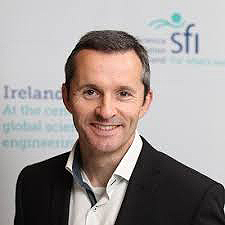
Irish Government announce the appointment of Dr Ciarán Seoighe as Director General of Forensic Science Ireland (FSI). His appointment will take over from his predecessor Mr Chris Enright, with effect from October 6th next, 2025.
Dr Seoighe brings senior experience in the fields of science and research, most recently as Deputy CEO of Taighde Éireann – Research Ireland. Dr Seoighe joined Science Foundation Ireland in 2018, which amalgamated with the Irish Research Council to form Taighde Éireann in 2024.
He has led the Strategy and Transformation Directorate and played a key role in shaping Ireland’s strategic direction in areas such as artificial intelligence (AI) and emerging technologies.
Prior to this appointment, Dr Seoighe spent nearly two decades as a global management consultant, advising leading organisations across ICT, finance and more.
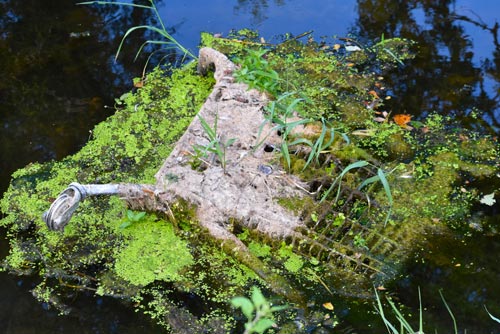
Communications update on pollution of the River Suir In Thurles town centre as received, up until today, September 23rd 2025.
Regarding my last communication updating details on the 12 year old River Suir pollution problem, four emails were sent on Friday last September 19th 2025 to:- Ms Sinead Carr(CE Tipperary Co. Council), [sinead.carr@tipperarycoco.ie]; Environmental Complaints section EPA [E.Complaints@epa.ie], Ms Sharon Scully, (Thurles Municipal District Admin) [sharon.scully@tipperarycoco.ie]; Mr Robert O’Brien(A/Executive Scientist, Environment & Climate Action, Tipperary County Council, Civic Offices, Clonmel, Co. Tipperary).[robert.obrien@tipperarycoco.ie]
To date we have received only two replies shown hereunder.
A reply from the Environmental Protection Agency, latter supposedly a public body responsible for protecting the environment in Ireland has sent the following email.
Dear Mr Willoughby, The EPA acknowledges receipt of your further correspondence relating to this matter. We have written to Tipperary County Council and await their response on any actions taken or planned regarding the matter. We will provide you with an update in four weeks. In the interim, we recommend you continue to report any further issues relating to this matter to Tipperary County Council. Please use the reference numberabove (COM021813) in any further communication with the EPA regarding this matter. Kind regards etc.
Today, I have received a reply from Mr Robert O’Brien, (A/Executive Scientist, Environment & Climate Action, Tipperary County Council, Civic Offices, Clonmel, Co. Tipperary), acknowledging my previous email sent on September 19th. We understand that Mr O’Brien who is on holidays since Friday last has also communicated as follows:-
Hello George, I acknowledge your email sent Friday 19th September. We need time to review your questions, and we will respond in due course. Kind regards etc.
My email sent to the above named on Friday last September 19th has now been sent to the following elected personnel this evening:-
Mr Darragh O’Brien (darragh.obrien@oireachtas.ie) (Minister for Climate, Energy and the Environment & Minister for Transport). Mr Alan Dillon (alan.dillon@oireachtas.ie) (Minister of State with responsibility for Small Businesses and Retail. Minister of State with responsibility for Circular Economy) Mr Timmy Dooley (timmy.dooley@oireachtas.ie) (Minister of State with responsibility for Fisheries, Minister of State with responsibility for the Marine).
Residents in Thurles, Co. Tipperary are becoming increasingly frustrated at the continued absence of even one proper bus stop in the town centre or in the surrounding areas.
In the heart of Thurles, recent half-finished street upgrades have already removed up to 80% of available parking. For those depending on public transport, the situation is even worse: commuters are left with no proper designated public transport areas. Passengers now huddle beneath the overhead canopy of the AIB Bank, for limited shelter on wet days, or under the entrance of a canopy at Thurles Garda Station on Slievenamon Road, where buses are forced to double-park and block traffic – putting road users at further risk.
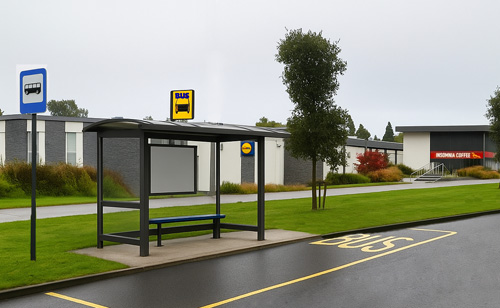
AI generated image of vacant area between Thurles Shopping Centre and Lidl Supermarket that if developed would give consumers options.
With winter fast approaching, this lack of basic infrastructure disproportionately affects families, students, older people, and anyone without access to a car. Something as simple as a sheltered bus stop would protect waiting passengers from rain and wind, while providing a safer, more accessible public transport system.
It is astonishing that in 2025, a town the size of Thurles still lacks such a fundamental amenity. This neglect hurts business footfall as much as residents on the move. While the government can allocate €336,000 for a covered shed supporting 36 bike spaces outside Dáil Éireann, surely the cost of installing a few bus shelters in Thurles would be only a fraction of that amount.
Beyond serving commuters, shelters in Thurles could even generate revenue. Advertising panels – whether static posters or digital displays – could provide income for Tipperary Co. Council itself while also improving currently decreasing town centre business.
The consequences of inaction are already clear. More people are resorting to driving, increasing congestion. Local shops are losing customers who might otherwise travel in by bus. Vulnerable groups – particularly the elderly, young people, and those on low incomes – are being left isolated. Businesses argue that this lack of provision is not just inconvenient, but unsafe, as passengers are forced to stand on busy pavements in poor weather with no protection.
This is a matter of fairness and safety. Public transport users in Thurles are not demanding the luxuries afforded to Leinster House – just the bare minimum: safe, accessible bus stops that connect the town to the wider region. Without them, Thurles will continue to fall behind.
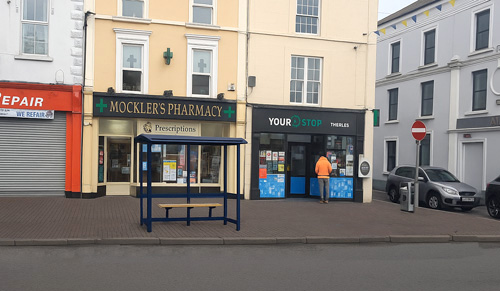
AI generated image of area for a bus shelter as detailed in recent Thurles planning upgrade.
We read that Tipperary County Council, in conjunction with the Local Enterprise Office, is inviting applications from Town Centre Teams, Trader Associations, Chambers of Commerce, Community Groups, Farmers Markets, Craft Markets, or those involved in the craft sector under the Christmas Retail Support Programme. This grant scheme, (View Application Form Here) they believe, will support towns and villages to implement activities aimed at boosting or retaining Christmas spending. Yet this approach rings hollow. It represents a deliberate waste of public money (for really just a 30 day promotion), when parking spaces in medium size town centres like Thurles are being eradicated, leaving shoppers with fewer options. Without convenient parking or public transport facilities, people will simply turn to online shopping for what appears to be cheaper shopping options – undermining the very local retail trade this scheme claims to protect. [Do remember the phrase ” Buy Cheaper – Buy Twice”.]
It is time for Tipperary County Council, transport authorities, and national decision-makers to act. Bus stop facilities are not an optional extra – they are an essential part of building a connected, inclusive, and sustainable community.
This website uses cookies to improve your experience. We'll assume you're ok with this, but you can opt-out if you wish.AcceptRead More
Privacy & Cookies Policy
Privacy Overview
This website uses cookies to improve your experience while you navigate through the website. Out of these, the cookies that are categorized as necessary are stored on your browser as they are essential for the working of basic functionalities of the website. We also use third-party cookies that help us analyze and understand how you use this website. These cookies will be stored in your browser only with your consent. You also have the option to opt-out of these cookies. But opting out of some of these cookies may affect your browsing experience.
Necessary cookies are absolutely essential for the website to function properly. This category only includes cookies that ensures basic functionalities and security features of the website. These cookies do not store any personal information.
Any cookies that may not be particularly necessary for the website to function and is used specifically to collect user personal data via analytics, ads, other embedded contents are termed as non-necessary cookies. It is mandatory to procure user consent prior to running these cookies on your website.





Recent Comments