Dáil Dining – Soup Up 50c, – Calamari Up €1.50, – Wine Heroically Holds the Line.
TDs and Senators have been hit with fresh price increases in the Dáil bar and Members’ restaurant, with higher charges for food introduced in November 2025, while the price of wine, in a brave display of stability, remained unchanged.
According to records released under FOI, the cost of a glass of the Oireachtas Merlot or Sauvignon Blanc is still €6.60, and the €25 bottle price (€60 in the Cashel Palace) also remains in place, proving that in uncertain times, some pillars of national life must not be disturbed.
Meanwhile, the food menu has not been so fortunate: Members’ Restaurant: Tough Choices, like whether to get Dessert and Soup. At lunchtime, soup is now €5.50, up from €5. On the afternoon menu: Deep fried Calamari (with Lemon and Garlic Aioli Rose – a Dip that is great with Chips), from €8 to €9.50. A prime beef burger has increased from €12 to €13.80. [Surprising increase move, what with all this cheap South American beef coming into Éire]. Desserts were repriced to €5.80, up from €5.00, offering options including, Mixed Berry Crumble, Strawberry Cheesecake,assorted Ice Cream, or Fresh Fruit Salad“for the health conscious you understand”.
Dail Bar.
A Soup, Main Course and Dessert now comes in at just over €25, roughly €3 above last year’s prices, but still comfortably below what most people might expect to pay for an equivalent three-course meal in nearby rural Tipperary or indeed in Dublin 2.
In the evening: A Chargrilled Sirloin or Rib-Eye Steak with Fries remains €20.50; this follows a €2.50 increase late last year. Grilled Lamb Cutlets (côtelettes d’agneau grillées) come in at €16 having been replaced by pan-roasted lamb rump (often called chump) at €18.50, (latter a tender, flavorful, and relatively inexpensive cut, that combines the succulence of roasting with the crispy, caramelized crust of pan-searing).
Members’ Bar: Modest Increases, with a few “Steep” surprises.
Evening menu increases included: Gourmet Beef Burger: €12 → €15 [again surprising increase, what with friends in Bord Bia, the Irish Food Board and Dawn Meats] House Chicken Caesar Salad: Possibly imported from the Netherlands, the UK, Brazil, or Thailand, €9 → €11.50. (Tough enough when one can buy a whole Chicken cooked and still hot in Dunnes Stores for €6.75).
Nevertheless, the ambience of the dining area remains reassuringly consistent: muted tones, soft seating, and that steady confidence of a place that rarely needs to check the prices on the street outside. It’s the kind of place where the calamari is deep-fried, the questions are lightly grilled, and accountability is strictly off-menu, while the décor continues to project polished wood, clean lines, and an overall feeling that someone else is picking up the Tab, emotionally, if not financially. In fact the room does what it says on the tin, while remaining dignified, understated and quietly insulated from the chaos of lunch with everyone beyond the M50 and the non-subsidised majority.
While the Suir silts up and sewage claims persist, Tipperary’s “solutions” look like optics-first spending, paid for by the public, twice over.
The Flooding “Solutions” Scam: Councils Let Rivers Choke, Then Sell Us Flood Barriers.
We’re being asked to accept flooding as inevitable. Each time the water rises, we’re told it’s “unprecedented”, that there’s nothing to be done, and that the only answer is another costly flood barrier, another engineered scheme, another grand capital project.
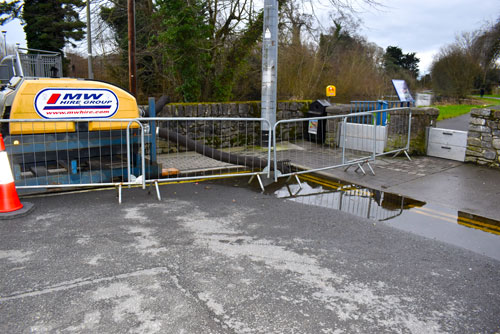
Although flood barriers are in place here and pumps are operating on Emmet Street, Thurles, flooding continues as water is rising through wastewater drains on the street surface, before being pumped again into the swollen river. In these circumstances, surface barriers offer little or no protection. Pic: G. Willoughby.
But for many towns, the more uncomfortable truth is this: a significant part of the problem is neglect, plain, predictable, year-after-year neglect, and it sits squarely with local authorities and the agencies they work alongside.
When river channels and outfalls are allowed to silt up, narrow, and clog, the river loses capacity. Water backs up sooner. “Manageable” rain becomes road flooding, business disruption, and damaged homes. That is not an act of God, it’s an act of governance.
Maintenance isn’t glamorous, so it gets skipped. Routine river maintenance is boring. It doesn’t lend itself to ribbon-cutting. It requires surveys, schedules, repeat work, and public reporting. And that’s exactly why it’s so often pushed down the list. Instead, we get the shiny alternative; manufactured flood barriers, the visible, photogenic, capital-heavy answer. They may have a place in specific settings, but far too often they’re treated as a substitute for basic poor river stewardship. Even professional bodies that caution against dredging as a universal fix still accept the basics: increasing channel conveyance can help reduce levels in smaller, more frequent floods. The key is that it must be targeted and properly managed, because indiscriminate dredging can speed flows and shift risk downstream. So nobody credible is demanding a reckless “dig everything” policy. What people are demanding is far more reasonable:
Why are we spending vast sums on barriers when the river’s basic capacity is being allowed to deteriorate in the first place?
Thurles: Tarmac by the river, while sewage flowed in plain view. Nowhere is the contradiction more glaring than in Thurles, Co. Tipperary.
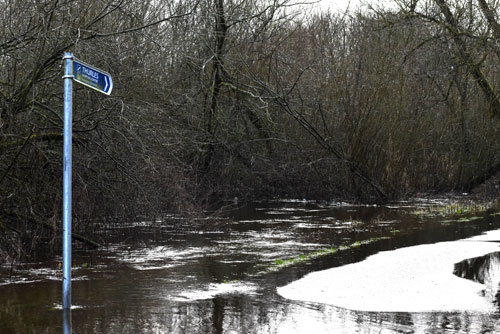
Flooded new Thurles tarmac pathway, while a tangle of willow trees and low, leaning branches stretch across the water, effectively blocking and constricting its flow. Pic: G. Willoughby.
In April 2022, a public district meeting heard claims that “raw sewage” was flowing into the River Suir along the extended Riverwalk area. The report quoted a councillor saying he had pictures and describing it as disgusting.
Read that again carefully: The issue wasn’t hidden away in a remote field. The allegation was that sewage was entering the river along the very walkway being promoted as an amenity. Then, in March 2024, a Thurles-based TD publicly questioned Uisce Éireann about discharges of raw sewage into the River Suir, in Thurles, and in September 2025, further local reporting again described sewage and pollution concerns in the town centre stretch. So let’s stop pretending this is a mere “perception issue”. If a town is paving and polishing riverside paths while the public is seeing (and smelling) pollution in the water, that’s not regeneration. That’s cosmetic spending beside a neglected system.
You also raise an accusation many locals will recognise: that some works were pushed through to use up available funding, especially after another walkway plan failed to materialise. I can’t independently prove the motive — but the pattern is familiar: when capital money appears, councils can scramble to spend it quickly on visible works, while harder, messier problems (pollution sources, maintenance regimes, enforcement) are left to drag on.
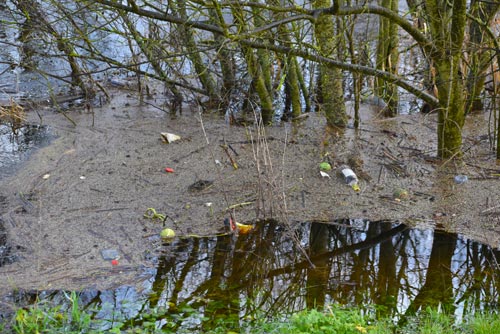
Stationary filth and litter in abundance as Thurles Municipal District provides river-side seating, without even one litter bin being placed in the vicinity. Pic: G. Willoughby.
Funding announcements don’t equal progress: In November 2025, a funding allocation of €447,300 for an extension of the Thurles River Suir walkway was publicly announced under the ‘Outdoor Recreation Infrastructure Scheme‘, including a planned looped walk.
Here’s the question that should be asked at every launch and photo-call: What is the point of extending a riverside amenity if the river itself is being allowed to degrade, and if flooding repeatedly makes sections unusable anyway? Local reporting at the time of that funding announcement explicitly linked renewed frustration to ongoing flooding and calls for proper maintenance of the river.
Who should be held responsible? Start with the council: This is where the gloves come off. Tipperary County Council cannot keep presenting flooding as a surprise while communities can see, year after year, the tell-tale signs of avoidable risk: silting, blocked channels, overgrowth, neglected outfalls, and the creeping sense that nobody is minding the basics.
And when the response defaults to barriers and big-ticket projects, rather than a published maintenance programme, people are right to feel played. Yes, extreme weather is real. But neglect is real too. And neglect is optional.
What Thurles (and every town) should demand now: If councils want to be taken seriously, the minimum standard should be:–
A published annual maintenance schedule for key watercourses: inspections, targeted desilting, vegetation management, debris clearance, and outfall/culvert checks, with dates and locations.
Before-and-after surveys at known pinch-points showing what capacity was restored and what risk was reduced.
A public pollution action list: identify suspect outfalls, state ownership/responsibility, publish remedial timelines (with named leads across council and Uisce Éireann).
A rule of priorities: no more “path-first, river-later” optics. If the water is compromised, fix the water first.
Independent oversight and reporting, including engagement with the Environmental Protection Agency and catchment structures like LAWPRO, which has recently hosted public discussions where concerns about the Suir around Thurles were raised.
And one final point: agencies such as the Office of Public Works can fund schemes and design defences, but if local maintenance and accountability are missing, we will keep paying twice: first in flood damage, then again in erecting flood barriers.
In the words of Forrest Gump, “Stupid is as stupid does”, meaning a person’s intelligence is defined by their actions and behaviour, rather than their appearance, reputation, or perceived abilities.
Again Three Questions: (1) Why have Rates in Tipperary increased by 5%? (2) Why are we forced, yes forced, to pay property tax on houses we worked hard to purchase, from already taxed incomes? (3) Why do we continue to elect and pay local councillors who make absolutely no contribution in dealing with the problems existing in our respective areas, while officials really make the decisions.
See link to PDF declaration HEREshowing salaries and expences over a 3 month period (12 weeks), of between €10,300.00 and €15,500 each.[Note: €15,500÷ 12 =€1 291.66 in costings per week, while double jobbing, per Tipperary Co. Council].
If we’re serious about flooding, stop buying flood barriers as being the first answer. Start with the river itself. Start with proper maintenance. Start with the truth.
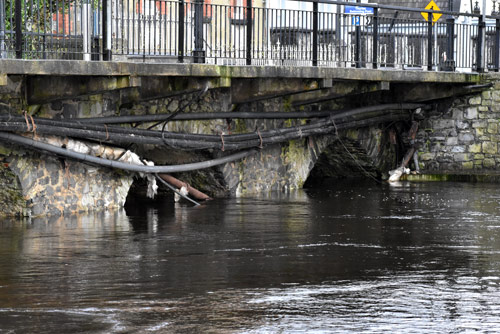
Local residents and visitors to the River Suir have this week been treated to the latest “upgrade” to the town’s riverside experience, with a section of substantial piping, (previously held up with binder twine and decades old iron brackets), having now visibly collapsed and is dangling into the flooded river.
Barry’s Bridge, Thurles, Co. Tipperary Pic: George Willoughby.
What the pipe contains is not known. That uncertainty, however, only adds to the intrigue, because nothing says “welcome” to a riverside town like a large, unidentified piece of infrastructure lounging in the water, like it fe..in owns the place.
Residents say the visual impact has been obvious for some time, but the situation has now progressed from “unsightly” to “are we seriously just leaving that there?” Come to think of it, didn’t I mention the problem only two years ago, back in January 2024, (See HERE), and then there was that time in February 2024,(See HERE). The collapsed pipework has become an additional spectacle for people walking the riverside, a kind of accidental attraction, minus the safety signage, the explanation, or the reassurance.
“We’re sure a risk assessment is underway,” a spokesperson for ‘Concerned Suirside Observers’ said, “in the same way we’re sure the Lotto ticket in our pocket is probably a winner“. In the meantime, the pipe has bravely taken matters into its own hands and made the move closer to the water.
Who’s meant to deal with this? Without claiming what the pipe is (or who owns it), the public is entitled to expect that whichever agency is responsible for infrastructure beside and above a river will treat a visible collapse into the Suir as something more urgent than a minor aesthetic quibble.
In Ireland, Uisce Éireann is responsible for the public collection and treatment of wastewater, and states it has responsibility for cleaning and maintaining the public sewer network. Separately, local authorities retain responsibilities across a limited number of water-service areas, including surface water drainage/flooding and water pollution.
Call for immediate action. As Mikey Ryan said to me in the Arch Bar last night, “The only way you’ll get your own back in this town is to pee against the wind”.
Concerned Suirside Observers are calling for:
An urgent site inspection and public clarification on what the pipe is (storm water, wastewater, utilities, etc.).
Immediate stabilisation/removal of any collapsed or unsecured infrastructure in or over the river channel.
A public-facing timeline for repairs and for restoring the riverside area to a basic standard that doesn’t make the town look like it’s given up.
If anyone suspects pollution. Members of the public who suspect environmental pollution can contact the relevant authorities; the EPA’s guidance on environmental complaints includes contacting your local council, Uisce Éireann, and/or the EPA. The EPA also provides out-of-hours incident contact details. For fish kills or urgent water-quality concerns, the EPA notes that Inland Fisheries Ireland can be contacted via its 24-hour confidential hotline (TEL: 0818 34 74 24).
Switzerland didn’t “get lucky” with clean rivers. It decided, in law, in funding, and in enforcement, that clean water is basic infrastructure. After decades when wastewater and industrial pollution badly damaged waterways, Switzerland eventually hard-wired wastewater treatment into national policy. By 2005, some 97% of the population was connected to a central sewage treatment plant.
And Switzerland didn’t stop at “good enough”. A revised waters protection law took effect on January 1st 2016, requiring many treatment plants to add extra purification stages to tackle trace pollutants. Today, Switzerland’s own federal assessment says bathing water in lakes and rivers is generally very good, with more than 97% of assessed bathing waters at least “sufficient”.
That’s the core lesson; clean rivers don’t come from speeches. They come from a system that measures, funds, upgrades, and insists on outcomes.
Now let us look at the Suir in Thurles. A river described as “disgraceful” in a town that should be proud of a God given assett. Indeed, the positioning of the River Suir should be one of Thurles’s defining assets. Instead, the public record reads like a running argument, frustration, photos, political rows, and a river that locals and officials say is fast “slipping away”.
Video hereunder shows one area of River Suir in the heart of Thurles town.
At a Tipperary County Council meeting, one councillor described the Suir running through Thurles as “disgraceful, embarrassing and shocking”, alleging rubbish, trolleys and “raw sewerage”. Local radio carried similar comments in 2024, calling the river an “eyesore” and “an embarrassment to the town”. This is not just “bad optics”, it’s a signal to the people on the ground that local government, charged with keeping essential infrastructure working and keeping the environment protected, is now seriously broken.
Tipperary County Council says it has a remit. Residents are asking, “Where are the results?” A national newspaper reported that EPA sampling, at Thurles Bridge in 2023, found the river “poor”, and quoted the council saying it has “a statutory remit to maintain and protect the water quality status of rivers” and works with the Local Authority Waters Programme (LAWPRO). Fine, but “remit” isn’t recovery. LAWPRO’s own reporting at a public meeting in Templemore captured what many locals believe is happening in the Suir catchment around Thurles; declines in water quality, impacts on fish and aquatic life, and “river weed growth” and “general neglect”, much of it linked to excessive nutrients. So the public isn’t imagining that something is wrong. Multiple sources, local reporting, stakeholder meetings, and the council’s own statements about responsibility, all point back to the same uncomfortable truth; the river needs a plan that delivers measurable improvement.
The wastewater system is a known pressure point, and the utility admits it Here’s the part that should end the “who’s to blame” merry-go-round. Uisce Éireann’s own project page for Thurles states plainly that “the current wastewater infrastructure in the town is inadequate” and that upgrades are required to meet environmental compliance and “alleviate flooding issues”. When your own infrastructure provider says the network is inadequate, it’s no longer credible to treat river decline as a mystery. It becomes a delivery question, what is being done, by when, and how will the river show improvement?
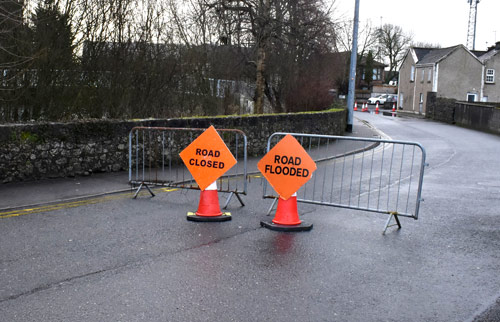
Robert Emmet Street, Thurles, closed today due to flooding for the second time in past 3 months.
Flooding, when the river rises, the same arguments return. This week, Tipperary County Council issued an operational update noting elevated levels on the Suir and overtopping in parts of the catchment area. Local press also reported flood scenes in South Tipperary, with the council saying water levels had risen and overtopping had occurred at several points. Thurles residents are familiar with what follows: the river rises, pinch points show up fast, and the anger sharpens around a simple claim, basic river management and preventative maintenance are not being done consistently enough.
A Thurles.Info article (November 2025) illustrates the Emmet Street riverside walkway and describes it as unserviceable due to flooding, arguing that repeated warnings over a 13-year period have not been matched by the maintenance needed to prevent blockages and overflow. To be clear, the precise causes of any single flooding incident, whether reeds, silt, debris, undersized drainage, or all of the above, require engineering assessment. But the political point is unavoidable, if people can’t see routine, transparent upkeep and enforcement, they assume it isn’t happening.
And here’s the paragraph Ireland can’t ignore: we have the money What turns this from local frustration into national hypocrisy is the scale of spending Ireland is willing to contemplate elsewhere. The Irish Government has backed the Water Supply Project for the Eastern and Midlands region, intended to bring a new long-term water source from the Shannon system towards the greater leaking Dublin area. RTÉ reported the proposal would take about 2% of the average flow and was estimated to cost €4–€6 billion. The Department’s own press release gives a preliminary cost estimate of €4.58bn to €5.96bn (verified through an expert review process).
So yes: Ireland can mobilise billions for water infrastructure for Dublin when it chooses. Which makes the Suir question harder to dodge: how can we plan to move vast volumes of water across Ireland while towns like Thurles are still fighting over basics; river health, monitoring, enforcement, and routine maintenance?
Switzerland vs Thurles: the difference is measurable accountability Switzerland’s lesson isn’t “be rich” or “buy better technology”. It’s this, treat water quality as a deliverable.
If Thurles wants a Suir that supports biodiversity, recreation, tourism, and doesn’t become a recurring source of anger, then the county needs to stop treating the river like a PR problem and start treating it like infrastructure with a public scoreboard:
Quarterly updates on the Thurles stretch (water quality trend points, incident reporting, actions taken).
A clear, named lead for publishing progress locally, one place the public can check.
Transparent milestones for the wastewater upgrades already acknowledged as necessary.
A preventative maintenance programme that is visible, scheduled, and publicly reported, so people aren’t left guessing until the next flood.
Switzerland didn’t fix its rivers by talking. It fixed them by building a system that delivers, and proving it, year after year. Thurles deserves the same axtion and seriousness.
Emergency Preparedness Booklet to be Delivered to every Irish household, with new guidance on Community Support Centres.
Every household in Ireland is set to receive an emergency-preparedness publication in the coming weeks, as Irish Government moves to strengthen national readiness for severe weather and other disruptive events.
Large tree blown over on the N62 close to Thurles Golf Club entrance, during Storm Éowyn, last January 2025. Picture: G. Willoughby.
The “household resilience” booklet, prepared by the Office of Emergency Planning (OEP) in the Department of Defence, will provide practical guidance for households on preparing for and coping with emergencies, particularly extreme weather events such as major storms and the potential loss of essential services including electricity, water, heat and communications.
The booklet’s publication follows a recommendation from the review group that examined Ireland’s response to Storm Éowyn, which struck on January 24th, 2025 and triggered nationwide red wind warnings. The Storm Éowyn review notes that 768,000 electricity customers lost power, with peak gusts reaching 184 km/h at Mace Head, and that disruption was particularly severe in remote and rural communities.
Uprooted tree at junction with Littleton and the N62, on Mill Road, to the rear of Thurles Golf Club, during Storm Éowyn, last January 2025. Picture: G. Willoughby.
According to reporting, the review group highlighted the importance of households having a clear checklist of actions to remain safe, warm, fed and hydrated during an extended outage, with practical steps aimed at helping families to manage disruption.
Community Support Centres guidance issued to councils.
In parallel, local authorities have been issued with guidelines for establishing Community Support Centres (CSCs) to provide the public with essential services when major outages and disruption occur.
The guidelines indicate CSCs may be set up in a range of premises, including sports halls, community centres, town halls and leisure centres, and list practical requirements such as a large main room, tables and chairs, a kitchen or food-preparation area, toilets, reliable Wi-Fi, and sufficient extension cables. Accessibility requirements and provision for private space for specific needs are also referenced.
Press reports are understood to indicate CSCs are not intended to be used as overnight rest facilities, and that a key operational requirement is that locations should be generator-ready (or capable of being made ready), with local authorities covering electrician costs and supplying generators.
An Oireachtas committee opening statement in late 2025 also referenced that a Guide to Community Support Centres is now in place for use by all local authorities.
This website uses cookies to improve your experience. We'll assume you're ok with this, but you can opt-out if you wish.AcceptRead More
Privacy & Cookies Policy
Privacy Overview
This website uses cookies to improve your experience while you navigate through the website. Out of these, the cookies that are categorized as necessary are stored on your browser as they are essential for the working of basic functionalities of the website. We also use third-party cookies that help us analyze and understand how you use this website. These cookies will be stored in your browser only with your consent. You also have the option to opt-out of these cookies. But opting out of some of these cookies may affect your browsing experience.
Necessary cookies are absolutely essential for the website to function properly. This category only includes cookies that ensures basic functionalities and security features of the website. These cookies do not store any personal information.
Any cookies that may not be particularly necessary for the website to function and is used specifically to collect user personal data via analytics, ads, other embedded contents are termed as non-necessary cookies. It is mandatory to procure user consent prior to running these cookies on your website.






Recent Comments