Temporary repairs which were undertaken this week on the surface of Slievenamon Road, has been successful.
Machine planing of this 200 metre section was undertaken on the night of July 29th last and total resurfacing was completed on the following night, thus greatly improving what was previously the most potholed streetscape of any town in Europe.
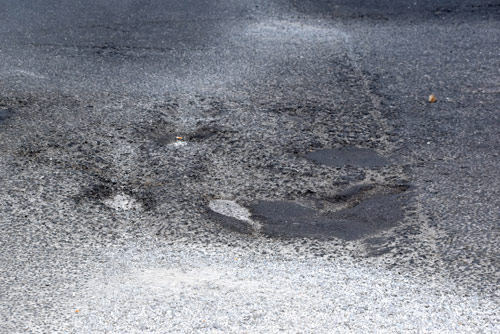
Section of road at the junction incline on Innisfallon Avenue and Stradavoher (R659).
Sadly, to quote Mr Bertie Ahern’s old slogan from many past Irish General Elections, quote, “A lot done, but a lot more to do”.
Perhaps local councillors and their officials would like to take a peek at the public thoroughfare at the junction of Innisfallon Avenue and Stradavoher on the R659, opposite the Honda car dealership of Denis Kinane Motors.
Twice a week over the past number of years this area received a couple of shovels of cold tarmac; often beaten into pools of water. Two mounds of torn up loose gravel now forms two hillock on this steep incline, requiring same to be removed and more permanent repairs undertaken, as soon as possible.
When finished there, the entrance to Westgate might receive further consideration.
Lest, in our daily haste we forget, motor tax revenues generated an estimated €6.5 to €7.0 billion for the Irish Exchequer last year, according to reports. The Irish State received over €1.6 billion from both the Vehicle Registration Tax on new and imported cars and the VAT on servicing parts and repairs. It also received almost €4.0 billion from fuel taxes and an estimated €1.0 billion from annual motor taxes. Based on the appearances of road surfaces over the past almost 4 years, it appears that Thurles town is entitled only to the odd daily shovel of cold tarmac to fill its craters.
Time now for these areas to be surface planed and resurfaced and stop wasting the precious time and energy of a skilled council worker force.
Fund to support the integration and employment of people, who have moved here as migrants, announced.
Up to €2.7 million available under the Employment, Inclusion, Skills and Training (EIST) Programme.
Fund is open to non-government and community organisations providing projects to increase the employability of people who moved here as migrants.
Fund helps people overcome barriers to employment including language difficulties, lack of training or social exclusion.
The Irish government yesterday announced funding of up to €2.7 million for projects that aim to increase the integration and employability of people who have moved here as migrants. Funding is being made available under the Integration and Employment of Migrants action of the Employment, Inclusion, Skills and Training (EIST) Programme 2021-2027.
The Programme is jointly funded by the European Union, through the European Social Fund Plus (ESF+), and the Government of Ireland.
Organisations can apply for funding for projects supporting:
EEA Nationals who are resident in Ireland;
Third Country Nationals with permission to enter employment in Ireland, including people who are Beneficiaries of Temporary Protection fleeing the war in Ukraine.
The funding will support a small number of significant projects and €200,000 is the minimum grant that can be applied for. All applications must be submitted by email to iem@justice.ie. Applications for funding will remain open until noon on Thursday September 11th, 2025.
Applications will be assessed according to the following criteria:
Strength of proposal;
Strategic fit and achieving the goals of the Integration and Employment of Migrants activity of the Employment, Inclusion, Skills and Training (EIST) Programme 2021-2027;
Capacity of applicant organisation to deliver work programme;
Value for money.
Previous successful projects. In Tipperary, Limerick, Clare, Galway, Westmeath, Longford and Laois, DORAS’ – “Gateway to Employment for Third Country Nationals” project, works with migrants and employers to overcome some of the most significant barriers to employment faced by migrants in Ireland including language barriers, lack of local work experience and limited social networks.
Further information and the application form are available online at gov.ie
The Irish government today (Tuesday 29th July 2005) has announced the appointment of Mr Justin Kelly to the post of Garda Commissioner for a term of five years with effect from September 1st next.
The recruitment process for the new Garda Commissioner was the first undertaken under section 26 of the new Policing, Security and Community Safety Act 2024 which commenced in April. A three-week recruitment campaign was held by publicjobs.ie (formerly the Public Appointments Service) in May last, including an international search for suitable candidates, which resulted in 14 candidates. The selection process included two interviews and a presentation by candidates as well as a detailed psychometric assessment.
Newly appointed Garda Commissioner, Mr Justin Kelly
Deputy Commissioner Mr Justin Kelly was selected as the preferred candidate and recommended for appointment and he was today appointed by the Government as Commissioner with effect from September 1st next.
Outgoing Commissioner Mr Drew Harris will continue to lead An Garda Síochána until the September date, at which time he will retire after 41 years of service to policing on the island of Ireland, including a total of seven years as Garda Commissioner.
A native of Dublin, Deputy Commissioner Kelly has more than 30 years policing experience and was appointed to his current role as Deputy Commissioner Security, Strategy and Governance in October 2024 last. He has a strong background, both academically and in operational policing, particularly in relation to combatting organised crime groups and safeguarding the security of the State.
In his previous role, as Assistant Commissioner/Serious and Organised Crime, he was responsible for leading the national policing response in areas of drugs and organised crime, cybercrime, economic crime, immigration and crimes against vulnerable persons. He was the strategic lead for the development of capacity and organisational policy in areas connected with serious crime investigation.
From 2020 to 2022 he was Detective Chief Superintendent, leading the Operational Counter-Terrorism Unit, the Special Detective Unit. He was previously Detective Superintendent, Garda National Protective Services Bureau, as well as a Detective Inspector, Drugs and Organised Crime Bureau, and a front-line Inspector in the Blanchardstown and Clondalkin areas of Dublin.
Career History. 1992 – 2017:- Garda, Sergeant and Inspector ranks. Aug 2017 – Oct 2020:- Detective Superintendent, Garda National Protective Services Bureau. Oct 2020 – May 2022:- Detective Chief Superintendent, Special Detective Unit. May 2022 – Oct 2024:- Assistant Commissioner, Organized and Serious Crime. Oct 2024 to current date:- Deputy Commissioner, Security, Strategy and Governance.
Education. 2006 – BCL (2:1), UCD. 2010 – MA Criminal Justice (First Class Hons), John Jay College, New York City (recipient of the 2009 McCabe Fellowship). 2019 – MBA (2:1), Dublin City University. 2019 – Professional Certificate in Governance (First Class Hons), Institute of Public Administration. 2019 – MA Serious Crime Investigation (First Class Hons), University of Limerick 2020 – Strategic Command Course – four-month senior police leadership programme, College of Policing, UK.
The salary for the Garda Commissioner role is currently €314,512, reflecting both the size and unique complexity of leading An Garda Síochána, which is a very large policing service with over 18,000 employees, and includes lead responsibility for the security of the State.
Applications for International Protection, from Pakistan, will be accelerated and prioritised with effect from today, Tuesday July 29th.
The Irish government has today announced that Pakistan will be added to the list of countries subject to accelerated processing for international protection applications.
Under an accelerated decision-making process, introduced in November 2022, international protection applicants that fall under this procedure are receiving first decisions in around four months and this is expected to reduce in the coming months.
Applications from Pakistan have grown considerably in recent years and in each of the last two quarters, Pakistan nationals have ranked as the second highest nationality for applications for international protection.
Section 73 (1) of the International Protection Act 2015 allows for the Minister to accord priority to any application, or to request the Chairperson of IPAT to accord priority to any appeal, having regard to criteria set down in Sec. 73 (2). Section 73A, allows for accelerated processing of cases having regard to the criteria set down in Sec.73 (2).
Accelerated processing for certain IP applications was introduced in November 2022. From today, Tuesday, July 26th 2025 it applies to: Applicants from 15 safe countries of origin, namely Albania, Algeria, Bosnia & Herzegovina, Botswana, Brazil, Egypt, Georgia, India, Kosovo, Malawi & Morocco, Macedonia (latter former Yugoslav Republic), Montenegro, Serbia, South Africa, Nigeria and Pakistan.
The table hereunder shows the number of international protection applications from Pakistan from 2021 to July 24th, 2025.
Year.
2021.
2022.
2023.
2024.
2025.
Total.
Pakistan.
68.
242.
624.
1,391.
905.
3,230.
All figures shown above are correct at time of issue, however, all statistics may be subject to data cleansing.
The 49 page 2025 National Development Plan Review, which sets out departmental capital ceilings up to 2030 and overall capital investment to 2035 was published yesterday.
Having briefly glanced through this document; to most people, I expect it will read like something a political party would publish having left office, in the hope of gaining re-election.
With Tipperary Co. Council unable to even fill a pothole in Thurles presently, residents of the town had, perhaps somewhat naively, expected some mention of funding for the long promised “Ring Road for Thurles”, but alas, once again the silence remains deafening.
One glimmer of hope perhaps, now stated in this National Development Plan review, states: “Over the coming months, individual Ministers will set out their priority programmes and projects within their capital allocations. A clear focus will be on providing greater certainty on the projects and programmes that will advance and get delivered in the next five years, with realistic timelines and budgets. The development of project pipelines will assist the construction in planning and capacity over the coming years.”
Are we to take it that this long sought after “Ring Road” could be delivered within the next 20 years, given the present poor quality political representation currently available in the town?
This website uses cookies to improve your experience. We'll assume you're ok with this, but you can opt-out if you wish.AcceptRead More
Privacy & Cookies Policy
Privacy Overview
This website uses cookies to improve your experience while you navigate through the website. Out of these, the cookies that are categorized as necessary are stored on your browser as they are essential for the working of basic functionalities of the website. We also use third-party cookies that help us analyze and understand how you use this website. These cookies will be stored in your browser only with your consent. You also have the option to opt-out of these cookies. But opting out of some of these cookies may affect your browsing experience.
Necessary cookies are absolutely essential for the website to function properly. This category only includes cookies that ensures basic functionalities and security features of the website. These cookies do not store any personal information.
Any cookies that may not be particularly necessary for the website to function and is used specifically to collect user personal data via analytics, ads, other embedded contents are termed as non-necessary cookies. It is mandatory to procure user consent prior to running these cookies on your website.






Recent Comments