|
|
 Irish Taoiseach Brian Cowen The General Election date has been set by an Taoiseach Brian Cowen for Friday 11th March next.
Speaking to the Dáil early this afternoon, he reassigned the portfolios left vacant by the resignation of six ministers in recent days.
In case any of our readers blinked or were distracted by the kids for a couple of minutes, the Minster for Enterprise, Trade and Innovation Batt O’Keeffe tendered his resignation from Cabinet today, Mary Harney, Dermot Ahern, Noel Dempsey and Tony Killeen gave their letters of resignation to the Taoiseach late last night, while Micheál Martin stepped down on Tuesday night following his failed revolt.
Mr Cowen did not appoint new faces to the Cabinet, stating he had reassigned the portfolios to existing members of Cabinet, because he had not wanted any additional cost to the State to be involved.
However, Green Party leader and Minister for the Environment John Gormley said this evening his party was not informed of the impending resignations and had opposed Mr Cowen’s original plan to make new ministerial appointments to the Cabinet.
He has reassigned the Department of Health and Children to Tánaiste Mary Coughlan, the justice portfolio to Minister for Agriculture Brendan Smith, the portfolio on transport has been assigned to the Minister for Community and Family Affairs, Pat Carey, the defence portfolio to Minister for Social Protection Eamon Ó Cuív and Thurles native and Minister for Tourism Mary Hanafin will take over the Enterprise, Trade and Innovation brief.
A Good Definition Of Irish Politics
Speaking of being distracted by the kids and politics, reminds me of a good definition of Irish Politics I heard recently:
A 12 year old boy, watching the evening news with his dad, asks, “Dad what is politics?”
Dad, delighted that his son is taking an early interest in current affairs, said “Well son, let me try to explain it simply: I’m the breadwinner of this family, so let’s call me Capitalism at work. Your Mother, well she’s the administrator of our money, so we’ll call her the Government or Fianna Fail, who is charged with taking care of all your countries needs. You, my son, represent the ordinary everyday people. Our poorly paid Polish nanny, we’ll call her the working class population and your baby brother, we’ll call him the Future of Ireland. Now son, ponder that scenario and let me know tomorrow if you fully understand my symbolism,”
So the 12 year old boy goes off to bed thinking deeply about dad’s explanation.
Later that night, he hears his baby brother crying, so he gets up to check on his well being. He finds that the baby has severely soiled his nappy. So the the 12 year old goes to his parent’s bedroom and finds his mother sound asleep. Not wishing to wake her, he goes to the nanny’s room. On finding the door locked, he peeks in through the keyhole and sees his father sleeping beside his nanny. Not wishing to disturb them he decides to undertake the nappy change himself.
Next morning at breakfast, the the 12 year old says to his father, “Dad, I think I understand the concept of politics now.”
The father says, “Good son, tell me in your own words what you think politics is all about.”
The 12 year old boy replies, “Well, while Capitalism is screwing the Working Class, the Government is sound asleep, the People are being ignored and the Future is in very deep shit.”
Matthew 21:16: “And Jesus saith unto them, Yea; have ye never read, Out of the mouth of babes and sucklings thou hast perfected praise?“
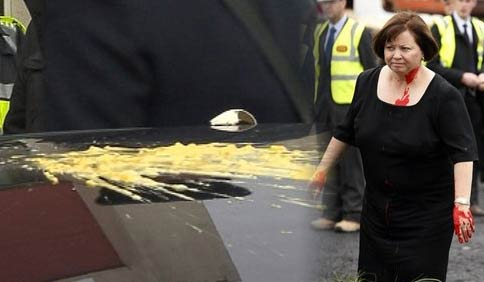 Mary Harney - The unnecessary victim of paint and eggs Health Minister Mary Harney has offered her resignation on Tuesday last, to the Taoiseach Brian Cowen. The former Progressive Democrats leader also confirmed she will not be contesting the next general election.
Minister Harney stated “I have reached my decision after considerable reflection and having taken into account the advice and constant support offered over many years by my family, friends and colleagues and accordingly I have offered my resignation as Minister for Health and Children.”
Currently a TD for Dublin Mid West, Ms Harney had served as minister of state for the Department of the Environment from 1989 to 1992 and Minister for Enterprise from 1997 to 2004, before becoming Minister for Health since 2004, to current date.
Ms Harney visited Tipperary and Thurles officially on many occasions. As Minister of State for the Department of the Environment, she was a guest of Thurles Tidy Towns Committee and officially switched on the then new fountain in the river Suir, sponsored to Thurles by Cantwell Electric Engineers, and currently still enjoyed at Cathedral Street in the town. One achievement often cited from her role in Environmental Protection was the banning of bituminous coal in Dublin in 1990.
It was at a Progressive Democrats meeting the Anner Hotel, Thurles, Co Tipperary that news of her engagement to Brian Geoghegan of An Foras Áiseanna Saothair (FÁS), was made public, first revealed by local Thurles photographer George Willoughby.
Ms Harney, a native of Ballinasloe, Co Galway, was first elected to the Dáil in 1981. She became the youngest ever member of the Seanad Éireann, when nominated by the Late then Taoiseach Jack Mary Lynch in 1977. She became a founder member of the Progressive Democrats together with Limerick born Desmond Joseph O’Malley in 1985 and became leader of the party in 1993. As leader of the PDs, she was Tánaiste from June 1997 to September 2006. She then stepped down as PD leader at that time and was replaced by Mr Michael McDowell, however following his defeat in the 2007 general election, Ms Harney stepped back in as acting party leader.
It was possibly on her last visit to Tipperary in November 2010, that a group of about 30 people protesting, threw eggs and cheese at Mary Harney’s car as she arrived at the Mid Western Regional Hospital in Nenagh, Co Tipperary. The minister was then officially at the Tipperary hospital to open a new Endoscopy Unit and speaking afterwards, the Minister said she was not upset, that she has had other things thrown at her that were probably worse, adding, ‘I think it’s a great pity that in a democracy people don’t use the opportunity to put their perspective forward in a different way. Politics is about choices, it’s about argument and debate. It’s not about engaging in public disorder offences or engaging in activity of that kind. I understand that many of those involved are politically motivated by a different persuasion than the mainstream parties in this country and maybe that’s part of the motivation.‘
The week previous to this, the Minister had been targeted with red paint, as she turned the sod at a mental health centre in Dublin.
It is expected that changes to the cabinet, including the vacancy created by rebel Foreign Affairs Minister, Micheál Martin, will be announced by the Taoiseach Brian Cowen in the next few days.
Irish Taoiseach Brian Cowen Taoiseach Brian Cowen will continue to lead the Irish Government into its dying days after surviving a plot to oust him prior to the forthcoming General Election, in about three months, possibly March 25.
Rebel Foreign Affairs Minister, Micheál Martin, who led the revolt against the embattled Fianna Fail leader, will now quit his Cabinet post following his failed and badly thought out, leadership challenge.
Following a three-hour meeting, Mr Cowen survived in the secret ballot as expected and accepted the resignation of his Foreign Affairs Minister. Mr Cowen stated:”It sends a very strong confirmation that there are consequences to the decision and the stand that he took.”
The Taoiseach said he did not expect any further resignations from his Cabinet, although some backbenchers and one junior minister did demand change. Chief Whip, John Curran refused to divulge detail the Taoiseach’s margin of victory, following the secret ballot. Taoiseach Brian Cowen’s 30 minutes speech to his colleagues was reported as being “fiery and a passionate display with little new” as he implored TDs to unite behind the final decision.
John Gormley, leader of the Greens is expected to meet the Taoiseach tomorrow to discuss a timetable for the Finance Bill, other outstanding legislation and of course the general election.
Thurles native and Minister for Tourism Mary Hanafin, who had her eye on the leadership post if is had become available, did not disclose how she voted in the motion of confidence in the Taoiseach at the Fianna Fáil parliamentary party meeting, although it is widely believed she told him he should stand down, when previously they met in their ‘one to one’ recent interview.
 Máire Hoctor Former Fianna Fáil Minister of State Máire Hoctor, last night came through a major threat to her political future, when she survived a strong challenge, at her local selection convention.
While some observers had predicted defeat for the sitting TD, prior to the selection convention, with her main stumbling block seen as County Councillor Micheal Smith (jnr), latter the son of former Cabinet Minister Michael Smith.
Fianna Fáil had already decided to run just one candidate in the constituency for the general election and successfully outmanoeuvred Micheal Smith by a total of 176 votes to 131 at the convention, which was held here in the Ragg, Inch, Thurles
Councillor John Hogan, also a candidate, informed the convention of his intention to withdraw from the race, at the outset of the delegate meeting. This move caused some surprise, as previously he had came close to defeating Máire Hoctor for a nomination, prior to the 2007 general election convention. However, rumours of dirty tricks in the race for power, within FF’s party grass roots, are believed to have been responsible for the ‘straight talking’ Councillor Hogan’s decision to withdraw his nomination. Untrue representation made to local newspapers in the North Tipperary/South Offaly constituency, prior to the election convention, which claimed that Councillor Hogan had indicated that he no longer wished to be considered by Fianna Fáil’s delegates, may have lead to his decision to withdraw.
While many of the FF grass roots would have welcomed a change in candidates, many delegates felt, that a change at this time might have given considerable advantage to Labour MEP Alan Kelly, who will now run as a candidate in the constituency and who is understood by many to fancy himself greatly as a possible future leader of the Irish Labour Party.
Following the Convention M/S Hoctor stated that Fianna Fáil members must now inform the constituency that both Labour and Fine Gael “are not ready for Government and that Fianna Fáil have not gone away or died.”
Máire Hoctor became a TD first in 2002 when she successfully ran, joining Michael Smith (Snr) on the FF ticket. She served as Minister of State for older people, but was sacked in March 2009, when Brian Cowen reduced the number of junior ministries. She is one of the earliest FF critic of Brian Cowen’s performance, accusing the Taoiseach last year of failing to communicate with her. Indeed M/S Hoctor grew increasingly unset with the way in which Michael Lowry TD was being allowed to wheel and deal with her party leader and was able to claim credit, in advance, for a series of capital projects in Ms Hoctor’s own constituency area, before she was even aware of any progress being made.
A contingent of ‘die hard’ FF party supporters, packed into the venue for last night’s selection event, with some 306 members entitled to vote. In the past Fianna Fáil has held two out of three seats in Tipperary North, with Mr Smith (Snr) losing his seat in the 2007 election.
Last night was councillor Michael Smith ( jnr) first attempt at an election nomination, while John Hogan, a county councillor for 11 years, had unsuccessfully sought a Dáil nomination in 2007.
With strong rumours of several previously strong businesses about to announce their intentions to close, within the town of Thurles in the coming weeks, Fianna Fáil support in the area is expected to be even further minimized come election time.
Many disillusioned local voters claim that there is now no real great leadership choice for them in the North Tipperary/South Offaly constituency and there is no one new who is prepared to come forward in time to challenge a seat in the next General Election.
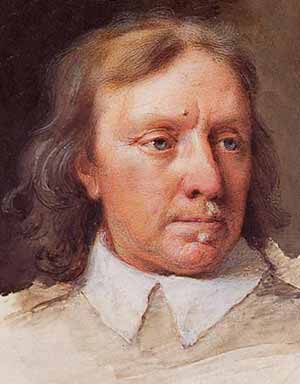 Oliver Cromwell (1599–1658) Oliver Cromwell is still a figure of hatred in Ireland, considered a regicide dictator with his name being associated with massacre, religious persecution, and mass dispossession of the Catholic community. A traditional Irish curse still used is ‘mallacht Chromail ort ‘ or translated into English ‘the curse of Cromwell upon you ‘.
On 15th August 1649 Oliver Cromwell landed at Ringsend,Dublin, with an army of over 3,000 battle hardened ‘Ironsides‘. The civil war in England had come to an end, and King Charles I had been executed seven months previously.
In Ireland the Roman Catholics had been in revolt since 1641 and now held much of the island. They had in general taken the King’s side, encouraged by the Church of Rome, though some inhabitants had observed that in England’s civil war internal turmoil a chance existed to restore independence to Ireland.
From Dublin Cromwell marched north to Drogheda, which was defended by an English Catholic Royalist, Sir Arthur Aston. When Cromwell’s surrender demand was ignored, he stormed the city ordering the death of every man in the garrison who held arms, describing his actions as “a righteous judgment of God upon these barbarous wretches“. The nearby garrisons at Dundalk and Trim, on learning the news, ‘took to their heels’.
Realising he had secured the route into Ulster, Cromwell turned on the south eastern port of Wexford town, slaughtering townspeople and the garrison alike. Neighbouring towns quickly submitted.
Oliver Cromwell’s campaign ended with an assault on Clonmel here in Co.Tipperary, where, after some stout resistance, the defenders withdrew, under the cover of darkness.
But the reign of Oliver Cromwell was not all bad, under his rule in England the contract between a monarch and his subjects was analysed and clearly defined. An elected representative must represent the best interests of his electorate and each subjects must obey the law of the land, as represented in the person of that elected individual.
Cromwell established that a parliament exists only to serve its electorate, and not the other way round. He demonstrated that governments were fully answerable to their subjects for any wrong doing. Under his leadership the reigning king, Charles 1, indeed was executed for the treason of ‘making war on his own people‘.
He demonstrated that good organisation and administration was more important in government than any social position, to get things done properly and that leadership can exist at all levels of a country’s society. He invited the expelled Jewish community to return to England, following their 400 years in exile, and thus began massive expansion of financial and trading services across Europe with England as the centre. Further proof of his appreciated governance is that in a 2002 BBC poll, in Britain, Cromwell was selected as one of the ‘Top 10 Britons’ of all time.
Cromwell’s principles of government have in the past been quoted by American colonists to justify their rebellion against British rule, by moderate French Revolutionaries, by the 1830 revolutionary leaders of Paris, by the 1848 revolutionary leaders of Vienna and Paris, by Frederick Engels in the Communist Manifesto, and by early Trade Union pioneers. His ideas have become relevant to many societies and world governments where it became necessary to overthrow tyranny and reckless greedy corruption.
His speech to the House of Commons on 20th April 1653, just minutes prior to him dissolving the Long Parliament, perhaps expresses the true feelings of many politically disillusioned men and women in the Ireland of 2011.
“It is high time for me to put an end to your sitting in this place, which you have dishonored by your contempt of all virtue, and defiled by your practice of every vice. Ye are a factious crew, (Exp: Given to promoting internal dissension) and enemies to all good government; ye are a pack of mercenary wretches, and would, like Esau, sell your country for a mess of pottage or like Judas, betray your God for a few pieces of money.
Is there a single virtue now remaining amongst you? Is there one vice you do not possess? Ye have no more religion than my horse; gold is your God.
Which of you have not bartered your conscience for bribes? Is there a man amongst you that has the least care for the good of the Commonwealth?
Ye sordid prostitutes, have you not defiled this sacred place, and turned the Lord’s temple into a den of thieves, by your immoral principles and wicked practices?
Ye are grown intolerably odious to the whole nation; you were deputed here, by the people, to get grievances redressed, are yourselves gone!
So! Take away that shining bauble there, and lock up the doors.
You have sat too long, for any good you have been doing lately. Depart, I say; and let us have done with you. In the name of God, go!”
Where can we find an Oliver Cromwell in 2011?
|
Support Us Help keep Thurles.info online by donating below. Thank you.
Total Donated 2026: €300.00
Thank You!
Daily Thurles Mass Livestream
|



Recent Comments