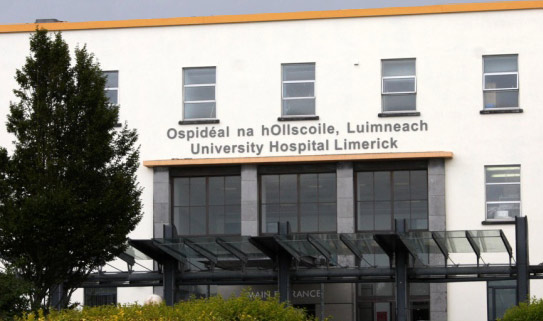
New 96-bed unit opened today at University Hospital Limerick.
A new 96-bed unit has opened at University Hospital Limerick (UHL), as part of efforts to ease chronic overcrowding at the Mid West’s main hospital serving North Tipperary.
Minister for Health Ms Jennifer Carroll MacNeill officially opened this new facility, which includes four wards of 24 beds each.
Around 400 additional staff are required to operate the unit, most of whom are already in place, according to the hospital.
UHL, which provides the only 24-hour emergency department for North Tipperary, Limerick and Clare, has consistently recorded the highest number of patients on trolleys in the country.
The expansion comes two weeks after the Health Information and Quality Authority (HIQA) urged immediate action and investment to increase bed capacity in the HSE Mid West.
HIQA outlined three options: expanding the Dooradoyle campus, developing a new nearby site, or constructing a new hospital. Ms Carroll MacNeill said all options remain on the table, adding that increasing inpatient capacity is her priority.
Ms Carroll MacNeill also welcomed the recent granting of planning permission for a second 96-bed block at the Dooradoyle site.
According to the Irish Nurses and Midwives Organisation (INMO), 100 people were waiting for treatment at UHL on Monday; 70 in the Emergency Department and 30 admitted patients still awaiting a bed.
Emergency departments in Ennis, Nenagh and St John’s Hospitals were closed in 2009 by under a Fianna Fáil led government, pursuing a reconfiguration of services, centralising emergency care at UHL.
“Annual income twenty pounds, annual expenditure nineteen and six, result happiness. Annual income twenty pounds, annual expenditure twenty pounds nought and six, result misery”. Extract from Charles Dickens’s 1850 novel “David Copperfield”.
Government Confirms €473,000 Cost Of Recent Deportation Flight To Pakistan.
The Minister for Justice, Home Affairs and Migration, Mr Jim O’Callaghan, has confirmed that a chartered flight used to deport 24 men from Ireland to Pakistan on September 23rd last cost approximately €473,000 — almost €20,000 per person, the most expensive deportation operation to date this year.
It was the fourth chartered deportation flight in 2025, following earlier flights to Georgia and Nigeria, which together cost over €530,000. In total, 130 people have been deported via chartered flights so far this year, with a further 137 removals carried out on commercial flights by the Garda National Immigration Bureau (GNIB).
Mr O’Callaghan said the cost of the Pakistan flight may rise as invoicing is still being finalised. He noted that deportations are “costly and complex to enforce,” adding that voluntary returns remain the preferred option.
“The returnees on this flight were accompanied by Garda personnel, medical staff, an interpreter, and a human rights observer,” he added.
The Department of Justice has issued 3,035 deportation orders so far this year, up from 2,403 in 2024.
One wonders would it have been cheaper to have allowed them to stay and found them jobs in the catering industry at the new national minimum wage of €14.15 per hour, but then I suppose what with no houses and despite global warming, tents can be still be draughty in Ireland in our winters.
Sadly, the government Learjet 45 owned by Irish taxpayer has only 7 passenger seats and the new one we the taxpayers just bought for world influencers Mr Simon Harris and Mr Micheál Martin at a cost of €53m; (due for delivery Xmas 2025, in time for Ireland’s EU Presidency in the second half of 2026), will only have 10 seats.
Could they not have used an Emirates Economy Return Flight from Dublin to Karachi which would only have costs €842.37 per person, (a saving of €19,000 per person), but then I suppose unions representing Garda personnel, medical staff, an interpreter and a human rights observer, would have objected to travelling Economy Class. Meanwhile, we read last month that Community Foundation Ireland, ranks Ireland 16th out of 27 European Union countries when child poverty is rated.
More than €1.1 million has been spent on taxi services for residents of International Protection Accommodation Service (IPAS) centres since the start of last year, according to new figures supplied from the Department of Justice, Home Affairs and Migration.
The costs, which cover transport to and from IPAS centres and urgent journeys such as medical appointments, totalled €904,222 in 2024 and €228,107 up to the end of May 2025. These figures exclude any direct payments made by accommodation centres.
Justice Minister Mr Jim O’Callaghan said transport forms part of the State’s legal obligation to provide accommodation and basic supports for international protection applicants. He noted that taxis are used when smaller groups require travel, or when transport is needed urgently or outside regular hours.
“The IPAS system involves residents regularly arriving, leaving, or moving between centres. Transport is required as part of these movements and for specific urgent needs,” the Minister stated.
He added that overall taxi costs have “reduced significantly” since last year.
Separately, the Department has spent over €12 million on wider transport for international protection applicants — including buses and taxis — since February 2022, following the activation of the EU Temporary Protection Directive.
Take A Quick Glance At Ireland’s Budget Details Announced Today.
Workers earning the national minimum wage will see an increase of 65 cent per hour, bringing the new rate to €14.15.
Motorists; Same will face higher fuel costs, with a 60-litre tank set to rise by €1.28 for petrol and €1.48 for diesel.
Smokers; The cost of a 20-pack of cigarettes will increase by 50 cent, bringing the average price to just under €19.
Social Welfare, Child benefit & Pensions; Core weekly social welfare payments, including the State pension, will rise by €10 per week. Child benefit; Same will increase by €8 per month for children under 12 and €16 for those aged 12 and over.
Fuel allowance: Eligibility for the fuel allowance will be expanded to include recipients of the Working Family Payment, and the weekly allowance itself will rise by €5.
Education& Grants; In education, college fees will be permanently reduced by €500, bringing the annual charge to €2,500—though this will represent an increase in real terms from the temporarily reduced rate of €2,000 in recent years. SUSI Grants; The income threshold for SUSI grants will rise by €5,000, to €120,000 per household. Capitation grants; Same will increase from €224 to €274 for primary and special schools, and from €386 to €406 at post-primary level. Special Needs Assistants; 1,717 new Special Needs Assistants (SNAs) will be appointed, bringing the total to almost 24,900, alongside 1,042 new teaching posts, including 860 for special education. Building Projects; A €1.6 billion capital investment will progress over 300 school building projects, delivering around 2,800 new places for special classes and schools.
Hospitality: The VAT rate on hospitality will be cut to 9% from July 2026, while the rate for completed apartments will drop from 13% to 9% until the end of 2030.
Renters; Renters will benefit from the extension of the tax credit for a further three years, remaining at €1,000 for individuals and €2,000 for couples. Mortgage interest relief will continue for two more years—€1,250 in 2025 and €625 in 2026.
Income Tax Bands; There are no major changes to income tax bands or credits, other than an increase in the USC 2% rate band to €28,700.
Public Transport; Reduced public transport fares will continue throughout 2026, and the 9% VAT rate on energy bills will be extended until the end of 2028.
Defence; The Defence budget will rise by 11%, funding 50 new civilian roles, 70 additional civil servants for areas such as cybersecurity, and new body armour and ammunition stock replenishment.
Health; The Health budget will increase to €27.3 billion, up €1.5 billion on this year, including 300 new mental health staff.
Law Enforcement; Up to 1,000 new Garda recruits will be deployed in 2026, with further investment in immigration processing, youth diversion, and domestic violence prevention programmes.
National Broadband Plan; A further €433 million will go towards the National Broadband Plan, while €357 million will be provided for broadcasting, including €65.4 million for TG4.
Renewable energy; Households generating renewable energy will benefit from an extension of the €400 income tax disregard for microgeneration earnings until 2028.
Sport; €3 million will be provided to establish League of Ireland youth academies, and the GAA will receive €1.6 million in funding for inter-county players.
Music; From Budget 2026, income tax relief for makers of uilleann pipes and Irish harps will be extended to 2028.
Sadly, Dr. Mansergh passed away unexpectedly in Western Sahara, while on a visit to Morocco.
His passing is most deeply regretted, sadly missed and lovingly remembered by his sorrowing family; loving wife Elizabeth (née Young), son Danny, daughters Fiona, Lucy, Alice and Harriet, grandchildren, brothers and sister extended relatives, political confidants, neighbours and friends.
For those persons who would wish to attend the funeral service for Dr. Mansergh, but for reasons cannot, same can be viewed streamed live online, HERE.
The extended Mansergh family wish to express their appreciation for your understanding at this difficult time, and have made arrangements for those persons wishing to send messages of condolence, to use the link shown HERE.
Note Please: House strictly private. Family flowers only. Donations in lieu, if desired, to a charity of your choice.
This website uses cookies to improve your experience. We'll assume you're ok with this, but you can opt-out if you wish.AcceptRead More
Privacy & Cookies Policy
Privacy Overview
This website uses cookies to improve your experience while you navigate through the website. Out of these, the cookies that are categorized as necessary are stored on your browser as they are essential for the working of basic functionalities of the website. We also use third-party cookies that help us analyze and understand how you use this website. These cookies will be stored in your browser only with your consent. You also have the option to opt-out of these cookies. But opting out of some of these cookies may affect your browsing experience.
Necessary cookies are absolutely essential for the website to function properly. This category only includes cookies that ensures basic functionalities and security features of the website. These cookies do not store any personal information.
Any cookies that may not be particularly necessary for the website to function and is used specifically to collect user personal data via analytics, ads, other embedded contents are termed as non-necessary cookies. It is mandatory to procure user consent prior to running these cookies on your website.







Recent Comments