Archives

Deputy Lowry TD Welcomes News On Lisheen Site.

Independent Deputy Michael Lowry has confirmed that EU Commissioner Phil Hogan will today formally announce the sanction and funding for a revolutionary bio-economy research project, led by Glanbia Ireland.

This exciting development will be based at the former Lisheen Mine site which has been designated as a green energy hub.

This project has huge prospects for full time employment and it is conservatively estimated that it has the potential to create 300 permanent jobs. The initial site preparation and construction phase of the development will employ both directly and indirectly; up to 160 people.

The project will involve the development of a new bio-refinery and will use technology which has been developed by Glanbia Ireland.

When completed the bio-refinery will help in tackling the current environmental crisis created by waste plastic across the country and the world.

Deputy Lowry stated, “I am pleased to have made my contribution to ensure that this key development would be located at the former Lisheen Mine site, and I compliment all the agencies involved in the partnership which will deliver this significant bio-refinery project.
I wish to thank Commissioner Phil Hogan and Minister Heather Humphreys for their support, cooperation and assistance throughout this complex and lengthy process”
.

Work To Begin Again On Barry’s Bridge – Whenever

The word on every person’s lips here in Thurles today is ‘JEEP’ – which as you know stands for ‘Jump Excitedly into Every Pothole’.

Around the year 1650, McRickard Butler’s workforce knew how to build a bridge. Using construction materials consisting of a combination of rubble and dressed limestone, and with their skilled hands they chiselled large lumps of limestone rock creating triangular cut-water pillars to meet the southward flowing water of the river Suir. On top of these same cut-water pillars, they formed seven round arches with dressed voussoirs, (latter wedge-shaped or tapered stones used to construct the arches), visible from both north and south elevations.

Barry’s Bridge Thurles begins to unravel after 4 days.

This limestone road bridge served us well, until around 1820, when it was reconstructed. In more recent years it was widened, its old stone walls replaced by footpaths and steel railings; its road resurfaced by concrete.

Today, 2018, despite major strides in education and communication the knowledge on how to fill a pothole has been lost. On Friday, March 30th last after three weeks of tolerating single lane, “Stop & Go” twenty-minute, traffic management delays, Barry’s bridge was reopened, having been resurfaced.

One hopes no cheques have changed hands, as yesterday, just 4 days later, already this new surface has begun to unravel. Someone in Tipperary Co. Council’s engineering department remains convinced that it is possible to glue tarmac to a sloping road surface and then run heavily laden 12-wheeler trucks over it.

You can only get from people what they are willing or able to give was always the definition of the quote, “You can’t squeeze blood from a turnip.”  But it appears that when it comes to the ratepayers and taxpayers of Thurles Town; yes, we turnips do actually produce blood and can be continuously squeezed.

Meanwhile, here in Ireland, there are still several streets in existence with no pot holes. These streets are now some 60 years old. Back then they used a miracle product for such surfaces. It was considered environmentally friendly; could be recycled, and contained no expensive petroleum. The miracle product was called cement.

Here in Thurles again today, the Council truck did its daily sweep of the town, filling an occasional water laden hole with cold tarmac, which will be reduced to gravel within 48 hours.

There is still no confirmation on the promised Thurles Bypass, initially pledged some 16 year ago.

There were just 6 votes separating Mary Newman and Garrett Ahearn at the recent Fine Gael selection convention here in Thurles, and it’s now thought that the Cashel woman may be added to the ticket for the next general election in October. One wonders will “The Bypass” arrive before then.

Könnten Wir Bitte Ihre Leere Plastikflaschen Und Dosen Haben?

Münster is an independent city in North Rhine-Westphalia, Germany. The city is regarded as the cultural centre of the Westphalia Region and renowned as the bicycle capital of Germany. Recently a friend of mine visited that lovely city and returned with the following true story.

Leading a group of some 20 other persons in Münster; my friend became aware that they were being followed, from a distance, by two elderly and possibly homeless persons. My friends group paused for a while at a nearby recognised picnic site, to consume some snacks and drinks, before being approached by these gentlemen, who inquired formally in German, “Könnten wir bitte ihre leere Plastikflaschen und Dosen haben?”  One of the company who spoke the German language translated; “Please can we have your empty plastic bottles and cans”?

My friend explained that in Münster as indeed in Germany, a deposit refund system was in place, to repel the growing plastic waste crisis. Every drink can and plastic bottle collected, when returned to vendors, is rewarded by a payment of 15 cents each, which had been previously charged when the product was initially purchased. These two men would redeem €3.00, if 20 plastic or metal drink containers were returned to vendors.

The returned containers are then reused or recycled. This system of recycling has proven to be extremely effective in the recovering of up to 98% of all such containers.

Drink containers are the convenience packaging for products used for outdoor recreation.

Here in Ireland our metal cans and plastic drink containers are to be found dumped in every nook and cranny. “Tidy Towns” judges, together with the “Irish Business Against Litter (IBAL)”, regularly highlight the issue within towns and villages, but rural country areas remain ignored with same items dropped to roll around on our streets; to be thrown into our gardens and unto our road sides by passers-by and motorists; while also being dumped into our rivers and onto the 7,000km of our golden beaches, to become the flotsam and jetsam of “God knows where,” depending on the currents and Tides.

The “Repak Model” of recycling is seen as being adequate by a short sighted Irish Department of the Environment. However, while it may be profitable for Repak; do take a look around our streets and you will see Ireland operates a “one use and then litter” model, with immediate change now fundamentally crucial. It would appear that our appointed legislators are possibly under pressure, from waste collection business operators, latter who only manage to recycle about 39% of our cans and plastic bottles (given to them for free), leaving 61% (43,000 tonnes) to decorate our green landscape.

But imagine the difference it would make to our unspoiled coastal regions; our rural countryside, our villages, towns and cities, if a deposit refund system were to be put in place, in a state that is growing more and more dependent on regular foreign Tourism.

The Netherlands, Germany and Denmark have operated successful ‘deposit refund systems’ for years. The UK have just announced they are about to introduce a similar deposit refund scheme, while Ireland continues to drown in its own litter, dependent on individuals to come out, voluntarily, to pick up and clean up after those who dump their unwanted garbage.

God be with the late 50’s, when my friends and I would rush down to the village with our empty ‘Taylor Keith’ cochineal reddened, fizzy, lemonade bottles and with the refund, buy a few Peggy’s Legs or a few strawberry flavoured Bubble Gum Balls, [latter banned in my house because same were seen to be ‘dirty’ and ‘unmannerly’, according to my grandmother, especially “in front of other respectable visiting adults.”].

Here in Ireland we will probably have to wait until the EU make ‘deposit refund systems’ compulsory, and the sooner the better. Understandably reverse vending machines operating a deposit-and-return drinks container regime, is not as popular with our elected County Councillors, as are Parking Metres in our town centres.

Three Billboards Outside Thurles, Co. Tipperary

You have possibly seen the film “Three Billboards Outside Ebbing, Missouri,” a 2017 drama film written, directed, and co-produced by Martin McDonagh and staring Frances McDormand as a mother who rents three billboards to call attention to her daughter’s unsolved murder.

It seems nowadays this kind of action is the only way to highlight neglect and injustice, as large rural Irish towns are abandoned in favour of overcrowded, dirty, crime ridden, sprawling cities.

Large and small business owners and their employees, operating in the heart of Thurles town, found themselves almost completely cut off from customers arriving from the east side of the River Suir yesterday, with both Thurles river crossings operating a ‘Stop & Go’ system of traffic control, because of two separate sets of road works.
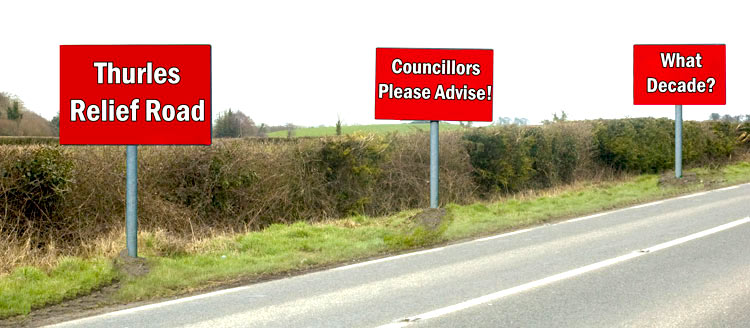
Three Billboards Outside Thurles, Co. Tipperary

Business people are aware and fully accept the necessity of repairing the long neglected Barry’s Bridge, but were not expecting the simultaneous and unnecessary road works begun yesterday on the Mill Road, (at the Y junction joining Thurles with Littleton Village and exiting unto Turtulla crossroads).

Traffic from the eastern parts of town had reverted to using this narrow dangerous Mill Road, as an alternative route to reach the centre of Thurles, thus avoiding the crossing at Barry’s Bridge, on the advice of redirection signs posted.

Because of the works being carried out on the Mill Road junction, traffic decided to travel instead once again via the single lane over Barry’s Bridge yesterday, taking vehicles 26 minutes to travel less than ½ a kilometre, with traffic tailed back to the Borroway roundabout. Similar tailbacks occurred on the narrow, and dangerously twisting track that is the Archerstown Industrial Estate exit, all due to a lack of basic logistical communication.

Huge anger is now being expressed by business people, with demands being made that Tipperary County Council immediately state when the promised Thurles Relief Road, announced as being funded under the recent National Development Plan, will actually materialise.

This Thurles Relief Road was already approved by An Bord Pleanala in 2014, however funding had then been withdrawn by the governing Fine Gael / Labour Collision.
For this front window view of a high sided diesel-spewing 12-wheeler lorry, we must pay the highest rate of property tax in Ireland.

The planned relief road, subject to conditions expected to be laid down by the Department of National Parks and Wildlife, together with the appointment of an archaeologist to monitor all intended site developments, was agreed to commence from the Clongour area of Thurles to the rear of the present old Erin Foods site, before crossing the river to exit onto the Mill Road, south-east of Thurles Town.

More importantly, residents living on narrow Thurles Streets, e.g. Croke Street, Mitchel Street, Parnell Street, Kickham Street, O’Donovan Rossa Street etc, are now obliged to live with electric lights burning all day in their front rooms, due to slow moving 12 and 18-wheeler, high sided lorries, vibrating their homesteads, while almost at a standstill, due to this now necessary, but nevertheless previously neglected road works.

I am referring of course to those residences who lack front gardens and, in the interest of community pride, are forced annually to paint their homes at least once each year, caused due to the filth from heavy duty vehicles, being splashed on the outer walls of their homes.

These residents are what author Uaitéar ÓMaicín’s (1915-1967) called “The Silent People”, on whom property tax was piled; increased with the permission of elected representatives; and who are forced daily to breath endless diesel pollutants containing unburned hydrocarbons, carbon monoxide (CO), nitrogen oxides (NOx) and other fumes; while having to wash the soot from their curtains every week, because they felt the need to open a window.

While today here in Thurles half of our population can’t cross the River Suir, the National Transport Authority (NTA) have announced plans in Dublin for a €3bn underground / over ground Metro service for Dublin.  Ms Anne Graham, NTA Chief Executive said the 26km track should be operational by 2027, if it succeeds in the planning process, (Which means this project is already well advanced).  This Metro service line will run from Sandyford in south Dublin to beyond Swords in north Dublin, taking in Dublin Airport. This service is expected to travel over ground from Sandyford to Charlemont, before vanishing underground to the airport.

The 26km distance, will, NTA boast, mean a journey time of just 20 minutes from the city centre to Dublin airport and 50 minutes from Sandyford to Swords, with trains travelling every two minutes in each direction. (Compare these drive times in Thurles, 26 minutes, to travel just ½ a kilometre.)

How long more the residents and businesses here in Thurles will continue their silence; we can’t be sure, but patience is most certainly running out fast. This lack of patience was previously highlighted when it was decided that Fine Gael TD’s, in government would no longer be elected in the county, and were found to be totally eradicated following the last General Election results held on Friday February 26th 2016.

Already there are whisperings to boycott local elections, because of town centre parking charges. Charges to commuters using Irish Rail for example and who park their cars at Thurles railway station, must now pay €4.50 on top of the cost to their over priced, standing room only, rail tickets, making it cheaper to simply drive to our larger cities.

With Local Elections due to be held in all local government areas of the Republic of Ireland in June 2019, and National Elections expected this autumn of 2018; politicians be warned, the days of receiving salaries for simply updating their social media sites, with unsubstantiated claims to power; are coming to an end.  Businesses are being expected to pay high rates, massive insurance and heavy taxes, in a town where its streets are becoming slowly derelict and its roadways more akin to gravelled driveways.  Regardless of current delays on Barry’s Bridge, it would be easier at present to access Thurles from the east by rowing boat, rather than by motor vehicle.


TD Michael Lowry Wins Appeal Against Moriarty Tribunal Decision

Independent TD Mr Michael Lowry has won his appeal in relation to the decision of the Moriarty Tribunal to award him only ⅓ of his legal costs, following his participation in same tribunal.

Mr Lowry had appealed that decision claiming that he was treated differently from one of the other tribunal subjects, the late former Taoiseach Mr Charles J. Haughey, who had been awarded his full costs. The three-judge Court of Appeal have now returned the question of legal costs back to the tribunal for their reconsideration.

The High Court had dismissed Mr Lowry’s appeal in relation to the specific ruling made by the Moriarty Tribunal; claiming that he had engaged in “a litany of falsification and deception” thus failing to co-operate with the said tribunal.

Today’s appeal decision was delivered by the Court of Appeal’s President, Mr Justice Sean Ryan, whose colleagues, Ms Justice Finlay Geoghegan and Mr Justice John Edwards, were also fully in agreement.

Mr Lowry had correctly argued that there had been a disproportionate reduction in the amount of costs he had been awarded. He had further argued that his non-cooperation findings demonstrated a breach of fair procedures, failing to provide adequate material to substantiate the conclusions made by the tribunal.

Mr Justice Sean Ryan therefore allowed Mr Lowry’s appeal in relation to the decision that he should only get ⅓ of his legal costs and Mr Lowry is therefore now entitled to an order quashing the tribunal’s initial costs decision of October 31st, 2013.