Tipperary County Council has been allocated €1.4 million under the latest round of the Government’s Voids Programme, in a move expected to help bring more vacant local authority homes back into use across the county.
The funding forms part of a wider €40 million national investment announced by Housing Minister Mr James Browne, which will support the refurbishment and re-letting of around 2,200 local authority homes across the country in 2026.
The latest allocation is expected to provide a significant boost for Tipperary as demand for housing remains strong and pressure continues on local authority stock. The funding will be used to prepare vacant council-owned properties for new tenants, helping to increase housing supply through the reuse of existing homes.
The announcement also signals a major policy shift in how future funding under the Voids Programme will be distributed.
Under a revised performance-based model introduced by the Minister, future allocations will be linked to how effectively local authorities reduce vacancy levels and improve turnaround times for re-letting homes.
From 2027, local authorities, including Tipperary County Council, will be expected to maintain a vacancy rate of no more than 2% and achieve a maximum average turnaround time of 18 weeks for vacant properties. The turnaround target will tighten further to 15 weeks in 2028 and 12 weeks in 2029.
Councils that meet those targets will qualify for full funding under the revised model, placing a stronger emphasis on delivery, efficiency and the rapid reuse of existing housing stock.
The funding will be seen as a positive development for Tipperary, particularly given the ongoing need to maximise available housing and reduce the time homes remain vacant between lettings.
Nationally, the Government says the Voids Programme has played a significant role in bringing empty social homes back into use over the past decade. Since the scheme began in 2014, a total of €385 million has been invested, supporting the return of 27,860 homes to active use.
The 2026 allocation is also a 29% increase on the previous year’s funding, reflecting what the Department says is a continued focus on tackling vacancy and increasing housing availability through refurbishment.
For Tipperary, the €1.4 million allocation is expected to support further progress in returning vacant homes to use, while positioning the local authority to meet the tougher targets that will shape future funding in the years ahead.
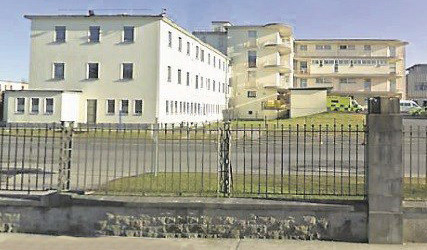
News that the HSE has acquired a 44-acre site in Raheen, Co Limerick, for €14 million for the development of a new hospital campus aimed at easing pressure on University Hospital Limerick, has been warmly welcomed in North Tipperary.
The newly purchased site at Raheen, is located about 2km from the existing UHL site in Dooradoyle and about 30 minutes travelling time from both Ennis, Co. Clare and Nenagh, Co. Tipperary, thus making it accessible for patients across the much neglected Mid-West health region.
Health Minister Ms Jennifer Carroll MacNeill confirmed the purchase today, Tuesday March 10th, describing the location as strategically important for the wider Mid-West.
The new campus follows one of the recommendations made by HIQA in its review of urgent and emergency healthcare services in HSE Mid West. HIQA found that the region’s main problem is a lack of inpatient bed capacity for seriously ill patients and recommended a mix of measures, including expanding UHL, developing a second site nearby, and planning for a new Model 3 hospital with a second emergency department.
University Hospital Limerick currently operates the only 24-hour emergency department for Limerick, Clare and North Tipperary, while also taking patients from parts of North Cork and North Kerry. It has regularly recorded the highest number of patients waiting on trolleys in the State.
Ms Sandra Broderick, Regional Executive Officer for HSE Mid-West, said the acquisition marked an important step for the region’s healthcare system and for the 10,000 staff working across services in the area. She said the move must help ensure that future patients do not face the experience of receiving care on a trolley.
Application Ref: 2660179. Applicant: John & Lorraine McLoughlin. Development Address: 3 The Glebe, Thurles, Co. Tipperary. Development Description: the following works: a) demolition of the existing single storey rear extension; b) proposed new 2-storey extension to the rear of the existing dwelling; c) associated alterations to existing dwelling external elevations to accommodate proposed new extension & internal layout; d) all associated site works. RETENTION PERMISSION is also sought for e) the existing shed structure; f) retention of the existing widened vehicular entrance & all associated site works. Status: N/A Application Received: 01/03/2026. Decision Date: N/A Further Details:http://www.eplanning.ie/TipperaryCC/AppFileRefDetails/2660179/0
Application Ref: 2660172. Applicant:Tom and Theresa Ryan. Development Address: Abbey Road, Thurles, Co. Tipperary. Development Description: a single storey rear extension to existing dwelling house, a domestic shed, rear vehicular entrance and all associated site works. Status: N/A. Application Received: 26/02/2026. Decision Date: N/A. Further Details:http://www.eplanning.ie/TipperaryCC/AppFileRefDetails/2660172/0.
Application Ref: 2660164. Applicant: Sola Energy Solutions. Development Address: Lands To Rear Of Rosendale and 4 Friar Street & To North-West of Croke Gardens, Thurles, Co. Tipperary. Development Description: demolitions and construction of 12 no. residential units (10 No. 2-bedroom houses & 2 no. 1-bedroom apartments) and all ancillary site development works and services consisting of: 1). demolition of part of the existing boundary wall to west of site & all existing structures on site; 2). removal of existing surface car parking spaces to west of site; 3). construction of 12 no. residential units in 2 no. 2-storey plus pitched roof blocks. Block A will consist of 2 no. 1-bedroom apartments & 4 no. 2-bedroom houses and Block B will consist of 6 no. 2-bedroom houses; 4). Construction of new vehicular and pedestrian entrance/ egress to west of site onto adjoining roadway & 5). All associated ancillary car parking, bicycle parking, refuse stores, signage, landscaping, boundary treatments, and all site development works and services. Status: N/A. Application Received: 25/02/2026. Decision Date: N/A. Further Details:http://www.eplanning.ie/TipperaryCC/AppFileRefDetails/2660164/0.
Application Ref: 2561352. Applicant: Sean Purcell. Development Address: Mitchel Street, Thurles, Co. Tipperary. Development Description: 2 new offices to the rear of my site with all associated siteworks Status:Refused. Application Received: 22/12/2025. Decision Date: 24/02/2026. Further Details: http://www.eplanning.ie/TipperaryCC/AppFileRefDetails/2561352/0.
A significant roads funding package for 2026, announced in February 2026, has been outlined for Tipperary, covering both regional/local roads and national roads.
Regional & Local Roads (Tipperary County Council): €49,379,670. The largest share of the allocation is directed toward the day-to-day upkeep and long-term resilience of the county’s regional and local network.
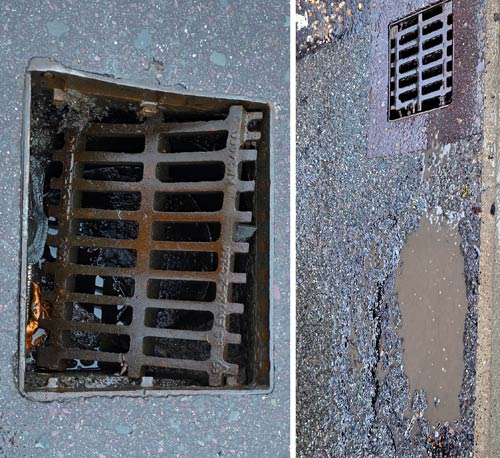
Over last weekend, you’d be forgiven for thinking Thurles, Co. Tipperary, had been abandoned, judging by the state of our streets. Once again we’re driving on loose gravel, while yesterday’s potholes are “repaired” with cold tarmac tipped straight into puddles, as if water were a suitable foundation.
Worse than that, a drain cover was left open since last Thursday, near to the junction at Bowe’s corner; the grate cover having been dislodged in direct line with vehicle wheels. (See picture featured hereunder.)
Pic 1 Left: Grate cover dislodged. Pic 2 Right: On Barry’s Bridge, once again, a sinking surface, as 18 wheelers bounce over a raised pedestrian platform. Pictures: G.Willoughby.
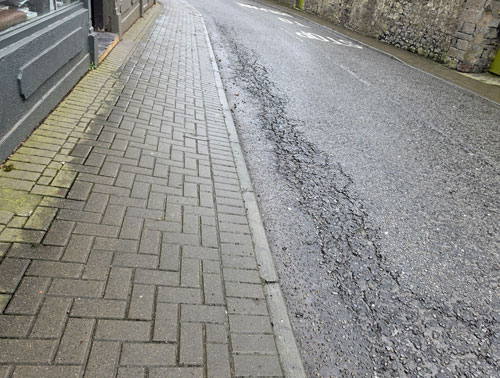
Parnell Street, Thurles beginning to sink and unravel with footpath now at a distinct sloaping angle. Picture: G. Willoughby.
“Protection & Renewal”: €36,234,670. Within the regional and local roads budget, €36,234,670 is assigned to Protection & Renewal. This funding supports a wide range of works and programmes, including:
restoration, improvement, and maintenance works
discretionary schemes
bridges and structures
drainage projects
road safety measures
climate adaptation works
community involvement initiatives (and other related supports)
National Roads (Tipperary): €8,360,343.
In addition, €8,360,343 has been allocated for national roads within Tipperary, supporting key routes that play a major role in commuting, freight, and regional connectivity.
A Combined Local Package of Approximately €57.7m. Taken together, the figures referenced locally bring the overall roads investment package for Tipperary to around €57.7 million for 2026.
National Context: Over €1.5bn for Roads in 2026. For broader context, the Department of Transport has stated that more than €1.5 billion was provided nationally in 2026 for national roads and regional/local roads, placing the Tipperary allocation within a substantial nationwide investment programme.
Homelessness in Emergency Accommodation Reaches New Record High of 17,112 in January 2026.
The latest monthly Homelessness Report, published by the Department of Housing, Local Government and Heritage, shows that 17,112 people accessed local authority-managed emergency accommodation in January 2026, the highest figure recorded to date.
The report indicates that 11,793adults and 5,319 children were in emergency accommodation during the month. The January total represents an increase of 378 compared with December 2025 (16,734).
In terms of nationality among adults in emergency accommodation, 5,897 were Irish, 3,572 were from outside the European Economic Area(EEA), and 2,324 were from within the EEA or the UK.
The report also shows that the largest adult age cohort was 25–44 years(6,232), and that the Dublin region accounted for the majority of adults in emergency accommodation (8,267).
Government response and measures: Minister for Housing James Browne said he is “very conscious” of the rising levels of homelessness and described the situation as unacceptable. The Minister pointed to tenancy terminations as a key driver and said the Government is strengthening tenant protections, through recently enacted rental legislation, aimed at improving security of tenure and reducing the frequency of notices to quit.
The Residential Tenancies (Miscellaneous Provisions) Act 2026 was enacted this week and is due to apply to new tenancies created on or after March 1st 2026, introducing new measures intended to provide greater certainty and stability for renters.
Tipperary visit: Minister Browne was speaking during a visit to Nenagh, in North Tipperary, where he viewed a new housing scheme nearing completion. The development is being delivered by ‘Respond‘ in partnership with Tipperary County Council, with construction by ‘WhiteBox Ltd‘.
Reactions from organisations and opposition. Homelessness service providers again urged faster delivery of solutions that reduce homelessness, particularly for families and children. The Dublin Simon Community said the figures underline the need for measures that will have the greatest impact, while Focus Ireland described the latest record as deeply distressing, highlighting the number of children affected.
Separately, opposition representatives criticised the Government’s rental policy direction and called for emergency action to prevent further increases in homelessness, but failed to offer any real solutions.
This website uses cookies to improve your experience. We'll assume you're ok with this, but you can opt-out if you wish.AcceptRead More
Privacy & Cookies Policy
Privacy Overview
This website uses cookies to improve your experience while you navigate through the website. Out of these, the cookies that are categorized as necessary are stored on your browser as they are essential for the working of basic functionalities of the website. We also use third-party cookies that help us analyze and understand how you use this website. These cookies will be stored in your browser only with your consent. You also have the option to opt-out of these cookies. But opting out of some of these cookies may affect your browsing experience.
Necessary cookies are absolutely essential for the website to function properly. This category only includes cookies that ensures basic functionalities and security features of the website. These cookies do not store any personal information.
Any cookies that may not be particularly necessary for the website to function and is used specifically to collect user personal data via analytics, ads, other embedded contents are termed as non-necessary cookies. It is mandatory to procure user consent prior to running these cookies on your website.








Recent Comments