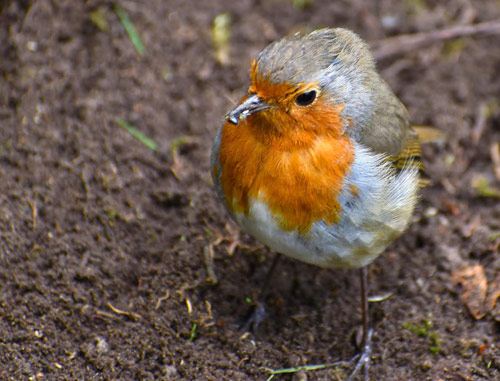
RSPB England Issues New Seasonal Guidance on Garden Bird Feeding to Prevent Disease Spread.
The Royal Society for the Protection of Birds (RSPB) has issued new guidance urging the public to adopt seasonal bird feeding practices to help protect vulnerable garden bird populations from disease. The charity is advising households across England to pause routine bird feeding between May 1st and October 31st, citing increased risks of disease transmission during warmer months, when feeders can become contamination hotspots.
Rising Concern Over Bird Disease. The recommendation follows growing concern over trichomonosis, a parasitic disease that affects birds’ mouths, throats, and digestive systems, often making it difficult for them to eat or breathe. The disease spreads through contaminated food and water sources and has been linked to significant declines in several species. Among the most affected is the greenfinch, whose population has dropped by an estimated two million birds in the UK, placing it on the conservation red list. Long-term monitoring data also shows a steep decline in sightings, with greenfinches falling from one of the most commonly recorded garden birds to much lower rankings in recent years.
Seasonal Feeding Approach Recommended. Under its new campaign “Feed seasonally, feed safely”, the RSPB is encouraging the public to rethink year-round feeding habits. While feeding birds can provide benefits, especially during colder months, the charity warns that concentrated feeding in summer can facilitate the spread of disease. Limited feeding may still be appropriate if done carefully. The RSPB advises offering only small quantities of food, such as mealworms or fat-based products, sufficient for one or two days at most.
Hygiene Measures Essential.
To reduce risks, the RSPB recommends:
Cleaning bird feeders at least once a week.
Regularly changing feeder locations to prevent waste buildup.
Providing fresh tap water daily if offering water.
Cleaning bird baths weekly.
Avoiding flat surface feeders, such as traditional bird tables, where contamination can accumulate more easily
The organisation has already begun phasing out flat feeders from its own product range.
Widespread Public Impact. Bird feeding is a popular activity in England, with millions of households participating regularly and significant annual spending on bird food. The RSPB acknowledges that changing established habits may be challenging but stresses the importance of protecting bird populations. The guidance has been developed in collaboration with scientific partners and is based on an extensive review of available evidence. While some industry groups have raised concerns about the changes, the RSPB maintains that precautionary action is necessary.
Supporting Birds Responsibly. The RSPB emphasises that feeding birds can still play a positive role when done responsibly. However, it warns that continuing current practices without adjustment could contribute to further population declines.
“We cannot continue as usual,” the charity stated, highlighting the need for collective action to safeguard garden birds for the future.
Thurles Co. Tipperary came alive today as the rural heart of mid-County Tipperary marked St Patrick’s Day with a parade that reflected the warmth, pride and community spirit for which the town is so well known. Despite the cold and cloudy conditions, large crowds gathered along the streets in great numbers, creating a lively and welcoming atmosphere from start to finish. Thurles is a thriving town in County Tipperary, and St Patrick’s Day, celebrated each year on 17th March, remains one of the most important occasions in Ireland’s civic and cultural calendar.
Families, friends, neighbours and visitors of all ages turned out in good spirits, wrapped up against the chill but full of enthusiasm and festive cheer. The parade offered a proud display of local identity, bringing together a broad and mixed population in a shared celebration of Irish heritage, community and belonging. The sight of the crowd lining the route, applauding participants and waving flags, captured the very best of Thurles; resilient, friendly and united.
Video: Courtesy G. Willoughby.
Today’s event was a reminder that even under grey skies, the spirit of St Patrick’s Day shines brightly in towns such as Thurles. The success of the parade is a credit to the organisers, volunteers, participants and all those who attended and supported the celebration. Their contribution ensured a memorable occasion that honoured tradition while strengthening the bonds of community that continue to define Thurles.
The Vee in the running for national “Best Drives” award, and here’s how to back Tipperary.
One of Ireland’s most dramatic road trips is in the spotlight this week, with The Vee shortlisted in the Best Drives series, run by The Journal in association with Allianz Insurance. The series celebrates standout scenic routes around the country, and the overall winner will be rewarded with a dedicated video feature shared across The Journal’s platforms.
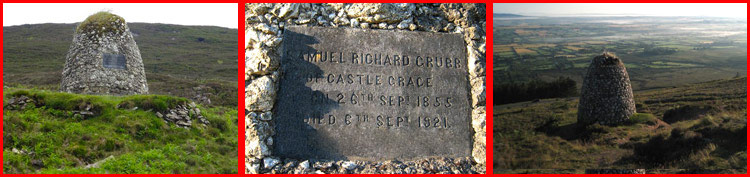
Why ‘The Vee’ is turning heads: The nomination describes ‘The Vee’, (VIEW HERE ), as “one of the most visually stunning drives in Ireland”, and it’s easy to see why. Named for its famous V-shaped bend, the route climbs into the Knockmealdown Mountains and opens up sweeping views over valleys and patchwork farmland below On clear days, you’re treated to big skies and big horizons, with views stretching towards the Galtee Mountains, home to Galtymore (917.9m), widely noted as the highest inland mountain in the country. And then there’s the height of the pass itself: The Vee rises to around 610 metres (2,000 feet) above sea level, adding that unmistakable “mountain road” feel, especially as the road curls past the lake and viewpoint.
The suggested starting route: The drive can be started from either Clonmel or Cahir, continuing through Clogheen, up and over The Vee, and onwards towards Lismore. It’s a route that manages to feel like a proper road trip without demanding an entire day, ideal if you want a scenic spin with a few memorable stops built in.
Don’t miss Bay Lough: A highlight mentioned in the nomination is Bay Lough, latter a quiet, upland lake close to the high point of the pass. It’s a natural “pull in, step out, and take it all in” moment, whether you’re after photos, fresh air, or a calm pause mid-drive. The nomination also suggests taking to the water, including kayaking, as part of the experience, underlining the sense that this is more than a nice view from a car window; it’s an outdoorsy corner of the county worth lingering in.
A route on the Tipperary–Waterford line: The Vee sits right on the border, straddling Tipperary and Waterford, a gateway drive that shows off the best of both sides of the mountains, with wide open panoramas and that signature V-shaped turn that gives the route its name.
How to vote: Tipperary County Council has urged people to “support Tipperary with your vote” as the poll goes live. To take part, look up The Journal’s “Allianz Best Drives” poll HERE and please do cast your vote for The Vee. (As we go to press now running in second place).
Tip: As always on upland routes, take it handy on bends, expect changing conditions, and pull in safely when stopping for photos, the views will still be there when you arrive.
Tarmac, Trolleys, Plastic Bags and Trampled Trees.
Double Ditch Obliterated, Then Abandoned.
Please first see the video immediately hereunder before preparing yourself to weep.
Now may I suggest you quickly grab a box of tissues.
Once upon a time, there was a place in rural Thurles, Co. Tipperary that had the cheek to be historic. They called it “The Double Ditch”; a raised path built through wet ground, faced with limestone, and rooted in the grim practicality of the once Great Famine, (1846-1849), to keep people working, to keep families alive, to keep feet dry enough to move. Yes, same was a civic scar, but an honest one, and a rare thing to be found in modern Ireland; a piece of lived history, a public walkway you could still walk on.
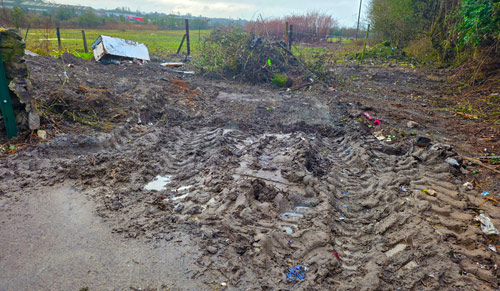
A recent abandoned attempt at cleaning the area.
Naturally, this could not be tolerated. So it became “connected”, “improved”, “enhanced”, “brought forward”, (whatever soothing verb local councillors, the local Municipal District Administrator and her officials would prefer), until all of it were “totally and wantonly obliterated”, its ancient hedgerows removed and the route flattened under heavy machinery, without so much as the courtesy of admitting what was being lost to the residents of our struggling town. Then, after much denial of its existence, with a straight face that would even shame a Victorian undertaker, it reappeared in planning language as being a “paved, pedestrian, walking route along a historical walking path”, despite being described by local councillors and politicians as not paved at all, before being levelled and left with only a temporary skin of tarmacadam.
And now we arrive at the masterpiece of their planning – “The Aftercare”.
Because nothing says “community amenity” like building a walkway and then abandoning it to rot, as if maintenance were an optional lifestyle choice, like decaf or seatbelts. The grand vision, a safe walking route on Mill Road, Thurles, tied into wider footpath plans, presented as “overdue” and “necessary”. The execution, however, appears to have followed the classic local-government model; do the ceremony; pour the tarmac; maximise the photocredit, then disappear vanishing into the mist.
So the area has now again begun its return to nature, that sacred Irish policy position otherwise known as “leaving it in a hape”. First came the willow saplings, same thrusting up through the tarmac like a botanical middle finger to uninterested municipal district officials, while rooting themselves into every crack that sheer neglect has kindly widened for them. Then arrived the briars and brambles, years of Autumn’s leaves, nettles and rank grass, all working in quiet co-operation like they’ve been awarded the contract. Soon enough, the walkway becomes less of a public route and more of a living demonstration of what happens when you build infrastructure with no real future plan to mind it, other than personal glorification.
And the litter, ah, the litter; not the dainty odd sweet-wrapper sort. No, this is the full rural-civic anthology, large plastic bags flapping like distressed flags; tyres slumped in the verge; broken wire fencing sagging like exhausted excuses. The occasional supermarket trolleys, thoughtfully dumped to ensure nobody confuses the place for cared-for land. If you’re lucky, a washing machine or two, because why wouldn’t you add white goods to a heritage corridor?
But the true flourish, the one that should make even the most hardened press-release writer blush, is how the site has been used as a stage for virtue, and then as a bin for its consequences.
In spring 2025, the area beside ‘Dun Muileann‘ on Mill Road, Thurles, became part of the One Hundred Million Trees planting push, funded locally by Allied Irish Banks’ Thurles branch, with students and the odd idle volunteer turning up to plant a dense mini-forest, using the Miyawaki Method; the whole point being fast-growing biodiversity and a carbon sink. The public reporting around it speaks of over two thousand native saplings planted at the site, a serious effort, and no small gesture of community buy-in.
And then, in the sort of anticlimax Ireland has successfully perfected; those young trees are left in a space now allowed to slide into total disorder, where over the past number of months horses are permitted to trample through the plantings that were meant to be protected long enough to establish themselves. A “green space”, promised and photographed, now reduced to a patch of scruff and horse manure, where the only thing thriving is the evidence of nobody being responsible.
That’s the moral of it, really, the fetish for the new, paired with the total inability to mind what’s then built.
Because it takes a special kind of civic arrogance to first flatten a famine-era landmark that once, literally, put bread into mouths, and then to shrug at the basic upkeep required to stop the replacement from becoming an overgrown dumping lane.
We are told, endlessly, about “heritage”, “biodiversity”, “active travel”, “community”. The words are always there; the maintenance however rarely is.
And so the Double Ditch, the real one, survives mostly as an idea: something that mattered, that was walkable, that carried memory in its stones. What’s left on the ground is the modern tribute: tarmac, blocked drains, weeds, rubbish, bent fencing, and the quiet certainty that nobody, supposedly in authority, will be held to account for any of it.
On behalf of myself, I offer my sincere apologies to Thurles Branch of AIB; (Sponsors), to MrRichard Mulcahy (Co-founder of the 100MT Project initiative) and to all those students who enthusiastically and eagerly took part in last April’s planting. Hopefully some of the trampled saplings will continue to survive, after all horse dung is a nutrient-rich organic fertilizer and soil conditioner.
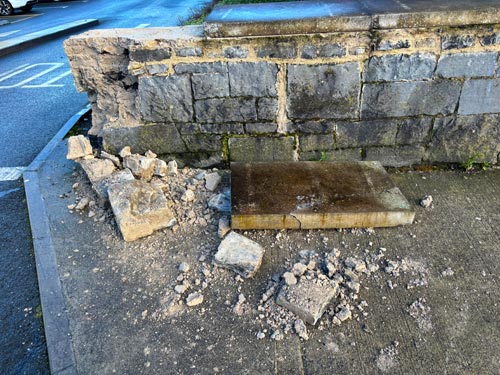
It started, as these things always do, with a local lad who had no reason to tell fibs, and every reason to be believed, because he said it with absolute conviction while pointing at the pile of rubble like he’d personally witnessed the fall of the ancient walls of Jericho.
“It was a pigeon,” he announced, solemn as a coroner. “Not your regular one either. Low-flying it was, doing eighty, like a feathery meteor.”
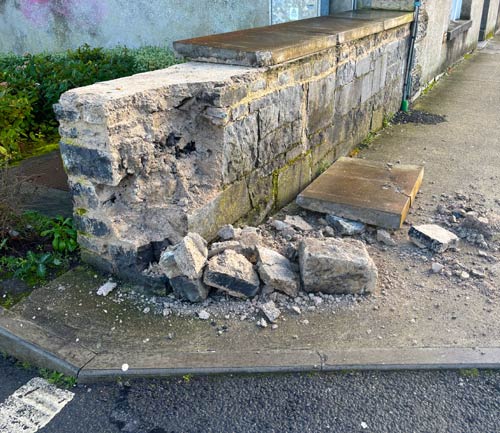
With the New Thurles Car Park entrance now widened, locals will also have noticed that the centre island/median at the mouth of the entrance has, for some time passed, also been demolished, leaving a cleaner, straighter run at the target.
Now, anyone with a bit of sense would have laughed, but the trouble was, the scene had the exact energy of a freak incident. The corner of the wall looked as if it had been clipped by something with intent. The slabs were splayed out like dominoes and there, faintly, on the remaining stone, was a dusty smear that could’ve been… anything. Cement, chalk, or, if you were inclined toward truth, pigeon ‘powder’.
The lad described it in detail, because once a man says “eighty,” he most certainly owes you a full reconstruction.
He’d been walking past with a breakfast roll, half thinking about nothing, when the air changed, that strange hush you get before something ridiculous happens. Then he heard it: a sound like a wet umbrella opening in a gale, followed by a “thwack” so crisp it could’ve been a cue in a slapstick film.
And out of the morning light came that pigeon; not flapping so much as committing to the air. Wings tucked. Head down. The posture of a creature that had made a decision and was seeing it through kamikaze style, consequences be damned. It skimmed the footpath at shin height, missing a drainpipe by inches, before striking the corner of the wall, with the confidence of something that had fully comprehensive insurance.
There was a split second of silence, then the wall gave a small, offended cough before the corner exploded. A puff of dust. A clatter of stone. Bits of dry mortar letting go. The slab on top shifted with a slow, dramatic slide, not fast, but certain, the way a decision, finally made, gathers momentum.
The pigeon, according to the lad, didn’t even look back. It hit, rebounded slightly, before landing on the path with a soft, insulting plop. It shook itself once, the way a dog shakes off rain, except this was more like a boxer loosening his shoulders after a solid clean punch, and then it waddled away. Yes, waddled. Not stumbled. Not fled. Not panicked. It waddled away with the leisurely swagger of a creature heading to a meeting that it was already late for, as if collapsing masonry was just part of its morning routine.
A split second of silence, then the wall gave a small, offended cough, before the corner exploded.
Our lad swore there was a moment of eye contact too, the pigeon looking at him with one eye, giving him that sideways judgement look, which sent a message; “You saw nothing”.
He tried, naturally, to tell people immediately. But you can’t just say “pigeon doing eighty” without consequences. The first person he told laughed so hard they nearly swallowed their Voopoo Vape. The second person said, “It was probably a van.” The third said, “That wall’s been in a bad way for years. Sure they forgot to add water to the cement”
And that was the thing, the wall had been in a bad way. Everyone knew it. Old stone, dry mortar, a corner that had taken a full two years of weather and knocks from the occasional careless wheelie bin. So the sceptics had an easy explanation. But the lad had his own, far more convincing logic, “A van would’ve left tyre marks,” he said. “A car would’ve stopped.”“A pigeon? A pigeon has no paperwork. No road tax, no NCT or comprehensive insurance details. No apology. It just flew off… gone.”
Soon the story grew legs, as stories do. Someone said the pigeon had been training, drafting behind Local Link buses, doing sprints off rooftops, building speed like an athlete. Another said it wasn’t a pigeon at all, others felt that this “grey blur,” was possibly a pigeon that had eaten something experimental behind a local chipper. A woman up the road claimed she’d seen a flock in formation earlier that week, flying like they were under command.
One fella, too confident by half, suggested it was an “urban falcon strike” until he was reminded falcons don’t waddle. And then, right when everyone had almost settled back into boring explanations, a child walked past, looked at the rubble and said: “That’s where the pigeon landed, isn’t it.” Because there, on the cleanest slab, plain as a signature, was a small white mark, ‘pigeon powder’. Not conclusive, not scientific, but deeply, spiritually… pigeonish.
By lunchtime today, the pigeon had become a local legend. People started blaming it for other things. A dent in their gate? (The pigeon). A missing wheelie bin? (The pigeon). A traffic cone mysteriously stuck up a tree? (The pigeon). A cracked phone screen? (Sure you know yourself). But our lad, he stayed firm, unwavering. “Eighty,” he’d repeat, as if defending a sworn statement. “Low-flying. Like a feathery meteor. It hit it and walked away.” He paused, then added the final detail, the one that made you almost believe him: “And the worst part is,” he said, “it looked disappointed the wall didn’t put up more of a fight.”
Pigeon or no pigeon, after today’s minor earthquake, the remaining wall line now matches neatly with the partially demolished left-hand side of the entry, giving the whole approach a more uniform look. In the spirit of getting it repaired properly, maybe it’s time to float a modest (and no doubt wildly popular) idea; another 5% on business rates ring-fenced specifically for repairs, which, no doubt would make this wall look like it was only built once, and had been actually done properly in the first instance.
This website uses cookies to improve your experience. We'll assume you're ok with this, but you can opt-out if you wish.AcceptRead More
Privacy & Cookies Policy
Privacy Overview
This website uses cookies to improve your experience while you navigate through the website. Out of these, the cookies that are categorized as necessary are stored on your browser as they are essential for the working of basic functionalities of the website. We also use third-party cookies that help us analyze and understand how you use this website. These cookies will be stored in your browser only with your consent. You also have the option to opt-out of these cookies. But opting out of some of these cookies may affect your browsing experience.
Necessary cookies are absolutely essential for the website to function properly. This category only includes cookies that ensures basic functionalities and security features of the website. These cookies do not store any personal information.
Any cookies that may not be particularly necessary for the website to function and is used specifically to collect user personal data via analytics, ads, other embedded contents are termed as non-necessary cookies. It is mandatory to procure user consent prior to running these cookies on your website.






Recent Comments