Archives

Man Remanded Following €8.1 Million Drugs Seizure In Nearby Co. Laois.

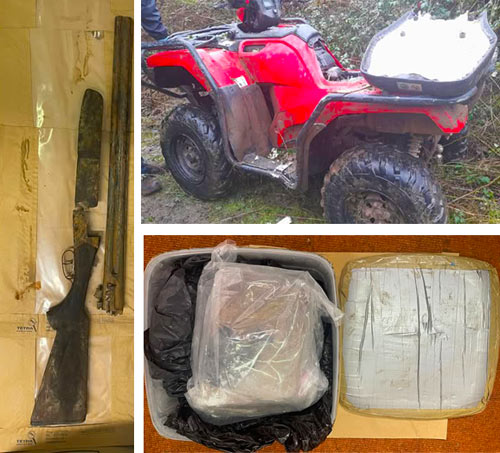
A man has been arrested following the seizure of more than €8 million (116 kilos) worth of suspected cocaine in Co Laois.

The discovery was made on October 28th 2025, during a planned search of a house and surrounding lands at Kilnaseer, south-west of Ballacolla, Co. Laois, as part of an operation targeting an organised crime group based in west Dublin.

Gardaí from the National Drugs and Organised Crime Bureau recovered 116kg of suspected cocaine hidden in nearby woodland, together with several electronic devices.

A man in his 30s was arrested and is being detained at a Laois garda station under anti-gang legislation.

Detective Chief Superintendent Séamus Boland (Head of the Garda National Drugs and Organised Crime Bureau), said gardaí remain committed to targeting those who collaborate with and facilitate organised crime and to disrupting drug trafficking routes into Ireland.

Separately, and earlier this year, in February 2025, drugs said to be worth more than 14 million euro were seized in Mountmellick, in the same county, and three men were arrested following yet another successful garda operation.
In last February’s seizure, approximately 182kg of cocaine and 4kg of cannabis herb was seized and in a follow-up search in west Dublin, approximately 17kg of cocaine was seized, together with 25,000 euro in cash.
Then the total estimated value of the drugs seized in Laois was more than 14 million euro.

Shortage Of Garda Staff At Thurles Station Raises Serious Concerns.

The staffing situation at Thurles Garda Station has been flagged by local people as being inadequate to meet the demands of the districts community. Thurles Garda station is indeed struggling from a lack of Garda manpower as our picture hereunder shows today, with Garda vehicles parked up due simply to the lack of Garda drivers.

A Rank of Garda Vehicles with no officers available to drive them.

In other areas we are aware from Oireachtas Data, that on some days of the week, there are only six Gardaí; (two in Newport-Killaloe, two in Nenagh on outside duty, and one or two in the Roscrea area), thus rendering the current situation in the north of Tipperary as being totally insufficient.
This leads to the obvious concerns now being raised by our local community, regarding response times and the ability of Gardaí to continue to provide a visible, reassuring presence in the now Thurles sub-district.

At national level Senior Gardaí are constantly reviewing the allocation of resources solely in the context of operational need, crime trends and policing demands, e.g, Dublin City centre, however, no specific timetable for additional deployment of Gardaí to the Thurles area has as yet been publicly communicated.

Implications for the area within the Thurles sub-district and the overall Tipperary community.

The shortage of Garda personnel has several practical implications:

  1. Fewer officers are available for community-based policing and visible patrols, thus undermining public confidence.
  2. Potential delays in response to incidents, especially in Tipperary’s rural hinterlands served by the Thurles sub-district.
  3. Administrative and procedural tasks (such as sign-offs for passport forms, motor-tax documentation) may become harder to obtain locally, increasing inconvenience for local citizens.
  4. The burden on those Gardai on duty greatly increases, with fewer officers available for proactive policing, referrals and outreach.

What is now needed?

  • A clear commitment is now required from the Department of Justice and the Garda Commissioners’ office, regarding the allocation of additional Gardaí to be deployed in Thurles and required in the districts rural outlying stations.
  • Enhanced support for community policing models that allow for proactive engagement, rather than purely reactive responses.
  • Transparent monitoring of whether the new operational model being rolled out in the Garda service will result in more boots on the ground in Thurles, not continuous reduced cover.

Conclusion:
The current staffing shortfall at Thurles Garda Station poses a legitimate concern for local residents especially the elderly. Without timely action to bolster numbers, there is a risk that both the visible policing presence and the capacity for community engagement will remain constrained.
As the Garda service progresses with reforms and new deployment models, ensuring that rural and regional stations like Thurles are adequately resourced remains a matter of extreme urgency.

I searched the available public databases [including the An Garda Síochána and the Oireachtas (Parliament PQ records)] for station-specific deployment figures (e.g. cars, drivers, shifts) for Thurles Garda Station, but could not locate any recent publicly-released data that details:-

  • the number of patrol vehicles assigned to Thurles Garda station;
  • the number of available drivers or officers authorised to drive same vehicles;
  • the shift-cover breakdown for drivers/vehicles at Garda station:

Next Question: Are all our salaried Public Representatives still on Summer Holidays or have they hibernated for the Winter?.

Cowardly Vandalism At Thurles TD’s Office Is To Be Condemned.

The office of Fianna Fáil TD Ryan O’Meara, situated in Thurles, have been vandalised sometime within the past 24 hours. The incident took place at his rented premises on the junction of Parnell Street and Cuchulain Road, latter a busy local landmark, better known as Hanafin’s Corner.

Office of Fianna Fáil TD Ryan O’Meara vandalised in Thurles.

This was not protest, nor was it political expression, it was pure vandalism. Whoever carried it out has shown nothing but disrespect for the local community and also for the democratic process.

Disagreeing with a public representative is one thing; attempting to intimidate or deface their workplace is quite another. Acts like this achieve nothing but division and damage the very tone of public life.

In a democracy, there are proper channels to voice frustration; through open debate, the ballot box, and community engagement. Resorting to mindless destruction is a coward’s substitute for reasoned argument.

No doubt local people will express shock and disappointment at the incident, and it is expected Gardaí will investigate. Those responsible should be ashamed of their actions, they have let down not only themselves but the town of Thurles as a whole.

Government Approval Granted To Progress Criminal Law Bill 2025.

Government gives approval to progress the Criminal Law (Sexual Offences, Domestic Violence and International Instruments) Bill 2025.

Bill will includes measures to:

  • Introduce ‘Jennie’s Law’ – a new publicly accessible Domestic Violence Register of Judgements managed by the Courts Service
  • Strengthen the law on sexual consent
  • Replace the term ‘child pornography’ in legislation with more appropriate term of ‘child sexual abuse material’

The Irish Government has approved the drafting of legislation to establish a publicly accessible Domestic Violence Register of Judgements, same to be published by the Courts Service. This new law will allow those convicted of domestic violence against a partner or former partner, to be publicly named on this Register of Judgements.

The General Scheme of the Criminal Law (Sexual Offences, Domestic Violence and International Instruments) Bill 2025 will also:

  • Strengthen the law on sexual consent.
  • Bolster our legislation on preventing and combating human trafficking;
  • Remove dual criminality in respect of certain offences including forced marriage; and
  • Replace references to “child pornography” with “child sexual abuse material” in legislation and in legal proceedings.

The General Scheme will now be referred to the Justice Committee for pre-legislative scrutiny and, when its report is received, work on finalising the Bill will be prioritised.

In practice, this means that when a person says they thought the other person had consented to sexual activity, this must be based on objective circumstances and not simply be the subjective belief of the accused. Under the new legislation this will apply not just to sexual intercourse but to all types of sexual activity between adults.

The proposed Register of Domestic Violence Judgements is a mechanism to facilitate publication of written judgments following conviction on indictment for serious offences relating to domestic violence, setting out details of the offence, the perpetrator, and other relevant information. Once issued, judgments will be published on the Courts Service website. The Court will retain the discretion to decide if a judgment should be delivered in a specific case, and the victim must provide their consent. The Register of Domestic Violence judgments will also signpost users to guidance on reporting domestic violence incidents and information on domestic violence supports.

In line with EU obligations and Council of Europe recommendations, the General Scheme also removes the requirement for dual criminality for sexual violence offences including rape, forced marriage, female genital mutilation and forced abortion and forced sterilisation. Until now, if such offences were committed abroad by an Irish citizen, they could not be prosecuted by the State unless this behaviour was also a crime in the place where it occurred.

The General Scheme can be read in full here: Criminal Law (Sexual Offences, Domestic Violence and International Instruments) Bill 2025.

EUAA To Assist With International Protection Appeals.

The EU Asylum Agency to assist the International Protection Appeals Tribunal with an increasing appeal caseload.

The European Union Agency for Asylum (EUAA) is an agency of the European Union mandated with supporting Member States in applying the package of EU laws that governs asylum, international protection and reception conditions, known as the Common European Asylum System (CEAS).

The EUAA Regulation allows Member States to request operational support from the Agency when their asylum or reception systems come under pressure.

Ireland has also opted into the relevant instruments of the Pact on Migration and Asylum and is benefiting from significant financial support under the Technical Support Instrument (TSI) to assist in the implementation of the Pact in June 2026.

The Irish government yesterday announced that Ireland has signed an Operational Plan with the European Union Agency for Asylum (EUAA) that aims to assist the International Protection Appeals Tribunal (IPAT) with processing appeals lodged against first instance decisions.

Ireland, like other EU Member States, saw an increase in applicants for international protection over the last years, with numbers increasing from 2,649 in 2021 to 18,561 in 2024. This increase has significantly impacted the appeal system, with around 15,929 cases pending appeal at the end of September 2025. In 2025, as of October 5th, 10,836 International Protection Appeals have been accepted.

This agreement with the EUAA for further supports is seen as a welcome addition and will help to speed up the decision timeframes in the Tribunal, ultimately resulting in reduced time frames for appeals.

Under the agreement, up to 30 EUAA personnel will be deployed to support the Tribunal’s work. This work includes preparing appeal files, conducting research on country-of-origin information and international protection jurisprudence, and providing interpretation in difficult-to-source languages.

The plan will be valid until December 31st 2026 and will allow the Tribunal to make best use of its resources while introducing new structures and processes required under the Pact.