Ireland’s minority Government today approved the text of the Health Regulation of Termination of Pregnancy Bill; same being the legislation that will give effect to the result of the Referendum on the Eighth Amendment of the Constitution which was held earlier this year. This bill is expected to be introduced and debated by all representatives in our Irish Parliment next week.
The present Minister for Health Mr Simon Harris has described today as a very important one for the women of Ireland, with the Government now acting on the instruction of the Irish people. This new legislation that will go before the Dáil next week will provide for access to abortion up to the 12th week of pregnancy.
Same new legislation will also provide for access to terminations in a case of where a mother’s life or health is at risk and where there is a diagnosis of a potentially fatal foetal abnormality. There will be a pause of just a 3 day period between the first meeting between patient and doctor and any future termination. Terminations are expected to be paid for at the taxpayers expense and free of charge to the patient.
It is expected that the Government is aiming to have this termination service in place and available on a national basis by the beginning of next year; following meetings with medical representative groups taking place over the coming weeks, latter who will argue on the future of such services and how will operate. There will also be a separate legislation enacted to introduce safe access zones to prevent women from being intimidated or harassed in the course of seeking such services.
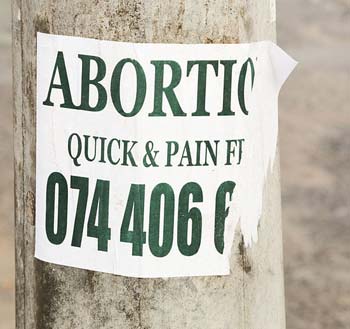
An abortion flyer in South Africa. – Courtesy wikipedia.org
However this present minority government have forgotten one small fact, namely Article 6 of our present Irish Constitution.
Article 6 of the Irish Constitution currently and unchanged to date, states: “All powers of Government, legislative, executive and judicial, derive under God from the people.” Thus this same unchanged as yet, Article 6 of the Irish Constitution currently debars the Dáil from passing laws authorising abortion, i.e., the killing of the unborn. Article 6 seem to have been somewhat overlooked in the rush by certain individuals to break the 5th commandment “Thou shalt not kill.”
The law of God which clearly states that “Thou shall not kill” , thus must surely prevail over Minister Simon Harris’s proposed abortion law. The present Government is therefore very mistaken in their thinking that the May 25th Referendum result, now grants them the right to legislate for abortion as proposed in Minister Harris’s general scheme of a Bill to Regulate Termination of Pregnancy.
Perhaps I am not making myself fully clear to all readers; so do allow me to further simplify my statement.
The people may be the supreme legislators in any Referendum to change the Constitution, but they, as well as our political leaders e.g. TD’s and Senators, are limited by what the Irish Constitution already states, regarding the source of parliamentary power. They cannot contradict or ignore what is said in the Irish Constitution’s preamble or introduction, which begins by stating that the Constitution is enacted “In the Name of the Most Holy Trinity, from Whom is all authority …” . Nor can they ignore what is said in Article 6 which states that “All powers of Government, legislative, executive and judicial, derive under God from the people.” (Scroll, if you will, down to Article 6.)
The words “under God” are significant. If God has said “Thou shalt not kill”, Simon Harris’s proposed law, which says that you may kill unborn babies, is therefore unconstitutional and beyond his or the Oireachtas’s legislative powers. Though many may be reluctant to accept it, the fact is that according to Article 6 of the Irish Constitution, the Oireachtas is not supreme, and the people who gave TDs and Senators their legislative powers are not supreme either. Only God is supreme, and he has given the Oireachtas no authority whatsoever to override the fifth commandment; “Thou shalt not kill”.
We as a nation may have recently paganised our laws by some 66.4% on the 25th of May last, by trying to delete the human right to life of the unborn, which the 8th Amendment previously acknowledged and protected, but until the people paganise our laws even more fully, by deleting the “Most Holy Trinity”, from the first sentence of the Irish Constitution’s introduction, and by deleting “God”, from Article 6; the Government and Oireachtas have absolutely no constitutional power, whatsoever, to legalise the killing of even one unborn baby by abortion.
“But, isn’t our Parliament Supreme”, I hear you all shout? The answer is simply “No”.
At one time, kings claimed a divine right to make whatever laws they wished. Nowadays democratic theory and most constitutions would say that the power to make laws comes to the legislature from the people. “Democracy” after all is the Greek word for “people power”. But are there limits to the powers the people may grant to their Parliament to make laws? Our minority Government seems to believe in the theory of absolute parliamentary supremacy, so that there is no higher authority to limit their authority to make any laws they wish.
Over a century ago, the ethician (a person who specializes in or writes on ethics or who is devoted to ethical principles), Sir Leslie Stephen, famously showed the absurdity of the theory of absolute parliamentary supremacy, explaining that; “If a legislature decided that all blue-eyed babies should be murdered, the preservation of blue-eyed babies would be illegal; … but legislators must go mad before they could pass such a law, and subjects be idiotic before they could submit to it.” [1] Now, you our readers, please substitute “unborn” for “blue-eyed” and Sir Leslie Stephen’s argument will still very much apply.
[1]Leslie Stephen, The Science of Ethics, (1882), p.145. In logic this argument is described as ‘reductio ad absurdum’, (Latin for “argument to absurdity”) or the appeal to extremes, is a form of argument that attempts either to disprove a statement by showing it inevitably leads to a ridiculous, absurd, or impractical conclusion, hence your argumentation is flawed. The surprise of many at the proposal to allow unrestricted abortion in the first 12 weeks, and their regarding of this as “going too far”, would be in line with this instinctive judgement of the absurdness of our Government’s proposed legislation.
Yet another problem with the theory of absolute parliamentary supremacy surfaced during the trials of the Nazi war criminals in Nuremberg during the years 1945-6. The Nazis claimed that what they did only what was authorised by German law, and in accordance with the theory of absolute parliamentary supremacy, this was a perfect defence. The Nuremberg courts, in deference to the Russian judges, who might be atheists, could not regard the Nazi atrocities as crimes against God, so they adopted the term “crimes against humanity” to justify finding the Nazis guilty.
Differently from many other constitutions, the Irish Constitution unashamedly admits that there is a God from whom all authority is derived, and whose laws are superior to human laws. Article 41.1.1º admits that there are “inalienable and imprescriptible rights, antecedent to and superior to all positive law.” The words “under God” were deliberately added in Article 6 to ensure that the Irish constitution would not be guilty of the absurdity to which the theory of absolute parliamentary supremacy leads. The Government and the Oireachtas do not have omnipotent power and influence, but are subject to the law of God.
The awkward fact for atheists, agnostics, the lapsed, and those in our Dáil, latter who haven’t bothered to read the Irish Constitution, is that those who did write it, and the majority who enacted it, back in 1937, for the most part actually believed in God and gave the Dáil no power to enact laws which are contrary to the law of God. When God said “Thou shalt not kill”, the consequence of Article 6 is that no Teachta Dála, no Seanadóir, no Judge, no Doctor and no Committee of Experts shall kill or authorise the killing of an innocent unborn child.
So, repealing the 8th Amendment has done only 66.4% of the project to introduce abortion to Ireland, and to complete the job of paganising our Irish Constitution; abortion advocates would need to take the words “under God” out of Article 6, and similarly delete the “Most Holy Trinity” and “our Divine Lord, Jesus Christ” from the Preamble. Until then, God remains in the Irish Constitution as a constitutional defence of an unborn child’s right to life, and Minister Simon Harris’s laws authorising abortion of the unborn are, I believe, totally unconstitutional.
Our present Government delayed the Referendum until after the Supreme Court had decided a case in which a Nigerian national had claimed a right not to be deported from Ireland, where he was an illegal immigrant, because of the rights of his unborn child. Judge Humphreys, in the High Court, agreed that there were constitutional rights of the unborn, in addition to the right contained in the 8th Amendment. The State appealed this to the Supreme Court, and the Government awaited the decision of the Supreme Court, before promoting the Referendum to repeal the Eighth. The Supreme Court obliged by overturning the High Court judgement, thereby, in the Government’s view, clearing the way for their intended abortion legislation.
But this is not so, and the way was not cleared, because the High Court decision, and the Supreme Court’s appeal decision, did not concern the constitutional rights of the unborn, if any, which were not dealt with in the Nigerian deportation case.
To sum up, Article 6 of the Irish Constitution still remains a major obstacle to proposed abortion legislation. In effect the Citizens’ Assembly, the Dáil Committee which implemented its findings, and Minister Simon Harris, both have been “firing blanks”, and while the latter blanks may contain gunpowder, projectiles have undoubtedly been found absent since 1937; by the Preamble and Article 6, both contained within our Irish Constitution.
Our RC Church leaders i.e. Bishops have remained silent in drawing attention to the Code of Canon Law, and Canon 1398 to be precise. Those involved in introducing abortion, [Latter word abortion which means the killing of the unborn any time from conception onwards], under the Code of Canon Law, are now automatically excommunicated from the church.
Canon 1398 States clearly; A person who actually procures an abortion, incurs a ‘latae sententiae’ excommunication. [‘latae sententiae’ means a penalty automatically incurred on the committing of such an offence, without the need for the intervention of any Judge or Superior to impose it.]
Finally our present minority Government, supported by Independents, have no money to provide houses for the homeless; no money to provide beds for those lying on trolleys; no money for painful degenerative spinal issues in children; no money for new and necessary pharmaceutical drugs; no money for mental health issues etc. etc. etc., the list is endless. But the irony of it all must be that we do have taxpayer funding for the provision of free abortions, and despite our decision to introduce said abortion, we will provide funding to investigate the scandal that is 796 dead babies found in a septic tank in Tuam Co. Galway, yet one other scandal that can be solely attributed to the lack of government supervision between 1925 and 1961; same being abortion yet again by another name.
 Twelve people in the Munster region are being interrogated this evening, as part of investigations into alleged child sexual abuse.
 The Minister for Finance has agreed to pay a former 44-year-old Tipperary hurling Captain, Garda Mr Aidan Flanagan, €1.16million following injuries suffered when he was kicked in his back, during the making of an arrest.




Recent Comments