Archives

Policeman Murdered On Liberty Square, Thurles.

It happened 100 years ago on Monday evening June 23rd, 1919.
Remember Ireland’s National Heritage Week 2019 begins August 17th – August 25th.

A centenary commemorative service will be held at 2.30pm on Saturday next, June 22nd 2019, in Passlands Cemetery, Monasterevin, Co Kildare. The service will be held at the graveside of District Inspector Michael Hunt, Royal Irish Constabulary, (55727 D.I., R.I.C.), killed while on duty in Thurles, Co. Tipperary one hundred years ago on Monday evening, June 23rd, 1919.

The Royal Irish Constabulary remained at the front line of the British government’s war against the IRA especially between 1919 and 1921. Policemen were targeted by the IRA while alone or sometimes when off duty. They were by far the highest number of crown force casualties, with more than 400 killed, almost double the number of army fatalities during the same period. The number of R.I.C. officers killed in Tipperary numbered 46 during the War of Independence; with the vast majority of them being Irishmen.

Some of those R.I.C. Officers killed in Tipperary included:-
Toomevara: Constable James Rocke aged 26 and Constable Charles Healy aged 25.
Rearcross / Newport: Constable William Finn aged 22 and Constable Daniel McCarthy aged 27.
Gooldscross / Clonoulty: Sergeant Patrick McDonnell
Tipperary: RIC Constable Michael Horan, Constable Joseph Daly aged 20, Constable Thomas Gallivan aged 20, Head Constable Christopher Davis aged 41, and Constable William Cummings aged 25.
Templemore: District Inspector William Harding Wilson.
Mullinahone: Constable William Campbell.
Ballylooby: District Inspector Gilbert Norman Potter aged 42.
Cloughjordan: Constable John Cantlon and Constable William Walsh, Constable Martin Feeney and Constable James Briggs.
Carrick-on-Suir: Constable Dennis Patrick O’Leary.
Soloheadbeg: Constable James McDonnell aged 50 years and Constable Patrick O’Connell.
Lorrha: Sergeant, Philip Brady
Thurles: Constable Luke Finnegan and District Inspector Michael Hunt.
Inch (The Ragg); Constable John Heany.

The then British Prime Minister David Lloyd George had emphasised that this same Irish conflict was for police to handle, supported by military personnel and not vice versa. It was logical therefore that members of the IRA should target armed police, in order to acquire necessary weapons.

This commemorative event on Saturday afternoon next will be followed by light refreshments; same to be served appropriately in a former R.I.C. Barracks, which today serves as the Monasterevin Local Community Centre.

District Inspector Michael Hunt

Born the son of a Co. Sligo father, Mr Martin Hunt, on September 3rd, 1873, Michael Hunt joined the Royal Irish Constabulary on January 2nd, 1893, serving in Co. Longford, Co. Kerry and later in Co. Tipperary.

He was married on May 16th, 1900, to Ms Kathleen Mary Bell, the daughter of Mr John Bell, Co. Kildare. They parented six children; with their eldest son, Michael John Hunt, going on to receive a commission in the Royal Irish Regiment; quickly to be promoted to the rank of Captain, before later joining the R.I.C. in his own right.

His younger sister Eva Hunt, aged 15 years, had passed away just seven months prior to her father’s murder. Buried in Thurles; her later erected small white marble headstone reads:- “In loving memory of Eva Hunt, daughter of the late Michael Hunt, (55727 D.I., R.I.C.) Thurles, died 27th Nov 1918, aged 15 years.”

It was on Monday June 23rd, 1919, one hundred years ago this coming week, that District Inspector (DI) Michael Hunt was murdered, as he carried out police duties during a Thurles Race meeting and while in the company of at least two other RIC officers.

Uniformed and walking near the top of Main Street, Thurles (Today renamed Liberty Square), at approximately 5.30pm in the evening, he was shot from the rear at very close range, the ammunition used – large calibre, blunt nosed revolver bullets.

Colleagues R.I.C officers Sergeant Joseph Grove and Constable Patrick Murphy, were both walking some yards ahead and on hearing the gun retorts, they rushed back to find Hunt’s prostrate form face down in the street, before lifting him to the safety of the footpath. Race goers and others, on witnessing the action, now in fear scattered in all directions, thus aiding his murderers to escape with ease into their midst.

Thurles doctor, Thomas Barry attended to District Inspector Hunt, however he was declared dead at the scene. His lifeless body was taken to the nearby home of a Mrs Scully. Further investigation showed that three shots had been fired, two of which achieved accuracy, with one shot severing two of the largest blood vessels in his body, directly causing him to bleed to death; while a third shot fired wounded a nearby child, named as Danny Maher, in the left kneecap. According to a local doctor’s statement to police, the injured 12-year-old boy was spotted soon after the initial mayhem had subsided. He was taken to the doctor’s house for treatment, before being allowed to go on his way.

At Monasterevin Railway Station, Hunt’s coffin was met by a party of constabulary colleagues together with his son, the aforementioned Captain Michael John Hunt (Royal Irish Regiment), latter who had journeyed from London to be in attendance.

Grave of
William Harding Wilson in Templemore.

The gun used in the murder had been brought to Thurles town from the area of Loughmore village; transported in a pony and trap and hidden under the clothing being worn by a baby. Some 20 soldiers with fixed bayonets were on duty at the race meeting and persons were being searched entering the town. At least two of the three shots were fired at close range, with the gun being fired through the pocket of an overcoat, possibly touching the District Inspector’s vertebrae.

Two days later at an inquest in Thurles, held on Wednesday, June 25th, 1919, it was revealed by witness Sergeant Joseph Grove, that a crowd had began to again collect around the dead man on the pavement. District Inspector William Harding Wilson asked if they offered assistance, to which the witness replied in the negative, further confirming that some of those who gathered were observed to be laughing and jeering.

The then Foreman of the Jury, after brief consultation with Jury members, stated that their majority verdict, was that Mr Hunt met his death in accordance with the reasons stated in the medical evidence put forward and that the bullet wounds were inflicted by a person or persons unknown.

District Inspector Wilson then enquired if the Jury did not confirm that it was “Wilful Murder”. The Foreman confirmed that the Jury were not unanimous. Inspector Wilson then declared that he couldn’t understand their hesitation regarding this case. In his opinion it was very clear that Mr Hunt had been shot twice in the back, in a position where he could not view his assailant. This to him was a case of wilful murder and he remained at a loss as to what other interpretation could be honestly construed.

Note: District Inspector William Harding Wilson would have a narrow escape himself in June 1920, when his head was grazed by bullets fired at an R.I.C. patrol, as they passed through the village of Templetouhy. On August 16th 1920 an IRA party was dispatched to Templemore to kill Wilson. At 6.45pm as Wilson was about to enter Templemore post office, he was shot once in the head from an adjoining lane way.

The epitaph on his headstone reads “In loving memory of my dear husband William Harding Wilson, District Inspector Royal Irish Constabulary. Died 16th August 1920 aged 56 years. His life for his country, his soul to God”

District Inspector Hunt was buried with full military honours, with his coffin covered in the Union Jack, in Passlands Cemetery, Monasterevin, Co. Kildare on June 26th, 1919. He was interred in the family burial plot of his wife, (nee Bell). Shots were fired over his grave.

On September 9th, of the same year, Hunt was posthumously awarded £5 for excellent police duty in connection with the successful suppression of a Sinn Fein meeting on Sunday May 25th, 1919 in Co Tipperary, latter which resulted in the arrest of the Sinn Fein MP for North Monaghan, Ernest Blythe.

Blythe was found to be in possession of an incriminating document, latter which contained instructions on how to intimidate police through terrorizing their known associates and next of kin. Blythe was convicted by a court-martial in Dublin and sentenced to 12 months imprisonment.

A Tipperary Court awarded £5,800 to the widow of Hunt, latter who had initiated a compensation claim amounting to £12,000. She successfully appealed against the sum awarded and at the Four Courts, Dublin, in March 1920 his widow and their full siblings were awarded £7,800 in final compensation.

Two first cousins Jim and Tommy Stapleton from Finnahy, Upperchurch and Jim Murphy (Latter known as “The Jennett”), from Curreeney, Kilcommon, would later be named as responsible for the killing of R.I.C. District Inspector Michael Hunt; named in a statement made by James Leahy, Commandant No.2 Irish Republican Army (I.R.A.) (Mid) Tipp-Brigade.

Jim Stapleton was also named for the aforementioned killing of District Inspector William Harding Wilson outside Templemore post office.

Unlike other military or civilian cataclysms, to date here in Ireland no single memorial now exists to remember all R.I.C. officers, latter killed in the line of what they saw as their duty. Perhaps Tipperary could now rectify this situation, thus allowing those, mostly young Irishmen who lost their lives, to be remembered by their relatives and indeed the public in general.

Cannabis Intercepted In Tipperary Bound Mail.

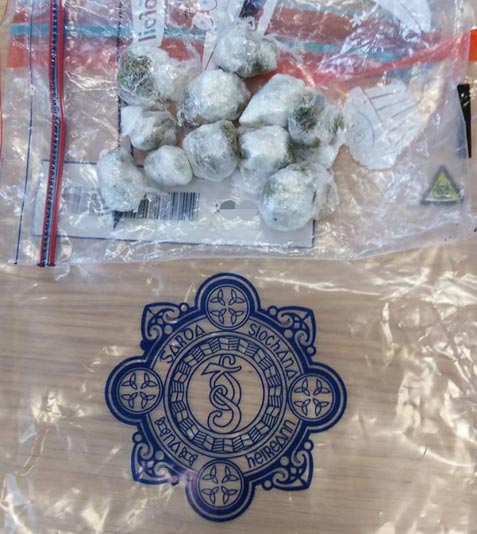
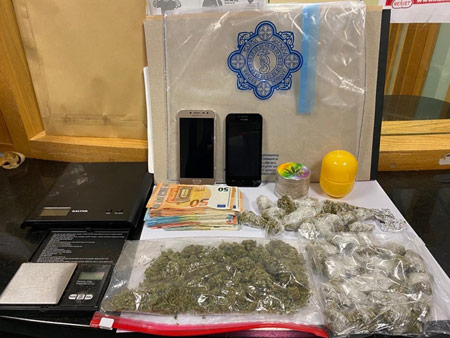
Customs Officers discovered over 3.4kgs worth of herbal cannabis at the Portlaoise Mail Centre, Clonminam Industrial Estate, Portlaoise, Co Laois, yesterday, with an estimated street value of some €68,000.

We understand that the drugs seized were found concealed in parcels labelled as “Herbal Tea” and “Yoga Cushions” and the parcels were destined for addresses in Co. Tipperary and Dublin.

Follow up investigations are expected to lead to prosecutions.

Tipperary Man Guilty Of Importing Illegal Firearms

Charges under Section 27A of the Firearms Act 1964 and the Criminal Justice Act of 2006, have resulted in a guilty verdict being found against a Tipperary man.

Mr Thomas Bates, No.51 Abbey Street, Cahir, Co. Tipperary, was found guilty of conspiring to possess an explosive substance, a firearm and ammunition. Same was uncovered following a joint operation by the FBI and An Garda Síochána investigating attempts made to access the aforementioned illegal items on the “Darknet”, (Darknet – A portion of the Internet purposefully not open / available to public view).

Following his conviction, Mr Bates has now been remanded in custody and is expected to be sentenced in July after he was convicted by a jury at Clonmel Circuit Court of the three charges between October 24th and November 10th 2017.

While found not guilty of the possession of ammunition on November 10th 2017, the two-week trial heard evidence from an FBI agent and a number of Gardaí which included members of the Special Detective Unit from Harcourt Square, Dublin.

The offences had been detected after an anonymous person with the online persona of Snow4, attempted via the darknet to purchase illegal items, namely a Glock pistol, a hand grenade and several rounds of ammunition. His activity was picked up by the FBI who contacted Gardaí. A delivery was then arranged to the address given by Snow4 and made via a Garda member posing as a postman to the address of Mr Bates under the name “Tim Bates”. Mr Thomas Bates was not Snow4.

Thomas Bates signed for three packages at 12.53pm on November 10th at his home and demonstrated no surprise when receiving the items. The accused informed the Garda / postman, that Tim Bates was his son and was currently hospitalised. There was in fact, in reality, no Tim Bates.

When Gardaí raided the house there was a fire lighting in the back garden and remnants of the packaging used in the delivery were located, while the items contained had been placed in a plastic bag near the gateway.

Messages were found from Snow4 stating “they landed bro, happy days, I’ll have them this evening,” and contained information that had to have come from an individual who had previously viewed the packages.

In Garda interviews following his arrest, Mr Bates had denied taking the delivery of any items or indeed starting a fire to destroy evidence.

One other accused, Mr Nigel Gartland aged 34, with an address at No.4 Knocklofty Heights, Clonmel, Co Tipperary was found not guilty by direction of Mr Justice Thomas Teehan.

Woman Cleared In Tipperary Murder Case.

A 48-year-old Latvian woman, Ms Inga Ozolina, who stated that her life had been made a living hell by her violent boyfriend and whom she had obtained safety orders against, has been cleared of his murder, but found guilty of his manslaughter.

Ms Ozolina, with an address at Old Court Church, Mountrath, Co Laois, had pleaded not guilty to murdering Lithuanian native Mr Audrius Pukas at ‘The Malthouse’, Roscrea, North Co. Tipperary, on November 20th 2016.

The Central Criminal Court heard that the 40-year-old father-of-two, Mr Audrius Pukas, had died at the scene from three stab wound, one of which had been administered to his chest, proving fatal.

The trial went on hear details of an often violent and volatile relationship between the couple, with photographs seen by the seven man / five women jury, containing injuries Mr Pukas had caused to Ms Ozolina, in that fatal fight, latter which included two bite marks to her arm. Witnesses gave evidence of seeing her in the past with various injuries.

The mother of two had sought an acquittal, on a number of grounds; including self defence and the possibility that her boyfriend had walked towards the knife she was holding while they were arguing.

The jury had begun their deliberations on Friday afternoon last and had spent just over 12 hours in the jury room trying to reach a unanimous verdict. Upon failure, however, they were then granted the option of reaching a majority decision, and returned a short time later, with a 10 to 2 majority verdict.

Mr Justice Alexander Owens refused an application for continuing bail and remanded Ms Ozolina in custody for sentencing on July 1st next.

IRA Leader Dies In Prison.

A ‘Real IRA’ leader, Mr Seamus McGrane, latter who plotted an explosion during the State visit of Prince Charles to Ireland, back in 2015, died yesterday in Portlaoise prison.

The 63-year-old Mr McGrane died from a suspected heart attack, while serving an 11-and-a-half year prison sentence for directing terrorism.

In 2015, Mr McGrane had been remanded in custody, to appear before a Saturday sitting of a non-jury Special Criminal Court, together with two other named individuals; Mr Donal Ó Coisdealbha (then aged 23) and Mr Dylan Cahill (then aged 22).

The latter, Mr Dylan Cahill, who held an address at No.102 Lower Irishtown, Clonmel, Co. Tipperary, was also charged with membership of an unlawful organisation, latter styling itself the Irish Republican Army (IRA), Oglaigh na hEireann.

Mr Cahill pleaded guilty to the possession of a .380 calibre Colt semi-automatic pistol and four rounds of .380 calibre ammunition at Sradrine, Glefarne, Co Leitrim on May 13th, 2015. He also pleaded guilty at the non-jury Special Criminal Court to the possession of two improvised explosive devices, or pipe-bombs, at the same place and on the same date.

Mr Cahill was sentenced to six years in jail with the final year suspended. A subsequent appeal of this sentence was later dismissed.

The Late Mr McGrane, was convicted of IRA membership back in 2017; becoming the second person, only, to be convicted for directing terrorism within the State; the other person being Mr Michael McKevitt, latter sentenced in 2003, to twenty years imprisonment.