If the Roads Around Cashel Fall Silent, Best Turn for Home.
If you find yourself out late around the town of Cashel, Co. Tipperary, take a bit of advice from the old people; go home before the road goes quiet.
Tourists especially beware, because according to the folklore of the Galtee country, there are worse things abroad at night than a Garda checkpoint or a missed Fish & Chipper.
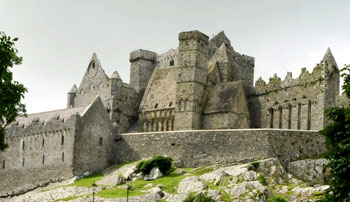
Rock of Cashel, Co. Tipperary.
Long before horror films discovered the headless horseman, Ireland already had the Dullahan, latter a charming individual who travelled the roads carrying his own head under his arm and announcing death wherever he stopped. No door lock kept him out. No gate latch held him back. The only known deterrent was gold, which feels very Irish altogether. Even supernatural evil respects inflation.
The most entertaining version of the tale comes from an old story called “The Good Woman”, collected by Thomas Crofton Croker in the nineteenth century. The story is set around the Galtee Mountains and Cashel, where a horse dealer named Larry Dodd makes the sort of decision that proves Irish folklore exists mainly to warn men against acting the maggot after dark.
Larry is riding home from Cashel one June evening after buying a horse. He’s feeling pleased with himself, no doubt after “just the one pint” that became several. Along the road he meets a mysterious cloaked woman walking alone at twilight.
Now, any sensible person in rural Ireland knows there are only three explanations for a woman silently appearing on a lonely road after sunset; a banshee, a fairy, trouble. Larry, unfortunately, ignores centuries of accumulated wisdom and offers her a lift. She says nothing. Climbs up behind him. Still says nothing, which, to be fair, should have been the first warning sign to any member of the male species.
Eventually the horse stops near the ruins of an old church. The woman slips down soundlessly and glides away across the graveyard. Larry, displaying the sort of judgement that has doomed Irish men since mythology began, chases after her looking for a kiss and catches her, only to discover she has no head.
At this point the story becomes considerably less romantic. Larry faints dead away and wakes among a gathering of Dullahans; headless ladies and gentlemen, soldiers, priests, musicians and skeletons tossing skulls around like hurling balls. Naturally enough, someone offers him a drink. Well this is still Ireland after all.
Things go poorly from there but eventually he escapes with his life, though not with his dignity, and his horse disappears entirely which may be the most authentically Irish ending imaginable. Survive supernatural terror if you like, but someone is still stealing the livestock.
So if you’re around Cashel late at night and happen to see a silent figure on the roadside, perhaps keep driving. Do not offer lifts. Do not flirt. And, absolutely do not follow mysterious women into ruined churches.
The old stories survive for a reason, and mainly because somebody ignored obvious warning signs and succeeded to live just long enough to warn the rest of us.
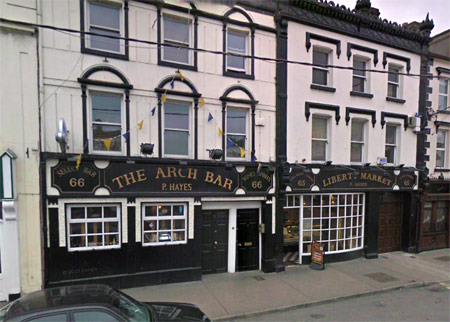
It was a damp Tuesday morning in Thurles when according to Mikey Ryan, he first heard whispers of “The Shed” in a conversation overheard in the Arch Bar. From his evesdropping he learned that this was not just any shed, no, this was “THE Shed”; a €127,000 monument to human ambition; a bicycle sanctuary if you will; a stainless-steel Cathedral to two-wheeled transportation, and a structure so majestic that local lads had begun referring to it as “The Taj Ma-Cycle.”
Mikey, using his Charlie Haughey granted free travel pass, was soon to be seen standing outside University Hospital Kerry with a chicken fillet roll in one hand and existential rage in the other.
“Sweet suffering Jaysus,” he was heard to mutter, staring up at it. “For that money they could’ve built a second hospital, or at least fixed the machine in SuperValu that keeps robbing me Clubcard points.”
The bike shed shimmered in the Kerry drizzle like a spaceship designed by accountants. A gust of wind blew dramatically through Tralee town as elderly pensioners, nurses, and one confused German tourist gathered around hospital trollies, gawked in stunned silence.
“They say,” whispered young Paudie who had journeyed down with Mikey for free, having declared himself to be an Independent Travel Support assistants, “that there’s heated bolts in it.” “Heated bolts?” said Mikey. “Heated Bolts” replied Paudie sounding like an echo. Mikey nearly fainted into a nearby puddle.
Meanwhile, inside the Dáil, panic spread quickly among the Shinners and the Peoples Before Profit Liberation Army; the announcement moving faster than free pints at an Irish wake. The Public Accounts Committee had declared the bike shed “extravagant,” which in Irish political language is only one level below “Ah now lads, come on seriously.”
Opposition politicians stormed corridors, led by Molly Loo, some carrying folders, spreadsheets, and previously unopened copies of “Value For Money For Dummies”. One TD dramatically slapped a photograph of the shed onto a desk. “This,” he roared, “is no longer infrastructure. This is performance art.” The controversy would soon echo the wider political fallout from the infamous Dáil bike shed saga at Leinster House, where a bicycle shelter costing more than €330,000, triggered a national debate on public procurement, value for money, and as suggested by a Tipperary Labour Deputy, should itself be classified as another UNESCO World Heritage Site.
Politicians now clutched spreadsheets like rosary beads, while ordinary citizens stared into the middle distance, calculating how many breakfast rolls, semi-detached houses, or actual bicycles could have been bought instead. At one point, rumours spread that the shelter included heated seating, mood lighting, and a part-time Sommelier (Latter a trained, knowledgeable wine professional), necessary for assisting exhausted civil servants arriving on electric scooters.
Meanwhile, the HSE defended the project. “It’s a long-term investment,” they insisted. “Long term” barked Mikey now back in Thurles, and seated on his couch watching RTÉ. “For €127,000 that bike shed should be curing gout and baptising children.”
Rumours spiralled wildly across Kerry. Some claimed the shed had underfloor heating. Others insisted it had held its own Eircode, three civil servants, the Healy Brothers and full diplomatic immunity. One woman swore she saw Michael Flatley emerge from it, days earlier, and at dawn surrounded in a cloud of dry ice.
Mikey Ryan was determined to uncover the truth. The next morning after a quick pint in The Arch Bar in Liberty Square, Thurles and armed only with a hi-vis Uisce Éireann jacket that he found in the boot of his cousin’s Corolla; then with the confidence of a man who once argued with a parking meter for forty minutes, he headed to Kerry to infiltrate the actual site. Inside, silence, stillness and bicycles, just normal bicycles, including a rusty Halford’s mountain bike stood, fitted with a child’s seat covered in rainwater. Another bike stood without any cycle lock; one wheel missing entirely, so it wouldn’t be stolen.
Mikey stared in disbelief. “That’s it?” he gasped. “There’s only bikes in it? I thought there’d at least be a butler.” Suddenly, a motion sensor light flicked on overhead with the drama of a Hollywood premiere. Mikey froze. The shed hummed softly around him. And then, suddenly Mikey understood. This wasn’t a bike shed anymore. No, it was a facsimile of Ireland itself; overpriced; overcomplicated; mysteriously damp and somehow still held together with zip ties and taxpayer goodwill.
A single tear rolled down Mikey Ryan’s cheek. Then he looked at the polished steel beams one last time and whispered: “Wouldn’t it be grand if they put in a coffee dock though.”
And somewhere deep in Leinster House, another civil servant was quietly ordering a €94,000 umbrella stand.
There are many great engineering feats across the world. The Pyramids. The Great Wall of China. The Hoover Dam. And now, proudly joining that list… The Invisible Night-Time Car-Destroying Humps of Liberty Square, Thurles car park.
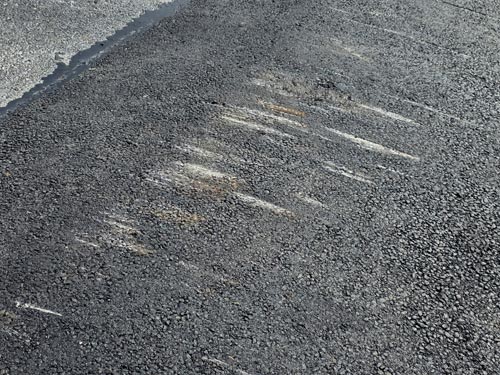
Yes, nestled in the thriving town of Thurles; a place known for its culture, history, and increasingly, its ability to test a car’s suspension beyond factory specifications; two magnificent road humps have been installed in the new car park situated south of Liberty Square. Not just any humps. Extremely high humps.The kind that don’t slow traffic; they redefine it.
Picture the scene. It’s dark. You’re driving home. All is calm. Then suddenly, BANG. Yes you’ve just discovered one of Thurles’ newest attractions; “Guess Where the Hump Is.” No reflective paint. No triangular hazard markings. No “hazard teeth.” Not even a polite hint. Just raw, unfiltered suspense. In fact, the lack of proper road markings is not even new to the area, concerns have previously been raised that road markings around Liberty Square are confusing and unsafe. But why stop at confusing when you can go full invisible ambush?
Vehicle Undercarriage Adjustment Programme, (V.U.A.P.). Locals report that cars are now receiving what engineers are calling: “Unscheduled structural realignment.” Others might call it: “The exhaust is now optional.” Between these humps and existing road issues, Thurles is quietly becoming Ireland’s leading centre for :- Suspension stress testing; Shock absorber retirement schemes, and spontaneous undercarriage redesign. And if you think that’s dramatic consider this: Tipperary has already seen over €50,000 paid out in compensation for pothole-related vehicle damage in recent years.
So clearly, the strategy is evolving; If potholes don’t finish the job, the humps will. While Thurles boldly pioneers the construction of Everest-sized speed ramps, meanwhile, the Potholes Live On. Oh, the potholes are heritage sites now. Protected. Preserved. Possibly getting listed. Residents have long complained about roads in poor condition, with some routes described as “full of potholes” and “very poor” , and even “deplorable” in broader Tipperary reports.
But filling them? Ah no, sure that would be reckless. Why eliminate a pothole when you can simply install a hump nearby and let drivers experience both?
It’s about balance. Engineering Brilliance (Or Something Like It), so let’s admire the process:-
Build two extremely aggressive road humps ✔️
Forget the hazard markings ✔️
Leave them practically invisible at night ✔️
Place them where unsuspecting drivers will absolutely hit them ✔️
This is not a mistake. This is performance art. A bold statement on modern infrastructure. A physical metaphor for life in Thurles: “You won’t see the problem… until it hits you.”
Final Thought:- Add a scoreboard; Give out prizes for best airborne moment, and rebrand the car park as: “Liberty Square Adventure Zone”.
Today, Sunday 15th March 2026, is Mother’s Day in Ireland, and that feels especially fitting for a nod to the legendary “Irish Mammy” energy Brendan Grace made so memorable; the woman who could find your lost jumper, your manners, and your future all in one sentence. So let us begin by honouring the queens of the side-eye, the guardians of “Were you raised in a barn?”, and the fearless women who could heal any illness with tea, toast and a threat.
Mothers don’t just bring us into the world; they spend the rest of their lives asking why we went out without a coat and whether we’ve thanked them properly for the privilege.
The Irish Mother.
And as we close, let’s raise a cup of tea, hide the good biscuits, and salute the women who somehow managed to keep the whole show on the road, while making it look like we were the hard work.
Happy Mother’s Day to every mammy, mum, mother, and maternal legend, may your compliments be plentiful, your feet be up for at least ten minutes, and may nobody dare say “What’s for dinner?” unless they’re the one cooking it.
ESB Networks Under Pressure to Explain Smart Meter Failure and Full Extent of Data Error.
ESB Networks is facing mounting pressure to provide a full and transparent account of how an internal software failure was allowed to generate grossly inaccurate smart meter readings for customers across Ireland, triggering alarm, confusion and serious questions about oversight, safeguards and accountability. The company has confirmed that a planned software upgrade carried out last Friday led to some electricity usage data being processed incorrectly, resulting in highly inflated figures appearing on customer accounts and supplier platforms.
You may check your ‘not so smart’ reading HERE, if you can trust the system.
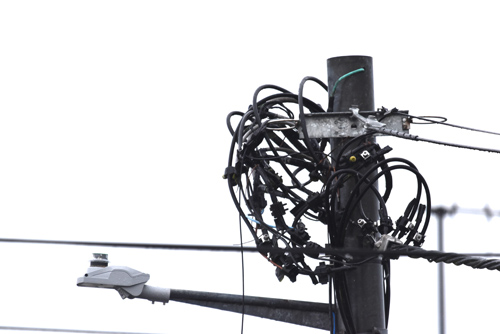
Emotionally overwhelmed eletric wiring on display located at Ikerrin Road Thurles, Co. Tipperary. “Behold sky spaghetti”. Somewhere inside that knot is one cable doing all the work. Pic: G.Willoughby.
While ESB Networks has apologised for the “confusion and concern” caused, the seriousness of the incident goes far beyond inconvenience. Customers reported seeing apparent one-day electricity costs rise to extraordinary levels, in some cases hundreds or even thousands of euro, with usage figures so extreme that they should have been immediately recognised as impossible, by any functioning validation system. Reports included daily costs of €738 and €2,500; figures that have prompted widespread disbelief and anger.
The incident has exposed what appears to be a major failure in internal controls. If abnormal readings of that scale were able to pass through ESB Networks’ systems and appear on customer-facing accounts, it raises unavoidable questions about the adequacy of testing, monitoring and escalation procedures surrounding critical software changes. A planned upgrade to a nationally significant metering system should not have been capable of producing such obviously absurd outcomes without immediate containment. That it did so points to a deeply troubling lapse in operational assurance.
Perhaps most damaging is the lack of clarity over duration. ESB Networks has identified the trigger as last Friday’s software upgrade, but there is still no full public explanation of how long the issue remained live, when it was first detected internally, how many customers were affected, or whether warning signs emerged before the problem became visible to the public. In the absence of that detail, there is every reason for customers to ask whether this issue was caught promptly at all, or whether it only gained urgency once consumers began highlighting impossible charges online.
ESB Networks has insisted that the issue is internal, that smart meters themselves remain reliable, and that affected data will be corrected automatically with no action required from customers. But reassurance alone is unlikely to restore confidence. With smart meters intended to deliver accuracy, transparency and trust, this episode represents a significant reputational failure. ESB Networks must now do more than fix the numbers; it must explain, in full, how this happened, how long it persisted, and why customers were left to discover the problem before the system did.
This website uses cookies to improve your experience. We'll assume you're ok with this, but you can opt-out if you wish.AcceptRead More
Privacy & Cookies Policy
Privacy Overview
This website uses cookies to improve your experience while you navigate through the website. Out of these, the cookies that are categorized as necessary are stored on your browser as they are essential for the working of basic functionalities of the website. We also use third-party cookies that help us analyze and understand how you use this website. These cookies will be stored in your browser only with your consent. You also have the option to opt-out of these cookies. But opting out of some of these cookies may affect your browsing experience.
Necessary cookies are absolutely essential for the website to function properly. This category only includes cookies that ensures basic functionalities and security features of the website. These cookies do not store any personal information.
Any cookies that may not be particularly necessary for the website to function and is used specifically to collect user personal data via analytics, ads, other embedded contents are termed as non-necessary cookies. It is mandatory to procure user consent prior to running these cookies on your website.




Recent Comments