|
|
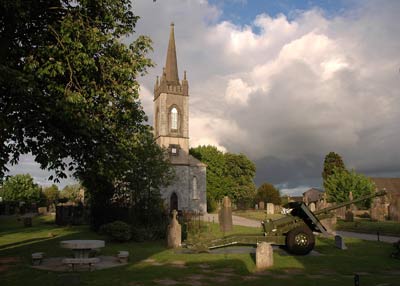 St. Mary’s Famine Museum, Thurles. Tipperary. Primary Source Education, readily available here in Thurles to students attending Primary, Secondary and Third Level educational facilities nationally, has received a huge boost this week, due to being highlighted by Irish TV.
As many Tipperary people are aware, Irish TV’s media programmes now highlight local daily happenings here in Co. Tipperary and elsewhere; broadcasting to a wide global audience.
These programmes generate interest in our county; encouraging tourists to visit, while keeping our forced emigrants, both past and more recent, up to date with regard to everyday happenings in and around our Premier County.
One of the many venues visited this month, by Irish TV’s popular programme presenter Miss Fiona O’Sullivan, was the popular Thurles tourist visitor attraction St.Mary’s Famine Museum here in Thurles.
To view Irish TV’s latest Tipperary video broadcast, please click Here. (Use the Seek Bar Slider on the bottom time line of the video to slide to 12.56 minutes to view the St Mary’s Famine museum section of the programme.)
A big ‘Thank You’ to Irish historian Monsignor Dr Maurice Dooley, Tipperary / Thurles Co. Councillor Seamus Hanafin and Museum Guide Stewart Willoughby for taking part in this video and of course to Thurles AV Star Systems, for their skilled photography, presentation and superb editing of this their latest Sky 191 TV production.
 Thurles Halloween Festival 2014 Tipperary Councillor Jim Ryan, Chairperson of the Thurles Halloween Arts Festival 2014 reports.
The 7th annual Thurles week-long Halloween Arts Festival begins in 7 days time from October 24th to October 31st 2014 inclusive.
Once again this year there is a wonderful festival line up, with some of the best national and international acts (All now fully confirmed) performing in our midst this year.
A continued policy of Thurles community participation is very much evident once again and with so many different forms of ‘The Arts’ taking place here in Thurles this year, both local and an anticipated large turnout of visiting public will most definitely find something for each and everyone, in this year’s diverse programme of major events.
Daily Programme of Events for Thurles Halloween Arts Festival 2014
Friday 24th October
ART – “Art Exhibition.” VENUE: Cabragh Wetlands. TIME: Each Day of the Festival period – 10.00am to 5.00pm. ADMISSION: Free of Charge.
Exhibition by Artist Michael Fogarty whose work is mainly inspired by the Irish countryside. Artist will be in residence each afternoon during the festival.
BOOK LAUNCH – “Rights of Succession.” VENUE: Cabragh Wetlands. TIME: 7.00pm. ADMISSION: Free of Charge.
The book, a tale of early 19th century family intrigue by author Michael Fogarty will see the author on hand to sign copies of his new book.
DRAMA – “In Acting Shakespeare” – Written by and starring James DeVita. VENUE: Source Arts Centre. TIME: 8.00pm. ADMISSION: €18/€16 (concession).
“In Acting Shakespeare” expect a funny, touching and uplifting story of one man’s discovery of Shakespeare, acting and language. This is a show for anyone interested in Shakespeare or theatre. The show is followed by Q&A session with James DeVita.
Music – “Whistle This,” VENUE: Bowes Pub. TIME: 9.30pm. ADMISSION: Free of Charge.
A night of culture and music with some of the Premier County’s finest singer song writers, poets and musicians in an intimate atmosphere.
MUSIC – “CLEM O’ BRIEN BLUEGRASS BAND.” VENUE: Bowes Pub. TIME: 10.00pm. ADMISSION: Free of Charge.
Truly one of Ireland’s finest Bluegrass musicians, Clem O’Brien; brings his unique band to Thurles for a special performance not to be missed.
Saturday 25th October
MUSIC, FOOD & CRAFT – “SCARE IN THE SQUARE.” VENUE: Liberty Square. TIME: 12.00 noon to 4.00pm. ADMISSION: Free of Charge.
Come join us for live music, food & craft stalls, Street Entertainment, Funfair Rides and much more, as we transform Liberty square into a Halloween “Scare in the Square,” occasion. Note: This year we will be having a Halloween Scarecrow Trail around Thurles town. With the help of ‘Thurles Mens Shed’; over 25 Scarecrows will be put on display around the streets of Thurles during the duration of this years festival. We hope to grow this into a major event going forward and we hope you enjoy the creative skills of the volunteers who created these pieces of scary art.
LITERATURE – “Poetry in the Making.” VENUE: Source Arts Centre. TIME: 3.00pm to 5.00pm. ADMISSION: €20.00.
This poetry workshop, run by poet Enda Wyley, is suitable for emerging poets. It aims to celebrate the power of poetry and the making of it. Participants will be encouraged to create new work of their own and to enjoy poetry by established poets, including the work of Thurles poet Dennis O’Driscoll. (Limited capacity – early booking advised. Please book directly through the Box Office on 0504/90204.)
LITERATURE – “A Public Interview with John Kelly.” VENUE: Source Arts Centre. TIME: 7.00pm. ADMISSION: €10.00.
In memory of Thurles poet Dennis O’Driscoll. For many years John Kelly has been at the forefront of music and arts broadcasting in Ireland. Having presented ‘The View’ on RTÉ television for 12 seasons, and assorted programmes for BBC NI before that, John now heads up RTÉ Television’s brand new arts show ‘The Works.’ Known for his wide-ranging knowledge of music he has also presented some of the best-loved and most critically acclaimed music programmes on the Irish airwaves. From his shows on the BBC to the legendary ‘Eclectic Ballroom’ on Today FM and the award-winning ‘Mystery Train’ on RTÉ1, he has always put the music first. He currently broadcasts the ‘John Kelly Ensemble’ on RTÉ Lyric FM and ‘Radio Clash’ on RTÉ Digital Radio 2XM.
WORKSHOP – “Halloween Art and Craft Workshop.” VENUE: Bookworm, Parnell Street, Thurles. TIME: 11.00am – 5.00pm. ADMISSION: €5.00 per person.
Get in the Halloween spirit, come and get creative; experience the make construction of some Halloween arts and crafts. Each workshops begin on the hour and last for 50 minutes. Note: Please book in advance – Tel: 0504/22257.
COMEDY – “TOM O’ MAHONY & GUESTS.” VENUE: County Bar, Liberty Square. TIME: 10.00pm sharp. ADMISSION: Free of Charge.
Dubbed by the critics as a ‘Bad-ass of Irish comedy’ Tom starred alongside the legendary and late, great Rik Mayall on RTE’s hit comedy Damo & Ivor in 2013 and made his return in Season 2 (alongside Snatch’s Alan Ford) reprising his role as the intolerable toff ‘Tarquin.’ A finalist in RTE’s 2013 New Comedy Awards, this lad has starred in several TV adverts, (typically playing someone you wouldn’t like). In 2014 Tom played support to Nina Conti at the Cork Opera House and also Police Academy’s Michael Winslow on a nationwide tour. Playing the country’s biggest festivals, Tom supported the brilliant Stewart Francis at this year’s Vodafone Comedy Festival in Dublin. This year saw another sell-out solo show of Tom’s, “Bring on The Apocalypse” in theatres nationwide and at the Edinburgh Fringe. Tom has a weekly radio slot on Spin103.8 entitled “Mantime,” where he discusses the failings of modern blokes and how they can redeem themselves (There are a lot of stanley-knives and hammers).
Sunday 26th October
TOURS & TALKS – “Cabragh Wetlands Trust Open Day.” VENUE: Cabragh Wetlands. TIME: 11.00am to 4.00pm. ADMISSION: Free of Charge.
Cabragh Wetlands invite the public of Thurles and Tipperary to an all day open event. There will be a ‘Walk and Talk’ at 11.30am which will be repeated at 2.30pm, led by volunteers and environmental experts. Find out about their work in conservation and education, and their plans for the future. Take this opportunity to view their exciting new building, have a guided walk around the wetlands or wander around at your own pace, see what they do and join them for a cup of tea. All are welcome.
MUSIC – “Flamenco Guitarist John Walsh.” VENUE: Anner Hotel. TIME: 4.00pm. ADMISSION: €5.00.
John Walsh is Ireland’s leading Flamenco Guitarist and an accomplished musician and composer, performing solo since 2006. Along with performing concerts throughout Ireland together with venues in Spain and the UK, he has performed in one of the most historically important flamenco venue’s ‘El Candela’ in Madrid, as well as being the invited International Artist for the 2014 Flamenco Festival “Flamenco de Consuegra”.
MUSIC – “THE TIPPERARY JUNIOR CHAMBER ORCHESTRA.” VENUE: St Mary’s Church, Thurles. TIME: 8.00pm. ADMISSION: €10.00.
PARTY– “FANCY DRESS PARTY.” VENUE: Thurles Rugby Club. TIME: 10.00pm till Late. ADMISSION: €15.00.
Thurles Rugby Club presents its annual Halloween Fancy Dress Party with live music and disco. This event is one of the highlights of the year in Thurles and we would encourage those attending to purchase your ticket as early as possible to avoid disappointment. Tickets available from Hickey’s Pub or any Rugby Club Member.
Monday 27th October
FAMILY SHOW – “Halloween Trick or Treat Party.” VENUE: Anner Hotel. TIME: 2.30pm to 4.30pm. ADMISSION: €5.00 per child & €2.00 per adult.
This annual children’s party returns with all the usual favourites. Dress up in your favourite Halloween costume and let your child enjoy a wonderful and safe spooky party. Event includes: Party food and drink, Party music & games, Barney, Bob the Builder, Peppa Pig and Friends show, Magic show, Balloon Modelling and Face painting.
Tuesday 28th October
WRITERS – “A Writers Covert.” VENUE: Anner Hotel. TIME: 8.00pm. ADMISSION: Free of Charge
Writers from across Tipperary’s many regular writing groups will get together to read their own compositions and well-known writers works. This event is open to the general public, so do feel free to bring along your own work and join in. Note: Refreshments will be served.
WORKSHOP – “Pumpkin Carving and Painting.” VENUE: Bookworm, Parnell Street, Thurles. TIME: 2.00pm to 3.00pm. ADMISSION: €5 per person. Note: Pumpkins will be provided. Please book in advance – Tel: 0504/22257.
WW1 COMMEMORATION – “Ecumenical Thurles WW1 Memorial Service of Remembrance.” VENUE: St Mary’s Church, Thurles. TIME: 7.30pm. ADMISSION: Free of Charge, however a collection will be made during the Service with proceeds going to the St Mary’s War Museum. (Latter presently under re-construction and due to be reopened as a local tourist attraction on May 1st 2015 next.)
The Great War of 1914-1918 was so terrible and inflicted such large numbers of casualties on all sides that when it was over it was believed by many to be “The War to end all Wars”. Alas, by the end of four years of fighting from August 1914 to November 1918 many thousands of families around the world including some 72 households from Thurles were affected by this tragedy, through the wounding or loss of life of at least one of their family members.
The ceremony will begin with the naming of all 72 known Thurles WW1 soldiers who lost their lives.
Church music for this event is being provided by renowned local pianist M/s Mary Rose McNally, with special guests; music composer and much-loved Folk Singer M/s Nora Fogarty and Retd and former Aide de camp to H.E. the President of Ireland and Co Galway native, Commandant Michael Walsh, latter who will also give the commemorative address.
The remembrance service will be conducted in St Mary’s Church by the Rector Rev. Ian Coulter and will be followed by a rare display of local primary source artefacts pertinent to Tipperary participants in this Great War of 1914-1918 .
Continue reading Week Long Thurles Halloween Arts Festival
“If anybody steals a horse, blame it on the Kelly’s. If anybody breaks the law, blame it on the Kelly’s.
Anyone does something new, or does what you would like to do, cause if the troopers don’t know who, blame it on the Kelly’s.”
The ruined home of infamous and controversial Tipperary / Australian bushranger Ned (Edward) Kelly, containing two rooms, has been sold at auction to a private buyer in Australia.
The property, situated at Beveride some 60km north of Melbourne in rural Australia and which today is little more than a stone and wood ruin was built by the late outlaw’s Co Tipperary born father, John ‘Red’ Kelly in 1859 and occupied by his family until 1864.
The property sold for €445,000 (Aus$640,000) at auction just last weekend to a nearby family who fell passionately in love with the irreplaceable ruin and its immediate surroundings and look forward to the day when it can be refurbished. The National Trust of Australia has pledged to help the new owners maintain the heritage-listed ruin, which has not been occupied since the Kelly’s moved out in 1864.
The single storey cottage was originally built by Ned Kelly’s father using materials he scavenged from the surrounding bushland and was added to the Victorian Heritage Register in 1992, offering the building and site the equivalent of an Irish Preservation Order.
In 2013 over 40 members of the Kelly clan, including a number of the outlaw’s immediate descendants, gathered in Moyglass, here in Co Tipperary which had long been identified as the true John ‘Red’ Kelly ancestral home, prior to his being transported as a convict to Tasmania in 1841, at the age of 22 years; his crime the stealing of two pigs in nearby Ballysheehan, Co Tipperary.
His son Ned Kelly was hanged for murder on November 11th 1880 at the age of 25 years, some 133 years ago at Melbourne jail. Three years ago, in 2011, Ned’s remains were exhumed by a special licence granted to his living relatives and he was identified using DNA analysis, after which his remains were returned to his family. A statement later from the Kelly family said that they wanted his burial to be in keeping with the bushranger’s last wish before his execution in 1880; that he then be buried in consecrated ground with only his family in attendance in order to ensure a private, respectful and dignified funeral.
In a statement, the family have detailed Ned Kelly’s third letter to the Governor, written the day before his execution, pleading for the release of his mother Ellen from prison. It also tells of Ned’s last meeting with his mother prior to his own execution. “Mind you die like a Kelly, Ned,” she had warned her first-born son and third born child.
The location of Ned Kelly’s skull is still today shrouded in mystery, having been stolen from an Old Melbourne Gaol display case in 1978.
One of the first Victoria Crosses ever won by an Irishman will be auctioned in London on Friday next (September 19th 2014) by medal auctioneers and valuers DNW (Dix Noonan Webb) of Bolton St, Mayfair, London. The VC for auction, the British Army’s highest honour for bravery, was awarded to the Cashel, Co Tipperary, born Stephen Garvin in 1857, during the Indian Mutiny, latter a 19th-century rebellion against British rule in India.
The Victoria Cross medal is the highest military honour to be awarded in the world and a medal which has always been awarded regardless of an individuals class, religious creed or colour. Indeed when Queen Victoria first instituted the Victoria Cross first in 1856 she essentially wanted it to be an award “Trifling in intrinsic value, but shall be highly prized and eagerly sought after.” This small medal, often referred to as “The little Cross of Bronze,” manufactured from the bronze of two Russian cannon captured at Sevastopol during the Crimean War, soon was to become the world’s most prized gallantry award.
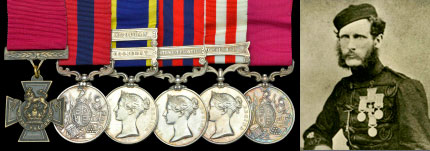
Stephen Garvin VC, Cashel, Co Tipperary
Stephen Garvin was born in Cashel here in County Tipperary, Ireland, in 1826 and originally enlisted in the 74th Regiment first in 1842. Later he transferring to the 60th Rifles, seeing action in the Punjab campaign of 1848-49 and in operations on the North-West Frontier in 1849-50. He was serving in India when the Mutiny broke out in 1857 and was one of those men of the 60th who found the mutilated bodies of two comrades and the corpse of a popular Englishwoman, all of whom who had been killed by the mutineers.
A Colour-Sergeant in the 60th Rifles, Stephen Garvin was regarded as one of the great heroes of Victorian Britain, also winning the Distinguished Conduct Medal and was the most highly decorated non-commissioned soldier to emerge from this conflict. He was personally presented with the VC at an investiture in Windsor Home Park by Queen Victoria herself, when he returned to England in 1860.
Garvin was awarded his Victoria Cross following a deed which took place on 23rd June 1857 at Delhi, India.
His citation reads; “For daring and gallant conduct before Delhi on the 23rd of June, 1857, in volunteering to lead a small party of men, under a heavy fire, to the ” Sammy House,” for the purpose of dislodging a number of the Enemy in position there, who kept up a destructive fire on the advanced battery of heavy guns, in which, after a sharp contest, he succeeded.”
Stephen Garvin left the army in 1865 and was later appointed a Yeoman of the Guard. He moved to Cambridge, where he died in 1874 aged 48, just months after the deaths of his second wife Mary and baby daughter Sophia. The three of them remain buried together in St Andrew’s Churchyard, Chesterton, Cambridge.
The London sale of Stephen Garvin’s six medals, brought to the market by a private collector, are expected to reach a possible sale price of some €175,000.
Of course Stephen Garvin was not the only Tipperary VC winner present in India at this time. William Bradshaw VC (12th February 1830 – 9th March 1861), born here in Thurles, County Tipperary, was also an Irish recipient of the Victoria Cross. He served during the Crimean War in the 50th Regiment of Foot, transferring latter to the 90th Regiment of Foot.
William Bradshaw VC, Thurles, Co Tipperary
William Bradshaw was 27 years old and an assistant surgeon in the 90th Regiment (later known as ‘The Cameroonians’ (Scottish Rifles)), of the British Army during the Indian Mutiny when the following deed took place at Lucknow, India, and for which he himself was awarded the VC.
Assistant-Surgeon William Bradshaw carried out his act of bravery on 26th September, 1857.
His citation reads; “For intrepidity and good conduct when, ordered with Surgeon Home, 90th Regiment, to remove the wounded men left behind the column that forced its way into the Residency of Lucknow, on the 26th September, 1857. The dooly (A light litter (stretcher) suspended from men’s shoulders, for the carrying of persons.) bearers had left the doolies, but by great exertions and notwithstanding the close proximity of the sepoys (Private Soldier), Surgeon Home, and Assistant-Surgeon Bradshaw got some of the bearers together and Assistant-Surgeon Bradshaw with about twenty doolies, becoming separated from the rest of the party, succeeded in reaching the Residency in safety by the river bank.”
William Bradshaw died on March 9th 1861 and is buried in St Mary’s Church graveyard, here in Thurles, with a memorial to be found within the church itself. His Victoria Cross is displayed at the Army Medical Services Museum in Aldershot, Hampshire England.
In all 30 Irish Victoria Crosses (VC) were awarded during the Crimean War with 59 Irish VC’s awarded during the Indian Mutiny. Some 46 Irish VC’s were awarded in numerous other British Empire campaigns between the years 1857 to 1914 followed by 37 Irish VC’s awarded during World War I and eight Irish VC’s awarded during World War II. Latter therefore represents a very large number of VC’s being awarded to Irish military born personnel, especially when you understand that in the 158 years since it was first instituted, only 1356 VC’s are understood to have ever been awarded in total.
Celebrating Ireland’s International Best Selling Historical Crime Mystery Series.
The 5th three-day gathering of international enthusiasts of the best-selling historical crime series “The Sister Fidelma Mysteries,” by Peter Tremayne will be held in The Cashel Palace Hotel, Cashel, Co Tipperary from Friday 12th to Sunday 14th September 2014.
The series, which has been published in some 18 languages to date, is set in 7th century Ireland, whose sleuthing heroine is Fidelma, sister of King Colgú of Munster. With her companion, a Saxon, Brother Eadulf, she is an advocate of the Brehon Laws of old Ireland. There are now 25 books in this series.
The event will be extra special as it will coincide with the twentieth anniversary of the publication of the first ever Sister Fidelma novel entitled “Absolution by Murder” published in 1994.
Online registration is now open. You may pay in Euro or dollars. Full registration is €160 or US$225. This fee covers the opening reception on Friday evening, a registration pack, three days of talks, an outing to Coolmore Stud Farm to accompany a talk on the horse breeds in Fidelma’s day, tea/coffee breaks and of course the Saturday evening gala dinner with Peter Tremayne and guests.
Day registration is also available, which will include the three lectures and tea/coffee break at €30 per day and €40 if a visit to Coolmore Stud Farm is also to be included.
Please Note: There is limited availability to Coolmore Stud Farm for day registration.
Féile Fidelma 2014 Community Programme of Events
Friday, September 12th 2014
From 18.00-19.00: Registration at The Cashel Palace Hotel.
19.00: Reception by the Mayor of Cashel.
19.30 Official Opening of Féile Fidelma Weekend 2014.
20.00 An Evening with Peter Tremayne.
This will be followed by an informal session in the Cellar Bar.
Saturday, September 13th 2014
09.30: The Sister Fidelma Novels: Professor Edward Rielly, Maine, U.S.A..
10.30: Coffee Break.
11.00: What was in Sr. Fidelma’s Liber Hymnorum?: Dr. Ann Buckley, T.C.D..
12.00: Horses in Fidelma’s Day: Mr. Noel Mullins, equestrian expert.
14.30: Visit Coolmore Stud Farm, the centre of bloodstock breeding in Ireland.
19.30: Gala Dinner in The Cashel Palace Hotel featuring Caroline Lennon (The Voice of Fidelma) who will read passages from the Sr. Fidelma Series.
Click here to download the Gala Dinner Menu
Sunday, September 14th 2014
09.30: Food in Fidelma’s time: Regina Sexton, U.C.C..
10.30: Coffee Break.
11.00: The Eóghanacht: Professor Pádraig Ó Riain, U.C.C..
12.00: David Robert Wooten, founder of the International Society.
13.00: Conclusion of Féile Fidelma Weekend 2014.
Distinguished Speakers
Professor Edward Rielly from Maine, USA, who was co-editor, with David Robert Wooten, of the academic study “The Sister Fidelma Mysteries”: The Historical Novels of Peter Tremayne (2012). Rielly is Professor of English at Saint Joseph’s College of Maine in the U.S.A.
Professor Pádraig Ó Riain is Ireland’s leading scholastic expert of the Fidelma’s period. Ó Riain is an Irish Celticist and prominent hagiologist focusing on Irish hagiography, martyrdom, mythology, onomastics and codicology. He has spent much of his academic life at the University College Cork, where he became a lecturer in 1964 and was professor of Old and Middle Irish. He has been a member of the Royal Irish Academy since 1989, president of the Irish Texts Society since 1992, Parnell Fellow at Magdalene College, Cambridge, since 2002 and more recently, a member of the ‘Place Names Commission of Ireland,’ (Irish: An Coimisiún Logainmneacha).
Dr Ann Buckley is a leading expert on liturgical music in Fidelma’s time. Buckley holds a B.Mus., M.A. (National University of Ireland), doctoral (University of Amsterdam) and a Ph.D. (University of Cambridge) and is a research associate at the Centre for Medieval and Renaissance Studies, Trinity College, Dublin.
Regina Sexton from University College Cork, who is a food historian, food writer, broadcaster and cook. Sexton has been researching and publishing in the area of Irish food and culinary history since 1993. Her research interests include food and identity, food and tradition and food in the Irish country house. She has published widely at academic and popular levels and is a leading expert on food in Fidelma’s time.
Noel Mullins is an equestrian expert. Mullins has not only authored two books about the origin of horses in Ireland, countless articles in equestrian journals, but he is also an expert advising and appearing in many films and television shows on the subject. In 2005, for example, he played a huntsman in the remake of ‘Lassie’ with Peter O’Toole.
David Robert Wooten is the founder of The International Sister Fidelma Society, its director and editor of its thrice yearly journal The Brehon. Wooten will be introducing and chairing the first evening with the author, Peter Tremayne. He will also be winding up the event on Sunday with his usual look at the state of Fidelma’s World. He will be reflecting on the Society’s thirteen years of existence (it was founded in 2001 and The Brehon was launched in February, 2002). And, of course, he will be examining the Féile Fidelma past and present and future.
Caroline Lennon is the actress acclaimed as the ever popular ‘Voice of Fidelma,’ and who reads the Sister Fidelma Audio Books published by Soundings, Isis Publishing Ltd.
So please do note your calendar to experience this truly most enjoyable of annual events.
Book Your Tickets: http://www.cashelartsfest.com/content/Buy-Tickets.html
Date: Friday 12th until Sunday 14th September
Venue: Cashel Palace Hotel, Cashel, Co. Tipperary
Cost: €160.00
|
Support Us Help keep Thurles.info online by donating below. Thank you.
Total Donated 2026: €300.00
Thank You!
Daily Thurles Mass Livestream
|



Recent Comments