|
|
Today, the 17th of May 2016, marks the 42nd anniversary of the Dublin and Monaghan bombings in 1974.
Four devices exploded in both counties, taking the lives of 33 civilians and a full-term unborn child, while injuring almost 300 other innocent civilians; whose only crime was being in the vicinity.
In Dublin city three car bombs were detonated without warning, during rush hour on the 17th of May 1974, and shortly afterwards another bomb was exploded in Monaghan, some ninety minutes later.
Here in Co. Tipperary, today in particular, we remember two victims of this outrage; namely M/s Breda Turner and Maureen Shields.
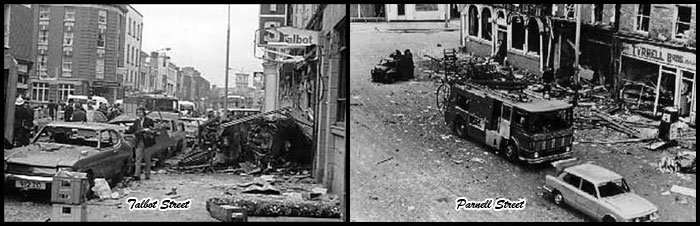
Miss Breda Turner aged just 21 was working in the Office of the Revenue Commissioners, the primary State Body responsible for the assessment and collection of Taxes and other Duties here in the Republic of Ireland. Originally from Thurles, in Co. Tipperary, she had moved to Dublin and was engaged to be married on the following Easter.
Murdered in the Parnell Street explosion; M/s Turner was then survived by her parents, Bridget (Biddy) and Jimmy, together with other siblings.
Mrs Maureen Shields aged 46 was originally from the village of Hollyford, Co. Tipperary. Maureen had moved to Dublin, where she also worked in the Civil Service until her marriage to Leo in 1953. The couple had one son and two daughters.
Maureen was murdered in the Talbot Street explosion.
At this time of remembrance, let us not forget the Tipperary victim of the Dublin bombing of the 1st of December 1972.
Mr George Bradshaw, aged just 30, was a bus conductor from Fethard, in Co. Tipperary, one of two male victims who died when a car bomb exploded at Sackville Place at approximately 8.15pm on that fateful day. Both victims were bus drivers with CIE and brutally murdered, having just left the nearby CIÉ Workers’ Club.
Mr Bradshaw had only moved to Dublin less than two years previously. Married to wife Kathleen, a nurse from Belfast; both were parents to two young children, Lynn and Rory.
While these Dublin and Monaghan crimes in 1974 were the biggest mass murder in the history of the Irish state, no one person has ever been charged with these bombings. The Ulster Volunteer Force (UVF), a loyalist paramilitary group from Northern Ireland, claimed responsibility for the bombings in 1993.
Former Northern Ireland Police Ombudsman, Baroness Nuala O’Loan, found that Special Branch officers gave the killers immunity and officers ensured that the murderers were never caught.
Ar dheis Dé go raibh a anam dílis.
“A Badly Wanted Man: The Story of Sean Hogan” by Tom Hurley.
 Sean Hogan (1921) There will no doubt be much interest generated in the Premier County and further afield in an upcoming four-part documentary due to be aired on Tipp Mid West Radio, which investigates the life of IRA freedom fighter Sean Hogan, a native of Stokaun, Greenane, situated just outside of Tipperary Town, in Co. Tipperary.
Sean Hogan first gained notoriety as a teenager from his role in the Soloheadbeg and Knocklong engagements of 1919. He went on to become one of the most wanted men in the British Empire for the duration of this Irish revolutionary period. Hogan together with Dan Breen, Sean Treacy and Seamus Robinson made up what was known as “The Big Four”, and participated in numerous other IRA engagements, which will be highlighted in this radio broadcast.
When the civil war ended in 1923 Sean Hogan did his best to re-adjust to some sort of normal life, but at times down through the years found this exceedingly difficult to achieve. Possible reasons for this are examined in detail in these broadcasts, along with a look at his time spent in America; jail; later family life; vices, and the circumstances behind his death in 1968.
The programmes, which chronicle his whole life, also reflect on the reasons behind his move to live to the Leinster area; querying why he never in later years provided a written account of his revolutionary activities, as did so many of his former comrades. These radio broadcasts will conclude with a look at his legacy and how he is regarded in his native county today.
His life story is investigated and revealed through incorporating material taken from newspaper accounts; parish records; census records, together with genealogical documentation and interviews recorded in his native county and further afield.
Contributors to the programmes include his son Sean Hogan (Jnr); his grandson Treacy Hogan; historians John Connors (Borrisoleigh), Tom Toomey (Limerick) and Sean Hogan (Puckane). There are also interviews with Aileen Sweeney (a descendant of one of the RIC men killed at Soloheadbeg); Anne Power (Tipperary Town); Cormac O’Malley (son of Ernie O’Malley) and Micheál Martin (Cork).
Overall there is a lot of new information contained in these programmes and light is shed on the lasting effects that involvement in the independence struggle had on many of the leading participants.
The four-part documentary entitled “A Badly Wanted Man: The Story of Sean Hogan” by Tom Hurley will be aired at 11.05am on May 16th, 17th, 18th & 19th on Tipp Mid West Radio.
The programmes can also be heard on www.tippmidwestradio.com (Listen Live).
Hannah Sheehy Skeffington – Loughmore Mill, Loughmore, Templemore, Thurles, Co. Tipperary.
A State commemoration ceremony for Francis Sheehy Skeffington and journalists Thomas Dickson and Patrick McIntyre, all who were executed together in Portobello Barracks (today known as Cathal Brugha Barracks), in Rathmines, Dublin, was held recently on the 26th April of this year.
It is however possibly less well known that Hanna Sheehy (1877-1946 & wife of Francis Sheehy Skeffington) lived and received her early education at Loughmore, Thurles, Co. Tipperary, at the end of the 19th century. This historic occurrence, today, closely connects the now presently inactive Loughmore Corn and Wool Tucking Mill, with this same unfortunate April 26th 1916 event.
 Pictured L-R: (A) (L-R) Msgr. Dr. Maurice Dooley, with mill proprietors Tom, Geraldine & Tomás Larkin. (B) Existing partial interior of Sheehy’s original Mill, soon to be restored. (C) Hanna Sheehy’s original residence, as seen today. About 1878 David Sheehy (Hanna Sheehy’s father), his wife Bessie (née McCoy), and their eldest child Hanna, came to live; renting the Mill in Loughmore. David was born in County Limerick and attended the Irish College, studying for the priesthood, in Paris with his older brother, Eugene,[*1] latter known as the ‘Land League Priest‘ and also one of Éamon de Valera’s teachers. However he (David), was sent home from Paris during an outbreak of cholera, there in 1866. On his return home he became implicated in the ill-fated Rising of 1867, after which he fled the country, going to sea. After a few years he returned home and ran a mill at Kilmallock and later at Kanturk, before renting the mill at Loughmore around 1878. It was while in Kanturk that he married Bessie McCoy,[*2] who was from the region of Ballyhahill, in Co. Limerick.
[*1] In 1886 Fr Eugene Sheehy was C.C. of Kilmallock, Co. Limerick and later P.P. of Bruff. He resigned in 1909 because he had gotten into trouble with his bishop, Dr Edward Thomas O’Dwyer. He went to live with the Sheehy’s who were then living in Dublin. He was jailed in Kilmainham with Charles Stewart Parnell. He died in 1917 and is buried in Glasnevin cemetery.
[*2] Bessie’s sister Kate was Mrs Kate Barry of Barry’s Hotel, Dublin.
David and Bessie went on to have seven children, six of whom were born in the village of Loughmore, Thurles, Co Tipperary. Before the end of the century the whole family had moved to No 2. Belvedere Place, Dublin. David became Secretary to the Irish Parliamentary Party and an M.P. for Meath and later for South Galway; a post he held until the Sinn Féin landslide of 1913. James Joyce, a student at the nearby Belvedere College was a regular visitor to No 2. Belvedere Place, in 1896-1897 and he nursed a secret love for Hanna’s sister Mary, who was later married to Irish economist, journalist, barrister, writer, poet, soldier and Home Rule politician Tom Michael Kettle. Bessie died in 1917 and David around 1932/33, at the age of 86.
Before moving to Loughmore, his eldest daughter Hanna Sheehy had been born 3 years earlier in Kanturk, North Co. Cork, on the 24th May 1877.
The text hereunder is reproduced from an old newspaper clipping from the year 1938.
Continue reading Tipperary – The Hannah Sheehy Skeffington Connection
Ireland’s Ancient East Tourism Region
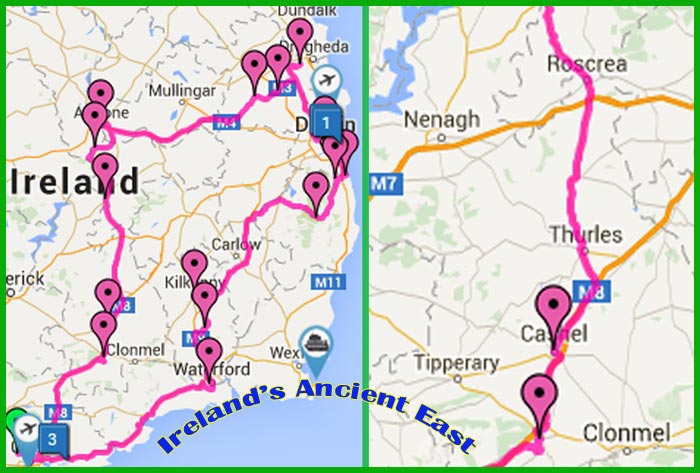
The Map below shows the Route expected to be taken by some extra 600,000 overseas visitors, by the year 2020, thus increasing revenue in this Eastern Tourism Region by almost 25%, or an estimated €950m. Well that’s according to the spin from outgoing Tourism Minister Mr Paschal Donohoe, TD, but do read on as your rural future may very soon depend on it.
“View Ireland’s Ancient East Map Route.
Fáilte Ireland
Firstly we should understand that Fáilte Ireland is Ireland’s National Tourism Development Authority. Their role is to support Ireland’s tourism industry and work to support and maintain all of our beautiful green island equally as a high-quality, attractive, tourism destination. Their work is to support / provide a range of practical business supports to help tourism services to better manage, market and grow already existing services, while working closely with other state agencies and representative bodies to encouraging further value added products.
They are required to promote the island of Ireland fully as a holiday destination, through domestic and overseas marketing (See DiscoverIreland.ie), while managing / financing, a network of nationwide tourist information centres, offering advice to those on holiday.
Ireland’s Ancient East
Ireland’s Ancient East is best described as a “Touring Region,” as opposed to a “Route,” like the “Wild Atlantic Way”. This new cultural and heritage trail stretches in circular motion from the Boyne Valley in the north-east, down through the midland of Meath & Tipperary, and east & south through Wicklow, Kilkenny, Carlow, Wexford & Waterford; eventually ending up in Cork city.
To-date only projects funded by the Office of Public Works (OPW) are seen as worthy of inclusion on this touring route in Fáilte Ireland’s marketing efforts. Private and non nationally funded, but nevertheless, attractive tourism enterprises are deemed not worthy of real note in attracting the visitor.
Continue reading Imagine Visiting Disney Land To Find No Mickey Mouse
Local correspondent Mr Gerry Bowe kindly sends us the following report:-
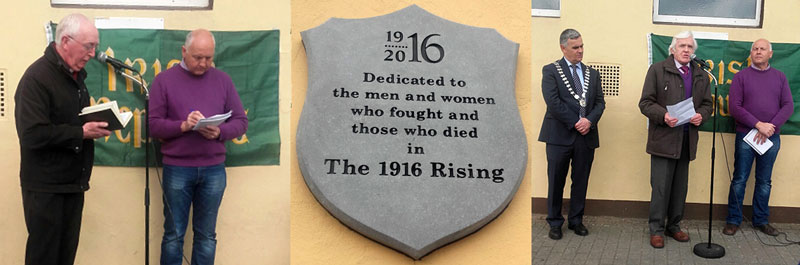
A plaque dedicated to the men and women who fought and those who died in ‘The 1916 Rising’ was officially unveiled at the ‘Munitir na Tire’ (National Organisation Promoting Community Development in Ireland) Hall, Littleton on Saturday last, April 23rd 2016, by Mr Seamus Hanafin, (Councillor & Cathaoirleach, Tipperary County Council).
Mr Gerard Neville, (Sean Treacy Pipe Band), gave his rendition of music, on bagpipes, of all relevant music relating to the history of 1916.
Mr David Brown officially welcomed guests; Mr Hanafin (MCC), and Rev.Fr. George Bourke, Rev.Fr.Joe Tynan (Local Priests) and the many others from the local community, who were in attendance for the unveiling.
Mr Brown formally invited Mr Hanafin to officially unveil the 1916 Plaque, following which Mr Hanafin gave a very interesting and inspiring talk on 1916 and the Irish Proclamation.
The newly unveiled plaque was commissioned to honour the sixteen Patriots who were executed after the 1916 rising, together with the brave men and women who fought and those who died during this troubled period in our Irish history. It is especially dedicated to all those from Co. Tipperary or with Tipperary connections who died; those who fought and those who were ready to fight and later went on to give their lives for freedom and independence in later years, which we as Irish people enjoy today.
Fr. Bourke then read prayers in both Irish and English; blessing the Plaque and recited that wonderful poem; now a hymn; “I see His Blood upon the rose” by executed Irish nationalist, poet, journalist, leader of the 1916 Easter Rising, and signatory of the 1916 Irish Proclamation (Easter Proclamation), Joseph Mary Plunkett.
It should be noted that following the surrender in 1916, Joseph Mary Plunkett, aged 28, was held in Kilmainham Gaol, where he faced a court martial. Seven hours before his execution by firing squad, he was married in the prison chapel to his sweetheart Grace Gifford. Grace’s sister, Muriel, was married to Thomas MacDonagh, a native of Cloughjordan, Co. Tipperary and Joseph Plunkett’s best friend; former who was also executed for his role in the Easter Rising.
Mr Brown then introduced M/s Tara O’Brien who gave her rendition, on Concertina, of “The Foggy Dew” and Mr Micheál Treacy who recited “Who fears to speak of Easter week ?”. Mr Paddy Lambe then sang “The Foggy Dew.”
Mr Brown thanked the organisers and those who took part in the unveiling ceremony.
‘Amhrán na bhFiann’ (‘The Soldiers’ Song’, Irish National Anthem) was sung by all in attendance, accompanied by Mr Gerard Neville on Bagpipes.
|
Support Us Help keep Thurles.info online by donating below. Thank you.
Total Donated 2026: €300.00
Thank You!
Daily Thurles Mass Livestream
|



Recent Comments