|
|
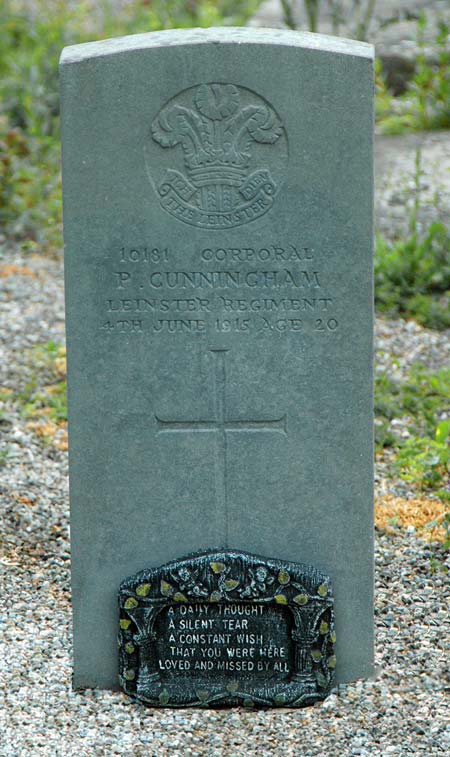 Resting place of Corporal Patrick Cunningham, younger brother of Thurles born Corporal John Cunningham, latter honoured by His Royal Highness, Charles (Prince of Wales) and his wife Camilla (Duchess of Cornwall) in Glasnevin Cemetery, Dublin today. He Ain’t Heavy, He’s My Brother
“The road is long, with many a winding turn
That leads us to who knows where, who knows where,
But I’m strong, strong enough to carry him,
He ain’t heavy, he’s my brother”.
(Lyrics – Bobby Scott and Bob Russell.)
His Royal Highness, Charles (Prince of Wales), unknowingly, just got a little bit closer to his ancestral home of Thurles, today (May 12th, 2017), when he unveiled and paused before a memorial paving stone, dedicated to Corporal John Cunningham, while at Glasnevin Cemetery in Dublin.
Prince Charles and his wife Camilla (Duchess of Cornwall), were taking part in a ceremony to unveil remembrance stones to World War I Irish-born Victoria Cross recipients (1917) – namely Company Sergeant Major Robert Hill Hanna (Kilkeel, Co. Down & Canada); Lieutenant Frederick Maurice Watson Harvey (Wanderers & Ireland Rugby player, Athboy, Co Meath & Canada); Private Michael James O’Rourke (Kildimo, Co. Limerick & Canada) and the aforementioned Corporal John Cunningham (Thurles, Co. Tipperary).
Corporal John Cunningham VC.
Son of Joseph Cunningham and Johanna Smith, natives of Stradavoher, Thurles, Co. Tipperary; Corporal Cunningham was born on October 22nd, 1890 in Thurles and died on April 16th, 1917, at the age of 26 years, while a member of the 2nd Battalion, Prince of Wales’s Leinster Regiment fighting in Barlin, Pas-de-Calais, Nord-Pas-de-Calais, in France.
An Irish recipient of the Victoria Cross, [VC. (without Bar)]; latter the highest and most prestigious award given to British and Commonwealth forces, for gallantry in the face of the enemy; Corporal Cunningham today is buried in Barlin cemetery, Pas de Calais, France, (Plot 1, Row A, Grave 39).
Perhaps the outstanding bravery carried out by Corporal John Cunningham on that fateful day in April 1917, may have been partially influenced by the loss of his brother Corporal Patrick Cunningham, also a member of the Leinster Regiment, who tragically lost his life some twenty two months earlier, on June 4th 1915, at the tender age of just 20 years. Corporal Patrick Cunningham, is buried in St. Mary’s Churchyard, St Mary’s Lane, Thurles, Co. Tipperary. (See picture above, left.)
Corporal John Cunningham’s citation published in,’The London Gazette’, dated June 8th 1917, relates to a deed performed on April 12th 1917 at Bois-en-Hache, near Barlin, and reads as follows:-
“For most conspicuous bravery and devotion to duty when in command of a Lewis Gun section on the most exposed flank of the attack. His section came under heavy enfilade fire and suffered severely. Although wounded he succeeded almost alone in reaching his objective with his gun, which he got into action in spite of much opposition. When counter-attacked by a party of twenty of the enemy he exhausted his ammunition against them, then, standing in full view, he commenced throwing bombs. He was wounded again, and fell, but picked himself up and continued to fight single-handed with the enemy until his bombs were exhausted. He then made his way back to our lines with a fractured arm and other wounds. There is little doubt that the superb courage of this N.C.O. cleared up a most critical situation on the left flank of the attack. Corporal Cunningham died in hospital (later) from the effects of his wounds.”
The medals belonging to Corporal John Cunningham, we understand remain on loan to the Imperial War Museum in London, however his name and that of his brother are recorded on the WW1 Memorial Wall, (Separate from Patrick’s grave site), situated in St. Mary’s Cemetery, Thurles, Co. Tipperary
“At the going down of the sun and in the morning
We will remember them.”
[Extract from poem “For the Fallen”, by Robert Laurence Binyon (1869-1943).]
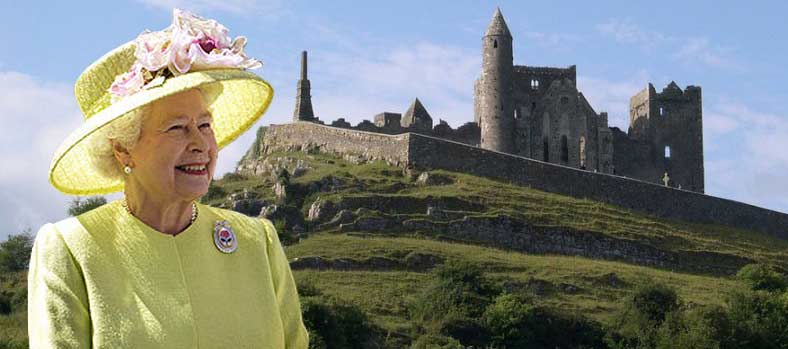
Again this year, access to OPW-managed heritage sites will be free on the first Wednesday of every month, to individuals wishing to visit these sites, and for the duration of their particular opening season.
Families looking for a free day out in Ireland, particularly here in Tipperary and indeed elsewhere here is your chance “To see old Ireland free”. So please, old age pensioners and those enjoying free travel, do take full advantage.
That means that visits to sites in Tipperary such as:- Cahir Castle, the Swiss Cottage, the Rock of Cashel, Roscrea Heritage (Castle) and the Blackmills, and venues further afield nationally like Kilkenny Castle, Clonmacnoise, Ross Castle in Killarney; to name but a few, won’t cost you a red cent.
Of course, tickets will be allocated on a ‘first-come, first-served basis’, so visitors are advised to arrive early to avoid delays, and do keep in mind that some attractions are open all year-round, while others may have opening hours which are seasonal.
You can get more information regarding these venues, simply by clicking HERE.
 At Kilshane House, Co. Tipperary recently, attended by over 200 guests from the Multi-National and Indigenous Sectors, Enterprise Ireland, the IDA, as well as high profile figures drawn from the world of Sport and Entertainment were L – R; Tipperary Co. Council Chairperson Siobhan Ambrose, Minister for Jobs, Enterprise and Innovation Mitchell O’Connor with the very able Tipperary County Council Chief Executive (CE) Joseph MacGrath. Here in Co. Tipperary we respectfully ask the questions:
(1) Is Thurles Co. Tipperary ‘THE PLACE, ‘THE TIME’ for to encourage the government to “join other leading organisations”, to couple with our “rich culture of heritage“?
(2) “Is a purchase, by Government, of the ‘Black Castle’ here in Thurles justified, given our present economic situation nationally?
(3) Should the Minister for Arts, Heritage and the Gaeltacht, M/s Heather Humphreys or Minister for Jobs, Enterprise and Innovation M/s Mitchell O’Connor be asked, by our local politicians, to bring this ‘Black Castle’ purchase matter before Cabinet, recommending its purchase?
 History of the Black Castle
For those not familiar with the historic Black Castle in Thurles, do please read on; remembering that same building has now come up for sale as part of a commercial lot, having been previously in private ownership.
The sale of the Black Castle, which is located on the west side of Liberty Square, presents an ideal opportunity for the present government to now, through the Office of Public Works (OPW) who maintain the State’s property portfolio, bring this historic castle into public ownership.
The castle was once the home of Elizabeth Poyntz, formerly of Acton Court, Iron Acton, Gloucestershire, England,[A] known as Lady Viscountess Thurles, following her marriage to Thomas Butler, Viscount Thurles, in 1608. Thomas Butler was son of Walter Butler “Walter of the Rosaries,” latter probably the first of the Butler family to take up residence in Thurles Castle.[B] Viscount Thurles was summoned from Tipperary, to England in 1619 to answer charges of treason, but the ship, conveying him, was wrecked off the coast of Wales, in an area known as The Skerries and he was drowned on 15th December 1619. His wife Elizabeth Butler (Poyntz), the celebrated Lady Thurles was now a widow and the lone parent of three sons and four daughters.
After the death of Viscount Thurles, Lady Thurles, married again, about 1620, Captain George Mathew of Radyr and Llandaff in Glamorganshire, Wales, by whom Lady Thurles had a further two sons and a daughter.
Captain George Mathew died at Tenby in Wales in 1636. A period portrait, oil on canvas, of Lady Viscountess Thurles is in the possession of the Tipperary County Library, situated in the Source building, Cathedral Street, Thurles.
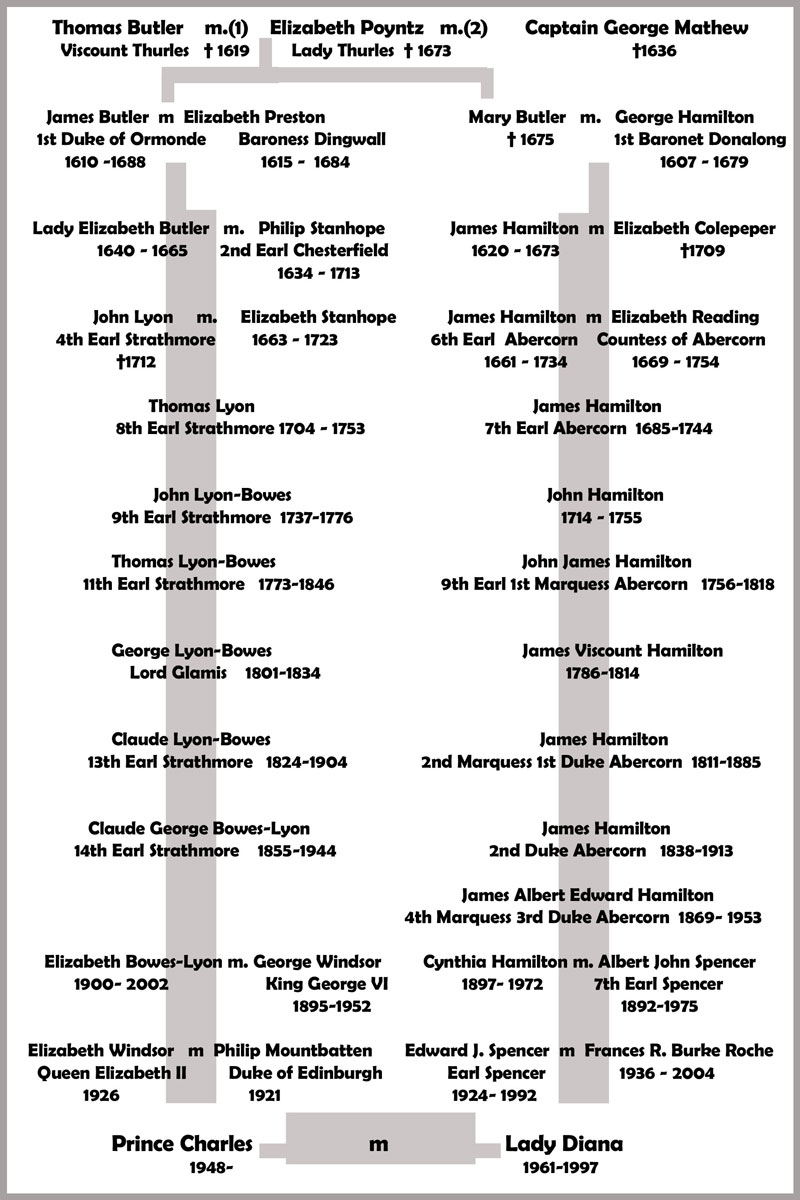
 Memorial Plaque marking the burial place of Elizabeth Butler in St. Mary’s Church Thurles. Note Elizabeth Butler (Poyntz) was also progenitor (ancestor) to Honora “Nano” Nagle (1718-1784) the “Lady with the Lantern”, founder of the “Presentation Sisters” and a pioneer of Catholic education in Ireland. The Presentation Sisters here in Thurles this year celebrate 200 years of being resident in the town (1817-2017). Nano Nagle was declared venerable in the Roman Catholic Church on 31st October 2013 by Pope Francis (Jorge Mario Bergoglio). Elizabeth and Thomas Butler (Lord & Lady Thurles), through their first son James FitzThomas Butler, 1st Duke of Ormond, is a direct progenitor (ancestor) to Charles Prince of Wales, who is the eldest child and heir apparent of the present Queen Elizabeth II.
The late Princess Diana is also connected to the history of the castle and through the daughter of Lord and Lady Thurles, (Mary Butler), and her ancestors the Hamiltons, descendants of whom married into the Spencer family. Indeed the late Princess Diana was the 12th cousin, twice removed, of Prince Charles.
Despite a visit from Oliver Cromwell’s Parliamentarian army during the period 1658 to 1660, Lady Thurles and her children resided in the castle for a great deal of her life. Following her death in 1673 she was buried, at her own earlier request, in Thurles, inside the earlier pre 1820 ‘Little Chapel of St.Mary’, now St. Mary’s C of I Church. A commemorative polished limestone plaque, within the church building, recalls this historic period.
Does Rural Ireland Receive its Fair Share of Government Funding?
Here in the Thurles half of our Templemore / Thurles Municipal District of Tipperary, our appointed fiscal executives at both Municipal District and County Council level, correctly and carefully count the cost of administration, prioritising our spend. Thurles after all is part of a forgotten rural Ireland; which the present Fine Gael government fully agree has been totally neglected for at least the past 15 years.
According to our recent 2016 Census returns, between 2011 and 2016 the Thurles Urban Electoral Division population actually dropped by 115 persons (From 6,929 to 6,814), while Thurles Rural Electoral Division increased only by 14 persons (From 2,300 to 2,314 – a miserable .61% increase). Of course the figures posted in these 2016 Census returns are not in fact actually true; instead these figures reflect the numbers of persons forced to migrate or emigrate elsewhere in order to find work; with all employment prospects in the town completely absent.
On April 27th last, we posted details of Fáilte Ireland’s recently announced €11.5m funding, to be invested in the refurbishment of ten key OPW sites in Dublin, within Ireland’s Ancient East Region. I pointed out that within a 33 miles radios of Dublin’s popular O’Connell street, went the majority of funding; yes over €8m in total. This included €3m towards a new museum and viewing platform in ‘The Record Tower,’ at Dublin Castle; €300,000 towards a Phoenix Park tourism and amenity study. While twenty-five miles’ away the Brú na Bóinne Visitor Centre got €2.58m; and thirty three miles away Newgrange got €1m with Knowth a further €1.4m.
Continue reading Is The Purchase By Government Of The Thurles ‘Black Castle’ Justified?
 Grave of Gobán Saor, 16km (10Mls), from Thurles at Derrrynaflan, Ballinure, Co. Tipperary. Little is truly known about ‘An Gobán Saor’, pronounced Gubawn Seer, (Gobban the Builder; free smith, free mason or free carpenter), whom legend states is buried 16km (10mls), from Thurles, at Derrrynaflan, Ballinure, Co. Tipperary.
Back in the days when our present ancient stone castles, monasteries, round towers and churches (now, alas, many, for the most part, in ruins), were originally being constructed, stone-masons /smiths /architects, just like ‘An Gobán Saor’ (also spelt Gubin Saor & Gobban Saer) and other possibly lesser skilled, associates, would have assembled at prearranged building sites, in the hope of obtaining gainful employment. Non-locals selling their skills would have travelled with their whole families, setting up camp close to the area where there was a promise of construction work.
According to legend, the father of the Gobán Saor was himself a famous mason and architect. Convention states that the Gobán Saor lived sometime around the seventh century. Folklore also indicates that he married a respectable and very beautiful Sligo woman. He possibly travelled extensively, often incognito, not just in Ireland, but also in England and even on the Continent, designing splendid sturdy edifices, while working as a common stone mason.
Folklore indicates that An Gobán Saor was highly intelligent, jovial and at all times generous with his knowledge. From the many tales told we learn that the traits he finds most difficult to understand are miserliness combined with greed.
 Picture (A) Abbey Rd. area of Thurles and St. Brigid’s Graveyard (Shown circled in green), as it existed prior to 1846. Picture (B) The mason’s mark or symbol of ‘An Gobán Saor’, on a pillar beside St. Brigid’s Graveyard (Shown circled in red). The 2.4m pillar on this site was constructed in much more recent times possibly from stones relating to an older church building no longer evident on site.
To build these stone structures; these itinerant, skilled, stone masons would have remained camped in areas for many years, living, not in huts or houses, but in temporary tent-like dwellings, roofed over using bent, flexible, saplings covered in an oiled cloth to repel the weather. These nomadic skilled individuals were the past artists, designers, and architects, while also working as stone mason.
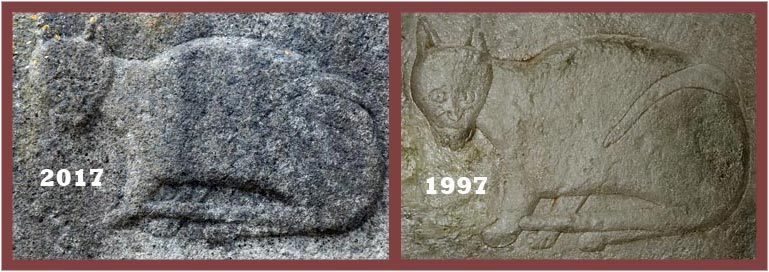 Stone carving of the cat with two tails, the mason’s mark or symbol of ‘An Gobán Saor’, in Thurles Co. Tipperary. This feline demonstrates a somewhat sad, frightened, stare at the visitor, while its set of whiskers points downwards.
Tales of An Gobán Saor‘s exploits verbally related down through the years’ state that he once applied seeking work to the master builder of a Cathedral. The master builder placed him in a work-shed by himself, and pointed to a block of stone inviting him to carve from it a cat with two tails. Next morning Gobán had disappeared, but when the master unfastened his shed and looked in, he found that the block of stone had been most beautifully carved into a cat with two tails. The Cathedral builder was heard to exclaim that this could only have been the work of An Gobán Saor himself, as no other human could have produced such superb work, and so fast.
So was born the mason’s mark or symbol, associated with An Gobán Saor; the cat with two tails, as shown above.
The story is also told that while building a monastery, the monks demanded that he lower his agreed price. To force this issue, they removed his climbing ladder from a castellated area he was building, preventing him from easy descent. Gobán began to slowly dismantle the stones structure, tossing the building materials to the ground, genially informing his employers below that this method of reaching the ground was as good as any. The monks are said to have quickly returned his ladder, and paid him his agreed price.
Because of the skilled ability of these itinerant builders, they were usually allowed, for the most part, to govern themselves. Sons inherited their skills and the trade secrets from their fathers, thus it was essential, that they would also develop their own private signs and a clandestine language, to ensure that these same trade secrets remained covert.
So also did the Tinkers; those specialising in skilled metal work, and some of this secret language, over the years, has made its way into the public domain; words like:- Kuenig (Eat), Án or Tes (Bread), Lokh or Lima (Milk), Chiman (Stick), Bós (Fist), Rístan (Prison), Krub (Foot), and a word used quite often today in conversation, which we relate to unemployment benefit; the word Dóle, which back then meant ‘Bread Trough’.
A Gobán Saor symbol can also be viewed by visitors attending at the Swiss Cottage, Cahir, Co. Tipperary, although same was possibly moved to this spot, in more recent times.
Fáilte Ireland announced that €11.5m is to be invested in the refurbishment of ten key OPW sites in Dublin and within Ireland’s Ancient East region. But then of course the OPW Heritage Services work in partnership with this same Fáilte Ireland, so no great surprises here. It was simply a case of tourism revenues earned by the OPW, being given back to the OPW.
It is not really the distribution of funding that actually bothers me, after all Co Tipperary got a share; Ormond Castle were granted €585,000, while the Rock of Cashel were granted €1.78m.
Gobán Saor’s cat rapidly eroding. Of course, the area within a 33 miles radios of Dublin’s popular O’Connell street, as usual, got the majority of funding; yes over €8m in total. This included €3m towards a new museum and viewing platform in ‘The Record Tower’ at Dublin Castle; €300,000 towards a Phoenix Park tourism and amenity study. Twenty-five miles’ away the Brú na Bóinne Visitor Centre got €2.58m; and thirty three miles away Newgrange got €1m and Knowth €1.4m.
This Fáilte Ireland funding announced earlier this month, when truly examined, certainly represents a true strategic partnership with the OPW, if you know what I mean. Plus, as Fáilte Ireland point out, our Irish tourism sector after all currently sustains 220,000 (minimum wage) jobs, while generating an estimated €6bn in economic value per year to the State.
As already stated, it is not really this unequal distribution of funding that actually bothers me, no my fear centres around the wanton destruction of our local unique history and culture, which provides that strong incentive in bringing people to our shores. To get to the crux of this matter perhaps I need to explain further.
Tourists who visit Ireland are not exactly attracted by our weather, rather a huge percentage of foreign visitors are incentivised to holiday on our island, because of our wild, unspoilt, scenic beauty and remarkable ancient history. While most of our history is protected in museums, much more remains totally unprotected.
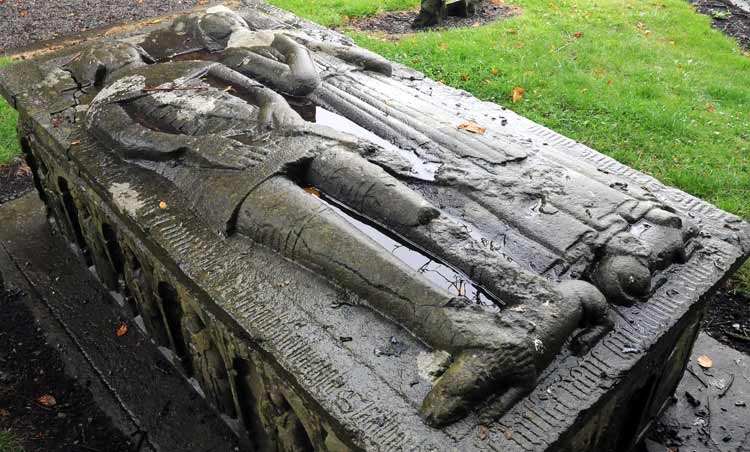 Archer Tomb Date 1520. Present condition in 2017. Here in Thurles town Co. Tipperary, alone, numerous pieces of our rich heritage lie unprotected from weather erosion. Year by year, with the passing of each season; rain, wind, frost, snow and even sunshine, all ploy and conspire to shorten and destroy the future life of centuries old rare historical artefacts. Private funding offered, to protect this heritage, are resolutely refused, however funding is being (alas to late), provided to carry out photogrammetry surveys. See HERE and HERE.
The world was outraged in May 2015 when ISIS militants destroyed some of the historic buildings in the ancient city of Palmyra, located in war-torn Syria; which in the past flourished as a Roman trading outpost around A.D. 200. While this similarity is perhaps extreme, the same situation is being allowed to happen to valuable history in rural Ireland.
Dublin not only get the employment opportunities now-a-days it would appear, but into the future, only within a 50 mile radius of our capital city, will limited history survive, courtesy of Fáilte Ireland’s neglect of rural Ireland.
We rightly worry about the disappearance of Banks, Post Offices, Garda Stations, Hospitals and Public Transport from rural Ireland, now our politicians can add tourist attractions to this ever-growing list; while into the future the actual visitor.
Incidentally, those of you who reside abroad and continue to retain close links with Thurles, Co. Tipperary, you can purchase a cast, (at reasonable cost), of the Thurles Goban Saor’s cat with two tails, shown above, from HERE. Same will ensures one hell of a talking point for visitors to your home, when hanging on your sitting-room wall.
We will be talking about this Gobán Saor’s cat in the coming days.
|
Support Us Help keep Thurles.info online by donating below. Thank you.
Total Donated 2026: €300.00
Thank You!
Daily Thurles Mass Livestream
|



Recent Comments