|
|
The humanitarian priest, and valuer of human life, Fr. Jack Finucane, passed away today at the age of 80.
Ordained in 1963; Fr. Jack was a brother to the late Fr. Aengus Finucane, latter a former Chief Executive of Concern Worldwide, and earlier a former teacher at Rockwell College, secondary school close to New Inn, Cashel, here in Co. Tipperary.
The brothers were both natives and ‘Freemen’ of Limerick; being aptly recognised in 2005 for their inspirational and tireless work with the starving of Africa and Asia. Fr. Jack, with his brother Fr. Aengus, tended to some of the poorest people in the world; from Biafra in Nigeria to Bangladesh and Ethiopia.
Fr. Jack would later became an adviser to Sir Bob Geldof and his Live Aid team, and in 1985, escort a young Bono (U2 fame) on his first trip to Ethiopia, greatly influencing latters future thinking.
This staunch belief by both men; based on the view that all human beings deserve respect and dignity and therefore should be treated as such, would lead to the formation of the organisation known as Concern Worldwide in 1968.
Fr. Jack and Fr. Aengus had been sent to Nigeria by the Holy Ghost Fathers and were at the ‘coalface’ in the distribution of aid, flown into Biafra by Concern and other relief organisations. Both Finucane priests had become involved in the distribution of this humanitarian aid, following the Nigerian government’s blocking of food supplies to the breakaway state of Biafra (Biafran War or Nigerian Civil War carried on from July 6th 1967 to January 15th 1970 with the loss of over 1 million lives). This food blockade caused massive starvation and continued despite receiving, back then, worldwide condemnation. The Finucane priests organized food to be sent through makeshift airstrips, including one at Uli, Anambra.
 Frederick Forsyth CBE, with Fr. Jack Finucane, latter who passed away today. The Royal Air Force pilot, novelist (70 million books), political commentator and spy, Mr Frederick Forsyth CBE, (Works include ‘The Day of The Jackal,’ ‘The Odessa File,’ ‘The Dogs of War’, ‘The Fourth Protocol,’ ‘The Biafra Story‘ and ‘Cry of the Innocent,’ latter film made here in Ireland), who was then a journalist covering the Biafran war, knew both Fr. Jack and Fr. Aengus; indeed Mr Forsyth regularly dined with both men close to Umuchima village, Uli, at the airstrip code named ‘Annabel Airport’, during his stay of some 2 years.
Both religious brothers were involved in using old Douglas DC6s and DC7s from the 50’s, together with old worn out Lockheed Constellations planes from a similar era, in their efforts to get sick children out and food provisions in, and while dodging Nigerian MiG-19 jets supplied by East Germany and manned by East German pilots.
Frederick Forsyth, wrote of the children airlifted out of Biafra, stating that these children were a “living, breathing monument” to the work of Fr. Aengus Finucane and his colleagues.
Irish President Mr Michael D. Higgins stated today; “His (Fr. Jack Finucane) commitment to the ethical basis for, as well as the practical application of humanitarian principles was exemplary. Jack Finucane’s lifelong commitment to protecting the dignity of some of the world’s poorest and most marginalised people will stand not only as a lasting tribute to all that is good about mankind, but is exemplary in its invitation not to avert our gaze from our current challenges of global hunger and poverty.”
Go ndéana Dia trócaire ar a anam dílis.
His headstone in St Mary’s Graveyard Thurles, reads: “O holy cross under thy shadow I will rest.” In loving memory of John O’Brien, 19 Main St, Thurles [Co.Tipperary]. Died 30th June 1917, aged 62 years. R I P. “An upright man fearing God and avoiding evil”. [Grave Ref: 349].
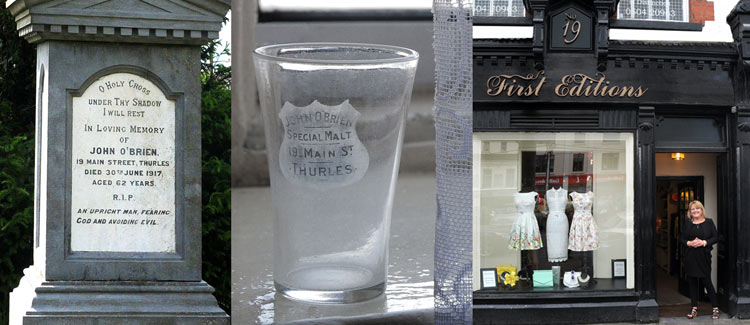 Pic (1) Gravestone of J. O’Brien, No 19, Main St. (Liberty Square) Thurles. Pic (2) A 100-year-old Whisky Glass with the O’Brien name from No 19, Liberty Square (Main St.) Thurles. Pic (3) First Editions today (June 2017) also situated at No 19, Liberty Square (Main St.) Thurles. For the many years that I have been a resident of this town, ‘First Editions’ situated at No 19 Liberty Square, Thurles, (Previously Main Street) has been retailing not just the ‘crème de la crème’ in lady’s fashion and design, but also providing effective fashion guidance; advising ladies of all ages in “what to wear, what to bare, and what to keep under wraps”.
However, No 19 Main Street, Thurles, was not always the home of ‘Haute Couture’ for devoted followers of high fashion. Previously it had been a Licensed Hostelry (Pub, Watering Hole supplying ‘Special Malt’ whiskey) and occupied by Mr John O’Brien. Prior to Mr O’Brien’s tenancy it was occupied by one Mr Adam Cooke, who according to research, possibly ran a Delph and Hardware business before 1843.
Today, following his death almost 100 years ago this month, when we examine his place of burial, we can fairly assume that Mr John O’Brien, was a man of some substance. Born just after the Great Famine and passing away shortly before Thurles became fully involved in the fight for Irish freedom, his headstone epitaph is possibly the only headstone in St Mary graveyard with hammered smooth, lead lettering.
So why letters made using Lead (Symbol Pb, Atomic No 82) ?
Lead lettering on signs and headstones was up to 50 years ago a technique that had been in use for at least the previous three to four hundred years. In our dimmer past, the highlighting of lettering on any type of sign was difficult, due to the absence of long lasting exterior paints, with latter being unfit to endure Irish weathering and thus unable to remain clearly visible to the eye for any great period of time. Lead lettering, therefore, while highly skilled and labour intensive, was the only other option, depending on ones available finances.
Seldom seen today, except in graveyards; this lead lettering would be sketched out on the surface of the stone initially in pencil. The intended inscription would then be incised or scored into the stone using a hammer and different sized sharp chisels, producing a V style cut into the surface. Except for the surface outlines, the stone cutter was not required to finish the carved-out letter shapes cleanly.
Now using a hand driven band drill and a steel bit, the stone mason could drill a series of tiny holes internally into each incised letter. Soft malleable type lead, supplied in sheets and twisted into the shapes of each letter, would then be hammered into each incised letter cutting, using a wooden mallet. The lead would then be sanded down so as to be level with the stone surface. Together with the rough finish and drilled holes the stone mason was assured that the lead would grip tightly for decades and in the case of the O’Brien gravestone, one hundred years this month.
New York publican, Mr Aekerman Jensen, had arrived into Terminal 1 at Dublin Airport. He was on a trip to Upperchurch in Co. Tipperary, in an attempt to chase down his ancestors, latter whom he believed had emigrated from Tipperary bound for the US on board the coffin ship “Ellen Simpson” in 1847.
Arriving here in Thurles for the first time on the 1.00pm Dublin to Cork train, he dismounted with his luggage from the carriage and looked around. His gaze became immediately focused on Mickey Ryan standing behind a long folding table on which were displayed an assortment of what looked like bleached human skulls.
“What are these?” asked Aekerman.
“Oh, I be selling real human skulls”, replied Mickey, “Sure as Fáilte Ireland have already told you in their adverts, this be part of promoting rural Ireland and promotin Ireland’s Ancient East.”
Aekerman suddenly recalled the Fáilte Ireland brochure he had picked up from the travel agents. It had read; “From ancient high kings to modern day poets, saints and scholars to ramblers and fishermen, Ireland’s Ancient East pulsates with legendary tales”.
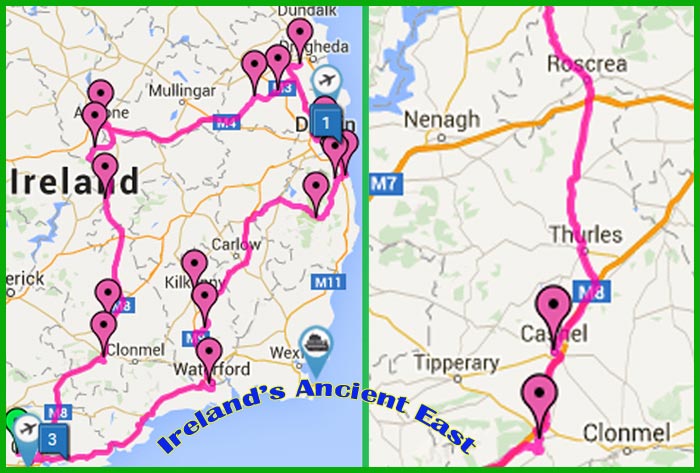
“I never knew Thurles was in Ireland’s Ancient East” said Aekerman, inquiring further, “Do you have any skulls from ancient high kings, famous poets or saints?.”
Mickey raised his eyebrows “Sure don’t I have the skulls of the most famous of Irishmen that have ever lived.”
“That’s really great” said Aekerman, “Can you give me some names?.”
“Begod I can sir!” said Mickey, pointing to his varied collection, “That one there is St. Patrick, the Patron Saint of Ireland, and that one there with the hole in it, is Mick Collins the man who won us our freedom back in 1922.”
Mickey continued “Sure the odd shaped one over there for example, is none other than James Joyce, a famous Dublin author and playwright, and that…..”
Aekerman interrupted, “Sorry but did you say St. Patrick?”
“Begod that is correct sir” said Mickey with a knowing nod.
Aekerman again recalled the wisdom of Fáilte Ireland’s brochure promise, “Learn the stories of a place and you’ll come to understand the soul of its people”.
“I believe I will buy from you St. Patrick” said Aekerman, who immediately paid over the asking price of €3,000 in cash. But then as Mickey correctly explained later “If people want quality, they expect to pay for value.”
Aekerman flew back to New York a week later and proudly mounted the skull of St. Patrick’s on the wall in his Pub. People, especially from the ‘auld sod’, came from every America State to view this famous Skull, making him a small fortune and allowing him to retired early, a truly wealthy man.
It was during this retirement, some five years later, that Aekerman decided to come back to visit Ireland, Thurles, and Upperchurch, the source of his wealth, and to reconnect once more with his ancient ancestors. Walking once again along the Thurles railway station platform, he spotted Mickey and his skull collection.
Anxious once more to get another bargain Aekerman asks “And what skulls do you have today?.”
“Sure begod, I have the skulls of the most famous Irishmen that ever lived” replied Mickey.
“Give me some names”, demanded Aekerman, beginning to tear some €50’s of a rather fat roll of paper currency.
“Well!” said the Irishman, pointing to various skulls. “That one there is Michael Collins, that one is James Joyce, and that one is St. Patrick, the Patron Saint of Ireland, God bless his coming to Éire and the Rock of Cashel, and that one…”
“Sorry” Aekerman interrupted, “But did you say St. Patrick, the Patron Saint of Ireland?”
“Begod, that’s correct!” said Mickey.
“Well”, said Aekerman, “I was here about five years ago and you sold me St. Patrick’s Skull.”
“Begod so I did” said Mickey beginning to place his wares quickly into the back of his van, “Sure don’t I remember you well … now … you see … ah … this scull here today actually is St. Patrick when he was just a boy.”
 Some 196 Community projects nationwide are set to benefit from grants just announced (2017) by the Heritage Council. Community Projects in Co. Tipperary which have been awarded Grants are listed hereunder, with total bestowed funding amounting to €15,000.
Tipperary Libraries – Carrick-on-Suir Library – Urban Wildlife Garden 2017.
Awarded €1,500 to convert the library garden into an Urban Wildlife Garden which will raise awareness while also providing habitat for small mammals, insects, birds and especially pollinators.
BirdWatch Ireland – Making nature accessible – “Wildlife outside your window”.
Awarded €4,000 to showcase less accessible natural heritage to a diverse audience through video productions to engage children and adults of all ages with the wonders of wildlife outside their window.
Commons Old School – The Commons Past and Present.
Awarded €1,500 to provide a structured activity for young people living in the village to record/research/present past life of The Commons village, through different media of visual art, audio recordings and model Construction.
Burncourt Community Council Ltd. – Repair of windows to a John Nash designed hunting lodge (Mountain Lodge).
Awarded 6,000 to restore Mountain Lodge and return to use as a niche accommodation facility, hill-walkers stop and seasonal café.
South Tipperary Beepkeepers’ Association – Pollinator Education in South Tipperary in line with the All Ireland Pollinator Plan.
Awarded €2,000 to increase awareness of the plight of native Irish pollinators. To encourage young adults to take on the responsibility of safeguarding our bee and pollinator population.
Thurles Library’s “All Hands Together” Exhibition
As part of the Bealtaine Festival, Thurles Library (The Source, Cathedral Street, Thurles) are currently and kindly hosting an amazing exhibition in the Source Library & Arts Centre Gallery.
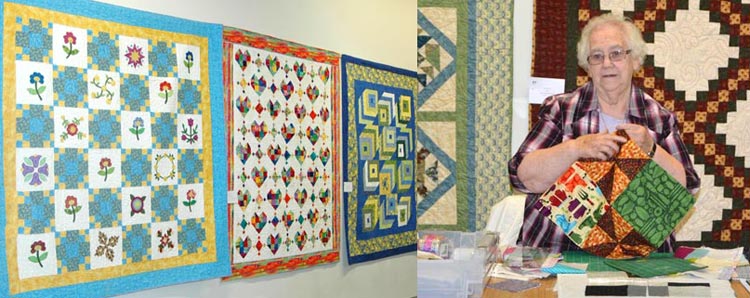 Ms Phyl Dwyer, Turtulla, Thurles, demonstrates the ancient art of ‘Quilting’. This exhibition, featuring the skills of the ‘Spike Quilters of Littleton’ and entitled “All Hands Together”, is open free to the public until Tuesday May 30th next; to be viewed in conjunction with the opening hours of Thurles Library.
The Spike Quilters of Littleton.
‘Spike Quilters’ are a group of compatible and inclined women aged between 15 years & 90 years, who meet together on a monthly basis to undertake and learn the ancient art of patchwork. With their monthly meeting place in The Muintir na Tíre Hall, Littleton, Thurles, Co. Tipperary; here the elderly share the considerable knowledge they have acquired in the art of ‘Quilting’ with their younger counterparts. Meetings are held in the hall from 10.30am to 4.00pm on the appointed day, (Usually second Sunday of every month), with each individual working on their own project, be it a ‘Wall-Hanging’ or a ‘Quilt’. Here colours are discussed, ideas are exchanged, progress encouraged and all over numerous cups of tea and chat. Guest teachers are a regular feature of these workshops, initiating new ideas and up skilling.
The Patchwork Quilt.
A patchwork quilt is a multi-layered textile in which the top layer consists of pieces of fabric sewn together to form a design. Originally, this was to make full use of accumulated left-over or salvaged scraps of fabric.
As stated, the quilt is usually formed of three individual layers; the patchwork quilt top; a layer of insulation wadding (batting), and a layer of backing material. Same may be used as throws, wall hangings, table runners or even tablecloths.
- The art of quilting has a long history, first evidence of which appears back in the 35th century BC, with an ivory carving, found in the Temple of Osiris, at Abydos near the modern Egyptian towns of el-‘Araba el Madfuna and al-Balyana, during 1903 and currently in the collection of the British Museum. This carving features the king of the Egyptian First Dynasty wearing a cloak which appears to be quilted.
- Attributed to the 1st century BC – 2nd century AD, we have a textile in the form of a quilted linen carpet found in a Mongolian cave tomb which today is housed in the collection of the Leningrad Department of the Institute of Archaeology of the Academy of the Sciences of the Union of the Soviet Republic.
- Made circa 1400 AD, we have a Milanese ivory carving of the Holy Family depicting the ‘Flight into Egypt’, showing Joseph wearing a coat quilted in a diamond pattern. Same is housed in the collection at the Victoria & Albert Museum, United Kingdom.
- In 1547, the Inventory of King Henry VIII of England lists “Quyltes” and “Coverpointes” among the bed linen. The inventory describes the quilts as made of “holland cloth” (linen or cotton), “bockeram” (cotton),” or various types of silk including “sarceonett”, “tapheta,” and “lynnen.” Some of these quilts would have been given to lesser members of Court, either as a sign of favour or as a gift. Indeed, the young 16 year old Catherine Howard, fifth queen (for three months only) of Henry VIII, was given a gift of two dozen quilts, sometime before being beheaded, on the grounds of treason, and for supposedly committing adultery, while married to Henry.
Now thankfully, due to the ‘Spike Quilters of Littleton’ and Thurles Library; in 2017, the craft of quilting can be seen to continue, with this exhibition showcasing work to most impressive effect.
When shopping in Thurles over the next 10 days, please do take a coffee break and go visit this exhibition of splendour and truly talented aptitude.
|
Support Us Help keep Thurles.info online by donating below. Thank you.
Total Donated 2026: €300.00
Thank You!
Daily Thurles Mass Livestream
|



Recent Comments