|
|
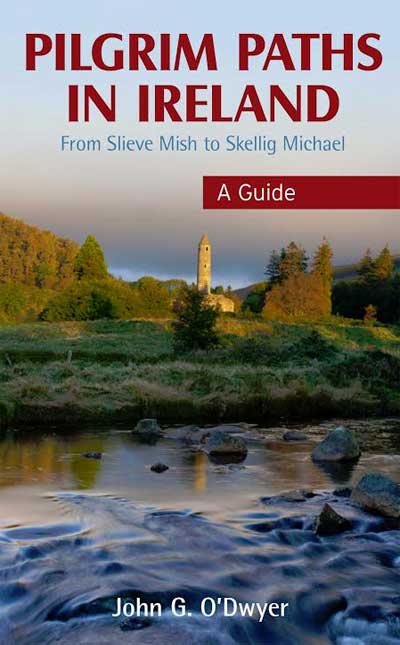 At the invitation of Ardmayle Heritage Society, Mr John G. O’Dwyer, Chairman of Pilgrim Paths Ireland will give a lecture and slide-show on his exploration of ancient pilgrim trails, entitled “Walking Through History.” The event will take place in Ardmayle Church, Cashel on Wednesday, March 2nd, 2016, at 8:00pm sharp. At the invitation of Ardmayle Heritage Society, Mr John G. O’Dwyer, Chairman of Pilgrim Paths Ireland will give a lecture and slide-show on his exploration of ancient pilgrim trails, entitled “Walking Through History.” The event will take place in Ardmayle Church, Cashel on Wednesday, March 2nd, 2016, at 8:00pm sharp.
Mr O’Dwyer, the author of the first guidebook to Ireland’s Pilgrim Paths, will also talk about the more recent developments on the pilgrim paths of Ireland and the upcoming ‘Pilgrim Paths Week’, which takes place from March 22nd to March 29th. Tipperary will be offering two fully guided pilgrim walks during this week long event, same taking place on ‘St Declan’s Way’ with a crossing of the Knockmealdown Mountains and on the ‘Kilcommon Pilgrim Loop’.
His talk on March 2nd next will also cover details of Ireland’s new Pilgrim Passport, which is similar to the Spanish Camino passport; offering an opportunity for Irish people and overseas visitors to get out and explore 120 kilometres of Ireland’s most unforgettable penitential paths, while reconnecting with the pilgrims past.
Those who have all Five Panels stamped on Passports, latter certifying full completion, automatically become eligible for a Teastas Oilithreachta (Irish Pilgrim Walk Certificate) from Ballintubber Abbey.
So, if you would like to walk some of Ireland’s pilgrim paths in the future or find out more about them, this upcoming lecture is certainly the event for you.
Admission to the lecture is free and all are welcome to attend.
For more information, contact M/s Marion Ryan at Tel: 087-6110338 or visit www.pilgrimpath.ie
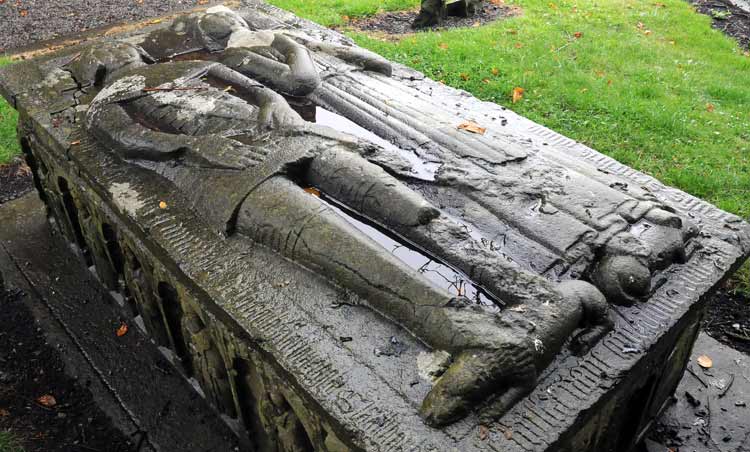 The Heritage Council has announced it will allocate €700,000 to heritage projects under its 2016 Heritage Management Grant Scheme. The grants are aimed at supporting projects that apply good heritage practice to the management of places, collections or objects (including buildings). The Heritage Council has announced it will allocate €700,000 to heritage projects under its 2016 Heritage Management Grant Scheme. The grants are aimed at supporting projects that apply good heritage practice to the management of places, collections or objects (including buildings).
Grant applications must be submitted on the Heritage Council’s online application system before 5:00pm on Monday, March 7th 2016.
Speaking about the grants scheme, Heritage Council Chief Executive, Michael Starrett stated; “The past number of years has brought many challenges to those working hard to preserve and promote Ireland’s heritage and to highlight its significance to people and their places. In that context, the Heritage Council is delighted to be able to offer some financial assistance to community-based heritage projects. These local projects are very important in protecting our heritage, as well as creating jobs and promoting local tourism”.
We understand that grant aid is supported by National Lottery funding and Arts, Heritage and Gaeltacht. Applications for this online grants system, which was due to end on February 29th, has now been extended to a Monday 7th March, deadline.
Grants may be awarded for:-
•The preparation of a conservation report, conservation plan or conservation management plan to inform future works (a ‘Conservation Plan’ is a plan prepared in accordance with the process set out in The Burra Charter (http://australia.icomos.org/wp-content/uploads/The-Burra-Charter-2013-Adopted-31.10.2013.pdf): The Australia ICOMOS Charter for Places of Cultural Significance, 2013).
•The carrying out of actions that are in accordance with a fully developed conservation plan or a management plan that applies good heritage practice.
•Works to buildings and structures where the special heritage interest of the building or structure is demonstrated to be at risk.
•Conservation of heritage collections and objects, including documents.
•Conservation or management of a wildlife site where a conservation/management plan exists.
Note: Applications must be submitted through he Heritage Council’s online Grants System located at http://www.heritagecouncil.ie/grants/grants/.
Word of Warning: Please ensure you use search engine Internet Explorer only when attempting to use the online grants application system shown above, as the system is not, alas, compatible with ‘Firefox’.
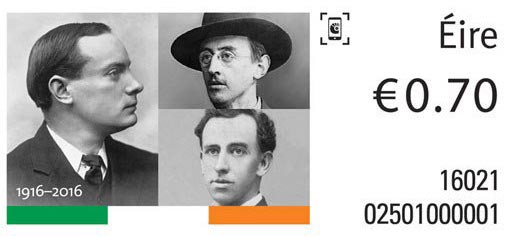 As most Irish people are aware, Thomás MacDonagh the Irish political activist, poet, playwright, educationalist and revolutionary leader was born in Cloughjordan, Co Tipperary. As a signatories to the Proclamation of the Irish Republic, he was executed for his part in the 1916 Easter Rising. As most Irish people are aware, Thomás MacDonagh the Irish political activist, poet, playwright, educationalist and revolutionary leader was born in Cloughjordan, Co Tipperary. As a signatories to the Proclamation of the Irish Republic, he was executed for his part in the 1916 Easter Rising.
An Post have now issued sixteen 1916 centenary stamps, and huge national and international demand is expected for this 1916-2016 definitive stamp series, which includes an image of the Tipperary born MacDonagh.
The stamps are grouped into four different categories reflecting a chronological progression from the lead-up to the 1916 Rising through to its aftermath. Represented are: Leaders and Icons; Participants; Easter Week and The Aftermath, all designed as a narrative rather than as 16 individual images. These new stamps will be available for the remainder of 2016 at all Post Offices and in special souvenir packs and booklets. [See http://www.anpost.ie/AnPost/IrishStamps/Home/ ]
A huge feature of each set of stamps is the use of ‘Augmented Reality (AR)’ (Latter elements are supplemented by a computer-generated sensory input, involving sound, video and graphics data), thus linking the stamps to a wealth of additional material; through scanning them with the CEE Explorer Smartphone App.
Thomás MacDonagh final communication home.
It is interesting to note that one year after MacDonagh’s death, his wife, whom he had married in 1911, Muriel (née Gifford), drowned in a swimming accident off the Skerries coast, in north Co Dublin, leaving their children, four-year-old Donagh and one-year-old Barbara, orphaned.
His original last letter posted home, currently is not to be found in the National Library of Ireland’s current excellent collection, however a copy truly exists. In this communication MacDonagh laments that his death will leave his family impoverished.
MacDonagh writes; “The one bitterness that death has for me is the separation it brings from my beloved wife Muriel, and my beloved children, Donagh and Barbara. My country will then treat them as wards, I hope. I have devoted myself too much to national work and too little to the making of money to leave them a competence. God help them and support them, and give them a happy and prosperous life.”
Thomás MacDonagh, once, also speaking about Ireland prior to 1916 stated: “This country will be one entire slum unless we get into action, in spite of our literary movements and Gaelic Leagues, it is going down and down. There is no life or heart left in the country.”
One wonders today is the vision and sacrifice MacDonagh dreamed for this country; is it at all reflected in our Ireland one hundred years later in 2016?
Some €150 million is being spent to redevelop the historic 1916 Boland’s Mill site in Dublin’s docklands, including the construction of a 15-storey apartment block, by Dublin City Council.
Buildings at No.14 to No.17 inclusive at Moore Street, Dublin have been purchased since 2015 from Nama, by Fine Gael Minister for Arts, Heritage and the Gaeltacht Heather Humphreys. Possibly three of these buildings were in ruins prior to the 1916 Easter Rising and therefore, despite Sinn Féin’s revenge protestations, are of no real historic significant. Admittedly around three hundred Irish Volunteers and members of Cumann na mBan did use the cover of these derelict buildings to escape from the GPO after it caught fire, following a bombardment by British artillery; breaking in and tunnelled their way through gable walls. The fourth house No.16 is important, since it became Volunteer headquarters and the place from which it was decided to finally surrender on April 29th, 1916.
An extra €2 million in 2015, we are informed, was transferred from Arts to secure funding for the wages of staff operating free tourist admissions to National Cultural Institutions which included the National Museum of Ireland, the Natural History museum on Dublin’s Merrion Street, Archaeology on Kildare Street and the National Library of Ireland.
We are informed that a capital provision of €22 million was allocated in 2015 to a number of flagship projects, including the development of a permanent exhibition space and interpretative centre at the GPO in O’Connell Street; the renovation of Kilmainham Courthouse in Dublin to enhance the visitor experience at Kilmainham Gaol; the provision of a permanent visitor facility at Cathal Brugha Barracks for the Military Service Pensions Archive; renovation works at Richmond Barracks; the development of a Tenement Museum in Dublin; and the restoration of the Kevin Barry rooms in the National Concert Hall.
Forgetting the €150 million spend on the historic 1916 Boland’s Mill site, some €28 million, at least, has now been set aside for 1916 projects; all of which has one theme in common – DUBLIN.
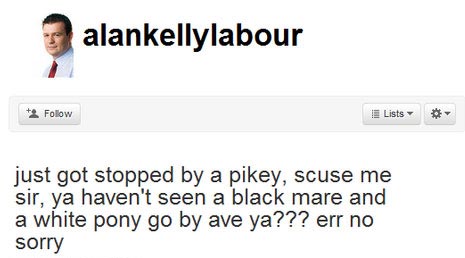 Today the Tipperary Kelly / Coonan Circus rolled into Thurles, led by their Ringmaster the Minister for Property Tax, Water and higher Bin Charges, Mr Alan Kelly. You know the guy I mean; in April 2010, as an Irish MEP he had his Twitter account supposedly “compromised” and God forbid, if the little ‘divils’ didn’t write; “just got stopped by a pikey, scuse me sir, ya haven’t seen a black mare and white pony go by ave ya??? err no sorry”. The word ‘Pikey’ here in “Éire of the Welcomes” is rightly considered a derogatory insulting racist reference, directed at members of our Travelling Community. (It was on the back of this insulting Tweet that no doubt gave justification to Labour’s Joan Burton to raise Kelly’s political stature to the post of “Minister for the Homeless”.) Today the Tipperary Kelly / Coonan Circus rolled into Thurles, led by their Ringmaster the Minister for Property Tax, Water and higher Bin Charges, Mr Alan Kelly. You know the guy I mean; in April 2010, as an Irish MEP he had his Twitter account supposedly “compromised” and God forbid, if the little ‘divils’ didn’t write; “just got stopped by a pikey, scuse me sir, ya haven’t seen a black mare and white pony go by ave ya??? err no sorry”. The word ‘Pikey’ here in “Éire of the Welcomes” is rightly considered a derogatory insulting racist reference, directed at members of our Travelling Community. (It was on the back of this insulting Tweet that no doubt gave justification to Labour’s Joan Burton to raise Kelly’s political stature to the post of “Minister for the Homeless”.)
The other partner of this Circus, Fine Gael’s Minister for Nothing or Other, Mr Noel Coonan also arrived into Thurles today; no doubt to familiarise himself after five years with the Thurles layout. After all when you get a few extra Saturday shoppers walking the town one thinks in the words of our Saviour Jesus Christ “Where two or three are gathered together in my name, there am I in the midst of them.”
The late session with the Taoiseach Enda Kenny in Templemore last night must have kept the junior Minister for Something or Other, Mr Tom Hayes running late; no sign of him.
Anyway, I digress; sure feck-it, unable to afford the price of a parking space in Liberty Square, didn’t I miss both or all of these fine publicly elected representatives.
Question: Why bother, I hear our readers say?
Answer: I suppose Firstly I wanted to sincerely thank all three for staying up in Dáil Éireann to vote, thus supporting their ‘Party Whips’ wishes; that they should support the largest majority government in the history of this State, instead of being down here in their constituencies of Co. Tipperary spreading “The Recovery.” Well done boys; as FG MEP Phil Hogan would have said “That’s real patriotism being expressed lads.”
Secondly: I wanted to thank them both for creating 135,000 jobs since 2012, and to explain that I understand perfectly, unlike other ungrateful bastards, why all three of these boyo’s failed miserably to find even one job, over the last 5 years in Tipperary, until 6 weeks before the forthcoming 2016 General Election.
Thirdly: Boys, what happened, on your watch, to ‘The Bolton Library’ down the road in Cashel?
Question: What the hell is ‘The Bolton Library’ I hear you say?’
Answer: Read on and be enlightened!
Continue reading Broken Promises Lead To Rural Tipperary’s Destruction
“Where Tipperary leads, Ireland follows.”
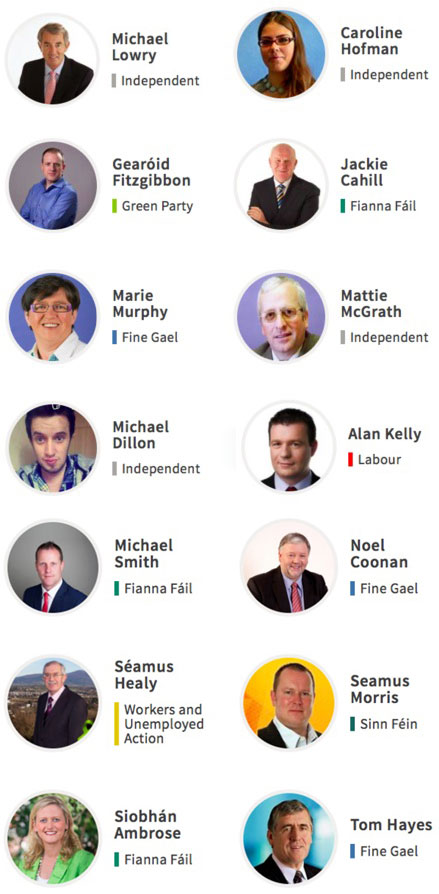 The Runners & Riders in the 2016 Tipperary General Election. Tipperary is often referred to as the “Premier County,” a term attributed to Thomas Davis, editor of ‘The Nation‘ newspaper in the 1840’s. Davis gave Tipperary this name as a tribute to the strong nationalistic feeling held here at that particular time. It was he who also coined the phrase, “Where Tipperary leads, Ireland follows.”
The idea of Republican democracy did not begin in Dublin in 1916. It began in Co. Tipperary with a rather naive, yet thoroughly well-meaning rebellion in 1848, some 68 years previous. The venue; the Widow McCormack’s cabbage patch, in Ballingarry South, in Co. Tipperary. Ireland was three years into the middle of a famine which had cost the lives of some 1.3 million Irish people nationally. The 1916 rebellion in O’Connell Street, was also a failed, naive rebellion, which regrettably saw the execution of thoroughly well-meaning patriots, including Cloughjordan, Co. Tipperary born Thomas MacDonagh; himself a signatory of the Proclamation of the Irish Republic.
Ask yourself the following questions: (A) “Identify the government regime currently existing in the Ireland of 2016, one hundred years after the 1916 rebellion?” (B) “Do we currently reside in a Democracy or under an Authoritarian Regime?”
Democracy
The term democracy comes from the Greek language, meaning “rule by the people”. This means just that; rule by all the people, not just some of the people; some rich people; some poor people or some middle income earners, – no it means all of the people.
Some simple dictionary definitions of democracy are described as: (1) A form of government in which people (yes all people) choose their leaders by voting; (2) An organization or situation in which everyone is treated equally and has full equal rights. (3) A meaningful political participation by all citizens.
Our theory of modern democracy was not really formulated until the so called ‘Age of Enlightenment’; when between the 17th and 18th century, then theorists; truth-seekers; thinkers – whatever you will, defined the essential elements of democracy as; A Separation of Powers; Basic Civil Rights & Human Rights; Religious Liberty and the Separation of Church and State.
Authoritarianism
‘Authoritarianism’ stands in fundamental contrast to real ‘Democracy’. Under Authoritarian Regimes there usually exists one ruler or a small group of leaders who hold the real power in the political system. One example of blatant Authoritarianism is the ‘Chief Whip’ system. Same operates within Irish political parties to ensure that all Deputies, including Ministers, attend for Dáil Business and follow the reigning government line on all issues. Politicians therefore are being forced to disregard the precise wishes of their electorate.
Usually Authoritarian Governments hold elections and those going forward for election may have had, as is the case in Ireland, very limited contact with their citizens. But citizens, as we have amply observed in the last 5 years, are not necessarily permitted to have any real voice in how they themselves wish to be governed. Their elected leaders do not give their subjects free choice. Instead, they decide what the people can or cannot have. Citizens are observed as subjects who must obey, have no independent will and are not participants in any government decisions made on their behalf.
Thus individuals or small groups such as Prime Ministers, Taoisigh, Presidents, Dictators, Aristocrats, Kings / Queens, Military Leaders, and Emperors may rule at the head of an Authoritarian Government, while hiding behind the face of apparent democracy. Numerous examples of an authoritarian regime can be examined over the past 5 years under our present Labour / Fine Gael government. In highlighting just two; namely the introduction of Water Charges and Property Tax, we find that despite continuous massive street protests the voter / electorate has been ignored in the governments pursuance of an authoritarian regime; thus disregarding their voters democratic wishes.
Other authoritarian activity now abounds abundantly in our midst, which must be recognised as an affront not just to voters in Co. Tipperary, but far more seriously to Ireland’s attempts to achieve future real and full democracy.
This activity is being aimed at the Tipperary electorate through the so called “free press”. “Are you prepared to enter into government supported by Michael Lowry TD”, is the daily question fired by the press at our present authoritarian coalition members. “No way” states Labour member Minister Alan Kelly and company.
Here in Tipperary our electorate see that as – If Michael Lowry TD is elected and invited to support any future government, Alan Kelly (assuming he is elected; a situation which on a daily basis seems ever more unlikely, unless Noel Coonan passes on second preference votes), together with his possible diminished 8 seat authoritarian Labour government, his party will no longer wish to prop up a coalition. A possibly larger retained Fine Gael party will now not have any difficulty in finding others to take Labour’s place. The same goes for other political groupings. Of course this scenario now begs the question; “Why bother to vote for Alan Kelly and his diminished, dishonest Labour Party membership at all?”
To the members of the Dublin based, so called ‘Free Press’ and their ‘Copy & Paste .ie colleagues’, please take note:- The Tipperary electorate will vote and choose their 5 elected representatives in the forthcoming February 2016 General Election. They will vote for the representative whom they believe will:- best represent them in Dáil Éireann; whom they believe will democratically support this county; whom they believe will enhance our local communities; whom they believe listens intently to all people as individuals; whom they believe has the ability to solve the problems communicated, by taking same to the heart of government; and finally, whom they believe will fight their corner to bring about democratic change.
|
Support Us Help keep Thurles.info online by donating below. Thank you.
Total Donated 2026: €290.00
Thank You!
Daily Thurles Mass Livestream
|





Recent Comments