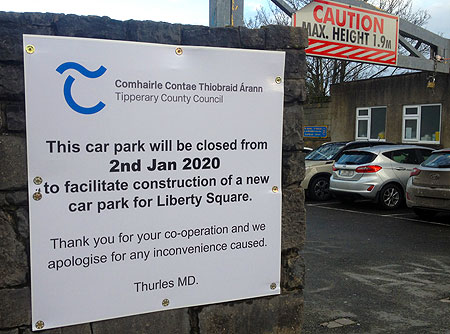
The car cark situated beside Lár Na Páirce, latter the Gaelic Athletic Association’s (GAA) Museum, on Slievenamon Road in Thurles, is to close Temporarily with effect from January 2nd, 2020.
Slievenamon Road car park, Thurles.
According to officials from the Thurles Municipal District, this area will be closed to facilitate the long-awaited further development of the new car park, which can be entered from the south side of Liberty Square (referred to affectionately as the ‘money side’).
This entrance was facilitated by the demolishing of Griffin’s newsagents’ premises.
One question however, for our local Municipal District Councillors to answer. Where is the plaque which I had personally erected in the mid 1990’s which was previously to be found located on the wall between CostCutters Off-License and the now demolished Griffin’s premises? [Watch Video and note dissappearence]. Certainly, CostCutters Off-License did not remove it in recent shop front upgrades. Could perhaps Smith Demolition throw some light on its disappearance. In the interest of Thurles residents, it is now essential that Tipperary Co. Council have this plaque replaced.
Not that it matters a whole lot as far as I personally am concerned; but not only have Thurles Municipal District councillors and Thurles Chamber, in association with Tipperary Co. Council; presided over the total destruction of Liberty Square, Thurles, Co. Tipperary as a business hub, but also our elected representatives must be seen as being responsible for the destruction of our valuable local history.
“Thousands of candles can be lighted from a single candle, and the life of the candle will not be shortened. Happiness never decreases by being shared”.
Buddha
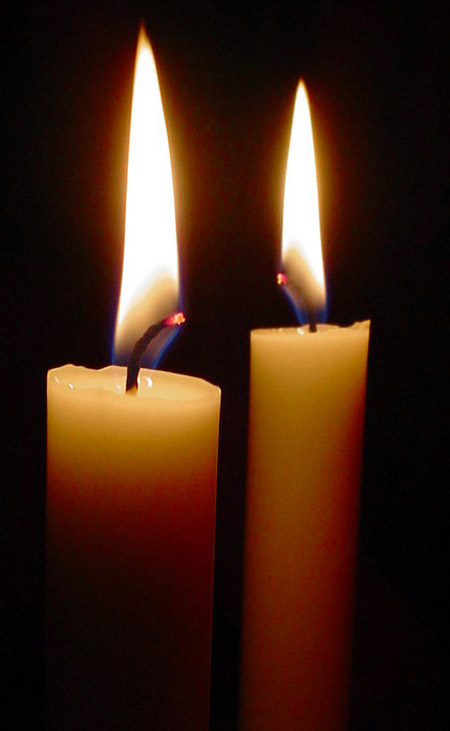
All the 54 years of her married life, every Christmas Eve, up until her death in 1969, Eliza-Jane, my grandmother, placed two candles in the window of our single-story home. She claimed that this tradition, gave a sign of welcome to all who passed our gate, and an invitation to come inside and share our fire.
A wooden slide bolt, on the back of our heavy door, remained pulled back, thus allowing any traveller who “passed the road” to enter, should they arrive after our family had retired to bed.
Should those travellers of course be named Mary and Joseph, then it was better not to advertise that a baby could be in their company. After all, according to the Gospel of St. Matthew, (Chapter 2 – Verse 7), KingHerod; fearing the prophesy handed down in the Old Testament, [Latter found in Isaiah Chapter 9: Verses 6 & 7 ] [Same foretold of the coming of a “Prince of Peace”, whose government would be endless.], had called the three Magi [Named Bithisarea, Melichior and Gathaspa], secretly and had sent them to Bethlehem, saying: “Go, search carefully for the Child, and when you find Him, report to me, so that I too may go and worship Him.” King Herod’s intentions were far from wanting to worship this new born Prince, as we read later and realising this also, the three astute Magi returned home by a different route, to avoid him.
Candle traditions of course change from district to district. Here in the province of Munster, most families lit just one candle; its purpose simply to offer light along the way for Mary and Joseph; on their way to find that stable in Bethlehem. The candle was traditionally lit by the youngest girl in the house, who would also be called upon to extinguish same on Christmas morning.
A house without a candle was seen as unwelcoming, as per the innkeeper who had refused a room to the same Joseph and Mary. In the years prior to and since the Great Famine (1845 – 1849), as emigration left so many Irish families missing a loved one at Christmas, the candle came to be seen more and more as a sign of welcome to those able to afford a visit home.
Another explanation for the lighting of candles in a window at Christmas time, dates back to the time of Na Péindlíthe, (English: Penal Laws). Same period saw the introduction of a series of laws imposed, solely, in an attempt to force Irish Roman Catholics and Protestant dissenters to accept an established Church of Ireland or Protestant faith. Begun in the early 1600’s, practicing Catholicism became outlawed, with priests often forced into hiding, in order to defy the British government’s order that they cease performing Mass and other Sacraments.
According to the Dublin born statesman and philosopher, Edmund Burke, the Penal Laws were, “a machine of wise and elaborate contrivance, as well fitted for the oppression, impoverishment and degradation of a people, and the debasement in them of human nature itself, as ever proceeded from the perverted ingenuity of man.”
However, these laws did little to convert the faith of Irish Roman Catholics. Lit candles on Christmas Eve became a sign that a family was of the Roman Catholic faith and thus candles became an open invitation to any passing priest to come inside and say Mass with the family at Christmas. This feigned welcome for the Holy Family now became an explanation or cover story, used by households when British officialdom queried this “lit – candle” practice during these penal times.
“Perfume follows you; it chases you and lingers behind you. It’s a reference mark. Perfume makes silence talk.”
Above quote by late French fashion designer and writer, Sonia Rykiel (1930 – 2016).
“Perfume is not just about finding a fragrance you like”, according to Allie Quinn, [Latter Resident Cosmetic Consultant, at “Liberty Pharmacy”, No. 34 Liberty Square, Thurles, Co. Tipperary]. “Your choice is also about finding a fragrance that represents you the person and who you are. As French fashion designer Christian Dior once said, “A woman’s perfume tells more about her than her handwriting”.
This Christmas what fragrance should I buy?
“It is important to remember that once you have found a fragrance that you like; its concentration will impact on the products overall cost. So, depending on your budget, you may want to pick either an Eau de toilette, an Eau de parfum or a Perfume Extract “, replied Allie.
So, what’s the difference?
Allie explains “Fragrances come in a range of oil essence concentrations. The more concentrated the oil essence, then it follows the more you can expect to pay. Typically, Eau de Toilette is the least concentrated (Roughly 10% essence) and thus is the least expensive version of any chosen fragrance. The scent lasts a short time before easing off, so, you need a big bottle to re-apply it regularly.”
Allie continued, “Eau de parfum on the other hand is more concentrated (as high as 20% concentration) and therefore at a higher price point. Although more expensive, the higher concentration should ensure you smell nicer and for longer.
“The most concentrated and most expensive version of any fragrance is the Perfume Extract version. It can contain up to as much as 40% oil essence concentration and is most often sold in small quantities, because a tiny drop lasts a very long time”, continued Allie.
“Being powerfully evocative, remains the wonder of all great perfumes. The ability to accurately describe what our nose is signalling to our brain, often doesn’t come easily to either women or indeed today’s men. However, most of the ‘mass market fragrances’ are indeed enchanting; with each and every product having been created by truly imaginative and incredible dedicated perfumers”, concluded Allie.
The proprietor of Liberty Pharmacy, Kate Kennedy, is quick to point out that while modern perfumery began in the late 19th century, ‘Perfumery’, as in the art of manufacturing perfumes, began initially in ancient Western and Southern Asia, and in Egypt, around 3300 BC; same to be further refined in the ninth century, by the Romans and the Arabs. Indeed in 2003, archaeologists found what they believe to be the world’s oldest surviving perfumes in Pyrgos, latter a village in Cyprus. The perfumes found in Pyrgos are understood to date back more than 4,000 years.
The Liberty Pharmacy at No. 34 Liberty Square, Thurles, presently carry a wide selection of all perfumes for men and women of all ages. To help you find that fragrance most suited for you, why not drop into the Liberty Pharmacy and seek advice from their resident cosmetic consultant.
“Wear perfume wherever you want to be kissed”, was the advice of the late French fashion designer, Nazi spy and businesswoman Gabrielle Bonheur “Coco” Chanel(1883-1971).
The location of the top photo, as indeed all identical three pictures, can be found immediately east of Barry’s Bridge in Thurles, Co. Tipperary and was taken possibly sometime in the very late 1800’s
This street is known today as Cathedral Street, but back then, was identified as east Main Street; same being a continuation of Liberty Square, which was then west Main Street.
Barry’s Castle & Barry’s Bridge
But, firstly let us deal with the nearby Barry’s Bridge and Barry’s Castle, here in Thurles and how both acquired their names.
The names Barry’s Bridge & Barry’s Castle came about because of a major error made by an Ordinance Survey officer, latter involved in changing the names of certain Thurles streets and lanes; operating on behalf of the then Thurles Urban District Council. A local resident, named Thomas Barry, latter who was occupied as a ‘Nailor’, then resided at No. 92, just two doors up from the east side of the bridge; residing in a small building attached to and fronting unto today’s St Angela’s Academy of Music.
This Castle, referred to today as Barry’s Castle, has dominated the Thurles skyline since 1453, and was built possibly by the Norman invader McRickard Butler, of whom history records that he erected two castles at Thurles, around the aforementioned year. The bridge referred to as Barry’s Bridge was built three hundred and seventy years later, circa 1650, and was partially reconstructed again, circa 1820.
Perhaps it is time again to rededicate both these ancient structures, naming them Butler’s Bridge and Butler’s Castle, after our Liberty Square eventually gets upgraded. Same should be undertaken in an effort to encourage neglected tourism, and the rapidly fading town centre footfall.
Despite constant promises made by individuals, who put themselves forward for both local and national elections, proper tourism marketing plans have been strongly resisted, and only lip service, not backed by deeds are being offered; in the case of a town, whose past history should be the envy of Europe.
Cathedral Street, Thurles
While many will look at the top picture and state that little has changed over the years, this of course is not the true case.
Reading the picture from left to right note the changes: –
The Ursuline Convent brick wall was moved back and replaced by today’s visable stone. The front side gate, once positioned immediately to the left, has also been removed and the wall moved back.
The two, one-story houses immediately east of the Cathedral’s main gateway are also gone. The first house, at No. 87 Main Street, was once occupied by Mathew Cahill, a Baker by trade, while next door, No. 86, was a Public House, once occupied by Daniel Maher. Both houses today are gone, replaced by the front lawn of the current Archbishop’s residence.
Unseen in the picture, but eastward again, beside these latter two named houses, once existed Chapel Lane, leading up to the rear of the Archbishop’s Palace. Here in this lane was erected at the top was the Archbichop’s stables; with a school for girls at No. 2. Andrew Cahill, the Archbishops servant, resided at No. 4; Thomas Dowling resided at No.5 and Widow Ryan resided in a thatched residence at No. 6. These tiny dwellings have today been erased and form the present driveway to the back door of the Archbishops Palace.
The next major change to this street is the removal of the high wall and arched entrance in front of the Presentation Convent, the pavement outside displaying just one Gas Light. During the “Night of the Big Wind” (Oiche na Gaoithe Moire, feast of the Epiphany, 1839) the once thatched roofed row of six terraced houses, numbered 80 to 85, caught fire, when thatch was blown down one of the chimneys. These six ruined dwellings, which included No. 85 – Ryan’s Bakery; No. 84 – Ms Lucy Dohan’s home; No. 83 – Tierney’s Hucksters Shop; No. 82 – Clear’s Grocery and Bakery; No. 81 – Ryan’s Grocery, Spirits & Candle business and No. 80 – Headon’s Shoemaker’s premises, were later acquired by the Presentation Convent, who in 1862 would replace them, to build their Secondary School Boarding House, and the faintly pictured, yet visible high wall; latter no longer evident today and replaced by a lower wall and railings.
Obviously, missing today, centre of the picture and positioned at the junction of Quarry Street [today Mitchel Street], between Church Lane and Pike Street [today Kickham Street], was O’Keeffe’s Brewery; later to become Ryan’s Brewery Stores. Same residence, large buildings together with enclosed yard have now been replaced by shops and the Circle K petrol station.
Occupation ‘Nailor‘: A nailor, as the name suggests, was occupied making iron nails by hand and / or also occupied maintained the teeth on carding machines, latter used to separate and straighten wool & cotton before weaving. Names such as ‘rose’; ‘diamond’; ‘clasp’; ‘pearl’ and ‘sunken’; identified to any consumer the shape of the nail head, while their points were identified as ‘flat’; ‘sharp’; ‘needle’ or ‘spear’. The names; ‘bastard’; ‘strong’ and ‘fine’, readily described the thickness of any nail required.
Occupation ‘Huckster‘: A ‘Huckster’ was a person who sold small articles, either travelling door-to-door or from a market stall or small store; todays ‘Hawker’ or ‘Peddler’. The word today, when expressed, is usually spoken in derogatory terms, thus expressing negative connotation.
November 9th is a date forever synonymous with German history; same never to be forgotten.
Today and in recent years the fall of the Berlin Wall, which occurred, this day, (on Thursday November 9th 1989), has somewhat overshadowed the events of Wednesday November 9th, 1938, latter which should have been a warning and a strong indication of the future Jewish Holocaust; latter also known as the Shoah, or the World War II extermination and genocide of 6 million European Jews and others, carried out between 1941 and 1945, in extermination camps and gas chambers.
Companies such as BMW, Deutsche Bank, Ford, Opel, Siemens and Volkswagen would later face lawsuits for their use of forced labor during World War II.
The French State owned National Railway Company (SNCF), agreed, as late as 2014, to pay $60 million to Jewish-American survivors, (around $100,000 each), for their role in the transporting of some 76,000 Jews from France to extermination camps, between the years 1942 and 1944.
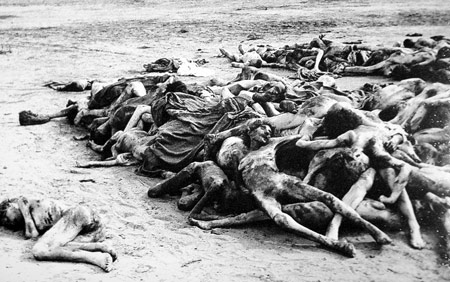
Emaciated dead Jewish bodies in a concentration camp, piled up awaiting disposal, which had then just been relieved by Allied troops.
On November 9th, 1938, German Nazis launched a campaign of terror against Jewish people and their homes and businesses throughout Germany and Austria. The violence, which continued through until Thursday November 10th was later labelled “Kristallnacht,” or “Night of Broken Glass,” following the countless smashed windows and other vandalism systematically carried out on some 7,500 Jewish businesses. Same deliberate, orchestrated and senseless activity would leave that night approximately 100 Jewish people dead and hundreds of synagogues, private homes, educational centres and graveyards, vandalized and pillaged.
Today is the anniversary of a peaceful revolution
However, for today at least, let us commemorate the fall of the Berlin Wall [German: Mauerfall – English: Fall of the Wall), which happened this day, 30 years ago, November 9th 1989. Same event was widely regarded as a pivotal event in the history of our world, soon to mark the fall of the “Iron Curtain”, latter a political, military, and ideological barrier, erected by the Soviet Union, following World War II; thus sealing off other non-communist countries.
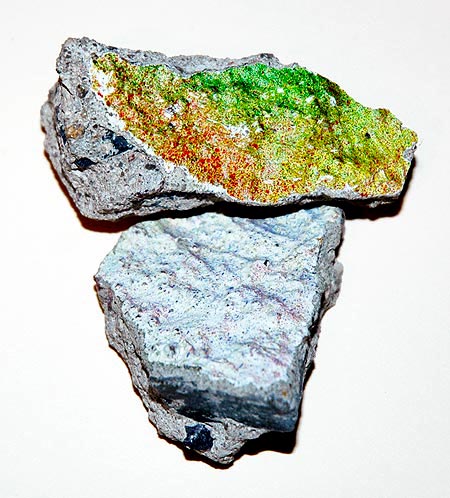
Two pieces, each from both sides of the Berlin Wall, on display previously here in Thurles. Note: The graffiti paint on the top piece, is from the western side.
Following the earlier dismantling of an electric fence (April 1989), latter which had stretched along the border between Hungary and Austria; refugees were finding their way into Hungary via Czechoslovakia.
This emigration was initially tolerated because of long-standing agreements with the communist Czechoslovak government, which had allowed for free travel across their common boundary.
This permitted movement of people now grew so large that it caused great difficulties for both countries. To further add to this, East Germany was struggling to meet loan payments on foreign borrowings.
Former East German politician, who was the last communist leader of East Germany, Egon Krenz had sent Alexander Schalck-Golodkowski to unsuccessfully negotiate a short-term loan from West Germany, to enable East Germany to make their interest payments.
It was at a Politburo meeting on November 7th of that year, that it was decided to enact a portion of the draft travel regulations addressing permanent emigration immediately. At the start, the Politburo planned simply to create a special border crossing near Schirnding, Bavaria, specifically for this current emigration. Personnel at the Ministry for State Security (Staatssicherheitsdienst, SSD or Stasi) had been charged with fashioning new document text for these intended changes. The latter had concluded same changes were not feasible and had produced instead new text relating to emigration and temporary travel details.
This new text now stipulated that East German citizens could apply for permission to travel abroad without having to meet the previous requirements then in vogue for similar journeys.
To ease the obvious difficulties, the Politburo, led by Egon Krenz, decided on November 9th to allow refugees to exit directly through crossing points between East Germany and West Germany, including between East and West Berlin. Later that same day, the ministerial administration modified this proposal to include private and round-trip travel. The new regulations were to take effect the next day.
An end to the Cold War was declared at the Malta Summit, on December 2nd–3rd, 1989, some three weeks after the fall of the Berlin Wall; latter which comprised a meeting between US President George H. W. Bush and the Soviet General Secretary Mikhail Gorbachev. The reunification of Germany would take place during the following year.
The actual announcement of these new regulations, which saw the wall taken down, took place during an hour-long press conference. Same led by Günter Schabowski, (latter an official of the Socialist Unity Party of Germany; the party boss in East Berlin; and the spokesman for the Socialist Unity Party (SED) Politburo). The press conference began at 18:00hrs Central European Time on November 9th and was broadcast live on East German television and radio, both then the state television and broadcaster in the German Democratic Republic (East Germany).
This website uses cookies to improve your experience. We'll assume you're ok with this, but you can opt-out if you wish.AcceptRead More
Privacy & Cookies Policy
Privacy Overview
This website uses cookies to improve your experience while you navigate through the website. Out of these, the cookies that are categorized as necessary are stored on your browser as they are essential for the working of basic functionalities of the website. We also use third-party cookies that help us analyze and understand how you use this website. These cookies will be stored in your browser only with your consent. You also have the option to opt-out of these cookies. But opting out of some of these cookies may affect your browsing experience.
Necessary cookies are absolutely essential for the website to function properly. This category only includes cookies that ensures basic functionalities and security features of the website. These cookies do not store any personal information.
Any cookies that may not be particularly necessary for the website to function and is used specifically to collect user personal data via analytics, ads, other embedded contents are termed as non-necessary cookies. It is mandatory to procure user consent prior to running these cookies on your website.




Recent Comments