“Violence is the weapon of the weak, non-violence that of the strong.”
“A good person will resist an evil system with his whole soul. Disobedience of the laws of an evil state is therefore a duty”.
[Quotes made during the life of Mahatma Gandhi.]
Looking at the behaviour our planet on just today alone, it is difficult to contemplate that, yes, today Monday, October 2nd, is the International Day of Non-violence, in honour of the birthday of Mahatma Gandhi.
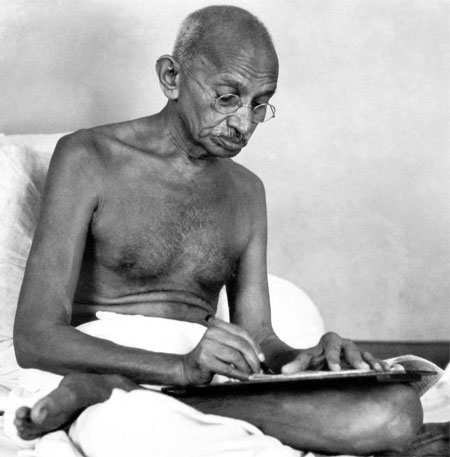
Gandhi in 1942 – (Picture Dinodia Photos/Getty Images)
The once leader of the Indian independence movement against British rule, Gandhi was born Mohandas Karamchand Gandhi on October 2nd, 1869 and was assassinated on January 30th 1948, in his 79th year, by a Hindu nationalist, one Nathuram Godse, latter who had links with the extremist right-wing Hindu Mahasabha political party. Gandhi, alas, died when his assassin fired three bullets from a 9mm Beretta pistol into his chest at point-blank range.
The birthday of Mahatma Gandhi, on today Oct. 2nd 2017, is commemorated as Gandhi Jayanti, (meaning Gandhi Jubilee or festival) an official national holiday celebrated in India, usually by prayer meetings, commemorative ceremonies in different cities, in colleges, local government institutions and socio-political institutions. Painting and essay competitions are conducted as projects in schools and communities, encouraging discussion on a non-violent way of life.
On June 7, 1893, while travelling from Durban to Pretoria, Gandhi was asked to leave the first-class compartment on a train and move to the van compartment, despite having purchased a first-class ticket. When he refused, he was physically thrown from the carriage. This incident transformed Gandhi from the extremely shy, struggling barrister into a political activist, who would from that time go on to oppose all racial discrimination.
Likewise, while working in South Africa, Gandhi again faced discrimination, because of the colour of his skin. He was not allowed to sit with European passengers in a stagecoach and was told he had to sit on the floor next to the driver. He was then beaten when he refused. Indians during that time were not allowed to walk on public footpaths in South Africa, which led to him being kicked into a gutter by a police officer, for daring to walk near a house.
In yet another occasion, he was thrown off a train at Pietermaritzburg, having refusing to leave the first-class compartment. Here in protest he remained sitting in the train station, shivering all night, seriously considering whether he should return to India, or protest in support of his human rights. Thankfully he chose the latter and was allowed to board the train next day.
Known with the great respect as the “Father of the Nation” in India, Gandhi went on to play a pioneering role in India’s struggle for independence, emerging as a global icon of non-violent protest.
In the words of Dr Martin Luther King; “Gandhi was inevitable. If humanity is to progress, he is inescapable. We may ignore him at our own risk.”
Surely today these prophetic words, by Dr King, regarding Gandhi, must reverberate across the world, in light of today and other more recent happenings.
Cork University Press today published, “Atlas of the Irish Revolution” regarded by history commentators as being the most comprehensive treatment of Ireland’s revolutionary years, from 1912 to 1923.
The Atlas of the Irish Revolution; edited by John Crowley, Mike Murphy, Donal Ó Drisceoil with associate editor John Borgonovo, weighs 5kg and contains just under 1000 pages, featuring hundreds of maps, photographs, paintings and other illustrations.
The publication presents the history of the Irish Revolution in a truly vivid and scholarly way, while using many photos and archival documents that have rarely been seen by the Irish public.
All key events are covered, through some 140 contributions from leading scholars; discussing the Home Rule Crisis, the First World War, the Easter Rising, the First Dáil, the War of Independence, the Treaty and the Civil War.
The roles of women and workers are also highlighted, as are the experiences of Ulster Unionists, Southern Protestants and Irish people in British uniforms.
The Deserted Village “And, as a hare, whom hounds and horns pursue, Pants to the place from whence at first she flew…” Oliver Goldsmith (1728–1774).
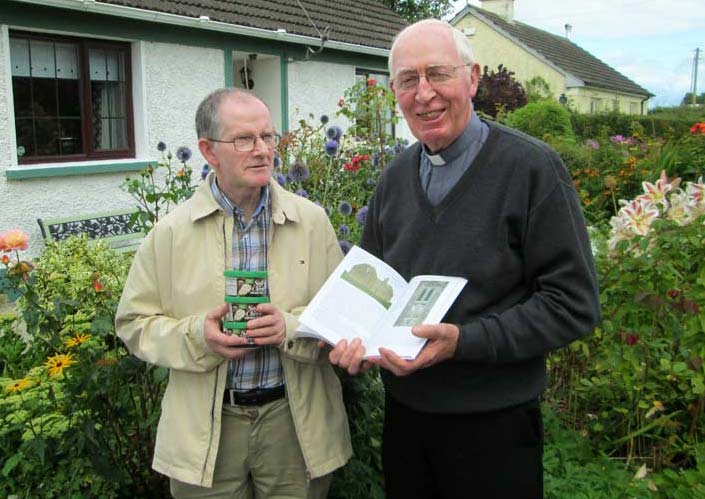
Pictured Above: Fr. Joseph Ryan (Larry Ryan), as he prepares to return to Norway with cheese donated by the Hayes family, Liathmore, Two-Mile-Borris, Thurles, Co. Tipperary, pictured with local priest Rev. Fr. George Bourke, latter donating a copy of the History of Pouldine School, outside the Ryan family home, Thurles Rd., Littleton, Thurles, Co. Tipperary.
Local correspondent Mr Gerry Bowe reports:-
On holiday this month with his family, who reside at Thurles Rd., Littleton, Thurles, Co. Tipperary, is Fr. Joseph Ryan (Larry Ryan) who has spent the last 25 years at the Cistercian Monastery in Mellifont Co. Louth. Fr. Joseph has been recently moved, on a permanent basis, to a new Monastery, which is at an early construction stage, in Norway. Currently the community is small with two priests and two brothers and a fifth member due to join them shortly.
The sale of home-made Monastery cheese currently helps pay the communities bills and on a recent visit to the sixth century Monastic site at Liathmore, Two-Mile-Borris, Thurles; associated with Saint Mocheomog(1); Fr. Joseph is reminded that today cheese making, on these same ancient monastic lands, continues to be carried on by the Hayes family. Mr Donal Hayes, on behalf of the Tipperary Cheese Company, gladly donated tubs of their soft cheese, which Fr. Joseph will now share with his brothers back in Norway.
(1) St. Mocheomog or Pulcherius, who studied under St. Comgall at Bangor and afterwards founded monasteries in Leinster and Munster; is said to have been born circa 550 A.D. and to have died at Leigh (Liath, Liathmore) in Co. Tipperary, on March 13th, (Year Unknown) at a great age.
Rev. Fr. George Bourke, in one of his final gestures as Parish Priest (PP) of Moycarkey-Borris-Littleton parish, presented Fr. Joseph with a copy of the Pouldine School History (Pouldine School – Inné agus Inniu) which has an excellent article by former Principal Mr Liam O’Donoghue, on the history of Liathmore.
Fr. Joseph met with members of the local ‘Legion of Mary’, and indeed attributes his calling to the times spent helping at the ‘Morning Star Men’s Hostel’, in Dublin city.
Fr. Joseph takes with him the best wishes of Moycarkey-Borris-Littleton parish community and for those wishing to contact him or spend some time on retreat, his address is Fr. Joseph Ryan, Munkeby (meaning ‘Place of the Monks’) Mariakloster, Munkeby Veger 310, Levanger, 7608, Norway.
The government has announced that they are to allocate almost €135,000 of taxpayers money into local and regional museums around the country.
A series of small grants with maximum funding of €15,000, have been made available under the Local and Regional Museums Funding Scheme 2017.
This money can be used for everything from the purchasing of purpose built display cabinets, to the designing new websites.
A total of twenty-three projects are presently to be undertaken nationwide.
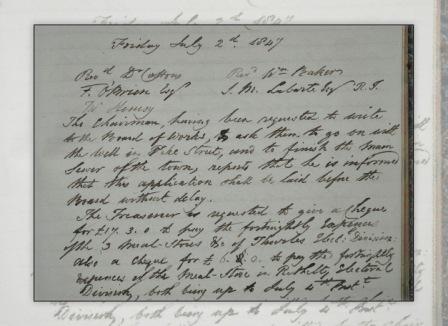
One such project here in Co. Tipperary will involve the Tipperary County Museum, and will sees an allocation of some €8.000 used for the setting up of an exhibition called “A message in time”.
The Tipperary County Museum is open to the public from Tuesday to Saturday from 10.00am – 4.45pm, (Closed Sundays, Mondays and Public holidays) and admission is free.
Only known image of Brady’s Mill, once situated in Archerstown, near Thurles. (Courtesy Michael Bannon.)
The more elderly members of our Thurles community still refer to Brady’s Mill as a general landmark, but of course, alas, Brady’s Mill today has long vanished from our Thurles district landscape. The limestone from its original walls I understand was moved to repair walls at Farney Castle.
Brady’s Mill once stood on the bank of the stream known as the Breagagh river,101 metres above sea level at Archerstown, Thurles. (Latitude: 52° 41′ 10″ (52.6861°) north, Longitude: 7° 45′ 53″ (7.7647°) west)
According to the Bureau of Military History (1913-21), it was sometime between mid-summer and mid autumn of 1918, that Brady’s Mill entered the spotlight in our town’s rich history. Around that time a meeting was convened to organise three formed Irish Republican Army (IRA) Battalions into a Brigade, which would be known as the 2nd (or Mid-Tipperary) Brigade of the IRA, during the Irish War of Independence.
This meeting consisted of officers of the 1st (Thurles), 2nd (Templemore) and 3rd (Upperchurch) Battalions and was presided over by Senator Michael Staines[1](1st May 1885 – 26th October 1955), who travelled from Dublin for the occasion. At that meeting James Leahy, Thurles, was elected Brigade Commandant; Edmond McGrath of Loughmore, was elected, Vice-Commandant; Michael Kennedy of Thurles, as Adjutant; and lastly John McCormack of Thurles, as Quartermaster.
[1]Michael Staines served as Quartermaster General in the GPO during the 1916 Easter Rising. Following ‘The Rising’ he was interned with fellow GPO insurgents at Frongoch internment camp, Merionethshire, in Wales; held under the Defence of the Realm Act 1914, which stated that he was “suspected of having honoured, promoted or assisted an armed insurrection against His Majesty.” Staines was later elected Commandant at Frongoch, after the former Commandant Jeremiah Joseph (J.J. ‘Ginger’) O’Connell was sent to Reading Gaol, Berkshire, England, on June 30th of that year.
Staines is possibly remembered best as the first commissioner of An Garda Síochána, of which he once stated, “The Garda Síochána will succeed not by force of arms or numbers, but on their moral authority as servants of the people.”
J.J. (Ginger) O’Connell, whom Staines replaced as Commandant at Frongoch, would be kidnapped in Dublin on June 27th 1922, by anti-treaty IRA forces from the Four Courts garrison. Same was in reaction to the arrest of Leo Henderson, following his raid on the car dealership of Harry Ferguson in Baggot St, Dublin, and became one of the reasons that led to the decision by Michael Collin to attack the Four Courts, the first act in the Irish civil war.
When next we hear of Brady’s Mill, same is contained in an article printed in the ‘Clonmel Chronicle’ on January 29th, 1921. (Place of publication of the ‘Clonmel Chronicle’ was Clonmel, in Co. Tipperary, from 1848 – 1935. The paper was published twice weekly at a cost of fourpence and published by S. Collins, Clonmel.)
This Report Reads:-
“On Thursday (27th January 1921), a large party (about eighty) of military, in two companies, followed by ten or twelve police all armed and marching in open formation, were seen turning down into Bank Street, (today known as Slievenamon Road, Thurles).
In the centre of the force attracting a good deal of attention, by a jennet (A small Spanish horse regarded as useful for war.) or pony; the owner walking at the animal’s head, and in the car were two or three machine guns. The appearance of such a formidable force attracted a good deal of attention, and there was a lot of speculation as to the reason for their appearance.
The forces marched along the Turtalla Road, and then to Archerstown, a townsland a couple of miles out from the town. Here they spread themselves out and made a search of the district.
At Brady’s Mill the police state they found some ammunition buried in the garden attached to the Mill and Mrs Brady’s son (Daniel) was arrested and and brought into the R.I.C. barracks. The forces returned in batches, and as the last party of police arrived at the River Bridge on their way back to Barracks they came upon Jeremiah Ryan of Liskeeveen, who is said to have been “on the run” for some time and James K. O’Dwyer, late of Molloy, Thurles. The men ran, on the approach of the police, who pursued them into a vacant house nearby and captured them. They also were lodged in the RIC barracks.
It is stated that the reason for the visit to Archerstown was that word was conveyed to the police that an ambush was being prepared near the place, but nothing definite can be ascertained as to this, and it is also stated that there was some skirmishing about the place. One of the police returning was seen to be bandaged, and another carried a broken rifle in addition to his own.
The whole affair has caused a great deal of excitement in town.”
Brady’s Mill, yet another piece of valuable history that has been allowed to vanish from the Thurles area.
This website uses cookies to improve your experience. We'll assume you're ok with this, but you can opt-out if you wish.AcceptRead More
Privacy & Cookies Policy
Privacy Overview
This website uses cookies to improve your experience while you navigate through the website. Out of these, the cookies that are categorized as necessary are stored on your browser as they are essential for the working of basic functionalities of the website. We also use third-party cookies that help us analyze and understand how you use this website. These cookies will be stored in your browser only with your consent. You also have the option to opt-out of these cookies. But opting out of some of these cookies may affect your browsing experience.
Necessary cookies are absolutely essential for the website to function properly. This category only includes cookies that ensures basic functionalities and security features of the website. These cookies do not store any personal information.
Any cookies that may not be particularly necessary for the website to function and is used specifically to collect user personal data via analytics, ads, other embedded contents are termed as non-necessary cookies. It is mandatory to procure user consent prior to running these cookies on your website.
 The government has announced that they are to allocate almost €135,000 of taxpayers money into local and regional museums around the country.





Recent Comments