|
|
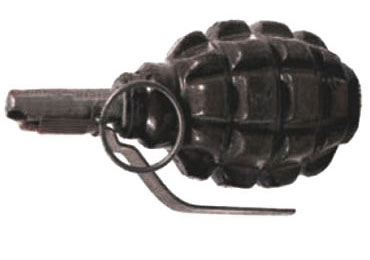 Grenade An Explosive Army Ordnance Disposal unit carried out a controlled explosion on a device found in a shed wall near the Slievnamon / Turtulla Road (N62) in Thurles, at around 4.30pm yesterday afternoon.
A member of the public had contacted Thurles Garda station, informing them that they had discovered the device in the Rosemount area of the town.
Thurles Gardaí having responded quickly to the call; observed what appeared to be a grenade at the location. The area was then quickly cordoned off and a number of houses in the vicinity were evacuated, as a matter of standard safety protocol.
The Explosive Ordnance Disposal team were dispatched to the incident arriving, at approximately 6.30pm. Traffic was halted and rerouted temporarily, while the device was made safe using a controlled explosion.
It is understood that the device may have gone undiscovered at the location for many years.
The 16th Century Norman ‘Black Castle’ In Thurles, Co. Tipperary, Is To Be Restored.
The former ‘Black Castle’, west of Liberty Square, close to the Charles Stewart Parnell carpark, in Thurles, Co. Tipperary; once home of Lord Viscount Thomas Butler & his wife, Lady Viscountess Elizabeth Butler (alias Poyntz), has been sold.
 Dr. Phyllis Maher, [Chief Executive Officer (CEO) Timothy Maher Finance]; Independent Dáil Éireann Deputy Mr Michael Lowry, TD & Sir Timothy Maher, [Chairman & Chief Financial Officer (CFO), Timothy Maher Finance] The privately-owned building had been offered for sale in May of last year by the Kenny family; relatives of the late Mr Billy Maher (Victualler), through the offices of Mr Sean Spain Auctioneers & Valuers, No 21 Fianna Rd, Thurles, Co. Tipperary.
The hugely historical building, in vacant possession, has now been purchased by Sir Timothy Maher (Knight of Innisfallen & Chairman & Chief Financial Officer (CFO), of Timothy Maher Finance) & his Lady wife American born Dr. Phyllis Maher (Chief Executive Officer (CEO), of Timothy Maher Finance). The couple are also well respected in antiquities and fine art circles.
Sir Timothy Maher, well remembered for his hurling prowess as a student in Cashel CBS, is originally a native of Boherlahan, Cashel, Co. Tipperary; son to the late Mr Michael Maher & Mrs Dina Maher, Castle Farm, Thurlesbeg, Co. Tipperary. His grandfather was Mr William Maher, Knocka, Drom, Co. Tipperary; a former Chairperson of North Tipperary Co. Council, whose son Fr. Thomas F. Maher, in turn was ordained a priest in St Patrick’s College, Thurles, now Mary Immaculate College, Thurles.
His wife, Dr. Phyllis Maher, who is a retired Medical Practitioner and who in the past specialised in serious trauma cases; is the only daughter of Mr Woodrow (Sean) O’Shields & Mrs Mildred O’Shields (nee O’Sullivan), natives of Oughterard, Co. Galway. Dr. Maher was conceived in Ireland and born a shortly time later, following the arrival of her parents in America.
Of course, the surname of ‘Butler’ is no stranger to the new purchasers, as Mr David Butler, former business proprietor in Liberty Square, Thurles and his sister M/s Jean Butler, a former Principal at the Presentation Convent here in Thurles for some 18 years; we discover, are Sir Timothy Maher’s in-laws.
The purchasers were first introduced to the property by Independent TD Deputy Mr Michael Lowry, who became aware that the couple were searching for a substantial property here in Ireland and suggested that they contact Mr Sean Spain, with a view to purchasing a building with a rich historical heritage. Following Mr Lowry’s invitation and a viewing of the property led by Mr Spain; Sir Timothy and Dr. Phyllis Maher; themselves lovers of Irish history, fell in love with the building and made their decision to purchase.
The successful firm of DHRyan Architects, No.1 Liberty Square, Thurles, have now been employed to undertake a feasibility study of the site and its associated buildings, and to prepare a development brief for the new purchasers. Solicitor Mr James J. Meagher (Thomas F. Griffin Parnell St, Thurles) have been retained to deal with all aspects of the site transfer.
Speaking afterwards to individuals with a major interest in promoting tourism within Thurles and the greater Co. Tipperary area, Michael Lowry TD stated; “I forecast exciting times ahead over the next 16 months for the town of Thurles; where a historical and iconic building, which was falling into dereliction, will rise once more to enhance our westerly horizon.”
“It should be noted” stated Lowry, “that the building may have become known as the Black castle in the past; due to it appearing as a black silhouette against the setting sun, however I remain confident that the new developers, through their love of history and antiquities, will give Thurles a sense of even greater pride in the months ahead, as necessary work is completed.”
So, who was Lord and Lady Thurles
Lady Thurles, (Elizabeth Poyntz) was formerly a native of Gloucestershire, England, and history records that her parents, who resided in Acton Court, Gloucestershire, once hosted King Henry VIII and the second and the most famous of his six wives, Miss Anne Boleyn, both who visited and stayed with the Poyntz household on Saturday August 21st, 1535, thus emphasising the social standing of the then Poyntz family. (Anne Boleyn was subsequently executed by King Henry, being beheaded, less than one year later, on the 19th May 1536.)
Thomas Butler (Lord Thurles) was son of Walter Butler “Walter of the Rosaries,” latter probably the first of the Butler family to take up residence in the Black Castle. [Note: The “Walter of the Rosaries,” Chalice still exists in Thurles to this very day. Thomas married Miss Elizabeth Poyntz in 1608, against her father’s wishes; Sir John Poyntz was then seriously in debt, and would die penniless in 1633.
Lord Viscount Thurles was summoned from Tipperary by King James 1st, (1603–1625) to England in 1619 to answer charges of treason, but the ship, conveying him, was wrecked in a storm off the coast of Wales, in an area known as ‘The Skerries‘ and he was drowned 10 days before Christmas, on 15th December 1619.
His wife Lady Elizabeth Butler (Poyntz), the celebrated ‘Lady Thurles’ now found herself a widow and a lone parent of three sons and four daughters.
After the death of Lord Viscount Thurles, Lady Thurles, married again, less than one year later in 1620, Captain George Mathew of Radyr and Llandaff in Glamorganshire, Wales, by whom Lady Thurles had a further two sons and one daughter.
Captain George Mathew died at Tenby in Wales in 1636. A period portrait, oil on canvas, of Lady Viscountess Thurles is in the possession of the Tipperary County Library, situated in The Source building, in Cathedral Street, Thurles.
Elizabeth and Thomas Butler, through their first son James FitzThomas Butler, 1st Duke of Ormond, is a direct progenitor (ancestor) to Charles Prince of Wales, whom readers will know as the eldest son and heir apparent to the British throne, set to follow the present Queen, Her Majesty Queen Elizabeth II of England.
The late Princess Diana is also connected to the history of the castle through one of the daughters of the said Lord Thomas and Lady Elizabeth of Thurles, (namely Mary Butler). She married into the Hamilton family, and her later descendants would eventually marry into the Spencer family, leaving the late Princess Diana a 12th cousin, twice removed, of Charles, Prince of Wales and Duke of Cornwall and Duke of Rothesay since 1952.
Despite a visit from Oliver Cromwell’s Parliamentarian army during the period 1658 to 1660, Lady Thurles and her children resided in the castle for a great deal of her life from her marriage until her death in 1673.
“The Power of Words”
“Silence is the first thing after hate, that is dangerous, because silence indicates approval”.
[The words of Sonia K, a Holocaust survivor, forced to reside first in the Warsaw Ghetto, before being transported to four concentration camps; namely Majdanek on the outskirts of the city of Lublin, Poland; Auschwitz, 37 miles west of Krakow, Poland; Ravensbruck, 56 mls north of Berlin, Germany; and finally, Malchow, Mecklenburg, Northern Germany.]
Every year, on the last Sunday in January, closest to the date of the liberation of Auschwitz-Birkenau concentration camp in Poland, by Russian troops (January 27th 1945); this same date across the world, has been dedicated as Holocaust Memorial Day.
During the existence of Auschwitz-Birkenau concentration camp, the Schutzstaffe (SS) camp authorities murdered nearly one million Jews from across Europe, together with other victims, which included approximately 74,000 Poles, some 21,000 Roma (Gypsies), and approximately 15,000 Soviet prisoners of war.
Today, January 28th 2018, this year’s theme is ‘The Power of Words’; yes, debate can make a difference today, both for good but alas also for evil. Nevertheless, this gathering of people is to remember that over six million Jews were brutally massacred by mad men, through being forced to live in Ghetto’s; in Concentration Camps; through the use of Carbon Monoxide Gas Wagons, and the deliberate use of Zyklon B Pellets, introduced into gas chambers designed to look like shower rooms, between 1942 and 1945.
These people the majority of which were Jewish, had been brought into numerous Concentration Camps from across Europe by train and cattle truck, the sole purpose, to enslave and annihilate.
Here in Ireland a Memorial Ceremony has been held in Dublin this evening, marking National Holocaust Memorial Day, organised by the Holocaust Education Trust Ireland. include readings, survivors’ recollections, and music.
The event was held in the Mansion House, and included readings, survivors’ recollections, music and the lighting of six candles to symbolise the six million Jewish people who lost their lives. Over 100 school children from across Ireland took part in the ceremony, reading from the Scroll of Names of Irish people living here in Ireland, whose next of kin died during the Holocaust.
The ceremony was attended by Taoiseach Mr Leo Varadkar, Minister for Justice, Mr Charlie Flanagan, Lord Mayor of Dublin, Mr Mícheál Mac Donncha, together with other dignitaries.
“We Remember”.
Thurles Lions Trust To Hold Information Day On Stanwix Homes Refurbishment
 Stannix Home, Thurles, Co. Tipperary
The Department of Housing has granted an allocation €3.15 million for the upgrade of the Stanwix Homes to Thurles Lions Housing Trust Association, who intend to carry out repairs to the existing building, as well as building new housing structures on the adjoining land.
To learn more regarding the history of the Stanwix Homes, click HERE.
Thurles Lions Club members through Thurles Lions Housing Trust Association, are now asking the community to please note that a public information day regarding The Stanwix Homes will be held on Saturday next, 13th January 2018, in the Order of Malta Hall, Boheravoroon (Borroway), Thurles Townparks, Thurles, Co. Tipperary, from 11.00am to 4.00pm.
Plans for the proposed refurbishment of The Stanwix Home, Upper Kickham Street, Thurles are now taking shape. This iconic building, known with affection as “The Widow’s Homes”, has provided sheltered accommodation for some 129 years. However, despite upgrading by Thurles Lions Club in the past, this accommodation is no longer suitable to modern day required standards, and thus a major refurbishment of the property is now well overdue. Future proposed works will ensure that the property can continue to provide sheltered accommodation, to a modern standard, for the next 100 years.
The plans to be put forward by Thurles Lions Trust Housing Association are to oversee the refurbishment of the existing building, latter a protected structure, to the highest possible standards; this together with the construction of new units of accommodation on the site. It is hoped to submit an application for planning permission to Tipperary County Council for works in the very near future, which, if approved, will deliver a total of 19 accommodation units for the site.
The new proposals include for the provision of the following facilities:-
(1) Nine one bedroomed apartments, to modern accommodation standards, following the refurbishment of the existing Stanwix apartments.
(2) Five new own-door one bedroomed apartments in a new block.
(3) A community home to accommodate 4 adults who will require 24 hour supported accommodation in addition to accommodation for 1 carer, and
(4) A communal facility in the former Director’s House which will combine community facilities for the residents of the development, with a support centre for the local community.
Prior to submitting the application for planning permission, Thurles Lions Trust are holding an information day where the plans for the proposed development can be viewed and where comments and suggestions from the public are welcome.
Thurles Lions Club are now inviting people to come along to Saturday’s public information day and give them your views.
For further information email john.mccormack@tlh.ie
Here in rural Ireland in particular, we use English everyday phrases with little understanding of their age or initial origin. So where did these, often descriptive, phrases originate?
“It’s Raining Cats and Dogs”: How often have you heard the phrase, “It’s Raining Cats and Dogs outside”. This saying is associated with the days, back when a large amount of homes had thick thatched straw or reed roofs, supported strongly with thick, wooden branches underneath. (Pic. 1 hereunder.) Same straw/reed thatched low roofs would often become home to domestic animals on cold winter nights; all attempting to keep themselves warm against freezing conditions, e.g. cats and dogs. When it rained the reed or straw would become slimy and sometimes the animals would slip and fall from the roof, particularly when cats went searching for mice, who also shared their thatched environment.
 (Pic. 1) (Pic. 2) (Pic. 3)
“Dirt Poor”: The description “Dirt Poor”, came from the fact that floors in most labourer’s cottages were simply dry clay/dirt upon which the house had been originally built. Only those wealthy could afford flag limestone or slate floors.
“Carry a Bride Over the Threshold”: So too the phrase, “Carrying a Bride Over the Threshold”. A threshold, as most people are aware, is usually a piece of timber planking or cut stone, forming the bottom of a doorway and crossed when entering any house or out-office. In earlier times floors coated in flag limestone or slate became greasy with muck and water carried in on boots and shoes. To avoid slipping, on wet well-travelled floors particularly in Inns, Hostelry’s and farmhouse kitchens; same were kept covered in threshed straw, with a board across the doorway to hold the straw back at the entrance, hence “Thresh Hold”.
To deviate slightly; the necessity to carry a bride over the threshold first began with the ancient Romans. The bride had to show, and even sometimes pretend, that she was not at all excited about leaving her father’s home, and so she had to be dragged across the threshold of her new groom’s house. Ancients believed also that evil spirits could curse the newly married couple, and would wait at the threshold of their new home. To avoid this curse the bride had to be lifted up to ensure that the evil spirits could not enter her body through the soles of her feet. These days, this exercise is carried out just for fun; then again, based on a few brides I have met in the past, the custom could have some basic truth. 😉
“Sleep Tight and Don’t Let the Bed Bugs Bite”: “Sleep Tight”, which was later enlarged to “Sleep Tight and Don’t Let the Bed Bugs Bite”; comes from way back in the 1500’s and indeed long before, when middle and upper-class persons began sleeping on wooden bed frames to avoid sleeping on damp floors. These bed frames were strung from side to side with heavy lengths of rope, which in turn supported a stuffed mattress. These ropes would stretch over time, forming a hollow in the bed, so it became necessary to tighten them. Hence the saying, “Sleep tight.”
Later of course was added, “Don’t Let the Bed Bugs Bite”, referring to the need for a canopy over the bed. (Pic. 2 above.) It may have been “Raining Cats and Dogs” outside, but with straw or reed roofs, there was little to stop creepy crawler’s, dust, foreign matter and mice falling from non-plastered ceilings inside the house; messing up your bed linen. It now became necessary to construct bed frames with four tall posts at each corner, covered over with cloth to offer roof protection to sleepers. Curtains around the beds would be later added to cut down on draughts. With the move to plastered interior ceilings, along came the ‘Half Canopy Bed’, (Pic. 3 above.) making sure to protect just the heads of those sleeping on their backs, snoring, with their mouths wide open.
Of course the belief that we all swallow, in our sleep, eight spiders on average each year is a total myth; flying in the face of both a spider’s intelligence and human biology, making it most unlikely that a live spider would ever end up in a mouth breathing out hot air in the first place.
|
Support Us Help keep Thurles.info online by donating below. Thank you.
Total Donated 2026: €290.00
Thank You!
Daily Thurles Mass Livestream
|





Recent Comments