|
|
What has Thurles Railway Station, Co. Tipperary and the English Houses of Parliament got in common?
Mr Sancton Wood (1815–1886) was an English architect, born in the London Borough of Hackney. He was the son of Mr John and Mrs Harriet (née Russell) Wood, his mother being a niece of the painter and antiquarian draughtsman, Mr Richard Smirke, (1778–1815).
Back in 1845, the first year of the Great Famine here in Ireland, Mr Sancton Wood won a competition for the designing of Kingsbridge StationA. in Dublin (Built 1846). The competition, commissioned by the Great Southern & Western Railway Company, saw Wood’s designs selected unanimously by the railway company’s London Committee, despite the fact that the Dublin Committee had favoured the design of an Irish architect, Mr John Skipton Mulvany, latter a founder member of the Royal Hibernian Academy of Art, situated in our capital city of Dublin.
A. Note: Kingsbridge Station in Dublin of course is today called Heuston Station, renamed in honour of Seán Heuston, an executed leader of the 1916 Easter Rising, who had worked in the offices of Kingsbridge Station.
In that same year Mr Sancton Wood was appointed as architect to the Great Southern & Western Railway Company; designing all the railway station buildings between Monasterevin, Co. Kildare (including Thurles Railway Station) and Limerick Junction inc..
All of these station houses, with the exception of Limerick Junction station, are designed in a gabled picturesque Gothic style. Mr Wood also later became an architect to the Irish South Eastern Railway Company, which developed their railway line between Carlow and Kilkenny from 1848-1850. Six years later Mr Woods work, with reference to Ireland, appears to have ceased altogether.
 Top Pic.: Thurles in 1846, before the introduction of the Railway in 1847/48. Middle Pic.: Back entrance view of Thurles railway station. Bottom Pic.: Front entrance of Thurles railway station. Architect Mr Sancton Wood – The Early Years
Having developed a taste for drawing, Sancton Wood’s mother arranged to have him admitted to the office of his cousin, Sir Robert Smirke, RA. (Royal Academy), latter then an artist and leading London architect. From here he was transferred to Mr. Sydney Smirke, R.A., who succeeded to his brother’s practice. He remained with Mr Sydney Smirke for several years, working on the drawings of important works; which included sketches of the designs for the rebuilding of the Houses of Parliament, which Sir Robert Smirke had already prepared for Sir Robert Peel B. the Prime Minister of the then English Conservative Party government, (1834–35), following a fire on October 16th, 1834.
B. Sir Robert Peel had entered politics in 1809, at the age of just 21 years, as an MP for the Irish rotten borough of Cashel, just 14 miles from Thurles here in Co. Tipperary. The son of a wealthy textile-manufacturer and politician 1st Baronet Sir Robert Peel, would ensure that his son Robert would become Chief Secretary for Ireland and the first future Prime Minister of England, from an industrial business background. With a double first in Classics and Mathematics from Christ Church, Oxford, and law training at Lincoln’s Inn; in 1809 Peel would become known as the father of modern policing, with his forces nicknamed ‘bobbies’ in England and less affectionately known as ‘peelers’ here in Ireland. In 1829, in setting up the principles of policing in a democracy, Peel declared that, quote: “The police are the public and the public are the police.”
It was Prime Minister Sir Robert Peel who first imported, secretly, maize into Ireland for the first time, which due to the lack of knowledge on how to properly cook it; same became known as “Peel’s brimstone”. His attempt to breech a ‘Laissez-faire (or ‘Let Do’) system of economics in Ireland, saw him loose out to Lord John Russell as Whig Party Prime Minister in 1846.
Following this Houses of Parliament fireC. the immediate priority for the British government, was to provide accommodation for the next Parliament, and so the ‘Painted Chamber’ (Latter the medieval Palace of Westminster), and the ‘White Chamber’ (Latter the meeting place of the House of Lords from 1801), were both hastily re-roofed and repaired for temporary use by the Houses of Lords and Commons respectively, under the direction of the only remaining architect of the Office of Works, the said same Sir Robert Smirke.
C. Yet, one other famous artist, William Turner RA. [Joseph Mallord William Turner (1775-1851)], had watched the burning of the House of Lords and Commons in 1834, before painting several canvasses depicting the scene.
Sir Robert Smirke’s temporary repairs to House of Lords and Commons were demolished in 1851, with the House of Commons deciding in favour of an open competition for the proposed rebuild. Alas, Sir Charles Barry conceived the eventual winning design for the New Houses of Parliament; the construction of which he continued to supervise until his own death in 1860.
Mr Sancton Wood died at his home in Putney Hill, in south-west London, England SW, on April 18th 1886, and is buried in Putney Cemetery.
Today, Thurles Railway Station, which officially opened on March 13th 1848, boasts two through platforms and one terminating platform and remains a major stopping stage on the Dublin-Cork railway line, with numerous trains running hourly in both directions daily. Three times winner of the Irish Rail Best Intercity Station prize, it was also from here that on August 5th 1848 William Smith O’Brien was arrested, following his unsuccessful insurrection in Ballingarry, South Tipperary, known by the British disparagingly as the “Battle of the Widow McCormack Cabbage Patch”.
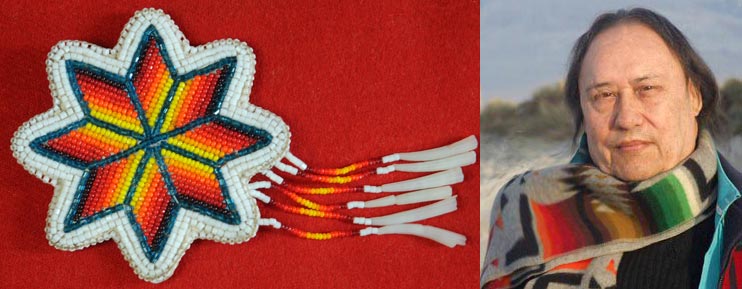 Picture shows a beaded, star shaped, neck tie medallion, latter a gift from International Artist and Choctaw Indian nation member Mr Waylon Gary White Deer, which will go on show at this year’s Lions Club, Vintage & Classic Car Show, scheduled for Sunday May 13th next in St. Patrick’s College Campus Thurles. The tale of the Choctaw Indian Nation (Name derived from the Choctaw phrase ‘Hacha hatak’ meaning ‘River People’), and their donation to Ireland’s Great Famine (1845-1850) victims is indeed one of firstly, great association and secondly, responsive compassion.
In the year 1847 referred to as “Black 47”, the Choctaw Indian community collected $170 to send to the Irish victims of the Great Famine, which is today’s equivalent of, in or around, €4,000. This great sacrifice by the Choctaw Indian Nation was sent despite the fact that they themselves had undergone a similar hardship involving exposure, disease, and starvation, some 15 years previously; same being forced to move west of the Mississippi by the government of Andrew Jackson (1767-1845), in a journey known and remembered today in history as the “Trail of Tears”. In 1831, the Choctaw Nation became the first to be removed, and their removal served as the model for all future relocations.
[Note: After two wars, the Seminoles Indian nation were removed in 1832. The Muscogee (Creek) Nation were removed in 1834, the Chickasaw Nation in 1837, and finally the Cherokee Nation in 1838].
Choctaw Indian Nation member Mr Waylon Gary White Deer, himself an Internationally Renowned Artist, visited Thurles back in 1999, leaving a gift of the beaded neck medallion, which can be seen at this year’s Lions Club, Vintage & Classic Car Show, scheduled for Sunday May 13th next in St. Patrick’s College Campus Thurles.
During World War I, Choctaw soldiers served in the U.S. military as the first Native American ‘Codetalkers’. 1
Yesterday the Irish Taoiseach, Mr Leo Varadkar, met with Choctaw leaders and addressed members of the nation community at an event in Oklahoma, 2 the 28th-most populous of the 50 United States of America, where he thanked members of the Choctaw Nation for the generosity shown by their ancestors to the island of Ireland during this period in Irish History. Mr Varadkar stated that at a time when the Irish people were being oppressed, abused, neglected and degraded by our Irish colonial master, the Choctaw spirit of generosity was at its highest.
He went on to announce a new scholarship programme, which in the future will allow members of the Choctaw Native American community to come here to Ireland to undertake further study; with the first scholarship commencing in the autumn of 2019.
1 Codetalkers: The use of obscure or little understood language, in this case the Choctaw language, for to provide a form of coded radio and telephone transmissions during wartime, offering secret communication.
2 Oklahoma: The name is actually derived from the Choctaw words ‘okla’ and ‘humma’, meaning “Red People”.
It looks like the necessary surface work required to upgrade Barry’s Bridge, crossing the River Suir here in Thurles town, is at last about to start.
Health and Safety barriers were erected on the bridge this morning beginning at 9.00am, together with led digital signage, requesting drivers of vehicles, where possible, to use alternative routes out of the town centre.
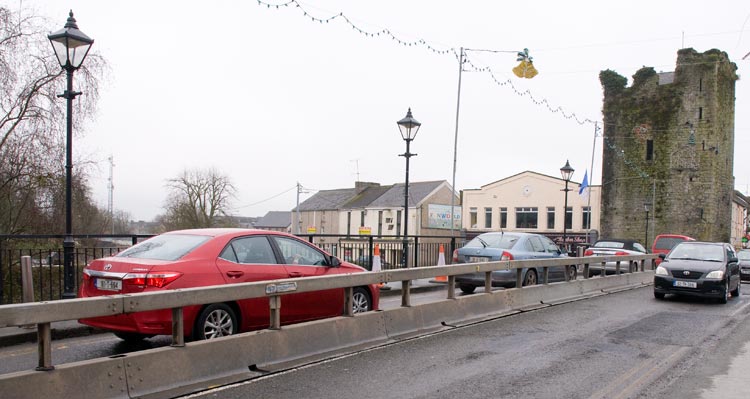
Barry’s Bridge in Thurles, Co Tipperary, has provided passage over the river Suir, since around 1650, and was partially widened again circa 1820.
Bridge Castle, overlooking this seasonally shallow river crossing, has dominated the Thurles skyline since as early as 1453, built possibly by the Norman invader McRickard Butler of whom history records that he erected, in 1453, two castles at Thurles and one at Buaidlic (Boulick).
While footpaths for pedestrians remain unrestricted presently, we understand that vehicles will be curtailed to one single lane of traffic crossing the bridge, for the duration of the period deemed necessary to carry out the resurfacing work.
So, where possible do try to use the alternative entrance and exit routes indicated, in order to keep traffic flowing.
St. Valentine – The Patron Saint of Lovers
Only a foolish lover will forget that in two day’s time (Wednesday February 14th), the love of your life will expect at lest a card inscribed with red hearts; or a bouquet of red roses; or a box of chocolate; or expensive lingerie; or a romantic dinner for two, combined with promises of undying love; to make an appearance sometime on St. Valentine’s day. But who was this saint whom we associate annually with human love and sexuality, (not to mention the extra expense imposed on us males so soon after Christmas) ?
St. Valentine
St. Valentine was a Christian Priest in Rome during the short reign of emperor Claudius II (Marcus Aurelius Flavius Claudius Gothicus – 268 AD to 270 AD), latter who persecuted the Christian church during his reign.
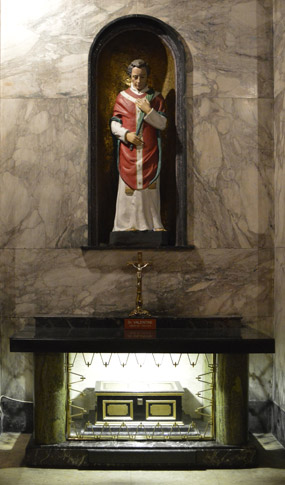 Human remains of St Valentine are to be found at Whitefriar Street Carmelite Church, No.56 Aungier St, Dublin 2. Emperor Claudius Gothicus II declared an edict that prohibited the marriage of young men in the army. Claudius in the past had gained both position and respect from soldiers for being physically strong and especially cruel, with legend telling of him having knocked the teeth out of a horse with one single punch. This edict now came into being based on his theory that soldiers, if unmarried, fought harder than those that were married, after all would not married soldiers live in constant fear of what would become of existing wives and children after their own death in battle.
The result of this edict saw a rise in overall permissiveness with polygamy (the custom of men mating with more than one mistress at any one time, whom they did not commit to marrying), being the popular order of the day. Now with some men attracted to the Christian faith; the church was teaching that marriage was sacred between one man and one woman and for life.
St. Valentine now began to secretly marry these followers of Jesus Christ, thus contravening the emperor’s edict. He was eventually caught and imprisoned for his actions and for helping other persecuted Christians.
Under house arrest with a judge called Asterius, whose daughter was blind; the magistrate interrogated St. Valentine on issues concerning his faith, religion and that Jewish preacher, known as Jesus of Nazareth. He asked St. Valentine to put his great faith to the test, by healing his daughter’s blindness. Valentine placed his hands over her eyes and she was miraculously healed. Humbled now by this action, Asterius immediately destroyed all the graven images in his home and became baptised, together with his family and some reported 44 members of his personal household, before freeing all held Christian prisoners.
However, this action did nothing to protect St. Valentine from his reigning emperor and in the year 269 AD he was sentenced to a three-part execution, which consisted of a beating, a stoning, and finally decapitation, because of his stance with regard to Christian marriage.
It is said that the last words written by him were in a note to the now healed blind daughter of Asterius, the signature on which today continues to inspire the commonly used, romantic communiqué, “from your Valentine”.
From an Irish perspective, in the sixteenth century, the human remains of St. Valentine were gifted to an Irish Carmelite priest, Father Spratt here in Ireland by Pope Gregory. This gifted relic is in the form of a sealed casket and was sent, accompanied by a letter of certification. The letter states that the casket, which today is located at Whitefriar Street Carmelite Church, No.56 Aungier St, Dublin 2, contains the remains of St. Valentine of Rome.
To this day the casket has never been opened.
On Monday morning last (February 5th), we first broke the exciting news that the former ‘Black Castle’, west of Liberty Square, overlooking the Parnell car-park, here in Thurles, Co. Tipperary; once home of Lord Viscount Thomas Butler & his wife, Lady Viscountess Elizabeth Butler (alias Poyntz), has been sold.
The vendor of this hugely historical building; namely the Kenny family; latter relatives of the late Mr Billy Maher; was sold through the professional offices of Mr Sean Spain Auctioneers & Valuers, No. 21 Fianna Rd, Thurles, Co. Tipperary.
The purchasers; Sir Timothy Maher (Knight of Innisfallen & Chairman & Chief Financial Officer (CFO), of Timothy Maher Finance) & his lady wife American born Dr. Phyllis Maher (Chief Executive Officer (CEO), of Timothy Maher Finance), have since employed the successful firm of DHRyan Architects, No.1 Liberty Square, Thurles, to undertake a feasibility study of the site and its associated buildings, and to prepare a development brief for the new purchasers. Solicitor Mr James J. Meagher (Thomas F. Griffin Parnell St, Thurles), has been retained to deal with all aspects of the site transfer.
However, this welcome news has now raised a massive inquisitiveness from those living both at home and overseas who have emailed us here at Thurles. Info, seeking further information on Lady Elizabeth and her interaction with Oliver Cromwell, who even in our modern Ireland, still evokes extremely strong emotions, some 360 years after his death in 1658.
In Ireland, though he only spent nine months of his reign here (August 1649 to May 1650), Cromwell stands accused of war crimes, religious persecution and the ethnic cleansing of Irish people on an unparalleled scale. The phrase ‘the curse of Cromwell on you and your house’, just 50 years ago, to elderly people, still evoke fear.
The Cromwellian administration was to find that Lady Viscountess Elizabeth Butler (Lady Thurles), was an extremely tough and feisty lady to deal with, and unlike many, she was never known to kowtow to Cromwell or his “Adventurers”, latter those who had financed his cause here in Ireland and Co. Tipperary, for their personal financial gain.
On 15th August 1649 Oliver Cromwell had landed at Ringsend, Dublin, and with him had come his Parliamentarian cavalry; an army of some 3,000 battle-hardened “Ironsides”, (Title “Old Ironsides”, was one of Cromwell’s nicknames). The civil war in England had ended, and King Charles I had been executed some seven months earlier.
 Lady Viscountess Elizabeth Butler (Lady Thurles) and later Lady Elizabeth Mathew, (following her second marriage). Here in Ireland, however, Roman Catholics had been in revolt since 1641 and were in possession and control of much of the country. Many had seen in England’s recent turmoil, an opportunity to restore Irish independence.
Cromwell a fanatical Protestant, would offer no quarter to papist rebels who had massacred English and Scottish settlers. Now in Ireland, he could also use confiscated rebel land to pay off the debts his loyal troops and the “Adventurers” who had financed his cause.
According to a Cromwellian edict, no Catholic who lived in the “Irish Quarters” before 1649, could be exempted from confiscation of property and transplantation; hence
“To hell or Connaught” was the quote and the choice, that Cromwell now offered the Irish. They would either be killed or go to Connaught, which meant their eventual death, because they all could not possibly have survived in a small ruggedly inhospitable province, not fully conducive to agriculture.
An Inquisition found that Lady Thurles held a life interest, in the right of her jointure, (an estate settled on a wife for the period during which she survives her husband), in lien (the right to keep possession of property) of a dower in the Castle, town and lands of :- Thurles, Leugh, Killinan, Athlummon, Clobanna, Lahardan, Derryfadda, Longfordpass, and Garranroe, in the Barony of Eliogarty; and Kilshane, Cleghile, and Lagganstown in the Barony of Clanwilliam.
Lady Thurles also owned 80 head of cattle, and 800 sheep and lambs; all of which ought to have been forfeited to Oliver Cromwell the then declared ‘Lord Protector of the Commonwealth of England’.
The Cromwellian financiers of his cause known as the “Adventurers” (as distinct from his soldiers) had, among the lands allotted to them, the Baronies of Eliogarty and Clanwilliam, and therefore now clamoured for the eviction of Lady Elizabeth, out of Thurles Castle and lands. Two thousand acres, calculated to return her an income of £200 a year, were set out for her in Connaught, but by various stratagems the astute Lady Thurles managed to delay her immediate removal.
She succeeded in winning over to her side to plead her cause, among others, such deep-dyed Puritans as the regicides or “King killers”, Sir Hardress Waller (latter condemned to death for his part in the regicide of Charles I. However his life was spared owing to the efforts of his friends and instead he was condemned to life imprisonment) and Colonel Robert Phaire (Governor of Cork, who avoided a similar fate through having married the daughter of Sir Thomas Herbert); also Colonel Hierome Sankey, (latter who sat in the House of Commons at various times between 1654 and 1659. He also served in the Parliamentary army during the English Civil War and later served in Ireland as Governor of the Tipperary Precinct of Clonmel), a man whose reputation for savagery in dealing with the Irish was scarcely less than that of Cromwell himself.
Petitions By Lady Thurles Sympathisers
In July 1656 the Cromwellian Council transmitted the petitions of these men on behalf of Lady Thurles to the Commissioners adjudicating on the Irish, in Co. Cork, for their report on it. Their report, on 13th August, shows that they were also under the spell of Lady Thurles.
- It stated that the good lady had several times in 1641 harboured, entertained, and preserved from murder and famine, divers English families whom the Irish had plundered, robbed, and attempted to murder. In total, 60 persons, and in particular Mr. Bullock and family, Joane Harris and family and Mr. Price, a protestant minister and his family.
- The report also stated, that after the fall of Archerstown Castle, Lady Thurles received the wounded Major Peisley, and others of his company, into her home, entertained them for several weeks until they were recovered, and then gave them money and other necessaries, before they betook themselves to the English garrison at Doneraile, Co. Cork.
- When Sir Charles Vavasour, who had raised a regiment of 500 men for service in Ireland from Cheshire, England, lay wounded and a prisoner of the Irish rebels at Clonmel, she had on several occassions sent him money, and later when he was very ill and weak, she had procured with great difficulty his liberty to come to her house where he was nursed to health, and was furnished with money on his departure.
- That in the years 1643-46, she gave considerable sums of money for the relief of the English, £500, £300, and divers other sums.
- That Lord Inchiquin, when he marched into Co. Tipperary, regarded Lady Thurles as English and of English interest and affection, and ordered that she and her tenants were not to be molested.
- That the Irish looked on her as an enemy, and several times pillaged and plundered her — in all, of 1500 sheep, 60 cows, and a great number of horses and colts; they broke down her weirs, and threatened to burn down her house if she did not hand over the poor English to their fury, but she refused to do so.
- That Owen Roe O’Neill, marching by her house, looked on her as an enemy and commanded her to furnish him with 200 beeves. She refused to pass them over, and notified Lord Inchiquin, who came to her relief and repulsed O’Neill.
- She was also instrumental in the rendition of Cahir Castle to Cromwell by her son, George Mathew.
- She also refused admission to Thurles Lieut. Colonel Brian O’Neill, and sent a messenger to Cromwell at Fethard, Co Tipperary to request him to send a garrison to Thurles, which he immediately did, under the command of Major Bolton, and for which, Cromwell promised her gratification, and this was seconded by the certificates of Colonel Sankey, Major Greene [later who settled at Killoghy, Mullinahone] and Colonel William Moore.
The Commission found her to be a very deserving person, but owing to legal and other difficulties, they now decided to submit her case for the decision of the Lord Deputy.
Continue reading Lady Thurles & Oliver Cromwell – “To Hell Or Connaught”
|
Support Us Help keep Thurles.info online by donating below. Thank you.
Total Donated 2026: €290.00
Thank You!
Daily Thurles Mass Livestream
|





Recent Comments