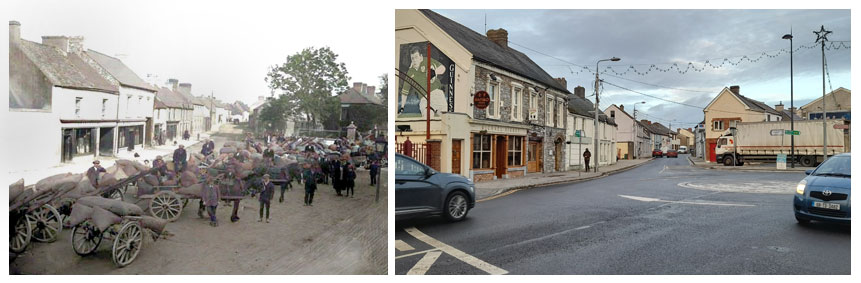
Cathedral Street, Thurles, (formerly East Main Street, Thurles), at the junction of (left – right) Mitchel Street(formerly Quarry Street); St. Mary’s Avenue(formerly Church Lane); and Kickham Street(formerly Pike Street or “The Pike”).
Picture left above shows farmers lining up to sell their wool to purchasers Ryan’s (Brewery Stores) on east Main Street Thurles. Picture right above shows East Main Street, today (December 30th 2020) renamed Cathedral Street, Thurles.
Sheep numbers grew significantly here in Ireland from some 2 million in 1848, towards the end of the Great Famine period; to 3.6m at the end of 2014. Land normally ploughed decreased almost by half within the same period, up until 1916, while land in pasture increased to double for grazing animals.
In hilly, mountainous areas, the selected breeds were prominently Blackface Mountain ewes and Cheviots, well able to survive on various and difficult terrains.
However, farmers, occupying the rich farmlands of Tipperary (Golden Vale), kept sheep for two main products, meat (mutton) and wool, thus reducing their dependence on the potato crop as their staple diet, towards the end of the 1800’s. Both mutton, wool and live sheep, in large numbers, were successfully exported to Britain.
Photograph on the left above was probably taken in the early years of 1900. The bright sunshine to the rear suggests the exposure was made mid-morning, towards the end of June when all sheep shearing was concluded. I base this observance on the fact that from June 1st in Tipperary, sheep were in the past, generally seen as ready to shear, with summer temperatures increasing.
Pictured (centre of crowd) An Taoiseach Mr Éamon de Valera (1882 – 1975) arriving in Thurles to turn the sod on the Thurles Sugar Factory, in 1933.
In 1933 the first state owned company, Cómlucht Siūicre Eireann Teo, was formed and the then Taoiseach Mr Éamon de Valera came to Thurles to turn the sod on the second of three new sugar beet factories.
One year later, in 1934 the first sugar beet campaigns commenced at Thurles, Mallow and Tuam. In the 1934 production campaign more than 44,000 acres of sugar beet were sown and approximately half-a-million tonnes of beet were processed.
In Thurles this enterprise back in 1934, transformed the fortunes of Thurles and its hinterland. In an era of acute economic hardship, arising from a worldwide depression and a bitter trade war with Britain, the plant was described as “manna from heaven”.
In 1989 the Thurles Sugar Factory closed with the loss of 400 jobs, delivering a blow from which Thurles, to date, would never recover. This devastation, would be followed later by the closure of the GMX factory, with the loss of 230 jobs; Erin Foods with the loss of 95 jobs, while smaller Thurles industries like Tipperary Candy and Tipperary Cereals also vanished; and while local politicians found themselves incapable of consigning even the smallest modicum of replacement industry.
Interesting to note from the picture the number of men found “doffing their hats” in a cultural expression of recognition, respect, gratitude, simple salutation or acknowledgement rarely seen in today’s Ireland.
May we here at Thurles.Info take this opportunity to wish everyone at home and abroad a very happy Christmas, especially those, who for one reason or another, have been unable to travel due to the present Covid-19 pandemic.
Our slideshow will hopefully carry a reminder of previous Christmas’s spent amongst us, and we look forward to welcoming you all back in the months ahead.
Meanwhile, Please Do Stay Safe.
Figgy Pudding:
“Oh, bring us some figgy pudding” is one of the traditional lines in the lyrics associated with “We Wish You A Merry Christmas”, our second song used in our video slideshow shown above.
Figgy pudding possibly first originated in the 14th-century, (referred to in 1390), as a way principally to preserve food and was initially served as a fasting meal in preparation for the Christmas season.
Beef and mutton were mixed with raisins and prunes, wines and spices and sometimes with eggs. When grains were finally added it gained the look of porridge, bearing the names “Frumenty, Frumentee, Furmity, Fromity, or Fermenty.”
In the early 15th century, the ingredients mutated into “Plum Pottage”. A mix of meats, grains, vegetables, fats, spices and fruits, most notably raisins and currants, and same were packaged like huge sausages inside animal stomachs and intestines, (some similarities with Haggis traditionally of Scottish origin and going back to 1430), to be stored until it was served as part of the traditional Celtic Christmas meal usually on Christmas Eve.
“Plum Pottage” was not always associated with Christmas, but was also connected with Mothering Sunday, (i.e. in late spring), and with sheep-shearing (i.e. held in June).
This Christmas styled dessert was banned in the mid-16th century. by Puritans (English Protestants), under Oliver Cromwell, but was reinstated as a Christmas pudding by King George I, in the early 18th century. Many Puritans objected to the Popish associations of Christmas and to the excesses of enjoyment associated, such as lavish eating, play-acting, gambling and dancing.
Figs have never actually been an official ingredient of ‘figgy pudding‘, but may have been briefly included from time to time, thus inspiring the name.
Possibly the oldest Christmas card in Thurles, was sent during the Christmas Season of 1917, by a soldier, Private William Cahill, 16th Irish Division, Company “C” South Irish Horse. The destination of the card was to his next of kin, his father, also named Mr William Cahill, Dovea, Thurles, Co. Tipperary.
Mr Cahill and his father, together with his uncle Mr Thomas Cahill were both then employees of the Trant Estate, at Dovea, Thurles, working under the supervision of one Mr William Swan, the Land Steward on the estate. All are described as “Good workmen, good ploughmen and understand well the workings of mowing and reaping machines”, and “can be confidentlybe recommended to anyone requiring their services”, writes Mr William Swan in a reference.
William Cahill (Jr) joined the British Army, aged 18 years and 1 month, on the 1st January 1914. His family regarded as “sober, honest and well conducted”; Private Cahill, on April 10th 1915, was transferred to the Military Police, earning two shillings and two 2 old pence per day.
A 103 year old Christmas card sent to Dovea, Thurles, in 1917, one year before the end of World War One. (Photo: G. Willoughby.)
Mr Cahill happily survived the war and return to Ireland taking up his position as a farm labourer and as an armed bodyguard on market days to the Trant family.
Today, despite the growing popularity of sending Christmas greetings and cards online, the physical Christmas cards still remains ever popular, thus keeping old traditions and that personal caring touch very much alive, at least once in our calendar year.
Initially, the first recorded Christmas cards were sent by a German physician, Michael Maier to James I of England and his son Henry Frederick, Prince of Wales in 1611.
This Christmas tradition of the posting of Christmas cards however progressed during the Victorian era. While centuries later, the much maligned Queen Victoria (Famine Queen), sent an official Christmas card, it was Sir Henry Cole, the first Director of the Victoria and Albert Museum (V&A and formerly the South Kensington Museum), who commissioned the first commercial Christmas card in 1843.
He placed an advert for the sale of the cards in the ‘Athenaeum’, latter a literary magazine published in London, from 1828 to 1921, which read:
“Just published a “Christmas Congratulation Card” or picture emblematical of Old English Festivity to Perpetuate kind recollections between dear friends.”
Initially his print run was for just 1000 card, designed by the artist John Callcott-Horsley, for Sir Henry Cole, and were printed lithographically before being hand-coloured by the professional colourer Mason.
Very few of these first Christmas cards remain in existence today, but if you come across one, expect a 4 figure sum, at least, as being acceptable as its basic value. This price compared favourably to Sir Henry Cole’s then selling price, back in 1843, of one shilling each; sold under the pseudonym ‘Felix Summerly’.
On Monday last, three men, named as Antoin Breathnach, Tom O’Connor and Diarmaid O’Cadhla, all members of a grouping calling themselves “Cork Street Names Campaign”, denied causing actual criminal damage by blackening out the name “Queen Victoria” on Cork street signs, (in both the English and Irish script). All three were oddly described by Judge Paul Kelly, who heard their case, as “people of the utmost sincerity”.
The accused admitted that on February 2nd, 2017, street names at Victoria Road (on both sides of the street), Victoria Cross Roads (on both sides of the street) and Victoria Street on the north side of the city, were damaged by them, using black paint.
However, the Judge pointed out that their actions did not entitle them to break the law, in furthering their deluded convictions. Accepting they did not go out to cause wanton vandalism, he acknowledged it was precise damage in furtherance of a particular view and found the facts proven and under the law was therefore not permissible.
The judge fined each of the three offenders €250 to be paid to the Society of St. Vincent de Paul, as a charitable contribution to finalise the matter at Cork District Court.
However, the accused appear to have picked up their knowledge of Irish history from their local pub, from an uneducated republican sympathiser just before closing time, believing the myth that Queen Victoria [known in Ireland in later decades as the “Famine Queen”, following a speech by Irish revolutionary Maud GonneMcBride, (1866 – 1953), long-time love interest of Irish poet W. B. Yeats.] had only donated a miserable £5 to famine relief here in Ireland.
The truth of the matter of course is that Queen Victoria had donated the sum of £2,000, [equivalent of £200,000 today], from her own personal resources, thus making her the largest single donor to Great Famine (1845 1849) relief in Ireland.
She also was patron of a charity that fundraised, publishing two ‘Queen’s Letters’, during Black 47. The first letter was published in March 1847 and the second in October 1847. In these letters she asked people in Britain to donate money to relieve Irish distress. The first letter was printed in the main newspapers and read out at all services in Anglican churches.
Following their publication, a proclamation was announced indicating that March 24th 1847 would be chosen as a day for a ‘General Fast and Humiliation before Almighty God’, with the proceeds to be distributed in Ireland.
The queen’s first letter raised £170,571, (In today’s money multiply by 1,000) the second raised £30,167 (In today’s money again multiply by 1,000).
“Always Engage Brain Before Putting Mouth In Gear“
This website uses cookies to improve your experience. We'll assume you're ok with this, but you can opt-out if you wish.AcceptRead More
Privacy & Cookies Policy
Privacy Overview
This website uses cookies to improve your experience while you navigate through the website. Out of these, the cookies that are categorized as necessary are stored on your browser as they are essential for the working of basic functionalities of the website. We also use third-party cookies that help us analyze and understand how you use this website. These cookies will be stored in your browser only with your consent. You also have the option to opt-out of these cookies. But opting out of some of these cookies may affect your browsing experience.
Necessary cookies are absolutely essential for the website to function properly. This category only includes cookies that ensures basic functionalities and security features of the website. These cookies do not store any personal information.
Any cookies that may not be particularly necessary for the website to function and is used specifically to collect user personal data via analytics, ads, other embedded contents are termed as non-necessary cookies. It is mandatory to procure user consent prior to running these cookies on your website.







Recent Comments