Destruction of Biodiversity on the Thurles Lady’s Well Right-of-Way & now destroyed Double Ditch Right-of-Way, are being denounced in Social Media threads. The threads begun by Thurles.Info and carried by @ThurlesHour demonstrate the growing feelings of lovers of our local environment and the distrust of County Councils and their officials.
Some of the remarks hereunder posted on Twitterby other people.
“County councils across Ireland don’t seem to ‘get’ nature.”
“Thurles Municipal District council got funding to design, secure planning & construct a river walk from Thomond Road to Turtulla. Landowner consent was not forthcoming. They decided to spend the money asap – removing all trees, laying down tarmac on the route of the Double Ditch!”
Biodiversity & Heritage Destroyed By Tipperary County Council & Irish National Parks and Wildlife Service, Without Any Local Consultation.
“Local authority greenway. No environmental oversight. Asphalt laid up to river. Token 2m buffer. Chain-link/welded mesh fencing down the side to ensue no critters pass. Eventually all these will need to be taken out, and the riverbanks restored.”
“Greenways are like a lottery win for quarry owners.”
“Wrecking the place.”
“What would a riverside greenway look like if it were ecologically sound? Is there an acceptable set back distance or preferred material?”
“This is happening along any path that is designated a Greenway.”
Thurles.Info now asks WHY?
Meanwhile: Attempts to contact Malcolm Noonan’s Office via email [Mos MOS@housing.gov.ie via mail3.itservices.gov.ie & malcolm.noonan@oireachtas.ie], between Sat, 22nd August 2020, and Thursday, 24th February, 2022, and on numerous other recorded occasions, fell on deaf ears. Currently staff at his constituency address; The Parade, Co. Kilkenny, do not even answer phone calls. In the past two years despite numerous attempts we have received only two “Automated Email Replies” from his office.
A Chara, Automatic reply: Destruction of Thurles Heritage Thank you for contacting the departmental office of Malcolm Noonan, T.D., Minister of State for Heritage and Electoral Reform. Your email will be reviewed and a response will issue in due course, should one be required. Le gach dea-ghuí, Malcolm Noonan Office of the Minister of State for Heritage and Electoral Reform
Our dealings with Mr Eamon Ryan TD have been equally ignored. Again we were sent 1 Automatic reply on Wed, 6th April 2022 and 4 on Mon, 11th April, despite being contacted only once, on each of the afore mentioned dates by myself. (So 4 staff opened it and decided to ignore the content.)
Automatic reply: Destruction of Thurles Heritage A chara, Many thanks for your email. As I am sure you can appreciate, I receive a large volume of emails on a daily basis. Your issue is important to me and myself or one of my team will be back to you as soon as possible. In the meantime, if you have a query relating to the below areas, you might find the following email addresses helpful: Matters related to Dublin Bay South constituency: eamon.ryan@oireachtas.ie Matters related to the Dept of Environment, Climate, Communications networks: minister.ryan@decc.gov.ie Eamon Ryan TD Minister for Environment, Climate, Communications and Transport.
Despite our email communications being civil, we have never spoken or received even one, single, reply from staff at Mr Eamon Ryan’s department. We did explain our problem on one occasion to a member of Mr Malcolm Noonan’s, Kilkenny Staff, who confirmed that they had received my emails in the past, but could not explain why they were not replied too.
Meanwhile, our dealings with staff at National Parks and Wildlife Service were equally disappointing. Early communications stated from NPWL stated, “Please note that if these works are part of development covered by planning permission then they are exempt from Section 40 of the Wildlife Act. John will update you on his findings in due course.”
Then NPWS service claimed they granted verbal permission to Tipperary Co. Council in late February on the grounds it was a road or other structure. Quote “However, it should also be noted that the clearance of vegetation in the course of road or other construction works or in the development or preparation of sites on which any building or other structure is intended to be provided is exempted under Section 40.”
The truth is, there was No Road; No new ConstructionWorks; No other new structures; just a small, yet valuable piece of 176 year old Thurles Heritage.
National Parks and Wildlife Service have further confirmed that because of “work stress”, they had forgotten to recognise the Mill Road address we had reported and identified in relation to breaches of Sect 40 of the Wildlife Act. Thus when asked for documentation they then confirmed, quote: – (A) “Communication between Tipperary County Council and a named Wildlife Ranger was only verbal, there is no written documentation.“ (B) “Any written communication between Tipperary County Council and the builder is in their possession, National Parks and Wildlife Service do not have same.” (C) “Furthermore any request for such information needs to follow the AIE process.“ [Latter AIE referred to is “Access to Information on the Environment”]
“Our heritage is what we have inherited from the past, to value and enjoy in the present, and to preserve and pass on to future generations. In helping shape our identity, our heritage becomes part of what we are. Our expression of this identity shows others what we value; it highlights our values and priorities. Our heritage provides clues to our past and how our society has evolved. It helps us examine our history and traditions and enables us develop an awareness about ourselves. It helps us understand and explain why we are the way we are.”
The above are not my words but the words of the Irish Heritage Council, See HERE .
Then this evening, April 20th 2022, out of the blue, we received an email in pdf format. Yes, readers I fool you not, after almost two years of waiting, it arrived from staff at Minister Malcolm Noonan’s Office, set in the form of a standardised letter, sent with the permission of Ms Danielle McDonnell, (Private Secretary to Minister Malcolm Noonan T.D.); signed by a person in his constituency office in Co. Kilkenny, latter yet another member of staff authorised to act on behalf of the same Ms Danielle McDonnell.
Mr Noonan’s almost two year old delayed communication read. Dear Mr. Willoughby, On behalf of Mr. Malcolm Noonan, T.D. Minister of State for Heritage and Electoral Reform, I wish to refer to your emails regarding the removal of a hedgerow by Tipperary County Council at Mill Road, Thurles. The works in question were carried out to facilitate the upgrade of an existing pathway. In this instance the National Parks and Wildlife Service are satisfied that these works did not constitute a breach of Section 40 of the Wildlife Act. Yours sincerely, P.P. Danielle McDonnell (Private Secretary to Minister Malcolm Noonan T.D.).
Remarkably, Minister Malcolm Noonan’s dictated communication, failed to explain in his long awaited communicated, why Tipperary Co. Council and builders were given permission to destroy irreplaceable Thurles history, which as we previously stated, was a certain sure attraction for foreign and domestic tourism.
Same has been destroyed despite every Irish Government department; Elected Tipperary Politician and double jobbing Local Councillor, being warned exactly what was going to happen, since 2019.
So, Minister Noonan, I totally reject your recent delayed communication. I continue to seek your explanation as to why, based on historic evidence (See page 6) and a falsified Archaeological Impact Statement, that two Green Party politicians; namely you Sir and Mr Eamon Ryan failed to communicate; to fully investigate this piece of Thurles heritage and now choose to protect the Department of National Parks and Wildlife Service?
According to the Heritage Council,Quote “An important part of their work is to encourage local communities to take responsibility for and participate in the development and conservation of their heritage. Such projects help generate a greater sense of pride and belonging in the local area through increased participation…and sheer enjoyment! Cultural tourism and activity holidays on our natural landscapes and countryside continue to grow, outperforming all other tourism sectors.”
Both of you gentlemen must now reply to the question being asked, WHY?
Tipperary Co. Council officials; latter led by Chief Executive Mr Joe MacGrath and Fianna Fáil Councillor & Cathaoirleach of Thurles Municipal District, Mr Seamus Hanafin; last month successfully set about destroying our Thurles Great Famine heritage. We at Thurles.Info feel it is necessary to fully highlight the serious damage done to the Thurles business community, through the loss of local Tourism, same brought about by the above named, in collusion with their council colleagues/officials/administrators and by Tipperary’s two most indolent T.D’s, Mr Jackie Cahill and Mr Michael Lowry.
The information supplied hereunder; were it to be linked to the now destroyed, Thurles “Double Ditch“; the existing Thurles Great Famine Minutes – (1846-1847); the newly digitized rare Gratuitous Relief Ration Record Book’; the Widow McCormack’s Cabbage Patch rebellion, (situated in Ballingarry, Thurles, Co. Tipperary); the Mining Museum, (latter situated in the Commons, Thurles, Co. Tipperary); the Tipperary villages of Glengoole; Ballingarry; The Commons, and Littleton, and towns like Thurles if added to the mix, could have been the foundation for much needed Tourism in the county, at no extra cost, whatsoever, to Tipperary Tax payers.
Where are Tipperary’s appointed tourism officials? Where are Tipperary’s various Chambers of Commerce members? Where are those people with a mere modicum of basic imagination?
Certainly no current ‘Double Jobbers’; demonstrating imagination were elected, when we visited polling stations in Thurles last election day. But, enough, not to worry, we can correct our mistakes in the not too distant future.
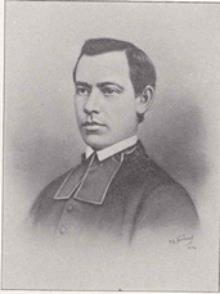
Stephen De Vere (1812-1904)
Stephen De Vere(1812-1904)
We begin with Stephen De Vere (1812-1904) latter born into an aristocratic Anglo-Irish Protestant family that owned large landed estates at Curragh Chase, Co. Limerick and at Glangoole, (Glengoole), Thurles, Co. Tipperary. He was a descended of Vere Hunt, latter a Cromwellian soldier who was first granted land in the mid-17th century.
His grandfather, 1st Baronet Sir Vere Hunt, was a wealthy and eccentric Irish politician, [also known as Aubrey de Vere Hunt (1761–1818).
In all this De Vere estate held considerable land here in nearby Tipperary, in the baronies of Eliogarty and Slievardagh, Co Tipperary. In all, his Tipperary property, comprised of over 6,000 acres and included coal mines at Glangoole, (Glengoole, Thurles), before same was sold off in the mid to late 1850s.
Glengoole, [glen of the coal], in copious documents, is written in various ways down the years; in 1401 it was Glangole; in 1508Glengowell; in 1534Glawngoyle; in 1655 as Glangale, while in the early 19th century, we find the names New Birmingham and Brimigim.
1st Baronet Vere Hunt is chiefly remembered here in Thurles, for his founding of the village of New Birmingham, Thurles, in Co. Tipperary, latter established in the early 1800s, aided by the help of Fr. Michael Meighan, a then local parish priest. Same was founded for the workers in his then existing coal mine at Glengoole, which at one time employed some 400 workers. New Birmingham had been chosen due to the existence of a Catholic Church and in Vere Hunt’s own diary, he records having laid out the street pattern himself, in person. He went on to obtain a charter, giving him the right to hold one or two markets and several fairs, every year. His hope was to turn New Birmingham into a major manufacturing centre, however he failed, mainly due to not having the financial necessities with which to further expand the new village area.
Stephen De Vere, (1812-1904) was the second son of the union between 2nd Baronet Sir Aubrey de Vere (1788–1846), latter an Anglo-Irish poet (a childhood friend of the English Poet Lord Byron), and Mary Spring Rice.
He was born into an aristocratic Anglo-Irish Protestant family. His elder brother was the poet and critic Aubrey Thomas de Vere. In 1832 Stephen’s sister Elinor would marry Robert O’Brien, the brother of William Smith O’Brien, latter the Irish nationalist Member of Parliament and leader of the Young Ireland movement; arrested at Thurles Railway Station, following the Ballingarry Thurles, Co. Tipperary insurrection/uprising of 1848, (Latter derisively referred to by “The Times” of London as the “Battle of Widow McCormack’s Cabbage Patch“).
Stephen was one of the most influential eyewitnesses of the Great Irish Famine migration of 1847. Despite his great wealth, De Vere felt closest to the Irish Catholic tenants on his estate, many of whom he sought to help escape from Ireland when it was afflicted by the Great Hunger between 1845 to 1849.
It was in that same year that he took passage in the steerage of an infamous “coffin ship”, same vessels then being used to transport Irish emigrants fleeing the Great Famine to British North America and the United States. Stephen De Vere wanted to share and witness, at first hand, the reported privations of the emigrants for himself and share in the horrendous conditions that were leading to the deaths of so many Irish ships passengers. During his voyage, he composed a damning report, now known as “The Elgin-Grey Papers”.
The Stephen De Vere red leather-bound diaries, (See video hereunder) kept during his voyage from Ireland to Canada in 1847-1848, remain today to provide, if needed, an invaluable record of Irish Famine migration.
In his report, Stephen De Vere writes:
“Having myself submitted to the privation of a steerage passage in an emigrant ship for nearly two months, in order to make myself acquainted with the condition of the emigrant from the beginning, I can state from experience that the present regulations for ensuring health and comparative comfort to passengers are wholly insufficient, and that they are not, and cannot be enforced, notwithstanding the great zeal and high abilities of the Government agents. Before the emigrant has been at sea a week, he is an altered man. How can it be otherwise? Hundreds of poor people, men, women and children, of all ages from the drivelling idiot of 90 to the babe just born, huddled together, without light, without air, wallowing in filth and breathing a fetid atmosphere, sick in body, dispirited in heart; the fevered patients lying between the sound, in sleeping places so narrow as almost to deny them the power of indulging, by a change of position, the natural restlessness of the disease; by their agonized ravings disturbing those around and pre-disposing them, through the effects of the imagination, to imbibe the contagion; living without food or medicine except as administered by the hand of casual charity; dying without the voice of spiritual consolation and buried in the deep without the rites of the Church. The food is generally ill-selected and seldom sufficiently cooked, in consequence of the insufficiency and bad construction of the cooking places. The supply of water, hardly enough for cooking and drinking, does not allow washing. In many ships the filthy beds, teeming with all abominations, are never required to be brought on deck and aired: the narrow space between the sleeping berths and the piles of boxes is never washed or scraped, but breathes up a damp and fetid stench, until the day before arrival at quarantine, when all hands are required to Scrub up” and put on a fair face for the doctor and Government inspector. No moral restraint is attempted; the voice of prayer is never heard; drunkenness, with its consequent train of ruffian debasement, is not discouraged, because it is profitable to the captain who traffics in the grog. In the ship which brought me out from London last April, the passengers were found in provisions by the owners according to a contract, and emaciated scale of dietary. The meat was of the worst quality. The supply of water shipped on board was abundant, but the quantity served out to the passengers was so scanty that they were frequently obliged to throw overboard their salt provisions and rice (a most important article of their food), because they had not water enough both for the necessary cooking and the satisfying of their raging thirst afterwards. They could only afford water for washing by withdrawing it from the cooking of their food. I have known persons to remain for days together in their dark close berths, because they thus suffered less from hunger, though compelled at the same time, by want of water to heave overboard their salt provisions and rice. No cleanliness was enforced; the beds never aired; the master during the whole voyage never entered the steerage, and would listen to no complaints; the dietary contracted for was, with some exceptions, nominally supplied, though at irregular periods; but false measures were used (in which the water and several articles of dry food were served), the gallon measure containing but three quarts, which fact I proved in Quebec, and had the captain fined for; once or twice a week, ardent spirits were sold indiscriminately to the passengers, producing scenes of unchecked blackguardism beyond description; and lights were prohibited, because the ship, with her open fire-grates upon deck, with Lucifer matches and lighted pipes used secretly in the sleeping berths, was freighted with Government powder for the garrison of Quebec. The case of this ship was not one of peculiar misconduct, on the contrary, I have the strongest reason to know from information which I have received from very many emigrants well-known to me who came over this year in different vessels, that this ship was better regulated and more comfortable than many that reached Canada.”
When the then Colonial Secretary of State for War and the Colonies, Henry George Grey, [3rd Earl Grey (1802-1894)] read his damning report of inhumane conditions, and forwarded same to James Bruce, 8th Earl of Elgin, Governor-General of the province of Canada, the Passenger Act of 1847, making “coffin ships” illegal was introduced, although many such ships would continue to operate.
Sir Stephen de Vere would later become a Roman Catholic, from his observation of the peasantry, whom he had often educated, fed and nursed.
Yes, this is the proud history of Thurles and how dare Tipperary Co. Council and elements claiming to represent Fianna Fáil interfere, to destroy our strong heritage!
The Stations will start at 12.00 noon at the Church boreen, beside two family residences, just after the signpost for the first junction to the right after the Turnpike. People will follow the ancient Mass Path to the little Church, before continuing on to the site of the Round Tower, before concluding in the Main Monastery Church of St. Mochaomhog (St. Pulcherius), latter saint known as ‘The Holy Man of Liathmore’.
There are two Churches on this Liathmore site; the larger one (above) was enlarged possibly in the 12th century, and contains a number of tombs.
Who was St. Mochoemog?
Different accounts vary, however from what we can glean from our history; St. Mochoemog was born to parents Beoanus and Nesse, latter a sister of St. Íte of Killeedy, a civil parish located south of Newcastle West, in Co. Limerick, possibly around 550 A.D.
It is believed that he was brought up or at least strongly influenced by his aunt, Saint Íte, and at the age of 20 was sent to then recently established Bangor Abbey, Co. Down (established 558 A.D.) where he was further instructed by the Clonmacnoise educated and founder of Bangor Abbey, Abbot Saint Comgall.
Bangor was then a major centre of learning, referred to as the “Light of the World”[Then spake Jesus again unto them, saying, “I am the light of the world: he that followeth me shall not walk in darkness, but shall have the light of life”. ( John Chapter 8: verse 12)], and was responsible for the training of many documented missionaries, including St. Columbanus, St. Mirin and Carthach (Saint Mo Chutu mac Fínaill)
He later returned to southern Éile (County Tipperary), where a chieftain granted him a site for a monastery in an area known as Liathmochaemog (Liathmore) in the parish of Two-Mile Borris, Thurles in the Barony of Eliogarty.
Today, as stated the site remains marked only by a church, latter the ‘stone survivor’ of a community that would have used wood, together with wattle-and-daub, for its alas no longer evident dwelling houses.
It was believed that St. Mochoemog lived long, and died at the age of 106 years, in Liathmore, on March 13th, 656 A.D, some 1,366 years ago, just last month.
Liathmore-Mochoemog would remain an important centre of Christianity between the 7th and 11th century, serving most of south Tipperary and Kilkenny.
Several miracles are attributed to St. Mochoemog, among others, his having cured of blindness, a holy virgin Canners, latter daughter of Fintan, who is considered to have been the relative of St. Molua, of Clonfert-Molua, latter who also learnt the monastic life at the northern monastery of Bangor under the tutelage of Saint Comgall, and possibly St. Mochoemog’s personal confessor.
Young people will be participating in this event and people of all age groups are most welcome to be in attendance.
With light rain forecast, please do dress appropriately for the weather and for walking both on the fields and on boreen.
Note: Parking will be available on the road side and all are welcome to this Christian gathering.
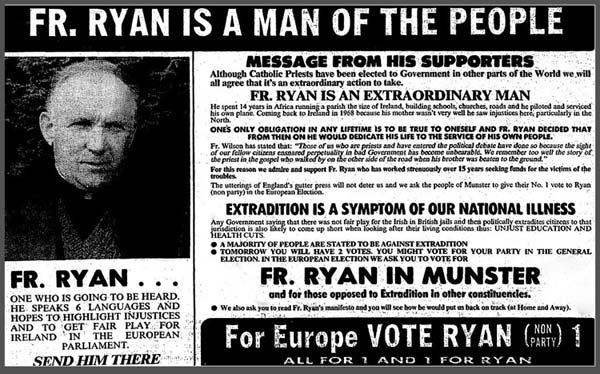
The Belfast Crown Court has ordered the BBC to hand over broadcast and withheld or withdrawn material, to the Police Service of Northern Ireland (PSNI), from their documentary series about the Northern Ireland Troubles, first broadcast back in 2019.
The material is expected to includes interviews with Rev. Fr. Patrick Ryan, latter a Roman Catholic priest, who told the programme he had maintained a network of Europe-wide contacts, same used to generate arms and money for the IRA.
The priest in question, Fr. Patrick (Paddy) Ryan, now in his 92nd year, was born on June 26th, 1930, in Rossmore, Cashel, Co. Tipperary, one of six children born to a rural farming family.
Fr. Ryan had shown no great interest in politics beyond a hatred for past and present British rule on the island of Ireland; however the Roman Catholic Church and the Pallottine Order would formally suspend him from priestly duties, after he refused a transfer to a Parish Church in England.
Later on, during a trip to Rome in the summer of that same year, he is reported to have informed Italian priests that he hoped that the IRA would bomb the centre of London.
By the Autumn of 1973, he was shuttling back and forth between Dublin and Geneva, opening bank accounts and transferring funding (over £1,000,000) reportedly, granted by his newly acquired contacts within Libyan Military Intelligence in Tripoli.
A PSNI lawyer told the court that there were reasonable grounds to believe that same material, currently the property of the BBC was likely to be of use in future terrorist investigations.
Keeping in mind the need to protect the public from terrorist activity; Mr Justice Neil Rafferty presiding in Belfast Crown Court, granted the order allowing the PSNI to access the gathered material.
Easter, also called Pascha (Passover) or Resurrection Sunday, is a Christian festival and cultural holiday commemorating the resurrection of Jesus Christ from the dead, described in the New Testament as having occurred on the third day of his burial, following on from his crucifixion by the Romans at Calvary c. 30 AD.
This year (2022)Easter Sunday falls on Sunday, April 17th, in exactly two week’s time.
Meaning of the word Hallelujah.
The word “hallel” in Hebrew means a joyous praise in song. The second part, “Yah”, is a shortened form of “Yahweha”, a lesser known name for God or Jehova, thus the word means “Praise Yahweh”, or “Praise God”, joyously.
An Easter Hallelujah.
Sung by Cassandra Star & her sister Callahan and written by Kelley Mooney
A crown of thorns placed on His head He knew that He would soon be dead He said, “Did you forget me, Father did you?” They nailed Him to a wooden cross Soon all the world would feel the loss Of Christ the King before His Hallelujah Hallelujah, Hallelujah
He hung His head and prepared to die Then lifted His face up to the sky Said, “I am coming home now Father, to you” A reed which held His final sip Was gently lifted to his lips He drank His last and gave His soul to glory Hallelujah, Hallelujah
The soldier who had used his sword To pierce the body of our Lord Said, “Truly, this was Jesus Christ our Saviour” He looked with fear upon his sword Then turned to face his Christ and Lord Fell to his knees crying Hallelujah Hallelujah, Hallelujah
Took from his head the thorny crown And wrapped him in a linen gown Then laid him down to rest inside the tomb The holes in his hands, his feet, and side Now in our hearts, we know he died To save us from ourselves, oh Hallelujah Hallelujah, Hallelujah
Three days went by, again they came To move the stone, to bless the slain With oil and spice anointing Hallelujah But as they went to move the stone They saw that they were not alone For Jesus Christ has risen, Hallelujah Hallelujah, Hallelujah
This website uses cookies to improve your experience. We'll assume you're ok with this, but you can opt-out if you wish.AcceptRead More
Privacy & Cookies Policy
Privacy Overview
This website uses cookies to improve your experience while you navigate through the website. Out of these, the cookies that are categorized as necessary are stored on your browser as they are essential for the working of basic functionalities of the website. We also use third-party cookies that help us analyze and understand how you use this website. These cookies will be stored in your browser only with your consent. You also have the option to opt-out of these cookies. But opting out of some of these cookies may affect your browsing experience.
Necessary cookies are absolutely essential for the website to function properly. This category only includes cookies that ensures basic functionalities and security features of the website. These cookies do not store any personal information.
Any cookies that may not be particularly necessary for the website to function and is used specifically to collect user personal data via analytics, ads, other embedded contents are termed as non-necessary cookies. It is mandatory to procure user consent prior to running these cookies on your website.





Recent Comments