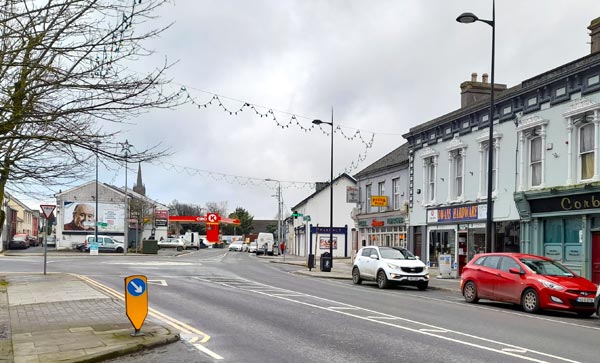
Cathedral Street, east of Thurles town centre, in Co. Tipperary has possibly undergone the most change in the last 50 years.
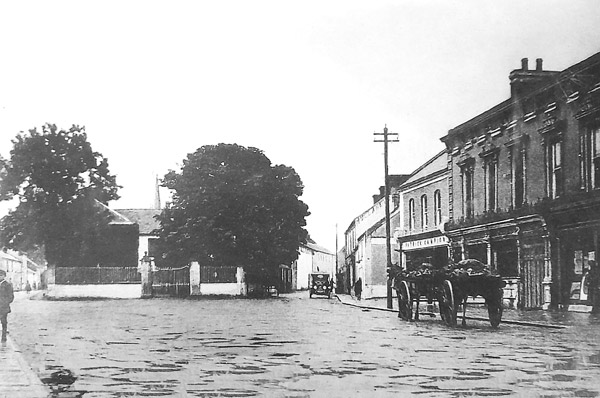
Gone of course is Ryan’s brewery stores, positioned in the monochrome picture hereunder, dividing Church Lane from Kickham Street (The Pike). Same has been replaced by modern shop units and a petrol station.
Image of Cathedral Street, Thurles (formerly known as East Main Street), possibly captured sometime between 1930 and 1940 based on the 1927 Ford Model T. Some 15 million of these cars were sold, and the model, as of 2012, stood eighth on the top-ten list of most sold cars of all time.
It was to this building, according to a traditional story, that a servant was dispatched from the Palace of Archbishop Price, in Cashel, Co Tipperary. Estate manager and the father of renowned Arthur Guinness, namely Richard Guinness, was in charge of supervising the brewing of beer for the estate’s employees on the Archbishop Price estate. Supplying beer to employees at that time was considered part of their weekly entitlement.
The servant had been charged with purchasing and delivering the necessary beer making materials, from Ryan’s brewery stores in Cathedral Street.
Cathedral Street, Thurles, February 2021. Photo: G.Willoughby.
Later, back in Cashel in the Palace kitchen, the purchased barley was accidentally roasted until virtually black, thus giving that unique burnt flavour known to us today as “Porters Ale” or “Guinness Porter” and described by the then Protestant Archbishop at that time as being “a brew of a very palatable nature.”
Today’s work being carried out on Liberty Square was initially the brainchild of visionary Mr Tomas (Tom) Barry, latter former Thurles Town Manager.
Back in 2002, following discussions with his Council Administrative Staff including Mr Michael Ryan, (latter then holding the post of Town Clerk), Mr Barry decided to promote a proposal to Thurles District Councillors [Today’s paid elected Municipal District Councillors], to increase the town’s overall ‘Commercial Rates’ by 25%, in the upcoming 2003 Budget estimates, bringing it into line with other Irish towns of a similar size.
His forward looking plan was that some 15% of this 25% increase would be immediately ‘ring fenced,’ to meet local contributions required for a possible number of future Capital Projects within the town. It was anticipated back then that this 15% would yield some €200,000.00 per annum.
Barry’s 2002 Vision for the Future of Thurles.
Liberty Square, Thurles, Co. Tipperary. Photo January 2021, George Willoughby.
Mr Tom Barry, in his five point visionary plan to drag Thurles town into the 21st century and into line with other Irish towns of similar size, unveiled the following projects as listed hereunder:- (1). Thurles Town Centre Enhancement. (2). A Regional Arts Centre. ✓. (3). A Leisure Centre. ✓. (4). Thurles Town Park ✓ and a River Walk. (5). Upgrading / Extension to Thurles Council Offices, ✓, (Latter then grossly overcrowded and unfit for day to day business transactions.) In relation to the Town centre Enhancement Scheme, he stated that such would dramatically augment an overall appearance of Thurles town centre.
Having shared his vision with Town Councillors, Mr Barry’s proposals were considered 19 years ago, at the 2003 Budget Meeting, latter which was held on Thursday, December 19th 2002. This aforementioned Budget meeting, which called for the introduction of this 25% Commercial Rates increase, was formally adopted by Thurles Council, by a 5 votes majority, with two other councillors unavoidably absent from that meeting.
One of those councillors who voted ‘Against’ Mr Tom Barry’s future vision for Thurles, was current day, Thurles Municipal Councillor, Mr Jim Ryan. Nevertheless, despite Councillor Jim Ryan’s objections, Thurles, within the next 16 years could rightly boast a new Regional Arts Centre, a new Library, a new Leisure Centre, an Extension to Thurles Council Offices and a new Thurles Town Park, courtesy of Thurles Commercial Rate payers.
All that is missing from Mr Barry’s vision today, is a properly maintained River Walk and the full completion of the enhancement to the Thurles Town Centre, latter now currently well advanced.
Alas, those were the days when rate payer’s money was carefully minded; local councils had employees; streets were kept clean and potholes were filled.
Note: All of these facts, above stated, are contained in Thurles Town Council Minutes, requested by me in the past, for my own perusal and available on request by the public for little charge.
Today, February 2nd, 2021; as part of the current upgrade to Liberty Square, it appears that sewer pipes are being installed.
It is therefore interesting to note that not one single politician or Municipal District councillor was present at a meeting in Thurles on Friday November 13th 1846, when the first ever sewage system was installed.
Present were the administrators of varying churches; Rev. Dr. Henry Cotton (Chairperson), Rev. Mr Laffan, Rev. Dr. O’Connor, Rev. Mr Barron. Rev. P Leahy, Rev. Mr Baker, Mr Francis O’Brien Esq. (Latter Justice of the Peace) and our old friend now well introduced to present day unproductive Municipal District councillors and useless politicians, yes, Dr. Robert Charles Knaggs, who had urgently instigated the building of a “Double Ditch”, thus placing food into the mouths of those close to starvation and death.
At this meeting in 1846, which began promptly at 3:00pm in today’s Ulster Bank building on Liberty Square, (then the home of the said Dr. Robert Charles Knaggs), details of the number of paupers then in the Poor House (former site of today’s Hospital of the Assumption) were recorded by the acting secretary, yes the same Dr. Robert Charles Knaggs.
“The original Poor House built in 1840, to accommodate 700 persons, had contained within it, “84 men, 184 women, 414 children — in all a total of 682 homeless, destitute persons.“
Being a medical doctor, Dr. Robert Knaggs was well aware of problems linked to a severe lack of hygiene. There were within the town of Thurles no sewers, people merely emptied their defecation into the nearest three cornered ‘shit well’, latter located, staggered in the various back lanes within the town. Contents of same wells would be removed weekly by an operating ‘Honey Waggon’(Horse drawn covered wagon) to be spread on farm land as fertiliser and also, quickly recycled, by Crows, Jackdaws and other bird life.
“Having discussed and resolved that 20 barrels of wheat should be purchased in the local market the following day, to be ground into meal, for distribution to those starving. Meal tickets (the 2nd only provision of such in Thurles) were issued on that same day, numbered as follows:- Stradavoher 601 to 700, Garryvicleheen (Abbey Rd. Area) 701 to 800, Pudding Lane (O’Donovan Rossa Street) 801 to 900, Quarry Street (Mitchel Street) 901 to 1000, Pike Street (Kickham Street) 1001 to 1100 and Main Street (today’s Liberty Square & Cathedral Street combined) 1101 to 1120.”
However, before the meeting concluded and adjourned to 3:00pm on the following Monday, the acting secretary Dr. Robert Charles Knaggs suggested that a large number of unemployed men could be employed on making the first sewers through the town, if there was a quarry made available. Chairperson Rev. Dr. Henry Cotton offers the use of a quarry situated on his land.
In less than 3 weeks, by November 30th 1846, plans had been drawn up as follows: –
To construct 42 perches (231yds/211.2m) of sewers from Rich’d Ryan’s to the Derheen, costed at £84.
To construct 96 perches (528yds/482.8m) of sewers from Danl Dwyer’s to the bridge, costed at £192
To construct 66 perches (363yds/331.9m) of sewers from Butler’s Gate to James Maher’s Yard, costed at £132.
To construct 9 perches (49.9yds/44.8m) of sewers from the Barracks (Opposite todays Premier Hall) to the Main Street, costed at £185.
To construct 66 perches(363yds/331.9 m) of covered drain or sewer from the bridge to the turn of the Mall with a tunnel under the river, and open a drain from the bridge in Thurles to Byrne’s Mill with a tunnel under the Drish River to carry up the levels for the drains of the town, costed at £800.
Total for this complete work, on wages of 8p per day, was estimated at costing £1,226.
A section of the sewer built in Thurles in 1846, during the Great Famine. Pictured in 1995, note the neat hand cut stone positioned on either side of the drain, lead lined and hidden by the water a flat 2.5in slate bottom. These sewers were so well built that many years later, they were used to accommodate modern day sewage pipes, by Thurles town council.
Additional works had also been approved of earlier for the Thurles area, on Thursday November 26th 1846, by the then Board of Works, consisting of the following, using available labour: –
Construct 400 perches (2,200yds / 2011.6m) of the road from Thurles to Urlingford between Lisduff and the Fort on the Widow Keogh’s farm at Rahealty, costed at £150.00.
To lower and remake two footpaths one from the corner of Pierce McLoughlin’s Delph shop(Today’s AIB Bank building, Liberty Square) to the Thurles Court House pier, being 22½ perches (123.75yds/113.16m) and the other from John Finn’s Hardware shop corner (Todays Carphone Warehouse, Liberty Square), back to the Police Barracks on the other side, (Opposite todays Premier Hall), being 19 perches (104.5yds/104.7m) costed at £10-7-6.
To repair 600 perches (3,300yds/3,017.5m) of the road from Athlumon Ford to Godfrey’s Mills costed at £80.00.
To repair 200 perches (1,100yds/1005.8m) of the road from Patrick Lahey’s gate at Kilrush to the Widow Shea’s house, Burris Road.
“Following a meeting held on December 4th 1846 the committee confirmed that 740 persons were in the Thurles Work House, as already stated, latter built only to accommodate 700 souls.”
By Tuesday, February 9th 1847 (Black 47), 1,991 persons were now employed, receiving wages from mostly local funding, at the above works listed hereunder: –
At Ballygammane – 84 employed persons, Pierstown Road – 56 persons, Seskin – 59 persons, cutting stone at the Stone Depot – 535 persons, at Drish Hill – 40 persons, at Rossestown Hill – 100 persons, working on Thurles Sewers – 163 persons, doing ‘Pathing’ – 225 persons, working on Embankment – 116 persons, on Kilrush Road – 47 persons, on the Widow Shea’s Road – 41 persons, on Turtulla Towpath – 82 persons, on Garrenrow Road - 100 persons, in Rahealty and Lisduff - 35 persons.
The then Member of Parliament (MP) for Tipperary, Mr Nicholas V Maher Esq. (Repeal Association MP and a member of the all-male, liberal Reform Club founded in 1836), subscribed £50 to the project. The absent then owner / landlord of Thurles, Viscount de Chabot, (Louis William de Rohan) also subscribed £50 and his son Count de Jarnac (Philippe-Ferdinand-Auguste de Rohan-Chabot). subscribed £10.
Their subscriptions compared dismally with the generosity of the aforementioned committee member present at the meeting, Mr Francis O’Brien Esq. JP (Justice of the Peace), who subscribed £30, and Rev. Dr. Michael Slattery, Archbishop of Cashel & Emly who subscribed £50.
This is the Dr. Robert Charles Knaggs, whom Tipperary Co. Council officials, together with Thurles Municipal District Councillors and our ever “Welcoming”,“Paste & Copy pictures of myself standing beside achievers to Facebook “ local elected politicians, through their ignorance, over the past 12 months, have stupidly decided to erase from our rich Thurles history.
One wonders if the “Double Ditch” got a mention in the first draft of the Renewal Strategy report presented to Thurles Councillors and their silent senior officials, on Monday, January 18th, 2021.
Thurles People can now surely understand fully, the phrase, “Eaten bread is soon forgotten”.
Our numerous readers of Thurles.Info all currently living overseas, especially those involved in searching for their “Roots”, are asked to please take special note.
Website www.irishgenealogy.ie, for free, has added a whole additional year of historic Births, Marriages and Deaths, now available to research.
The records now available online include: Birth register records – 1864 to 1920. Marriage register records – 1845 to 1945. Death register records – 1871 to 1970.
NB: Civil Registration of Marriages in the Roman Catholic Church only commenced in 1864.
The Civil Registration Service are currently working on updating the remaining records of Deaths dating back to 1864. These will be included in future updates to the records available on their website.
The website linked shown above is operated by the Department of Arts, Heritage and the Gaeltacht.
Again the website remains free of charge to use and no subscription or registration is required to use it.
The picture hereunder features Rooney’s Restaurant, once situated on Friar Street, Thurles on the left hand side, travelling west, close to the junctions of Croke Street (South), Liberty Square (East) and Abbey Road (West). This same photograph was possibly taken in the mid 1980’s.
We have confirmed that the man standing in the doorway was Mr John Joe Ryan, [a Camán (Irish: Hurley) maker], latter who once resided at No.1 Cabra Terrace, Thurles, Co. Tipperary. The same featured Mr Ryan was the father of Thurles Freelance Journalist, Author and Poet Mr Tom Ryan, who currently resides at “Iona”, Rahealty, Thurles, Co Tipperary, and who regularly contributes to the Thurles.Info. website. Mr John Joe Ryan sadly passed away in 1990.
The same attractive well maintained area today, which once was occupied by Rooney’s Restaurant.
The monochrome picture above was captured by photographer, novelist and painter, Jinnie(Jennifer)Fiennes[Wife of photographer Mark Fiennes (Married 1961) and the mother of English actor, film producer, director and Unicef UK ambassadorRalph Fiennes, who featured in the films “Schindler’s List“, “The English Patient” and the Bond movie “Skyfall“, to name but a few.]
Same picture was published and distributed as a post card having been printed here in Ireland by Thompson Price Ltd in 1980, possibly while the Fiennes Family were then living in County Kilkenny.
Sadly, Jinnie Fiennes was diagnosed with breast cancer in the 1980’s and passed away on December 28th 1993, at Odstock, Wiltshire, UK, aged just 55 years.
In 1845 this building, hereunder shown, situated on the left hand side of Mitchel Street, (then known as Quarry Street) Thurles, Co. Tipperary, [as you travel eastward closer to theMoyne Road area] was the then Thurles local Dispensary. Same is easily identified by its flat arch doorway, with its rare, detailed, ornamental relief surround; all be it in miniature form, reminiscent of what surrounds the bronze gates of Saint Isaac’s Orthodox Cathedral in Saint Petersburg, Russia.
In more recent years, residents will remember it was part of Ryan’s galvanized roof public house. Today is stands, like so many other buildings within the town of Thurles, vacant, boarded-up and decaying, long before the COVID-19 epidemic.
As you face the building today, note the premises on the left side of this Dispensary (formerly Ryan’s Pub) was John Mullany’s corn store in 1845, latter who also sold candles and soap, etc..
Continuing left and westward, the building next door, today currently occupied by Thurles Municipal District / Co. Councillor Mr Jim Ryan, was then the home of Denis Mullany.
On the right, again while facing the Dispensary building; previously in 1845, existed a right-of-way / lane-way, which has long since been built across. Next travelling east of this former lane was the home of James Kerwick, who was neighboured by John Carroll, latter a shoemaker.
In 1845 and right through the Great Famine years, in this dispensary the poor and dying came, seeking medicine and medical treatment, which was offered free of charge.
The treatments being offered here in 1847 is today a matter of public record, which saw patients being sent from here to the Thurles Fever Hospital, latter then run by Dr. George Bradshaw Esq M.D.. [Latter was the father of Dr. William Bradshaw V.C.]
Who was the doctor in the Thurles local Dispensary in Quarry Street, I hear you ask?
I suspect some of you may have already guessed. Yes, it was Dr. Robert Charles Knaggs, the same man who identified the project known as the “Double Ditch” which in turn gave employment to a large number of men 175 years ago, in 1846, putting bread into the mouths of starving Thurles families.
If you believe that Ireland in 2021 has too few ‘Intensive Care Unit (ICU) beds; read about our towns problems in March of 1847, transcribed from a meeting attended by the same Dr. Robert Charles Knaggs, who described conditions at the Thurles fever hospital; quote “Destitution and sickness are on the increase. The Fever Hospital is full. In the female ward there are two patients in every bed. The funds are nearly exhausted and it is with the deepest regret that we have to announce that the Hospital must be closed on the 13th April (1847) from want of funds.”
Then in 1845, as indeed now in 2021, little has changed; we the electorate, are still unable to get support from our elected politicians.
Perhaps now Thurles elected Co. Councillor Mr Jim Ryan, with his known established associations with this same building, together with all the other local lazy councillors and self-promoting politicians, might decide to answer the question, “Will the planned Thurles inner relief road impinge, in a negative way, on the 1846 Thurles “Double Ditch”, which has been a right of way and a Mass Path for 175 years and which is the property of the people of Thurles and a national monument?
By the way, when you our elected councillors and politicians; of all political groupings, assume a particular position for photographers; (anxious that latter photographic captured material be used to build your delusionary public profiles), while you lay wreaths at 1916 commemorative events; realise it was the Great Famine (1845-1849), which truly engendered the 1916 rising, undertaken by unselfish individuals “the latchet of whose shoes you are not worthy to unloose,” [Apologies toSt. Luke Ch.3: V.16.], and who eventually, at their great personal expense, brought about the freedom we all enjoy today; free from our colonial enslaving neighbours.
We promise you more startling news on the ‘Double Ditch’, coming very soon.
This website uses cookies to improve your experience. We'll assume you're ok with this, but you can opt-out if you wish.AcceptRead More
Privacy & Cookies Policy
Privacy Overview
This website uses cookies to improve your experience while you navigate through the website. Out of these, the cookies that are categorized as necessary are stored on your browser as they are essential for the working of basic functionalities of the website. We also use third-party cookies that help us analyze and understand how you use this website. These cookies will be stored in your browser only with your consent. You also have the option to opt-out of these cookies. But opting out of some of these cookies may affect your browsing experience.
Necessary cookies are absolutely essential for the website to function properly. This category only includes cookies that ensures basic functionalities and security features of the website. These cookies do not store any personal information.
Any cookies that may not be particularly necessary for the website to function and is used specifically to collect user personal data via analytics, ads, other embedded contents are termed as non-necessary cookies. It is mandatory to procure user consent prior to running these cookies on your website.









Recent Comments