Tarmac, Trolleys, Plastic Bags and Trampled Trees.
Double Ditch Obliterated, Then Abandoned.
Please first see the video immediately hereunder before preparing yourself to weep.
Now may I suggest you quickly grab a box of tissues.
Once upon a time, there was a place in rural Thurles, Co. Tipperary that had the cheek to be historic. They called it “The Double Ditch”; a raised path built through wet ground, faced with limestone, and rooted in the grim practicality of the once Great Famine, (1846-1849), to keep people working, to keep families alive, to keep feet dry enough to move. Yes, same was a civic scar, but an honest one, and a rare thing to be found in modern Ireland; a piece of lived history, a public walkway you could still walk on.
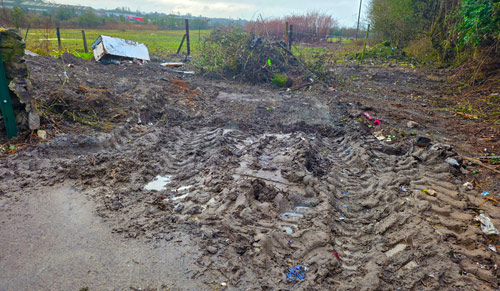
A recent abandoned attempt at cleaning the area.
Naturally, this could not be tolerated. So it became “connected”, “improved”, “enhanced”, “brought forward”, (whatever soothing verb local councillors, the local Municipal District Administrator and her officials would prefer), until all of it were “totally and wantonly obliterated”, its ancient hedgerows removed and the route flattened under heavy machinery, without so much as the courtesy of admitting what was being lost to the residents of our struggling town. Then, after much denial of its existence, with a straight face that would even shame a Victorian undertaker, it reappeared in planning language as being a “paved, pedestrian, walking route along a historical walking path”, despite being described by local councillors and politicians as not paved at all, before being levelled and left with only a temporary skin of tarmacadam.
And now we arrive at the masterpiece of their planning – “The Aftercare”.
Because nothing says “community amenity” like building a walkway and then abandoning it to rot, as if maintenance were an optional lifestyle choice, like decaf or seatbelts. The grand vision, a safe walking route on Mill Road, Thurles, tied into wider footpath plans, presented as “overdue” and “necessary”. The execution, however, appears to have followed the classic local-government model; do the ceremony; pour the tarmac; maximise the photocredit, then disappear vanishing into the mist.
So the area has now again begun its return to nature, that sacred Irish policy position otherwise known as “leaving it in a hape”. First came the willow saplings, same thrusting up through the tarmac like a botanical middle finger to uninterested municipal district officials, while rooting themselves into every crack that sheer neglect has kindly widened for them. Then arrived the briars and brambles, years of Autumn’s leaves, nettles and rank grass, all working in quiet co-operation like they’ve been awarded the contract. Soon enough, the walkway becomes less of a public route and more of a living demonstration of what happens when you build infrastructure with no real future plan to mind it, other than personal glorification.
And the litter, ah, the litter; not the dainty odd sweet-wrapper sort. No, this is the full rural-civic anthology, large plastic bags flapping like distressed flags; tyres slumped in the verge; broken wire fencing sagging like exhausted excuses. The occasional supermarket trolleys, thoughtfully dumped to ensure nobody confuses the place for cared-for land. If you’re lucky, a washing machine or two, because why wouldn’t you add white goods to a heritage corridor?
But the true flourish, the one that should make even the most hardened press-release writer blush, is how the site has been used as a stage for virtue, and then as a bin for its consequences.
In spring 2025, the area beside ‘Dun Muileann‘ on Mill Road, Thurles, became part of the One Hundred Million Trees planting push, funded locally by Allied Irish Banks’ Thurles branch, with students and the odd idle volunteer turning up to plant a dense mini-forest, using the Miyawaki Method; the whole point being fast-growing biodiversity and a carbon sink. The public reporting around it speaks of over two thousand native saplings planted at the site, a serious effort, and no small gesture of community buy-in.
And then, in the sort of anticlimax Ireland has successfully perfected; those young trees are left in a space now allowed to slide into total disorder, where over the past number of months horses are permitted to trample through the plantings that were meant to be protected long enough to establish themselves. A “green space”, promised and photographed, now reduced to a patch of scruff and horse manure, where the only thing thriving is the evidence of nobody being responsible.
That’s the moral of it, really, the fetish for the new, paired with the total inability to mind what’s then built.
Because it takes a special kind of civic arrogance to first flatten a famine-era landmark that once, literally, put bread into mouths, and then to shrug at the basic upkeep required to stop the replacement from becoming an overgrown dumping lane.
We are told, endlessly, about “heritage”, “biodiversity”, “active travel”, “community”. The words are always there; the maintenance however rarely is.
And so the Double Ditch, the real one, survives mostly as an idea: something that mattered, that was walkable, that carried memory in its stones. What’s left on the ground is the modern tribute: tarmac, blocked drains, weeds, rubbish, bent fencing, and the quiet certainty that nobody, supposedly in authority, will be held to account for any of it.
On behalf of myself, I offer my sincere apologies to Thurles Branch of AIB; (Sponsors), to MrRichard Mulcahy (Co-founder of the 100MT Project initiative) and to all those students who enthusiastically and eagerly took part in last April’s planting. Hopefully some of the trampled saplings will continue to survive, after all horse dung is a nutrient-rich organic fertilizer and soil conditioner.
Thurles Cathedral re-roofing project among Tipperary awards in €389,000 built heritage funding.
County Tipperary is to benefit from a total allocation of almost €389,000 under the Built Heritage Investment Scheme (BHIS) and the Historic Thatched Buildings stream, funded by the Department of Housing, Local Government and Heritage and administered locally through Tipperary County Council.
A total of 44 projects across the county will share €367,285 under the main BHIS scheme, with a further €21,377 allocated to seven thatched-building projects to support the maintenance of historic thatch.
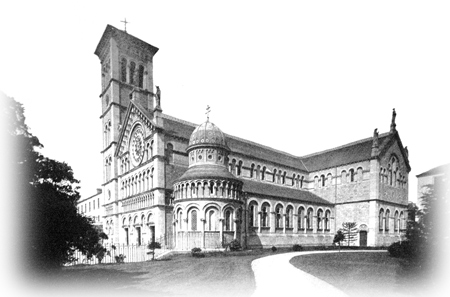
Among the county allocations, Thurles Cathedral’s re-roofing project has been awarded €14,000, thus supporting ongoing efforts to conserve one of North Tipperary’s most significant landmarks.
The largest single award in Tipperary is €18,000 for works at the old Courthouse building in Mullinahone. Other notable allocations include €10,000 for the Catholic Church in Cashel and €7,000 for the Catholic Church in Clonoulty.
A major refurbishment project is currently under way at the church in Cashel, including a new roof and works to prevent water ingress. The parish is taking on debt of approximately €250,000 for the Cashel works and the painting of the church in Rosegreen, with fundraising continuing locally, including a St Brigid’s Day Tea Party in Halla na Féile on Saturday, February 1st. Places are strictly limited; booking is essential for this FREE event, allocated on a first-come, first-served basis.
Elsewhere, allocations include €9,000 for the Bianconi Memorial Chapel in Boherlahan and €10,000 for the Wellington Memorial near Kilcooley. In Cahir, Cahir Post Office receives €12,000, while €13,000 has been awarded for No. 5 Pierce Street to support roof works.
In Clonmel, the 1798 Monument has secured €4,285, while the Michael Cusack Monument in Drangan has been allocated €4,000.
Projects supported under the thatch stream include €3,500 for a house in Clonoulty village.
The Built Heritage Investment Scheme provides grant support for repair and conservation works to protected structures, helping owners and custodians to safeguard historic buildings and support skilled conservation employment. Full scheme details and guidance for applicants are available through Tipperary Co. Council and gov.ie.
As Promised: Time to Construct Plans and Attempt to Find a “Bookable Visitor Experience,”for Thurles.
Thurles Tourism Debate: Part IV. Concerns over Tipperary’s ability to sustain and grow tourism have intensified following a recent council presentation on our tourism performance and marketing activity; but then in the words of T.C. Haliburton and later P.T. Barnum, “Talk is Cheap” and the words of councillors and officials come easier than their actions.
Thurles ‘A Sellable Product’.
“Thurles: Cathedral, Liberty Square & Local Stories, Lár na Páirce.” (90–120 mins)
The promise: (what the visitor gets.) A guided, easy walking loop that explains Thurles through three stops foreigners can understand instantly:
Cathedral of the Assumption: Big visuals + a clear “why it matters” story: architecture, stained glass, music/choir tradition, and key moments that root the town in Irish life.
Perfect as an add-on stop between other major routes.
Why Irish Rail is a big advantage for Thurles. Thurles has a very strong practical selling point; it’s a rail town with visitor basics already in place. From Irish Rail’s station information, Thurles station is 0.5 miles to the town centre, has toilets, passenger shelters, an enclosed waiting room, and strong accessibility (lifts to platforms, accessible toilet, ramps). It’s also on key intercity routes including Dublin Heuston – Cork (directs and intermediate), plus services connecting towards Limerick/Ennis and Tralee.
That means we can pitch Thurles as: “Arrive by train, walk the town, back on the train.” Ideal for weekend/day-trip groups who dislike motorway fatigue, parking stress, or long coach days.
In Part V, of our Thurles Tourism Debate, in the coming days we will assist in where to contact/sell and will provide a short, copy/paste social media advert.
Note: Since two paid tour guides with proper temperament, will be required to undertake this work, (yes we already have two knowledgable individuals, trained by myself), thus creating two jobs, which is more than our Tipperary public reps. have created in the past 20 years.
Time to increase failed footfall and reverse the deliberate destruction of our town centre, (Liberty Square), as a centre for business.
Learn how to make a St Brigid’s Cross – Tuesday next @2.30pm.
Please do remember: As with previous years, places are strictly limited. Advance booking is therefore essential for this free event and places will be allocated strictly on a first-come, first-served basis. Bookings Please to Tel: No. 062 63825.
Visitors attending this informative event can locate the Cashel Library building; situated on Friar Street, Lady’s Well, Cashel, Co. Tipperary, HERE. (Eircode E25 K798).
With Tipperary named by Lonely Planet as one of the world’s top places to visit in 2026, the county’s lesser-known heritage sites deserve renewed attention and care. An example of same should include a small, enclosed burial ground, where a scattering of largely forgotten eighteenth and nineteenth century headstones still survives at the edge of Thurles town.
Carved stones from a lost church, mounted on a pillar. Pic: G. Willoughby.
St Bridgid’s graveyard (Eircode E41 AC91), the remnant of a former medieval parish church site, lies just west of Ardán Bhríde (Bridgid’s Terrace), directly opposite Thurles train station and running parallel to what was once named Garryvicleheen Road, now better known as Abbey Road.
Trailing Ivy now protects Thurles history. Pic: G. Willoughby.
What makes this modest graveyard particularly significant, however, is a limestone pillar beside the entrance to this enclosure, where architectural fragments and carved stones, wisely salvaged from the lost church, have been gathered and mounted for safekeeping.
A pillar of fragments and a warning in stone. On the south face of the pillar, four carved stones are now just about visible. At the top sits a rectangular corner stone bearing a carved seated cat, traditionally said to have once had two tails. Severe weathering has already softened key details, and the carving is now so worn that it may not survive intact for another generation. The cat’s face is described as V-shaped, with what appears to be a mouse held in its jaws. Locally, the workmanship has been associated with the trademark craft of An Gobán Saor (Gobban the Builder),the legendary seventh-century master mason, though the cat itself appears stylistically later, likely of eighteenth or nineteenth-century date.
To the right of the cat is a square stone depicting a lion, set within a circular frame. Same may also have British Royal Family connections. A surviving window fragment, same a rare prominent, ornate window arch, with S-shaped curves (ogee) and decorative carved panels (spandrels) is yet another striking historic piece. Finally, a rectangular limestone block carved with what appears to be a bald individual in a long robe and tunic, the clothing suggesting a cleric, (could it represent St Bridgid/ Bridget). The individual holds a cross in their right hand and a circular string of beads, most likely a paternoster♦, in their left. Beneath the figure, the names Patrick Kennedy and James Bulter have been crudely cut, later interventions that now form part of the stone’s layered story.
♦Paternoster: The paternoster was used to count prayers, typically 150 recitations of the “Our Father”. These beads often formed a loop, sometimes with a cross, reliquary (a container for holy relics), or pomander (latter worn or carried in a case as a protection against infection in times of pestilence or merely as a useful article to mask bad smells), as its end. This style eventually evolved into the modern rosary beads used today. Wearing the paternoster openly served as a devotional act, identifying the wearer as a Christian and displaying their religiosity. Depending on the materials used, serve as a display of wealth.
The west side of the pillar carries a single, highly recognisable carving, now unseen while protected by ivy: a limestone block showing a unicorn and lion rearing on their hind legs, (See immediately hereunder) beneath a crown, framed within a recess with a semi-circular head and straight sides. This scene represents the Royal Coat of Arms of the United Kingdom; Thurles being the ancestral Home of current reigning King Charles III. The window head and the heraldic carving are considered older than the cat, with a provisional seventeenth-century date proposed for the lion and unicorn, (See picture hereunder).
A simple, yet urgent message: Please Protect What Remains!
Behind the ivy, the Royal Coat of Arms of the United Kingdom. Pic: G. Willoughby.
The carvings at St Bridgid’s/Bridget’s gaveyard site are not museum pieces behind glass; they sit in the open air, exposed year-round. Weathering is now actively destroying this history, softening edges, flattening relief work, and erasing the very features that allow the stones to be read, dated and understood.
Once those details are gone, they are gone for good. There is now a clear need for immediate, practical conservation at this site which must include protective covering to reduce direct rainfall and frost damage.
A practical way to safeguard this valuable heritage would be to enlist the services of Mr James Slattery, Slattery Monumental Works, Fianna Road, Thurles, Co. Tipperary (Tel: +353 86 2430213) to oversee the careful, professional removal of the carved stones and their placement in more secure, sheltered conditions.
It is suggested that the four limestone relief blocks, depicting (1) cat, (2)lion, and (3) unicorn and lion, be taken in hand and sympathetically installed within the Thurles Library area of ‘The Source’, in Cathedral Street, Thurles, where they could be properly interpreted and enjoyed by the public and visitors, in a controlled environment.
In addition, the limestone block carved with the (a) cleric figure shown in a long robe and tunic, and the (b) window fragment, could be respectfully mounted on a pedestal within the nearby Church of St Joseph & St Brigid, in Thurles, ensuring, again, both protection and an appropriate setting.
In both instances, these measures would not only secure all the fragments for future generations, but would also create safe, welcoming and attractive points of interest for visitors and history-minded tourists to Thurles.
While St Bridgid’s graveyard maybe a quiet corner of Thurles; these stones, gathered loosely on the top of that pillar, carry centuries of craft, belief, power, memory and identity. If they are left fully exposed, the weather will finish what time has already begun, erasing an important and irreplaceable chapter of Thurles history in plain sight.
This post has been sent to officials at Tipperary Co. Council, marked for the attention of Ms Sinead Carr, (sinead.carr@tipperarycoco.ie).
♦ Note: At no stage should an attempt to remove these historic fragments out of Thurles town, be undertaken, and any efforts to do so should be vehemently and firmly resisted.
This website uses cookies to improve your experience. We'll assume you're ok with this, but you can opt-out if you wish.AcceptRead More
Privacy & Cookies Policy
Privacy Overview
This website uses cookies to improve your experience while you navigate through the website. Out of these, the cookies that are categorized as necessary are stored on your browser as they are essential for the working of basic functionalities of the website. We also use third-party cookies that help us analyze and understand how you use this website. These cookies will be stored in your browser only with your consent. You also have the option to opt-out of these cookies. But opting out of some of these cookies may affect your browsing experience.
Necessary cookies are absolutely essential for the website to function properly. This category only includes cookies that ensures basic functionalities and security features of the website. These cookies do not store any personal information.
Any cookies that may not be particularly necessary for the website to function and is used specifically to collect user personal data via analytics, ads, other embedded contents are termed as non-necessary cookies. It is mandatory to procure user consent prior to running these cookies on your website.









Recent Comments