Percy French celebrated the County Limerick village of Dromcollogher in his comic song Drumcollier, [ Vocals:- The late Irish Tenor Brendan O’Dowda, (1925–2002 ) ], also recorded under spellings such as Dromcolliher. After receiving a particularly warm welcome there during a visit in the 1890s, the songwriter immortalised the village and its famously compact main street.
That same street was to become the setting for one of the darkest episodes in modern Irish history. On Sunday, September 5th, 1926, 100 years ago today, a fire in a makeshift cinema above Mr Patrick Brennan’s hardware store killed 48 men, women and children. The catastrophe would thereafter be remembered locally by two words: “The Burning.”
The upstairs loft normally functioned as an informal community hall, hosting meetings, dances and theatrical performances. It was an L-shaped timber structure, approximately 50 feet long and 15 feet wide, positioned about 12 feet above the store floor. Access was through a single narrow door reached by a steep wooden staircase. Small windows at the back were fitted with bars, while much of the roof, internal partitioning and wall covering was made from combustible materials.
The film show was organised by local hackney driver Mr William “Babe” Forde in association with Mr Patrick Downing, a projectionist employed at a Cork cinema. The films had reportedly been removed from the Cork venue, which did not open on Sundays, and brought to Dromcollogher without their protective metal cans.
Around 150 spectators paid nine pence each and crowded onto benches in the loft. The screening was scheduled for after Sunday-night Benediction in nearby St Bartholomew’s Church. The programme began with a short film called “False Alarm”, followed by the main feature, “The Decoy”.
At approximately 9:50pm, shortly after the second film began, a candle, being used near the projector, fell and ignited exposed cellulose-nitrate film. The nitrate film was extraordinarily flammable and, once alight, burns with fierce intensity.
The fire rapidly spread from the projection area to the timber floor, partitioning and wall covering. A burning reel was reportedly carried towards the entrance during the initial panic and fell near the wooden stairs, obstructing the loft’s only normal exit. People rushed towards the opposite end of the room. Someone eventually forced apart the bars on one of the rear windows, allowing several spectators to jump onto piles of hay below. That escape route was soon blocked, however, and many remained trapped inside.
Within approximately 10 to 15 minutes, the roof fell in and the loft floor collapsed into the hardware store beneath it. Forty-six people died at the scene. Two more who escaped subsequently died from their injuries, bringing the final death toll to 48; almost one person in every ten then living in Dromcollogher. Fifteen of the victims were children, while more than half were under the age of 25. The youngest, James Kenny and Thomas Noonan, were both seven years old; the oldest victim, Ms Mary Turner, was 68. An entire household was also among the dead; retired national schoolteacher Mr Jeremiah Buckley; his wife, Ellen; their ten-year-old daughter, Bridie; Ellen’s sister Mrs Kate Wall; and the family’s maid, Ms Nora Kirwan.
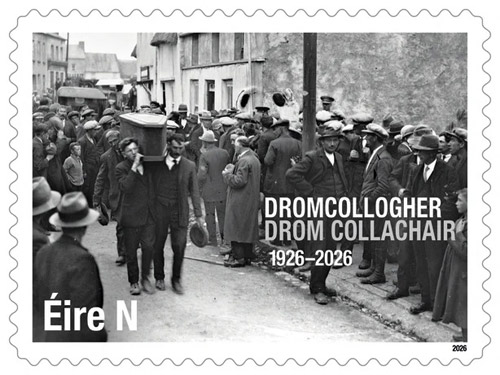
An Post have issued a commemorative stamp (September 3rd, 2026) marking the centenary of the Dromcollogher Cinema Fire.
A vigil was maintained through the night as the remains were recovered from the ruins. Identification was extremely difficult, and many victims could not be recognised. Forty-six of the dead were subsequently buried together in an enormous communal grave in the grounds of St Bartholomew’s Church.
President of the Executive Council W. T. Cosgrave attended the funeral. Messages of sympathy arrived from King George V, religious leaders, local authorities, trade unions and organisations throughout Ireland and abroad. Cosgrave established a national relief fund for those affected by the catastrophe; remarkably, its final payments were not made until 1958. The disaster immediately raised questions about responsibility. Although existing legislation required commercial film venues to be licensed and to observe fire-safety precautions, temporary screenings in rural halls, stores and other improvised premises were relatively common.
Downing and Forde were arrested and charged with manslaughter, but the State ultimately decided not to proceed with the prosecution. No public inquiry was held, despite Cosgrave’s initial promise of one. Regulations governing film screenings in unofficial premises were subsequently tightened. The site of the fire remained derelict for more than two decades. A local committee later acquired it, and in 1953 a public library was opened there as a permanent memorial. The library still occupies the site today, while a large Celtic cross over the communal grave bears the names and ages of those who died.
For decades, many families spoke little about the catastrophe. Survivors and relatives described a silence born from grief, trauma and the belief that such events had to be accepted as God’s will. Yet the memory has endured.
Now, a century later, the tragedy remains Ireland’s deadliest cinema fire. The National Library of Ireland preserves contemporary newspapers and photographs documenting its aftermath, while Dromcollogher’s memorial library and communal grave ensure that the 48 victims of “The Burning” are not forgotten.
One of Ireland’s most important medieval manuscripts; a chronicle of the medieval history of Ireland, has returned to public display in Ireland and it carries a fascinating connection to Emly, Co. Tipperary.
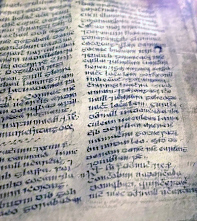
Nearly 1,000 years old, the Annals of Inisfallen comprise 57 vellum leaves handwritten in Irish and Latin. The manuscript preserves a remarkable account of Irish history, from the legendary Tuatha Dé Danann and the arrival of St Patrick, to Viking raids, kings, poets, warfare and the coming of the Normans.
Scholars believe the manuscript was initially copied at the monastery of Lismore, Co. Waterford, using earlier source material created at the great monastic centres of Emly, Co. Tipperary, and Clonmacnoise, Co. Offaly. This connection highlights Emly’s important role as an early centre of religious learning, scholarship and historical record-keeping.
During the 12th century, the manuscript was probably brought to Inisfallen Island in Killarney, where successive scribes continued recording events. Its extraordinary entries include the Viking raids on Skellig Michael in 823, the arrival of a group believed to be Ireland’s first Jewish community in 1079, the great snow of 1047 and the gift of a camel from the King of Scotland to a great-grandson of Brian Boru in 1105. Now preserved by the Bodleian Libraries at the University of Oxford, the manuscript is being exhibited in Ireland for the first time since 1983.
Recording the Past: The Annals of Inisfallen and the Making of Irish History is on display at the Glucksman, University College Cork, until November 1st, 2026.
For the people of Emly and Co. Tipperary, the exhibition offers a welcome opportunity to recognise the contribution their ancient monastic centre is believed to have made to one of Ireland’s greatest written treasures.
The Stench of Neglect: River Suir in Thurles Suffocates in Waste.
A Waterway Left to Fester: Apparent Pollution, Institutional Neglect and an Inexcusable Failure to Act.
The early images in the video immediately below are visually consistent with sewage-contaminated water, inadequately treated wastewater, detergent-bearing grey-water, or another organic effluent. The foam could indicate surfactants, while the grey colour and sludge may indicate suspended solids and decomposing organic matter. It does not resemble clean surface-water run-off.
However, a photograph alone cannot conclusively identify the slowly flowing substance in a river now almost static. Proper investigation should include samples from the suspected discharge point and locations upstream and downstream. Relevant analyses include dissolved oxygen, BOD, COD, ammonia, orthophosphate, suspended solids, E. coli, conductivity and surfactants. EPA material confirms that BOD, dissolved oxygen, ammonia, nitrate and phosphorus are central indicators of organic contamination, and that pollution-incident sampling should cover downstream, discharge-point and upstream locations.EPA sampling procedure
This slide-show above, however, presents a disgusting and deeply alarming picture; grey, foaming liquid and foul-looking sludge accumulating in what should be a living watercourse. Its exact composition must now be determined by laboratory testing, but its visible condition is wholly incompatible with the clean, healthy river environment the public is entitled to expect.
This river is neither a sewer nor a dumping ground. If analysis confirms an unlawful discharge, its source must be stopped, the damage remediated and every available enforcement power used.
Continued neglect after documented notification would be indefensible, a betrayal of the waterway, its wildlife and the community these authorities and representatives are supposed to serve.
Reminder
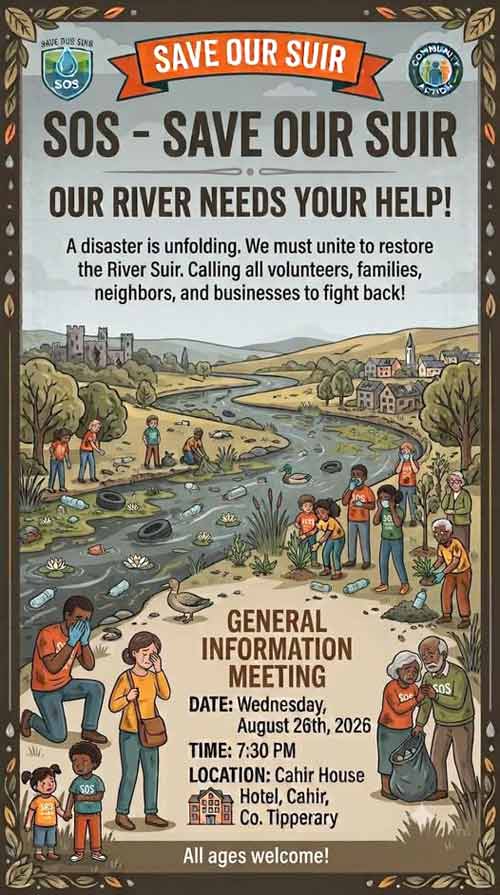
We can confirm that the above public meeting will take place, as stated above.
Thirteen years of warnings As stated in a recent post on Thurles.Info, the deterioration of the River Suir cannot credibly be described as “sudden” or “unforeseeable”. For more than a decade, residents, anglers and environmental campaigners have raised concerns about pollution, excessive vegetation, restricted flow, sediment, litter and neglect. These concerns were documented in “River Suir Crisis—Thirteen Years of Warnings, But Still No Coordinated Action”.
Now, 13 yearslater; the Minister of State Mr Kevin “Boxer” Moran recently visited sections of the Suir in Thurles and Holycross following representations from Independent TD Michael Lowry. It was stated that the Office of Public Works would support an application by Tipperary County Council under the enhanced Minor Flood Mitigation Works Scheme. However, I can confirm from recent discussions with varying responsible bodies, that they are not aware of any recent communication. Support for an application is welcome, but it is not a restoration programme. The public has not been shown the precise work proposed, the scientific evidence supporting it, the environmental assessments required, the anticipated cost and timetable or the body responsible for delivery and monitoring.
Political videos, visits and announcements by politicians and councillors cannot substitute for accountable work. Councillor Micheál Lowry, Deputy Michael Lowry and every other representative addressing the issue must be judged by measurable results. The same standard must apply to Tipperary County Council officials. [ Which begs the question; “Where were all the other local elected councillors when a recent promotional video, capturedby Mr Lowry TD, was uploaded unto social media.” ]
The missing ingredient for the River Suir is not more talk, it is delivery.We need clear answers:
► What works will be carried out? ► When will they begin? ► Who is responsible for delivery? ► Has the funding application now been submitted? ► What section of the river will be prioritised first? ► How will pollution and damaging discharges be reduced? ► How will progress be measured and reported publicly?
Mr John Downey was not merely someone whom Sinn Féin defended from a distance. He was publicly described by the party’s own newspaper as a “popular Donegal Sinn Féin member,” while senior party figures repeatedly campaigned on his behalf.
In December 2019, the High Court found, on the civil standard of proof, that Mr Downey was an “active participant” in the IRA’s 1982 Hyde Park bombing. The attack killed four Household Cavalry soldiers: Lieutenant Anthony Daly, Squadron Quartermaster Corporal Roy Bright, Lance Corporal Jeffrey Young and Trooper Simon Tipper. Thirty-one other people were injured and seven horses were killed. Downey denied involvement.
Also linked to this atrocity was the late Tipperary-born Fr Patrick “Paddy” Ryan, who admitted to BBC investigative journalist Jennifer O’Leary that he “had a hand in the Hyde Park bomb.” Ryan, who assisted the Provisional IRA by sourcing funds, weapons and bomb components, was not accused of planting or detonating the device and was never convicted in connection with the attack; nevertheless, his own admission and the evidence concerning the electronic component he procured establish his involvement in supporting the operation.
Mr Downey’s earlier criminal prosecution collapsed in 2014; not because he was acquitted on the evidence, but because the British government had mistakenly assured him that he was no longer wanted. The judge ruled that proceeding with the prosecution would therefore be an abuse of process. Sinn Féin had played a direct role in securing consideration of Downey’s status. An official parliamentary investigation records that his name was submitted to the Northern Ireland Office on January 10th 2002 as part of what became known as “Sinn Féin list two.” Sinn Féin representatives, including Mr Gerry Kelly, were subsequently kept informed about his case.
The party’s association with Downey continued publicly:
Sinn Féin’s newspaper described him as a party member and long-time supporter of the peace process.
Senior figures visited him in prison and spoke in solidarity with him.
Sinn Féin President Mary Lou McDonald said in 2019 that the party would continue supporting Downey and his family.
Pearse Doherty condemned Downey’s arrest and extradition as “vindictive.”
Sinn Féin speakers paid tribute to him at the party’s 2019 conference.
There are also serious questions concerning Downey’s property. Irish Land Registry documents reportedly showed that in June 2017; while victims’ relatives were pursuing civil proceedings, he removed his name from the ownership of the family home in County Donegal. Other land was reportedly transferred to his wife. The timing prompted allegations that assets were being placed beyond the claimants’ reach.
However, an important distinction must be maintained: no reliable evidence located so far proves that Sinn Féin owned, received or helped transfer these properties. The documented connection is political, personal and organisational; not a proven link to the movement of Downey’s assets.
The established facts are nevertheless significant; a court found Mr Downey civilly responsible as an active participant in an IRA bombing that killed four soldiers. Sinn Féin submitted his name to the “on-the-runs” process; the party identified him as a member; and successive senior Sinn Féin figures publicly supported him.
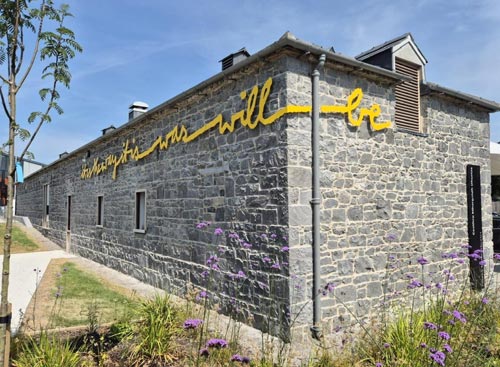
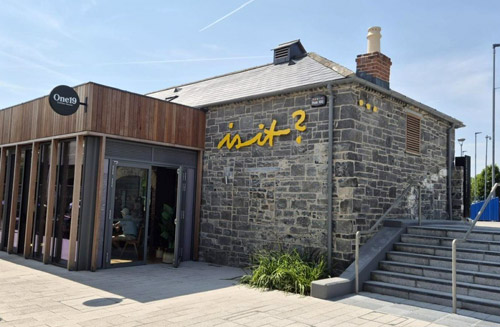
A striking ribbon of yellow now sweeps around the new café at Thurles Market Quarter, carrying with it the voices of the past, the questions of the present and the possibilities of tomorrow.
Thurles.Info has already highlighted the work of talented artist Ms Anja Buchheister, despite previously being unable to identify the artist by name. Our sincere thanks, therefore, to Ms Esther Griffin, (Research Assistant with the Tipperary Arts Office), for bringing the artists name and her magnificent new public artwork, once again, to our attention.
Thurles Market Quarter. Pic: Anja Buchheister.
Created by artist Ms Anja Buchheister, “Flowing Places” is far more than an architectural embellishment. It is a compelling meditation on memory, change and our relationship with place. Wrapped around a building once belonging to the farmyard of nearby St Patrick’s College, the artwork transforms a historic structure into a living conversation between generations.
Cut from powder-coated metal, its words unfold in an endless, thought-provoking sequence: “it is the way it is … was … will be … is it? …”
With this playful reversal of a familiar expression, Ms Buchheister challenges passive acceptance. Is a place simply what it is – or is it also what it was, what it may become and what its community chooses to make of it?
Thurles Market Quarter. Pic: Anja Buchheister.
The artist’s research reached deep into Thurles itself. Old maps and conversations with local residents revealed layers of memory embedded in the former old early 19th century agricultural machinery sheds. These recollections helped shape an artwork that honours the people who came before, while recognising that every landscape remains in motion. Like the nearby River Suir, the words flow continuously around the building. There is no fixed beginning and no final conclusion; only an invitation to pause, remember and imagine.
Originally from Wolfenbüttel, Germany, Ms Buchheister now works from her studio in Templetuohy, Thurles. Drawing on her training in sculpture and graphic design, she has created a poetic intervention that is simultaneously bold and delicate, deeply local and universally resonant.
“Flowing Places” is a magnificent addition to Thurles Market Quarter; an artwork that does not merely occupy public space, but awakens it. It celebrates heritage without trapping it in the past and turns an evolving corner of Thurles into a landmark of curiosity, creativity and civic pride.
Commissioned by Tipperary County Council under the Per Cent for Art Scheme and developed with Thurles Municipal District, the work stands as a powerful reminder that public art can do more than decorate a place, it can give that place a voice.
This website uses cookies to improve your experience. We'll assume you're ok with this, but you can opt-out if you wish.AcceptRead More
Privacy & Cookies Policy
Privacy Overview
This website uses cookies to improve your experience while you navigate through the website. Out of these, the cookies that are categorized as necessary are stored on your browser as they are essential for the working of basic functionalities of the website. We also use third-party cookies that help us analyze and understand how you use this website. These cookies will be stored in your browser only with your consent. You also have the option to opt-out of these cookies. But opting out of some of these cookies may affect your browsing experience.
Necessary cookies are absolutely essential for the website to function properly. This category only includes cookies that ensures basic functionalities and security features of the website. These cookies do not store any personal information.
Any cookies that may not be particularly necessary for the website to function and is used specifically to collect user personal data via analytics, ads, other embedded contents are termed as non-necessary cookies. It is mandatory to procure user consent prior to running these cookies on your website.




Recent Comments