|
|
 The Swiss Cottage Cahir As part of the 200-year anniversary of the iconic Swiss cottage situated in Cahir, Co Tipperary, a family day will be held tomorrow.
The Swiss cottage was built around 1810 at Kilcommon, Cahir, County Tipperary. The building is a very fine example of cottage ornée, or ornamental cottage. It was originally part of the estate of Lord and Lady Cahir, and used mainly as a hunting and fishing lodge and for entertaining guests. The cottage was probably designed by Anglo-Welsh architect John Nash 1752-1835, famous for his designing of much of Regency London.
John Nash came to work in Ireland as an architect after 1793 and also designed St Paul’s Church of Ireland church in Cahir, which was built in 1818 and one of only two known Nash designed churches to survive.
Cahir, may have been built by Richard Butler, 12th Baron Caher, 1st Earl of Glengall (1775-1819), who married in 1793, Emily Jeffereys, daughter of James St John Jeffereys of Blarney Castle, Co.Cork. Milady Cahir is referred to by Napoleon Bonaparte’s Josephine ( Joséphine de Beauharnais) in connection with the Château de Malmaison, latter formerly her residence and was from 1800 to 1802 the headquarters of the French government.
The Swiss Cottage, after many years of shameful neglect, was fully and painstakingly restored by the OPW starting in 1985 and was opened to the public again in 1989.
The family day will include an angling demonstration, guided woodland walks and demonstrations of traditional crafts such as thatching and stone carving. Admission for the day is free and programme of events start at 12.00 noon tomorrow until 5.00pm. If you are out and about for a leisurely drive this weekend, this event is well worth a visit.
Pierce Hayes and Johanna Finigan survived the Great Famine here in Co Tipperary and emigrated to America as very young children. Local Church and tenant records indicate that they had lived in the town-lands of Derry, Curraghmore, Clougherailymore, and Clougherailybeg, in East Loughmore, near Thurles.
Other surnames attached to the ancestral family through marriage include the inevitable Irish names of Ryan and Maher.
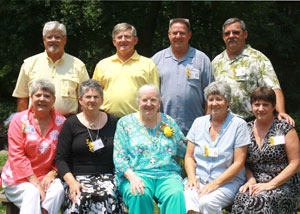 Back L-R: Joseph, Paul, Vincent, Patrick. Seated L-R: Bernardine, Rita, Therese, Mary, Louise. The emigrant families remained in close contact while in Massachusetts. Pierce Hayes went on to join the Union Army during the American Civil War and was seriously wounded in 1861. Pierce and Johanna later married in Massachusetts in 1862.
Fast forward now four generations and we come upon a descendant Hayes family of nine siblings, all born in Norwalk, Connecticut, but now spread all across America.
On June 13th, 2010, the eldest sibling, Therese Hayes, celebrated her Golden Jubilee, fifty years dedication to her convent. Sister Therese is a member of a small order, The Medical Mission Sisters, headquartered in Philadelphia. She spent her early years working for a hospital in Ghana and later doing inner-city AIDS mission work in Philadelphia. The convent has published several brief articles recalling her devout and dedicated service. (See Links http://www.medicalmissionsisters.org/healing/AIDS.htm and http://www.medicalmissionsisters.org/healing/200yearsinmission.htm.
In celebrating her Golden Jubilee in June, Sister Therese was joined by all eight of her younger siblings and an additional twenty nine nieces, nephews, spouses and friends. Indeed, such grand family reunions are organized every few years.
Brothers Paul, Vincent, and Patrick last visited their ancestral town-lands in Loughmore in February of this year, 2010, when they were briefly the guests of Thurles Town Mayor, Mrs Evelyn Nevin and Thurles Town Clerk, Mr Michael Ryan.
You may find more about this families history by viewing their Family Tree report. (See Link http://home.comcast.net/~hayesmcsweeney)
There are now 115 descendants of Pierce and Johanna living in America who can trace their ancestry directly to these two famine children from Loughmore East.
To Sister Therese: Congratulations on achieving your Golden Jubilee and from Tipperary go our best wishes for your continued good health and happiness and in the words of an old Irish Blessing:-
May the blessing of light be on you—light without and light within.
May the blessed sunlight shine on you and warm your heart, till it glows like a great peat fire.
Note: If there are any people out there who can shed further light on the Hayes and Finigan family roots here in Loughmore, we would love to hear from you and we will be happy to put you in contact with their American descendants – they would love to hear from you.
 The era of Queen Victoria was a time of industrial, cultural, political, scientific, and military progress within the United Kingdom of Great Britain and Ireland. Before our independence, postboxes bore the insignia of British reigning monarchs. “VR”, “ER” and “GR” latter insignia referring to Queen Victoria, King Edward VII and King George V. The era of Queen Victoria was a time of industrial, cultural, political, scientific, and military progress within the United Kingdom of Great Britain and Ireland. Before our independence, postboxes bore the insignia of British reigning monarchs. “VR”, “ER” and “GR” latter insignia referring to Queen Victoria, King Edward VII and King George V.
Some of these beautiful boxes can still be seen in parts of Ireland today. Postboxes erected since 1922 bear Irish logos, e.g. a harp entwined with the letters SÉ, short for Saorstát Éireann and later PT (Posts and Telegraphs) and, since 1984, An Post.
Since 1861, The residents of Kilmoyler have been posting letters in one of these designer Victorian cast-iron postboxes, embedded in the ivy clad wall opposite the Lady Gregory public house since 1861. Alas, now in this present age of speedy communication and sophistication, this simple luxury is no more, thanks to snails.
Recently the local postman noticed this mailbox had been infiltrated by snails who were munching on the envelopes contained their-in. On reporting this matter, An Post decided to suspend its daily collection and seal the box causing not a little complaining from local letter writers.
So Why Have Snails In Tipperary Begun Invading Our Perfectly Good Postal System?
In their natural habitat, land snails eat mushrooms, fruit, leaves and any other kind of vegetation they can find. Mostly, snails eat living plants, but can also eat decaying ones. Other forms of food include plant bark, flowers and algae. In order to get a nutritional supply of calcium for their shells, snail food includes limestone and they also eat ready available chalk from rocks.
Snails however also can easily acquire a taste for damp paper and cardboard, because same are mostly made from a fibre called cellulose that comes from trees harvested from plantations and forests. Wood chips are mechanically and/or chemically treated to release these fibres. This produces a pulp which is then mixed with large amounts of water to make a mush that is passed over a continuous, rapidly moving mesh. The water is drawn through the mesh, leaving the fibres behind. These damp fibres are then passed over a series of rollers to flatten and dry it, then rolled onto huge spools, and sent to factories for cutting and shaping. So remember that paper is made from plant materials and snails simply see it as another food source.
Snails also do not like hot and dry conditions as presently being experienced in Co.Tipperary. They like their atmosphere moist or humid and not too bright, so where better to spend their slow moving leisurely time than in a cast iron letter box, whose dark interior walls are covered in condensation.
So What Is The Solution To This Snail Mail Problem?
Continue reading Snails Eat Mail In Tipperary
 Ireland and the UK have been EU partners since 1973 and both Ireland and the British Isles share a long interlinked history and essentially the same popular culture. It is now high time to move on from the past to a complete normalising of relations between both our countries. It is not surprising therefore that An Taoiseach Mr Brian Cowen has signaled that Queen Elizabeth II will probably make a state visit to this country before the end of next year. Ireland and the UK have been EU partners since 1973 and both Ireland and the British Isles share a long interlinked history and essentially the same popular culture. It is now high time to move on from the past to a complete normalising of relations between both our countries. It is not surprising therefore that An Taoiseach Mr Brian Cowen has signaled that Queen Elizabeth II will probably make a state visit to this country before the end of next year.
Speaking in London after a meeting with British Prime Minister David Cameron, Mr Cowen signaled that the visit would, only rightly, be before the end of Irish President Mary McAleese’s second term in office which regrettably comes to an end next year.
The Taoiseach said that no obstacle now exists to prevent a State Visit to Ireland by Britain’s Queen taking place, and I like the vast majority of Tipperary people fully agree.
As a citizen of a modern, sovereign European state, I have no difficult with the head of state of my nearest neighbour coming over for a visit. She is not only the Head of State of our nearest neighbour, but also our most important trading partner and home to at least a million of our citizens.
This proposed visit is a measure of the long overdue parity of esteem that we as a Nation worked so hard for and achieved in the last 10 to 15 years. To those who voice opposition, I say leave the past to the past, where it rightly belongs and move on.
The very few opponents to her intended visit to this country need to grow up, so come on Ireland, show how far we’ve come and put out your ‘Welcome Mats’. This is a wonderful opportunity for the future of this country. Let us show the world that when it comes to ‘Welcomes’, there is no welcome like an ‘Irish Welcome’.
Already the smart busy tourist attractions like Kerry are ‘sticking their spade in’ suggesting she should visit their natural beauty spots, like Muckross Estate, but when Her Majesty Queen Elizabeth II comes to Ireland, the most obvious place to take her is to her ancestral home, here in Thurles, Co.Tipperary.
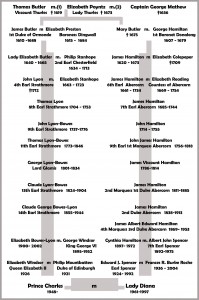
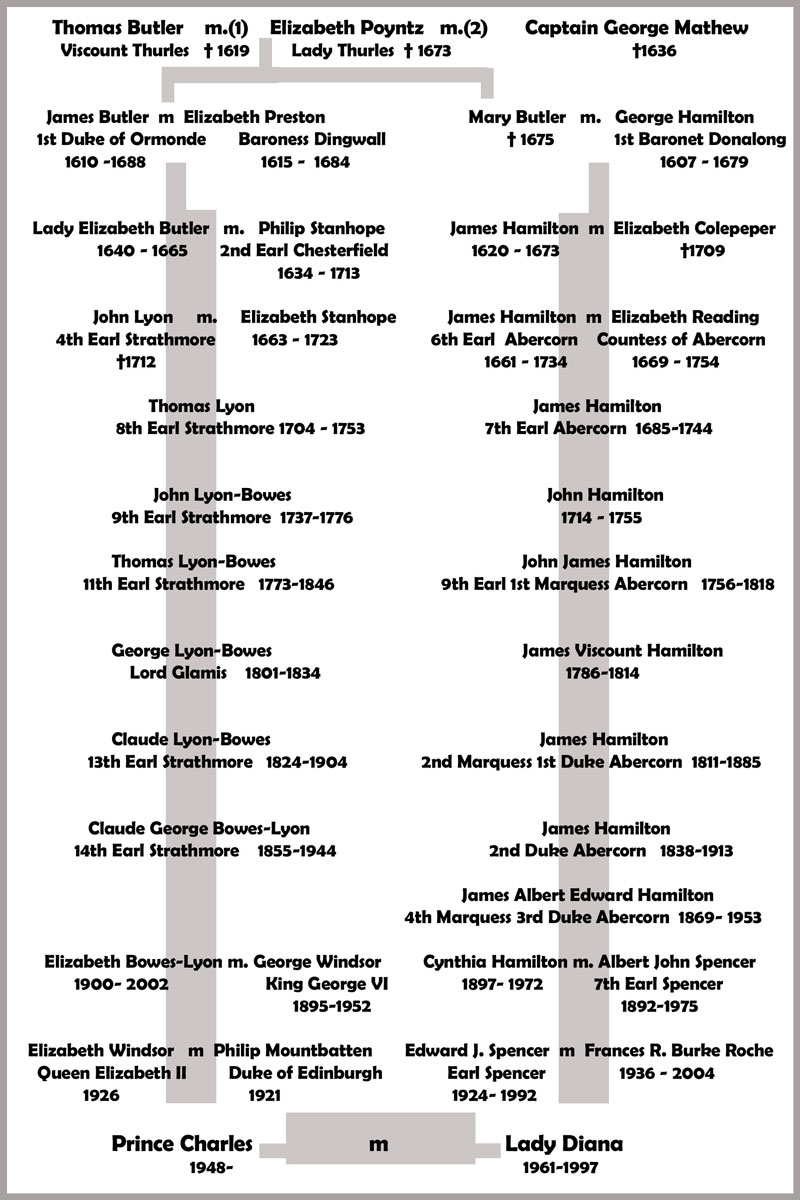
As our readers can observe by clicking on our ‘Family Tree’ picture, (on right of this screen), Queen Elizabeth II not only acquired her christian name, but is also a direct descendant of Viscount and Lady Elizabeth Butler of Thurles (Latter formally Miss Elizabeth Poyntz, daughter of Sir John Poyntz,Bart., of Acton in Gloucestershire, England.) through their eldest son, the Duke of Ormond. The Duke’s daughter, also Elizabeth, married Philip Stanhope, 2nd Earl Chesterfield, and their daughter Elizabeth Stanhope married John Lyon, 4th Earl Strathmore. Six generations later in direct line was the 14th Earl Strathmore whose daughter, Elizabeth Bowes-Lyon married the future King George VI; and these are the parents and grandparents respectivly of Her Majesty Queen Elizabeth II and her son Charles, latter heir apparent to the thrones of the Commonwealth realms.
Your Majesty we would love to have you amongst us, here in Thurles, as our guest, even if only for an hour or so.
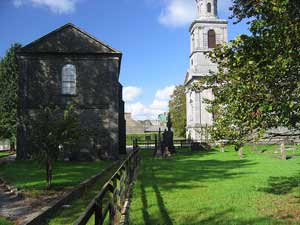 Bolton Library in the shadow of The Cathedral of St. John The Baptist, Cashel, Co. Tipp. An exceptional collection of literature, described by experts as the one of the most important of its kind in Ireland has been taken into the care of the State, by the Office of Public Works (OPW).
The Bolton Library in Cashel, Co Tipperary, was first established by an 18th century Church of Ireland Archbishop and skilled Canon Lawyer, Theophilus Bolton, (1678-1744), grandson of Sir Richard Bolton, Lord Chancellor of Ireland. Educated in Trinity College Dublin, Archbishop Bolton became Chancellor of St. Patrick’s Cathedral in 1714, Bishop of Clonfert and later Bishop of Elphin in 1724, before becoming Archbishop of Cashel in 1730. The Cashel Palace Hotel directly opposite Cashel Cathedral was originally built for his convenience, as a place of residence. His rare collection of some 11,000 books maps and pamphlets were bequeathed to the Cashel Diocese following his death.
This unique collection of antiquarian European books contain the thoughts, words and deeds of mankind for over 2,500 years, and include works by Dante, Machiavelli, Homer, Herodotus, and Plato. Amongst this collection can be found an interesting letter from a citizen of Athens to the then Roman Emperor, pleading for fair and reasonable treatment of Christians and amongst the maps a Geographical Survey of Ireland printed in Dublin in 1840, which warns of the disastrous effects of continuing to plant the potato crop.
The collection, currently securely housed in the Chapter House of the Cathedral of St. John The Baptist, has been traditionally cared for by the local Protestant Clergy and despite its immediate proximity to the Rock of Cashel, this rare collection is little-known and has attracted few visitors down the years.
Continue reading Bolton Library – An Exceptional Collection Of Rare Literature
|
Support Us Help keep Thurles.info online by donating below. Thank you.
Total Donated 2026: €300.00
Thank You!
Daily Thurles Mass Livestream
|



Recent Comments