|
|
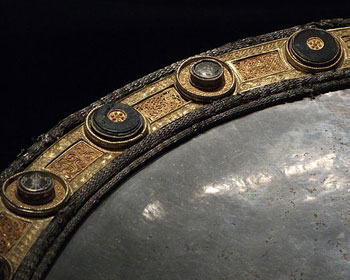 Efforts to organise the repatriation of the Derrynaflan Hoard back to its native home in Thurles Co. Tipperary were highlighted in yesterdays morning’s edition of the Independent newspaper & today’s Irish Examiner (page 4) Efforts to organise the repatriation of the Derrynaflan Hoard back to its native home in Thurles Co. Tipperary were highlighted in yesterdays morning’s edition of the Independent newspaper & today’s Irish Examiner (page 4)
The leading Irish newspapers stated that an organisation in Tipperary, called Hidden Tipperary, is calling for the permanent relocation of the Derrynaflan Hoard, now housed at the National Museum of Ireland, to be returned back to its county of origin.
Derrynaflan Hoard
The treasure trove known as the Derrynaflan Hoard consists of one highly decorated ninth century silver chalice, a large eighth century paten and stand, an eighth century liturgical strainer, and an eighth to ninth century bronze basin. A stone slab, found on the site and now also in the National Museum, and much associated with the original location of this treasure & inscribed “Or doan main Dubscull,” (Translated; A prayer for the soul of Dubscuile,) is also being sought.
Abbot Dubscuile mac Cinaeda, mentioned in the Annals of the Four Masters, is understood to have died around 962 AD & was the son of Cinaedh, and one of the eventual successors of St. Colum Cille (521 AD – 597AD).
St. Columcille or St. Columba was an Irish Abbot and missionary credited with spreading Christianity in present-day Scotland. He founded an important abbey on the island of Iona, which became a dominant religious and political institution in this region for centuries. He was highly regarded by both the Gaels of Dál Riata and the Picts of Scotland, and is remembered today as a Christian saint and one of the Twelve Apostles of Ireland.
Derrynaflan Island
The monastery at Derrynaflan was originally founded by St. Rhuadhan of Lorrha in the sixth century. Derrynaflan was an important monastery in the then eighth and ninth centuries and came under the patronage of the King-Bishops of Cashel. After the death of Feidlimid mac Crimthainn the King-Bishop of Cashel in 847, this monastery fell into decline & nothing of this early monastery’s structure now remains, except some very faint outlines of the original enclosure and the ruined walls of a slightly later church.
Suitable exhibition space has been identified in The Source complex beside the river Suir, and new high definition CCTV currently being installed in the town centre is expected to be incorporated into any required security deemed necessary by the National Museum, should an agreement to repatriate be reached.
Employment
Any repatriation of the Derrynaflan Hoard is expected to create at least 300 full-time & part-time jobs in the region, particularly in the tourism associated sectors, like Restaurants, Hotels, Theatres, as Guides etc, not to mention local associated SME’s. The estimated costs of €100,000 required to transport the Derrynaflan Hoard could be recouped within the first year, if a minimum of only €1 was implemented as a charge, during this initial start-up period.
Hidden Tipperary
“Hidden Tipperary,” are a new voluntary tourism promotion group, membership of which insists that all belonging to the organisation must be fully skilled professionals, prepared to volunteer their respective talents at no charge and to the benefit of all persons residing in County Tipperary.
Their committed membership include; local fully qualified I.T. professionals, qualified video camera operators, professional video editors, dedicated historians, award winning short story & script writers.
Tipperary Tourism Offices
Hidden Tipperary today also report that Tourism Offices, marked for closure in both Nenagh ( Bamba Square ) & Cahir ( Castle Car Park ), may re-open in the coming weeks, despite Failte Ireland recommendations. Over 40 per cent of tourism information offices across Ireland have now been dumped on local interest groups and businesses with little financial support from Failte Ireland, who charge for all materials supplied, despite in many cases free space being provided at the expense of the former.
Hidden Tipperary now invite all various tourism sectors in Tipperary, to ensure that all brochure & advertising materials are sent to these offices if & when the future of same are announced.
It has just been announced that more than 807,000 visitors attended the new Titanic centre in Belfast during its first year. The attraction, built at a cost £77 million, overlooks the slipways, where the legendary liner was launched, attracted tourists from some 128 countries worldwide in one year.
Meanwhile the total visitor figures to the 4 sites owned by the National Museum of Ireland in Dublin for 2011 were 1,096,027.
 The Dublin Kildare Street Museum houses “The Treasury – Celtic and Early Christian Ireland,” exhibition, a collection of masterpieces from Celtic and Early Christian Ireland, which contains the recently conserved Tipperary owned Faddan More Psalter & the Tipperary owned Derrynaflan Hoard. The Dublin Kildare Street Museum houses “The Treasury – Celtic and Early Christian Ireland,” exhibition, a collection of masterpieces from Celtic and Early Christian Ireland, which contains the recently conserved Tipperary owned Faddan More Psalter & the Tipperary owned Derrynaflan Hoard.
These above named two items in this Dublin exhibition, should by now be sitting in the Exhibition Centre at The Source Arts Centre, complex, but alas, due to in fighting amongst local councillors, and helpless Co Councillors & TD’s same remains to the benefit of Dublin’s continuously rising economy.
This Dublin Museum now boasts, at the expense of employment in Thurles, that it has had the 2nd highest tourism figure ever, with an overall 10% increase on the previous year 2011. You do not believe me? Then please CLICK HERE folks.
Thurles – Imagine For Just One Moment
Let us all imagine, for just one moment, that if only one third ( 365,342 visitors ) of the National Museum of Ireland’s visitors arrived in Liberty Square, Thurles, in any one year period, the difference it would make to our rural economy, in relation to full-time & part-time employment. Imagine the increase in revenues that would be returned to this present sleepy government.
A Pinch Of Powdered Rhino Horn Anyone?
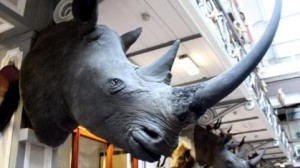
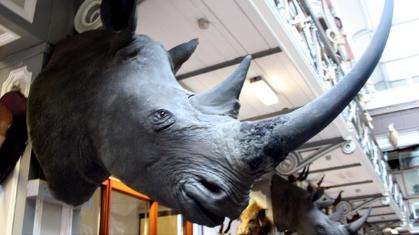
Rhino heads and horns worth €500,000 were ‘pinched,’ possibly by an Irish organized crime gang, from the National Museum of Ireland’s warehouse, in Swords, Co Dublin, late on Wednesday night last. The National Museum’s previous excuse, which usually stated that only it had the necessary security to protect our national heritage, has just evaporated. This also now begs the question, why were there any artefacts stored, not being made available for viewing by our visiting guests of the Irish Nation, especially during the year of “The Gathering.”?
In our submission to Minister Jimmy Deenihan some five months ago we stated:
“Finally, we would request the Minister (Jimmy Deenihan) to immediately order a full audit of the National Museum’s present artefacts, with special emphases to be placed on items currently not on display, e.g. Sheela-na-gigs, guns, swords etc, which would further benefit other tourist centres / museums etc. within the Irish mid-lands in particular & which would in turn further encourage / tease visitors to travel …”
It would appear that despite the existence of so many small wonderful museums, right throughout the heartland of Ireland, Dublin has decided that if history cannot be viewed by tourists in “The Pale,” Irish history cannot be viewed at all.
Where now are the Thurles chests, proudly displaying the powerful “Chains of High Office,” & those others claiming to be Community Leaders, when we need them?
Note: According to the Irish Examiner, dated yesterday, employment levels in firms supported by the IDA/Enterprise Ireland (EI) have decreased by more than 19,400, or 6%, to 281,965 in the past five years. Dublin and Cork accounted for three-quarters of all net job increases at IDA companies in 2012. At the same time, Tipperary, Kildare & Leitrim, experienced net losses, yet our County & Town remains silent.
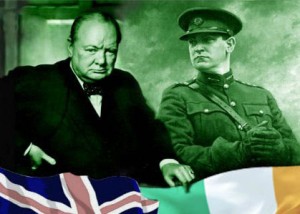 Written by Mary Kenny and soon to be performed at The Source Theatre Thurles, “Allegiance,” is a dramatization of reported events that possibly did change Irish history. Written by Mary Kenny and soon to be performed at The Source Theatre Thurles, “Allegiance,” is a dramatization of reported events that possibly did change Irish history.
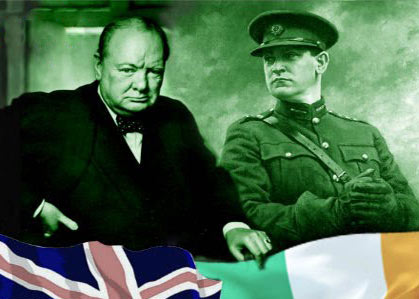
In 1921 Eamon de Valera ordered Michael Collins under sufferance, to travel to London, with the Irish delegation, his task to negotiate a Treaty that followed the truce in the Irish War of Independence.
Winston Churchill was then the Colonial Secretary in charge of Ireland and the two men met, equally prepared to totally detest one another. Yet, at a point when the Treaty talks seemed to be in deadlock, both Churchill and Collins spent a night drinking together in Churchill’s London home, both arguing, singing & reciting poetry. In the play, both men recount & compare family memories, Collins smiling at the memory of the elderly father he worshipped, Churchill blubbering on his own fond memories experienced prior to the death of his young daughter.
They both are to emerge from this encounter with high regard for each other & following this event Winston Churchill appears to soften somewhat his attitudes towards Ireland, thus giving Michael Collins and the Irish Free State, the latter he represented, greater support.
The play is a moving portrait of two great leaders who began as antagonists, yet at a certain level came to respect one another, each recognizing the leadership qualities of the other. Not many people are aware that Churchill had as many links as Collins to north County Kerry, having spent his childhood summers as his cousins’ estate at Tarbert House.
This play has previously had a very successful run in the Edinburgh Fringe Festival in 2006, starring Mel Smith as Churchill with Michael Fassbender reprising the role of his direct descendant Michael Collins.
This is a superb and very entertaining play and promises to engage the audience right from its very commencement.
Date: Thursday 7th March 8.00pm, for one night only.
Cost: Tickets €16/€14 concession.
So why not make a night of it and come early to enjoy a meal or bar bites at The Source Café from 7.00pm? Ring Matt on Tel No: 0504-58858 for more details. The Source Bar will also be open from 7.00pm.
For bookings click HERE or ring the Source Box Office on Tel No: 0504-90204.
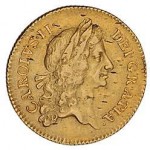 Charles II Gold Coin A hoard of some eighty one gold coins, described as a ‘significant’ discovery by the National Museum, has been found here in Co Tipperary.
The coins, made of pure gold and dating from the early 1600’s through to the early 1700’s, were discovered close to the foundations of a fire damaged pub on the Main Street in Carrick-on-Suir in South Tipperary.
The coins, which were located by workmen digging a support foundation at the licensed premises, following a fire, are described as being in excellent condition and were located without any form of wrapping or container, approximately two feet below the surface of the floor area.
A further search of the area by museum experts has located no other artefacts of significance.
The actual value of the coins found, now in the care of the National Museum in Dublin, have as yet to be estimated.
Local Police were called to the scene by employees who made this find, while working on the site.
Julia Kavanagh (Born this day, 7th January 1824 – Died 28th October 1877) was an Irish Novelist & Biographer, born in Thurles, Co Tipperary, the only child to parents, Dublin born Morgan, Peter (Latter his Confirmation Name) Kavanagh (Irish author, poet, and novelist 1800 – 1874) and Bridget (née Fitzpatrick, latter who died 1888).
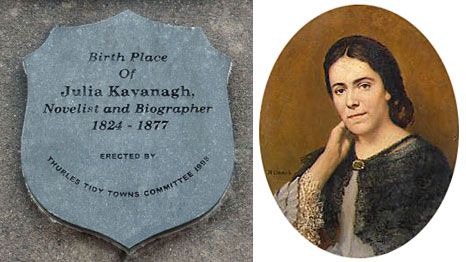 Her once small house sadly no longer exists, but stood at what is today the entrance to the Presentation Convent Secondary School, close to the junction leading from Cathedral Street into Mitchel Street, here in Thurles, Co. Tipperary. Her once small house sadly no longer exists, but stood at what is today the entrance to the Presentation Convent Secondary School, close to the junction leading from Cathedral Street into Mitchel Street, here in Thurles, Co. Tipperary.
An Irish Catholic, life for the young Miss Kavanagh was hard. She was partially crippled from youth (curvature of the spine), nevertheless she, through her own genius and strong connections, would carve out a successful career as a novelist, biographer and travel writer.
Her parents were married in 1823 and moved with Julia from Thurles to London, her father possibly as a teacher of languages. In late 1825 or early 1826 they moved to Paris, before returning to London again in 1837. When they returned to London, over the next year Morgan arranged for Julia to receive special treatment for her spinal problem. They returned to Paris in 1839 and stayed there until the early 1840s. It was during this early life with her parents in Paris, that Julia conquered her initial mastery of the French language and her remarkable insight into French modes of thinking, which was then perfected by her later long residences in Paris, Rouen and Nice.
Morgan was alone when he lived at 28 Dean Street, London in the early 1850s. Julia and her mother had parted from Morgan around 1846 and neither Julia or her mother are listed in the 1851 census for that address.
It was at this same address (28 Dean Street, Soho) that her father would become landlord & sub-lets two rooms to atheist Karl Marx, in Dec. 1850. This same address would also be the location at which Marx would write ‘Das Kapital,’ (1867) with the assistance of fellow revolutionary socialist Friedrich Engels. It was to here also that Friedrich Engels would send postal orders for £1 or £5 notes, each cut in half and sealed in separate envelopes, to avoid postal theft and in order that the impoverished and resident Marx family could pay their rent and continue to survive.
Note: Today, 26-29 Dean Street Soho, London, houses the famous restaurant “Quo Vadis,” (Latin: “Where are you going?”).
Julia now began to support herself and her invalid mother Bridget, with her writing career. Her first book was entitled “The Three Paths (1847), a story for the young, however her first work to attract the attention of her large readership was “Madeleine, a Tale of Auvergne,” (1848), a story of “heroic charity and living faith founded on fact.”
Her other works included; “Woman in France during the 18th Century,” (1850), “Nathalie,” (1851), “Women of Christianity,” (1852), “Daisy Burns,” (1853), “Rachel Gray,” (1855), “Adele,” (1857), “A Summer and Winter in the Two Sicilies,” (1858), “French Women of Letters,” & “English Women of Letters” (1862), “Queen Mab,” (1863), “Beatrice,” (1865) “Dora,” (1868), “Silvia,” (1870), “Bessie,” (1872), “John Dorrien,” (1875) & finally following her death, unmarried, on October 28th, 1877, at Nice, France, “Forget-Me-Nots,” (1878, a posthumous edition with preface by C. W. Wood)
Outside of her life as a novelist, her years appear rather uneventful, with a great part of her time devoted to the care of her invalid & later widowed mother. At the outbreak of the Franco-German War around 1870, Julia with her mother, both of whom were resident in Paris, moved to Rouen and then to Nice, where she died in her fifty-fourth year, following an accident, having fallen from her bed. Julia’s last words are reported to have been spoken in French: “Oh Mama! How silly I am to have fallen….”
Her mother Bridget continued to live in Nice until her death in 1888, but how she managed to cope financially after Julia’s death is not known. However, in 1884 Bridget donated a painting of Julia, by French artist Henri Chanet (dated 1875), to the National Gallery of Ireland.
Julia’s father is known to have entered into a common-law marriage with one Marie Rose in about 1856 and they had three children; Alfred, Matilda and Alexander Morgan. Her father died in 1874 and a Coroner’s Inquest, held at Islington, on February 14th 1874, indicates that, like Julia herself; his death was also caused by a fall.
|
Support Us Help keep Thurles.info online by donating below. Thank you.
Total Donated 2026: €300.00
Thank You!
Daily Thurles Mass Livestream
|



Recent Comments